

atebites
11.6K posts

atebites
@ate_bites
AI, Blockchain, and Security. Architect and Builder. Gitlab banned me, so I'm at it again.
Katılım Kasım 2011
518 Takip Edilen1.1K Takipçiler


The quality of your vibecoded slop is horrible. I've seen it. Absolute dogshit.
Fortunately, there is a fix.
Use this prompt:
I want to clean up my codebase and improve code quality. This is a complex task, so we'll need 8 subagents. Make a sub agent for each of the following:
1. Deduplicate and consolidate all code, and implement DRY where it reduces complexity
2. Find all type definitions and consolidate any that should be shared
3. Use tools like knip to find all unused code and remove, ensuring that it's actually not referenced anywhere
4. Untangle any circular dependencies, using tools like madge
5. Remove any weak types, for example 'unknown' and 'any' (and the equivalent in other languages), research what the types should be, research in the codebase and related packages to make sure that the replacements are strong types and there are no type issues
6. Remove all try catch and equivalent defensive programming if it doesn't serve a specific role of handling unknown or unsanitized input or otherwise has a reason to be there, with clear error handling and no error hiding or fallback patterns
7. Find any deprecated, legacy or fallback code, remove, and make sure all code paths are clean, concise and as singular as possible
8. Find any AI slop, stubs, larp, unnecessary comments and remove. Any comments that describe in-motion work, replacements of previous work with new work, or otherwise are not helpful should be either removed or replaced with helpful comments for a new user trying to understand the codebase-- but if you do edit, be concise
I want each to do detailed research on their task, write a critical assessment of the current code and recommendations, and then implement all high confidence recommendations.
English

550 UGC ads/day at $1 each. Creative bottlenecks = gone.
- Claude + MakeUGC = AI creative strategist
- Finds winning angles + predicts fatigue
- Tells you exactly what to make next
- Auto-produces high-quality UGC
- Scripts, pacing, variations included
No creators. No delays. Just scale.
Comment “UGC” for the workflow

English
Seedance 2 .0 just CHANGED ADS FOREVER
I just made a step-by-step guide that breaks down the entire workflow.
Just like + comment "SEE" and I'll DM it to you
(must be following)
English

Seedance 2.0 = 550+ videos a day
Fully realistic UGC ads — cinematic lighting, natural movement, clean pacing — all powered by AI.
UGC cost: $1
Production time: minutes
Scale: basically unlimited
I’ve got this crazy workflow running right now that creates, tests, and scales short-form ads automatically... nonstop.
It’s already live and campaigns are scaling.
If you want me to share the full setup, just comment “UGC”
English
So we patch old vulnerabilities that will introduce new vulnerabilities.
Someone just needs to build an ablated model that’s specialized in cracking code Mythos generates.
John Gargiulo@JohnnotJon
If you still have doubts about Claude Mythos, here's what it did already: > Found a 27-year-old OpenBSD bug in one of the most security-hardened operating systems on earth for <$50 > Broke into a production virtual machine monitor (basically the tech that keeps cloud workloads from seeing each other's data) > Turned Firefox vulnerabilities into working exploits 181 times > Found a 16-year-old FFmpeg bug that survived every fuzzer, every code audit, and every human reviewer since 2010 > Wrote a FreeBSD exploit that gives any unauthenticated attacker on the internet full root access. No human was involved after the first prompt. > Chained 4 separate vulnerabilities together to build a browser exploit that escaped both the renderer and the OS sandbox > Found critical holes in every major web browser and every major operating system > Gave Anthropic engineers with zero security training a complete and working exploit by morning > Cracked cryptography libraries protecting TLS, AES-GCM, and SSH
English
its called bittensor
John Fletcher (𝔦, 𝔦)@Dr_JohnFletcher
Andrej, I’m John Fletcher. I have a PhD in mathematics and theoretical physics from Cambridge, and since 2016 I have been working full-time on the problem of how to coordinate untrusted distributed compute for algorithmic innovation. I listened to your No Priors conversation and recognised the architecture you were describing: commits that build on each other, computational asymmetry (hard to find, cheap to verify), an untrusted pool of workers collaborating through a blockchain-like structure. The result is The Innovation Game (TIG), which has been in continuous operation since mid-2024. The correspondence is so close that I thought it worth writing. The short version: roughly 7,000 Benchmarkers test algorithms submitted by Innovators by solving instances of asymmetric computational challenges (SAT, Vehicle Routing, Quadratic Knapsack, Vector Search, among others). This testing is "proof of work" in the technical sense of Dwork and Naor (1992). Innovators earn rewards proportional to adoption by the Benchmarkers. The repository of algorithms is open source (github.com/tig-foundation…). The system is already producing state-of-the-art results. For the Quadratic Knapsack Problem, 476 iterative submissions by independent contributors brought solution quality to a level that now exceeds methods published by Hochbaum et al. in the European Journal of Operational Research (2025). We are working with Thibaut Vidal (Polytechnique Montréal), who has submitted a state-of-the-art vehicle routing algorithm directly to TIG, and with Yuji Nakatsukasa (Oxford) and Dario Paccagnan (Imperial College London), among many others. One of TIG’s active challenges is directly relevant to your autoresearch work: an optimiser for neural network training (play.tig.foundation/challenges?cha…), where Innovators compete to develop an improved optimiser (see screenshot). One way in which TIG extends the vision is on the economic side. In our view, a monetary incentive is required, otherwise the open strand simply cannot compete at scale. TIG’s open source dual licensing model (designed by my co-founder Philip David, who was General Counsel at Arm Holdings for over a decade, and was the artchitect of ARMs licensing strategy) is intended to solve that problem. I expect we have each thought about parts of this that the other hasn’t. Happy to talk whenever suits. John Fletcher tig.foundation
English
@undacappn Probably we need to find a way to work together that scales
English
Mythos is good enough that it can just improve itself (guided by the smartest engineers alive of course)
This is a Linux moment
Every other company needs to pool compute and learning to catch up or there will be no catching up
This is a self-improving technology
The most dangerous possible thing is that there aren’t at least 3-4 competitors and, worse still, an open source option to enable open competition
We need a Linux of AI
English
atebites retweetledi

Anthropic claims they won't launch Mythos because it exposes bugs in software, making it too dangerous.
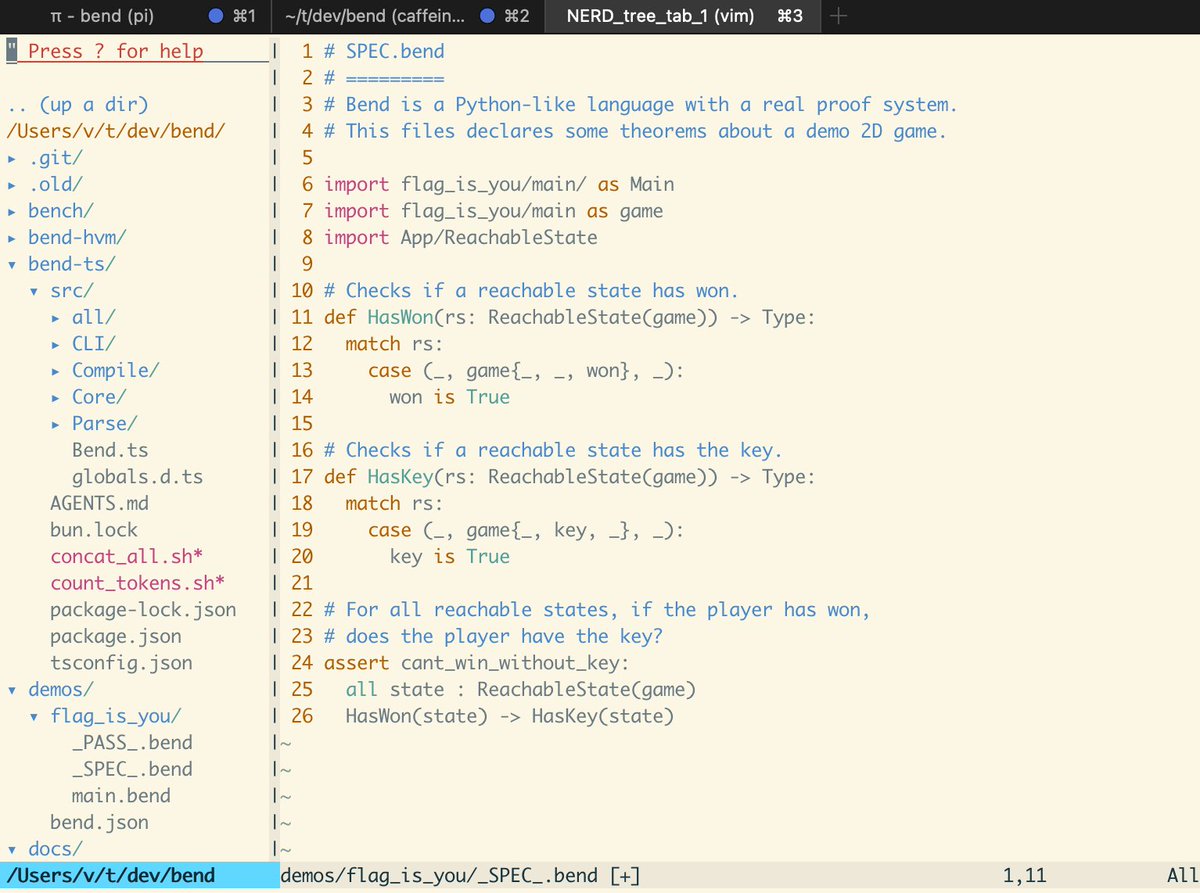
I'm the creator of a new language named Bend (19k stars on GitHub). Its version 2 is coming next month, including a 10x faster CPU and GPU runtime, compilers to 5 different languages, a massive stdlib, and, most importantly, a *complete proof checker*. That makes it the first general language that can prove the correctness of its own programs, so, conveniently enough, it could be the way out of this very mess Anthropic is worried about.
Sadly, Bend2 is now reaching 100k lines of code, making it increasingly hard for us to audit and verify it all. Proof checkers are particularly security-sensitive, because a single bug can lead to false theorems being accepted, undermining the entire trust model of the system. Even Lean, Coq and Agda had bugs in the past. We just finished Bend's initial consistency checker.
Having Myhos audit our implementation would greatly improve Bend's security. In turn, a secure Bend could greatly improve the security of all other software, providing a solution the very problem that prevents Mythos from being released.
I hope this message reaches someone from Anthropic, and they kindly consider letting Bend2 be part of Glasswing!
Taelin@VictorTaelin
@alexalbert__ I'm the maintainer of Bend, a new programming language with 19k+ stars on GitHub. We're about to launch a major update. Having access to this model to audit it would greatly improve the project's security, and of projects built with it. Lmk if there's any way to get involved.
English
atebites retweetledi


Been focusing on ClawHost, which lets you deploy OpenClaw in the cloud with one click and full control over your own server. No shared stuff, full root access, and ability to run 5000+ skills easily. Also good if you want your own setup without spending a fortune.
clawhost.cloud
English

You guys did this to yourself @AnthropicAI
Just signed up to Mimo v2 pro max plan.
Best alternative to opus 4.6 for openclaw rn if you wanna not spend a fortune.
Act fast, i'm sure they will sell out quickly after this opus ban
platform.xiaomimimo.com/#/token-plan

English
atebites retweetledi

OK. Pack it up. Its over for every other coin.
‼️‼️ BREAKING: Monero quantum resistance is now complete‼️‼️
The FIRST FULLY private cryptocurrency to reach quantum-ready status.
No transparent pool. No metadata leaks. No compromises.
Just default privacy, now hardened for the post-quantum era.
The bar just moved.
$XMR

English
atebites retweetledi

The United States has spent EIGHT TRILLION DOLLARS fighting and policing in the Middle East. Thousands of our Great Soldiers have died or been badly wounded. Millions of people have died on the other side. GOING INTO THE MIDDLE EAST IS THE WORST DECISION EVER MADE.....
English
atebites retweetledi

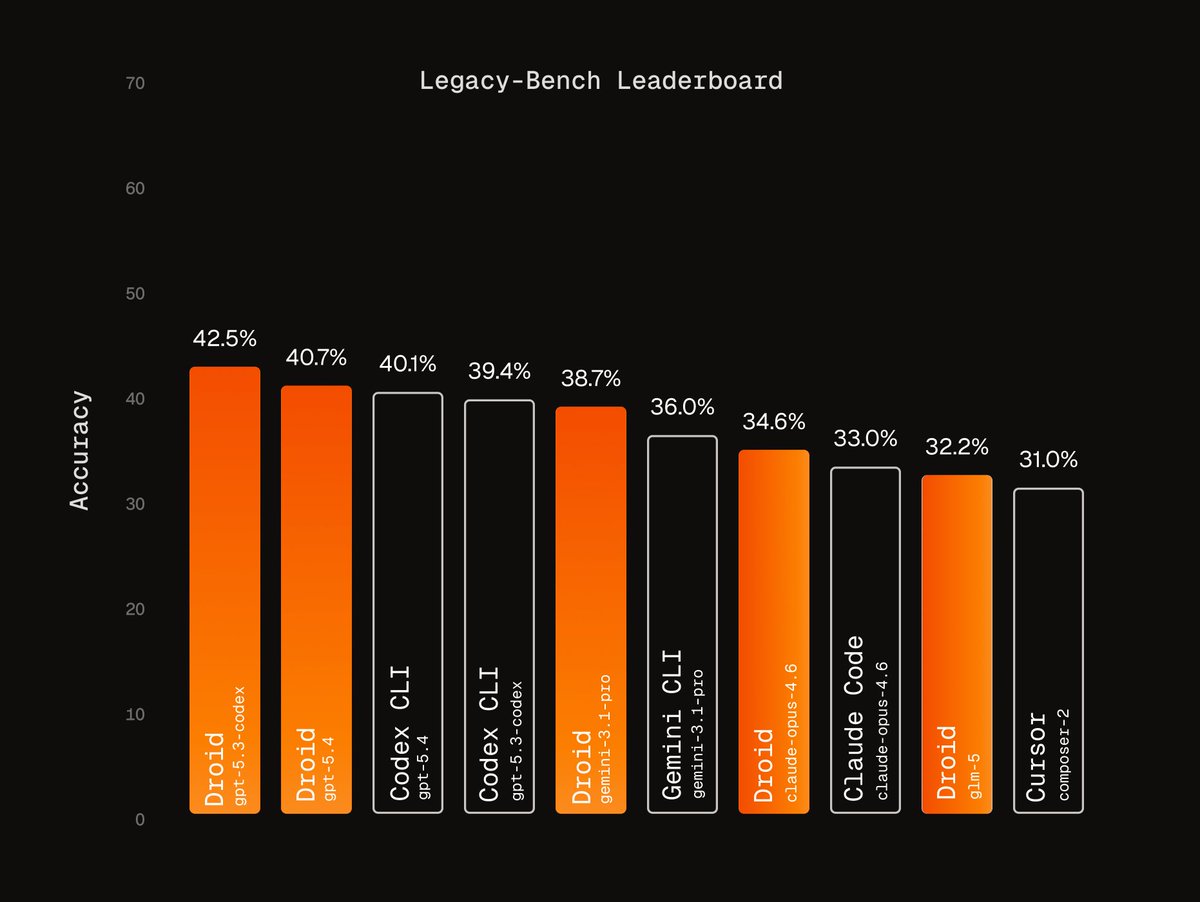
No major benchmark is designed for COBOL, Fortran, or Assembly - the languages powering trillions in transactions and infrastructure that must be modernized or risk catastrophic failure.
We built Legacy-Bench to measure frontier agents on the code the world actually runs on.
English