
Avalanche Policy Coalition 🔺

1.5K posts

Avalanche Policy Coalition 🔺 banner
Avalanche Policy Coalition 🔺

Avalanche Policy Coalition 🔺

@AvalanchePolicy

Education on Blockchain & Web3 policy, fundamentals, and use cases. 🔺Ava Labs Legal team 🌐 Discover more in our podcast and in https://t.co/mblw6uKUwq

Katılım Temmuz 2022
384 Takip Edilen2.2K Takipçiler
Sabitlenmiş Tweet
Avalanche Policy Coalition 🔺
Avalanche Policy Coalition 🔺@AvalanchePolicy·
🎉 Big news! Today, we're officially launching the Avalanche Policy Coalition Advisory Council to help shape smart, practical crypto rules that actually make sense. Why now? The US, UK, Australia, Korea, and other major players are drafting comprehensive crypto frameworks as we speak. This is our moment to get it right. We're thrilled to announce that Lee Schneider (@leelaughs5x), General Counsel at @AvaLabs, will chair the Council. He'll be joined by top minds from across the Avalanche ecosystem and policy experts who know how to translate blockchain jargon into helpful policy: 🔹Bart Smith (@gbartsmith), CEO of Avalanche Treasury Company (@avat_co) 🔹Laine Litman (@Laine_Litman), COO of Avalanche Treasury Company (@avat_co) 🔹Jolie Kahn (@jolie_kahn), CEO of AVAX One (AVX) Technology 🔹Lord Holmes (@LordChrisHolmes), a director for the Avalanche Foundation (@AvalancheFDN) and member of the UK House of Lords (@UKHouseofLords) What we're advocating for in 2026: - Token clarity: As real-world assets flood onto blockchain, we need crystal clear classification rules - Smart regulation: Blockchain infrastructure is not necessarily a financial instruments. Neutral rails should stay neutral - Internet freedom: Blockchains need an open, uncensored internet to thrive… a non-negotiable. 2026 is shaping up to be a pivotal year for crypto policy. Let's make it count. 💪 Full story from @TheBlock__: theblock.co/post/388043/av…
English
16
56
195
28.5K
Avalanche Policy Coalition 🔺
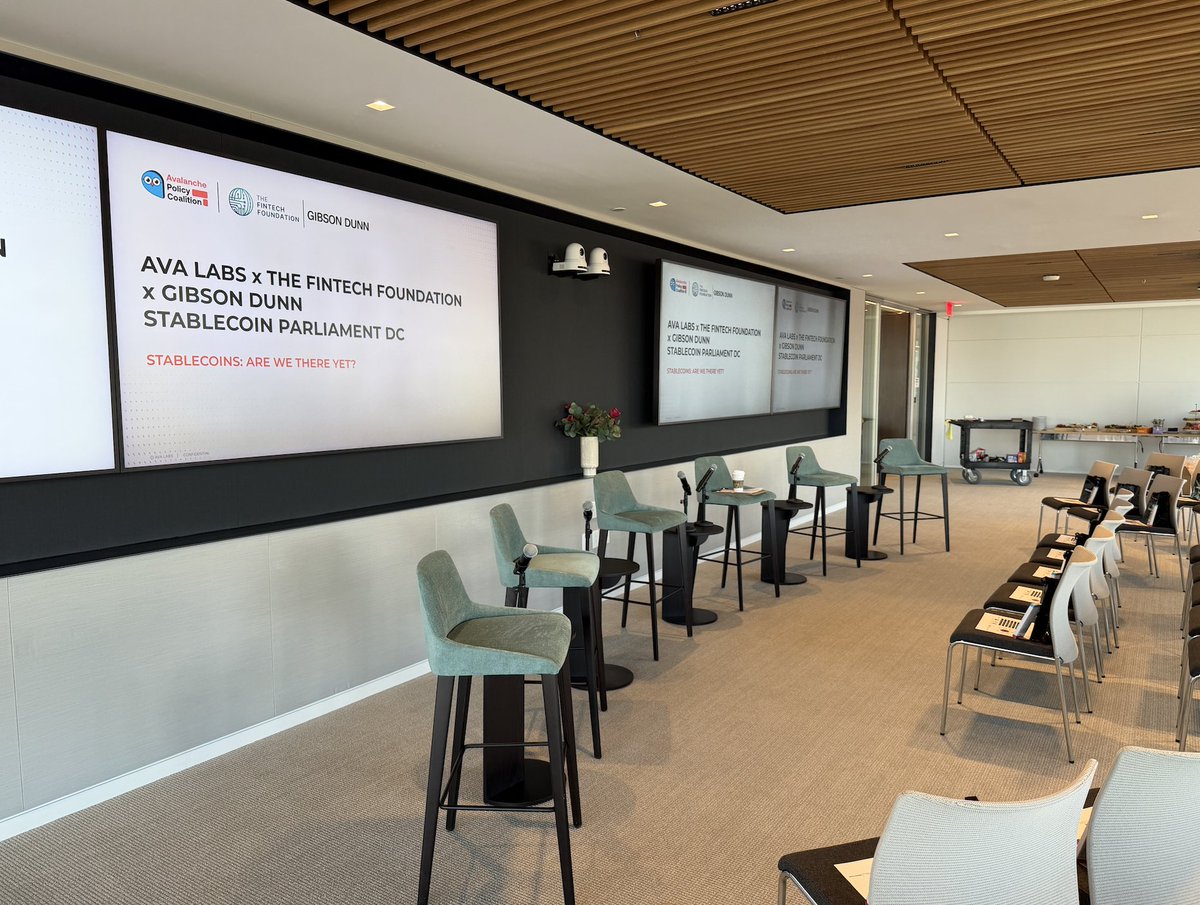
Last week in Washington, DC, we brought together leaders across policy, regulation, and financial innovation for an afternoon focused on one key question: Stablecoins: are we there yet? Hosted by @AvaLabs, @fintechthinksdc , and @gibsondunn , the DC Local Parliament convened voices from Capitol Hill, regulatory agencies, academia, and the overall industry to explore the evolving role of stablecoins in the financial system. We kicked it off with @FDICgov 's. Chairman Travis Hill and Professor @ProfYYadav1 , to in-depth panels on the GENIUS Act and the future of finance, the conversations highlighted both the progress made and the work still ahead. Our own Lee Schneider (@leelaughs5xled) led a panel exploring what a future shaped by stablecoins could look like, bringing together perspectives from across industry to examine how payments, banking, and competition may evolve. What stood out most was the shared sense of momentum. There is serious engagement from policymakers, increasing clarity around regulatory pathways and a growing recognition that stablecoins are central to the future of payments We are so grateful to everyone who joined us and contributed to such an interesting and exciting discussion. We look forward to keep building alongside this community.
Avalanche Policy Coalition 🔺 tweet media
English
0
0
1
87
Avalanche Policy Coalition 🔺
Everyone talks about DeFi as “more efficient finance.” And after this conversation, something else became clear: DeFi isn’t just changing efficiency, it’s also changing how risk works. 🔍 A few key takeaways: 1. Interest rates aren’t set by people, they’re set by the system - Rates adjust automatically based on supply and demand in each pool. As liquidity dries up, borrowing can become extremely expensive, very quickly. In theory, this stabilizes the system. In practice, it can amplify stress. 2. Connections create risk - One of the most important ideas: risk doesn’t just come from price drops, it comes from how everything is connected. Collateral in one market can support borrowing in another. So if one part weakens, the effects can spread. That’s how contagion can happen, even on-chain. ⛓️ 3. The system is transparent… but not necessarily simple - We can see everything: positions, collateral, liquidations, flows. However, the system is not easy to predict. In fact, more visibility doesn’t eliminate risk, but it does changes how we understand it. The big shift is this: in traditional finance, risk is often hidden and slow to surface. In DeFi, risk is visible and moves fast. 🏃🏼 Listen Here 🎧: 🌐 avalanchepolicy.com/en/podcast/ava… 🟢 open.spotify.com/episode/7BY4mE… 🟣 podcasts.apple.com/us/podcast/ava…
English
0
0
1
81
Avalanche Policy Coalition 🔺
Most people think DeFi is about crypto prices. But it’s not. More importantly, it’s about how money actually moves. 🌎 When we send money or buy something, the transfer just happens. We don’t think about how it works or who’s processing it in the background. It’s invisible to us. Today, when you buy something like a stock, it passes through layers of middlemen just to go from buyer → seller. DeFi changes that. It lets transactions happen: • directly • instantly • with rules enforced by code instead of institutions 🏦 That’s a big shift. It doesn't mean “no risk”, but it does mean different risk. With DeFi, there is less waiting, less middlemen, and more transparency, along with some new tradeoffs. So the real question isn’t “does DeFi matter?” It’s: do we still need a system built for the 1970s? ❓ Curious? Read this paper to learn more: papers.ssrn.com/sol3/papers.cf… And check out our DeFi resource page 👉 avalanchepolicy.com/en/defi/1/
English
0
1
4
98
Avalanche Policy Coalition 🔺
What actually happens when things start breaking in DeFi? ⚠️ It’s a simple, but important question and one we explored in this episode. Can risk spread across decentralized lending markets the same way it does in traditional finance? In this conversation, we talked about: - How these platforms actually work behind the scenes (how people lend, borrow, and earn interest) - What happens when the value of your collateral falls and how the system automatically sells it to repay the loan - Where things can go wrong (fast) - And whether DeFi is more resilient… or just different 💡 One of the most interesting ideas was DeFi isn’t just programmable finance, it’s actually observable. Meaning: you can see every position, every connection, every risk building in real time. That opens the door to something traditional finance has never really had. There are actually early warning systems for financial contagion. But it also raises new questions, like what if the system becomes too connected? What if one shock doesn’t stay contained? If you want to understand where on-chain finance is heading and what risks come with it than this podcast might be a good place to start. 🎙️ Listen here: 🌐avalanchepolicy.com/en/podcast/ava… 🟢 open.spotify.com/episode/7BY4mE… 🟣 podcasts.apple.com/us/podcast/ava… The paper discussed: papers.ssrn.com/sol3/papers.cf…
English
0
2
3
94
Avalanche Policy Coalition 🔺
Avalanche Policy Coalition 🔺@AvalanchePolicy·
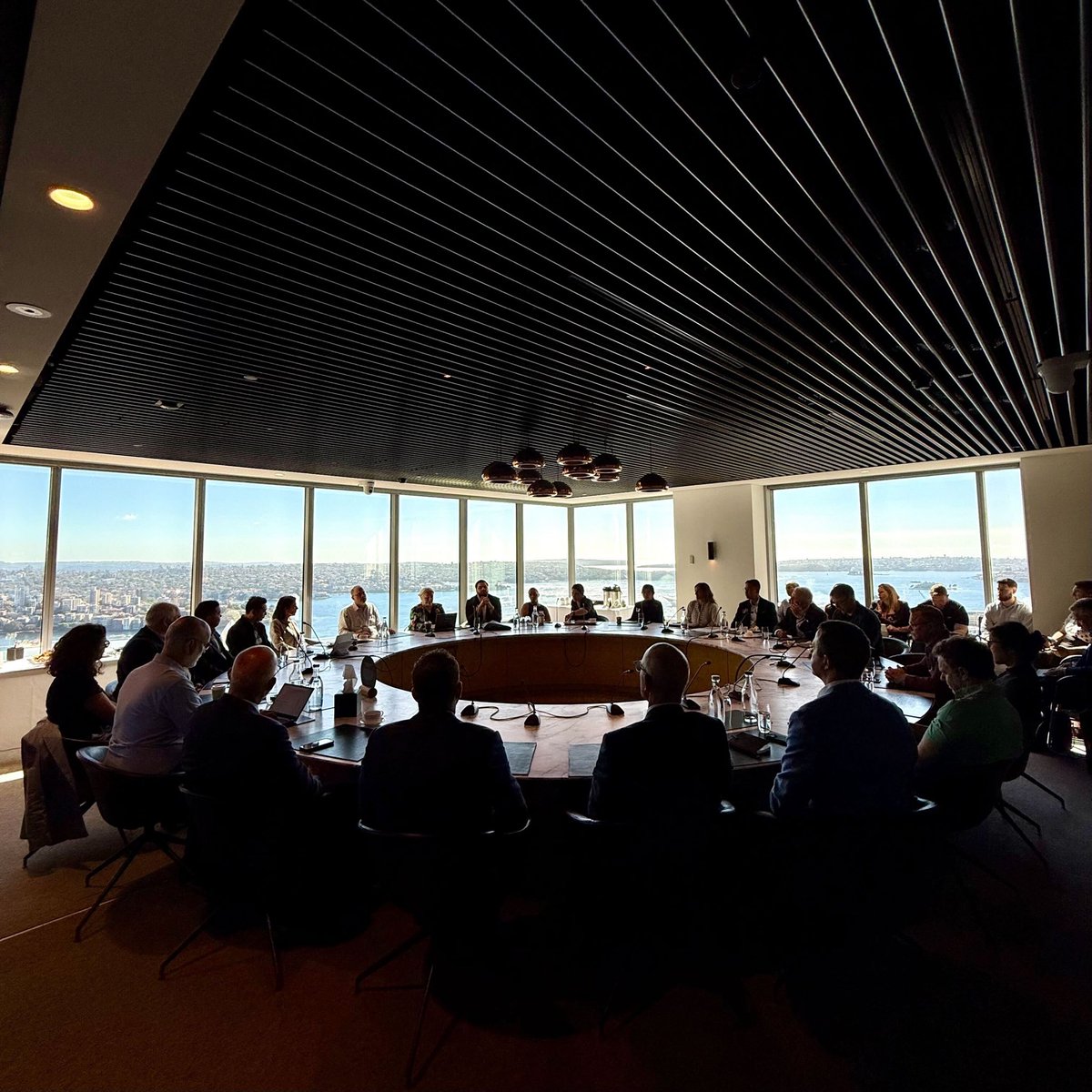
Sydney really delivered 🇦🇺 Last week, we brought our stablecoins roundtable series to @BlockchainAPAC’s Policy Weekfor a closed-door conversation in Sydney, co-hosted with our friends Prayas Pradhan and Jeremy Muir at @minterellison . The room included an excellent lineup of local builders and operators, including Fadi Kassis (Founder, Forte Tech Solutions & Forte AUD), @jonipirovich (CEO, @crystalaos ), and Drew Bradford (CEO, Macropod), alongside lawyers, policymakers, and market participants thinking seriously about the future of payments. What made the Sydney conversation stand out was how grounded it felt. The focus stayed on where stablecoins are already making a difference, what still needs work, and how policy and industry can move forward together. Here are four themes that stood out: 1️⃣ Stablecoins are exposing the real cost of moving money. Cross-border payments remain slow and expensive. FX spreads still hit smaller businesses and individuals the hardest. And retail payment systems quietly collect billions in fees each year. Stablecoins are gaining attention because they make those inefficiencies much harder to ignore. 2️⃣ Payments and remittances remain one of the clearest use cases. For financial markets, faster settlement and reduced counterparty risk matter. For everyday users, the opportunity shows up in cheaper international transfers, better FX access, and new payment options that reduce reliance on expensive card rails. 3️⃣ Banks are part of the story, whether they like it or not. A lot of the discussion centered on how banks will respond as stablecoins grow. Some may experiment with issuing or integrating them. Others may move more cautiously. But expectations around faster, cheaper, and more transparent financial services are clearly shifting. 4️⃣ Education is still one of the biggest unlocks. This came up again and again. Consumers, regulators, institutions, and policymakers all need clearer ways to understand how this technology works and where it fits. If stablecoins are going to become part of everyday financial infrastructure, education has to keep up. A huge thank you to Steve Vallas and Richelle Cox from Blockchain APAC for organizing such a thoughtful set of roundtables, panels, and events throughout the whole week. Truly wonderful organizers and people!
Avalanche Policy Coalition 🔺 tweet media
English
0
2
5
136
Avalanche Policy Coalition 🔺
Avalanche Policy Coalition 🔺@AvalanchePolicy·
Here’s another way to think about proof-of-stake security. 🧐Imagine trying to secretly buy 40% of a public company. You can’t just purchase it at yesterday’s stock price. The more shares you buy: • The price moves • Other investors notice • Supply dries up • Sellers demand more Now translate that to a blockchain. 👉🏼To disrupt settlement, an attacker would need a massive share of staked tokens. But those tokens aren’t all sitting on an exchange waiting to be scooped up. Many are locked & many are held by long-term participants & large purchases push the price up fast. So the cost of taking control doesn’t rise linearly. It accelerates. 📈 That’s the economic layer of blockchain security and it’s often overlooked. We explored this dynamic and what it entails on our latest podcast. 🎧Listen Here: 🟢 open.spotify.com/episode/3ppgAV… 🟣 podcasts.apple.com/us/podcast/ep-… 🌐avalanchepolicy.com/en/podcast/ep-…
English
0
5
8
275
Avalanche Policy Coalition 🔺
Avalanche Policy Coalition 🔺@AvalanchePolicy·
Coming to you from Sydney Harbour, where the owl has landed for Policy Week! We’re soaking up the conversations, the questions, and the energy here in the land down under. This edition is a bit of a postcard from the road, and in our next issue we’ll share a full recap of our time in Australia, so stay tuned. This week, we’re talking blockchain settlement economics, a UK crypto framework that is moving from blueprint to buildout, and a Washington calendar that shows stablecoins are no longer a side conversation. Newsletter Link: linkedin.com/posts/avalanch…
Avalanche Policy Coalition 🔺 tweet media
English
1
0
1
62
Avalanche Policy Coalition 🔺
Avalanche Policy Coalition 🔺@AvalanchePolicy·
What a strong start to Policy Week 2026 in Sydney 🇦🇺 We were incredibly excited to be part of today’s roundtable, Stablecoins in Focus: Global Momentum and Regulatory Frontiers and the conversation did not disappoint. Thank you to everyone who joined us and contributed to such a meaningful exchange. We’ll be sharing content, key insights, and a few exciting updates soon, so stay tuned. 🎤
English
0
0
0
51
Avalanche Policy Coalition 🔺
Avalanche Policy Coalition 🔺@AvalanchePolicy·
Picture a stadium vote where everyone inside gets a say. 🏟️ But your voting power depends on how many seats you hold. Well, now imagine someone wants to storm in and flip the outcome. They can’t just shout louder, that won’t help. They have to buy seats. In a proof-of-stake blockchain, “seats” = tokens that are staked. And here’s where it gets interesting: if half the seats are already locked in by long-term fans, then the attacker has to fight over what’s left. But, the more they try to buy, the more expensive the remaining seats become. And if many holders aren’t selling at all? The math gets brutal. 💡So what does that really mean? It demonstrates that security isn’t just software: it’s market structure. The more real activity happening on a chain, the more tokens get committed and the smaller the tradable supply gets. So, it becomes harder to buy control. This was a key theme in our recent podcast: in proof-of-stake systems, real usage doesn’t just grow the network, it also helps protect it. Listen Here: 🟢 open.spotify.com/episode/3ppgAV… 🟣 podcasts.apple.com/us/podcast/ep-… 🌐avalanchepolicy.com/en/podcast/ep-…
English
0
1
2
89
Avalanche Policy Coalition 🔺
Avalanche Policy Coalition 🔺@AvalanchePolicy·
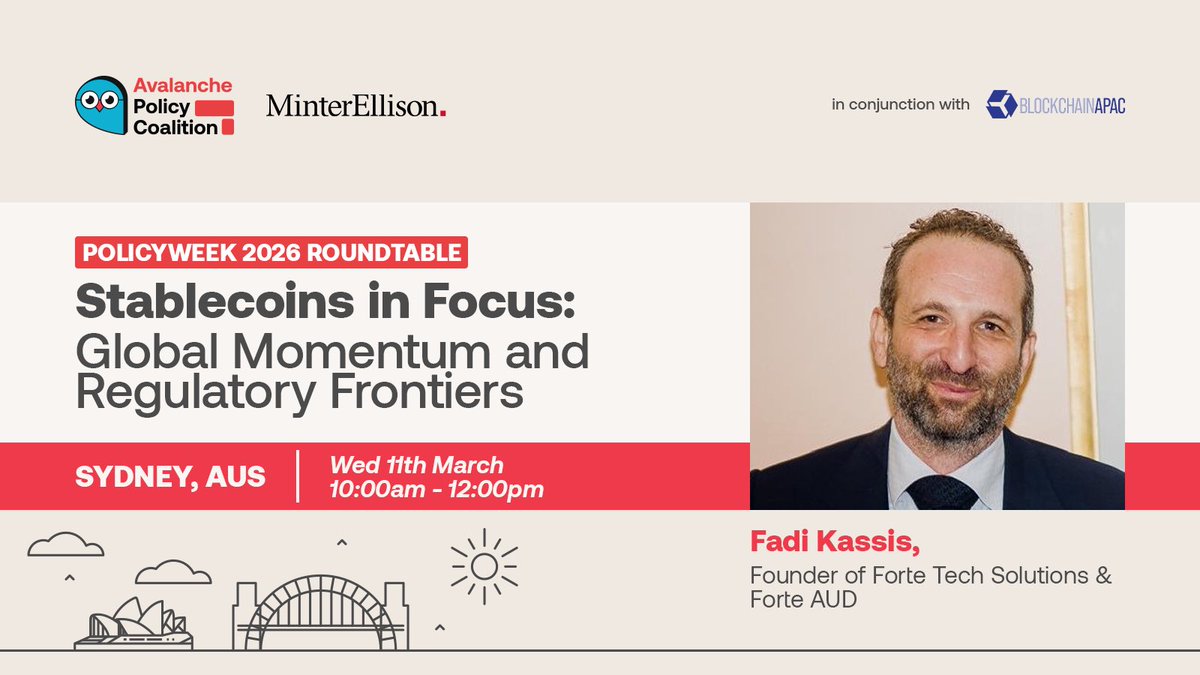
We’re getting closer to Policy Week 2026 in Sydney 🇦🇺 and we have another exciting speaker announcement! Please join us in welcoming Fadi Kassis, Founder of Forte Tech Solutions & Forte AUD, to our Policy Week roundtable: Stablecoins in Focus: Global Momentum and Regulatory Frontiers. This in-person discussion will bring together senior leaders for a candid, off-the-record conversation on the evolving stablecoin landscape and the regulatory frontiers shaping its future. We hope you are excited. It’s shaping up to be a powerful discussion. 📍 Sydney 🗓 Wednesday, 11 March 2026 ⏰ 10:00am–12:00pm 🔗 RSVP and see more details on the site: luma.com/avalanchepolic…
Avalanche Policy Coalition 🔺 tweet media
English
1
0
3
81
Avalanche Policy Coalition 🔺
Avalanche Policy Coalition 🔺@AvalanchePolicy·
For years, the critique was simple: “The UK is moving too slowly on crypto.” That argument no longer stands. Eight months ago, the UK had a crypto roadmap. 🗺️ Now? It has a construction site. What does that mean exactly? Well…the government has laid the legal foundations. The FCA is building the rulebook. The Bank of England is shaping systemic stablecoin oversight. In the past months alone, the UK has: ✔️ Brought crypto into the financial services regime ✔️ Built a full authorisation gateway ✔️ Advanced a prudential framework ✔️ Designed a systemic stablecoin model ✔️ Clarified digital assets can attract property rights While moving with the right speed is important, the crucial part is getting the details right. If developers or validators are treated like banks, innovation slows down. If tokens aren’t clearly defined, confusion spreads. The UK has structural advantages. Now all it has to do is convert them into competitive advantage. 🦉 Our new article explores whether London can get that balance right. Read “London Calling Part 2” here: avalanchepolicy.com/en/articles/lo…
English
0
0
4
107
Avalanche Policy Coalition 🔺
Avalanche Policy Coalition 🔺@AvalanchePolicy·
What actually makes a blockchain secure? 🤔Well what we know is: it’s not marketing or slogans. And it’s certainly not “just trust the protocol.” We decided to ask two economists, Fahad Saleh (@cryptoeconprof) and Kose John, in our recent Policy Layer podcast and they explained a simple but powerful idea: the more useful a blockchain is, the harder it is to attack. 🪓 Think about it like this. If no one uses a network, no one values it. And if no one values it, it’s cheap and easy to mess with. But if a blockchain has real apps, real users, and real money flowing through it, things change. In proof-of-stake systems, you can’t just “hack” the network. To take control, you have to buy a huge amount of the token. And the more people that use the network 👉🏼 the more valuable the token becomes. It’s like trying to buy half the houses in a city. If most owners aren’t selling, prices skyrocket fast. So security isn’t just about code or rules: it’s also about incentives, supply and demand and real economic activity. If you are curious about the future of finance and the economics behind security than this podcast might be for you! 🟢 open.spotify.com/episode/3ppgAV… 🟣 podcasts.apple.com/us/podcast/ep-… 🌐 avalanchepolicy.com/en/podcast/ep-…
English
0
1
1
110
Avalanche Policy Coalition 🔺
Avalanche Policy Coalition 🔺@AvalanchePolicy·
There’s a lot of noise around DeFi right now. It can be hard to separate what’s real from what’s hype. So let’s step back: what problem is crypto actually trying to solve? 🤔 Here’s the simple version. When you buy a stock today, it doesn’t just go from you → seller. It goes through: A broker > An exchange > A clearinghouse > A depository > And finally, a transfer agent. And it usually settles a day later (T+1). Why is it so layered? Because the system was designed in the 1970s to fix a “paperwork crisis” (when trades were literally stacks of paper certificates moving around Wall Street). 📄 That structure made sense then, but technology has changed. Blockchain introduces a different model: ✅ Ownership can be direct ✅ Settlement can be near-instant ✅ Transactions are recorded on a public ledger ✅ Execution, clearing, and settlement can happen together That doesn’t mean “no rules.” It means the rules should reflect how the infrastructure actually works. The debate about DeFi shouldn’t be abstract or ideological. It should start with a clear understanding of market structure and where risk sits, why intermediaries exist, and what new technology changes. If you are interested in the future of capital markets, this paper can be a helpful resource: papers.ssrn.com/sol3/papers.cf…
English
0
1
3
180
Avalanche Policy Coalition 🔺
Avalanche Policy Coalition 🔺@AvalanchePolicy·
Exciting news, APC fam: our Lee Schneider is speaking at Harvard Law School’s 5th Annual Blockchain & Fintech Conference on April 17, 2026 🎓 Smart lawyers, serious policy folks, academics, and the teams building the rails all in the same room, arguing (nicely) about what digital asset regulation should look like next. If you’re going, say hi. And if you’re on the fence, check out the amazing speaker lineup throughout the event and take it as your sign. 😉 Sign up here: orgs.law.harvard.edu/hlsbfi/fifth-a…
English
0
1
12
520
Avalanche Policy Coalition 🔺
Avalanche Policy Coalition 🔺@AvalanchePolicy·
When many people look at Web3, they see one thing: money. But Web3 isn’t a money tree: it’s an ecosystem. 🌏 ⚠️Here are a few misconceptions worth pruning: • Blockchain isn’t just FinTech: it’s new infrastructure for the internet. • Cryptoassets aren’t blockchain: they’re just one use case enabled by it. • Cryptoassets aren’t only financial instruments: in fact they’re digital representations of value, rights, identity, and more. • Decentralization doesn’t just mean “public”: it means no single point of control or failure. • DeFi isn’t just trading: it’s programmable finance replacing intermediaries with code. • NFTs aren’t just art : they’re digitally unique tokens that can represent almost anything. If we reduce Web3 to speculation, we miss the bigger shift: a redesign of how trust, ownership, and coordination work online. The tree is bigger than the fruit. 🌱 Want to learn more about our Tree of WEB3 Wisdom? avalanchepolicy.com/en/tree
English
1
0
1
51
Avalanche Policy Coalition 🔺
Avalanche Policy Coalition 🔺@AvalanchePolicy·
Fifty newsletter editions already! A cute milestone to celebrate with great music, and a good excuse to say thanks for reading and sharing these notes. Keeping the tropical DTMF mood this week: calm, clear, and focused on where policy meets reality. 🎶😎 Link to the whole newsletter: linkedin.com/pulse/news-fro…
Avalanche Policy Coalition 🔺 tweet media
English
0
0
1
85
Avalanche Policy Coalition 🔺
Avalanche Policy Coalition 🔺@AvalanchePolicy·
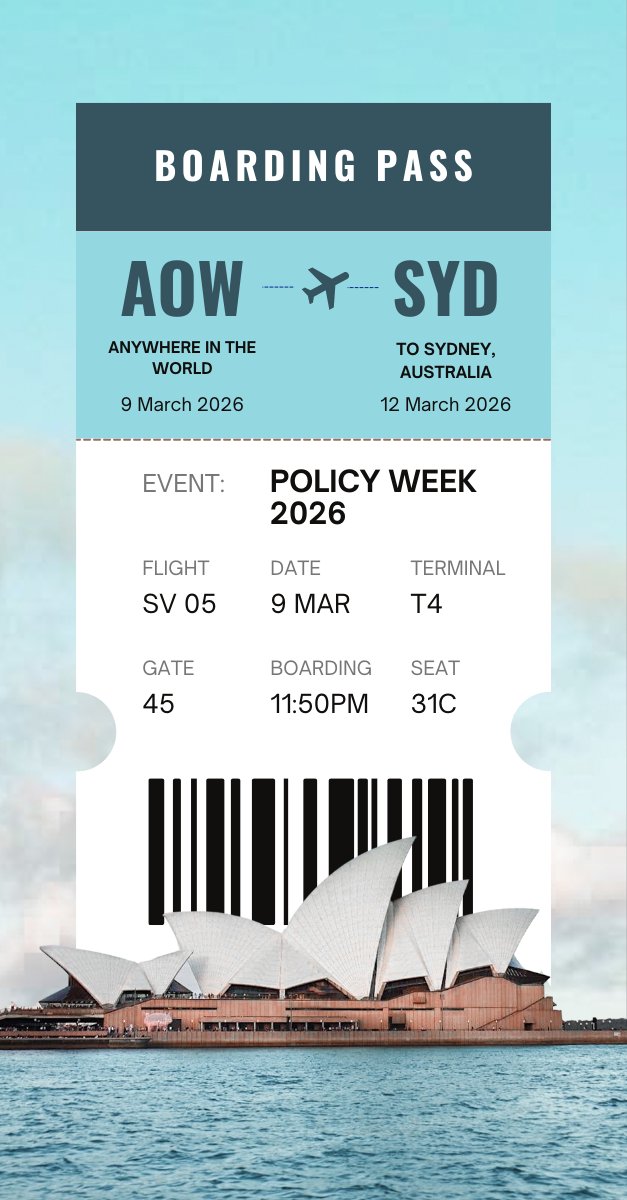
🦉✈️ The APC team is en route… and yes, it’s a long flight to Down Under. 🇦🇺 In two weeks, we will have our roundtable in Sydney for Policy Week 2026, bringing stablecoins, regulatory brainpower, and just enough jet lag to keep things interesting. We have partnered with MinterEllison for our roundtable "Stablecoins in Focus: Global Momentum and Regulatory Frontiers" Issuers, banks, regulators, policy thinkers... all in one room. Australia has become one of the most interesting jurisdictions to watch in the stablecoin conversation. Time to talk about it properly. Sydney, see you soon. 🩵 Last spots available: luma.com/avalanchepolic…
Avalanche Policy Coalition 🔺 tweet media
English
0
2
6
219
Avalanche Policy Coalition 🔺 retweetledi
Lee Schneider
Lee Schneider@leelaughs5x·
1/ Your Monday 🧵 on open, uncensored internet access — EU edition.
English
2
1
3
162
Avalanche Policy Coalition 🔺
Avalanche Policy Coalition 🔺@AvalanchePolicy·
Think about the difference between a bank vault and your own wallet. 🏦 If a company holds your assets in its vault, you expect oversight and safeguards. But, if you hold your own assets and simply use tools to interact with a network, the risk sits in a different place. That is the core point in our response to the FCA. ❗ Regulation should follow custody and control, not just participation. Staking and DeFi are not all the same. Treating them as one category misses where real risk actually exists. Why does all of this matter? 👉The UK has a real opportunity to draw these lines carefully. We are glad to be part of that conversation. Read our full response here: avalanchepolicy.com/en/comment-let…
English
0
0
1
50