Henry Alwyn Wootten
16K posts

Henry Alwyn Wootten
@awootten
Astronomer, Father, gardener
Amburg, Virginia Katılım Mart 2009
825 Takip Edilen492 Takipçiler
Sabitlenmiş Tweet
Henry Alwyn Wootten retweetledi

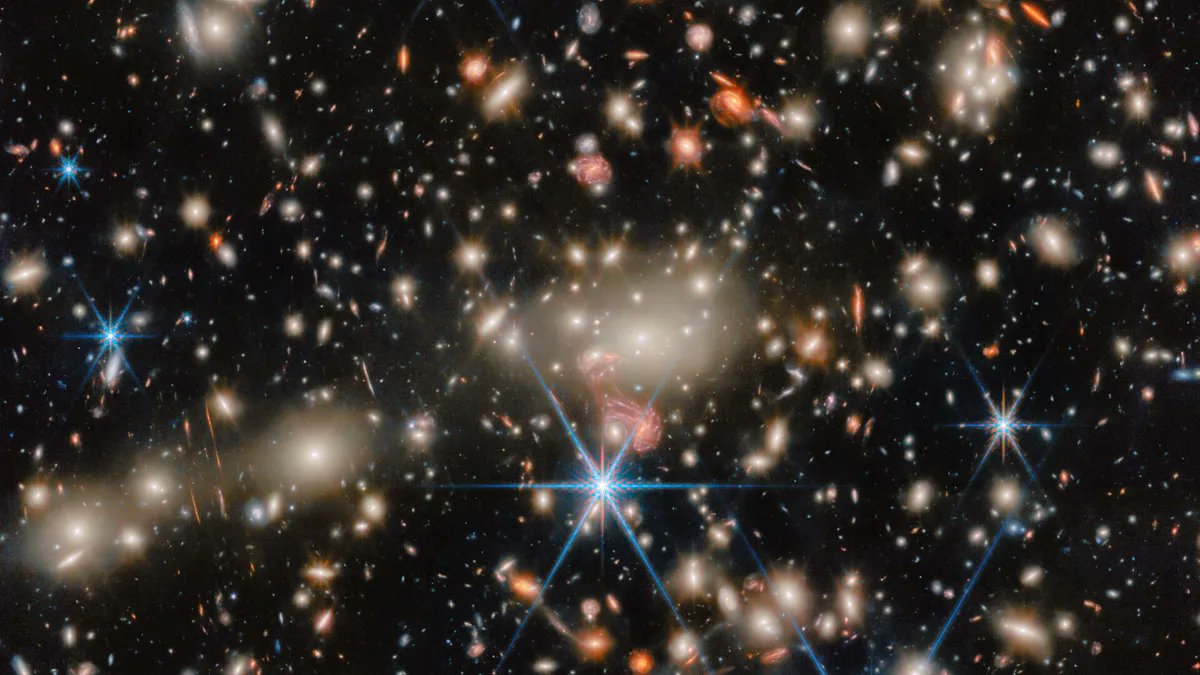
Recent observations with the JWST are providing what is likely the strongest evidence so far for the very first generation of stars in the universe, the so-called Population III stars, which until now had only been predicted by theory.
Instead of detecting these stars directly, which is extremely difficult because they were short-lived and existed very early, astronomers analyzed the chemical fingerprints left behind in ancient galaxies. In particular, they studied the ratio of helium to hydrogen in a distant system and used detailed modeling to infer the types of stars that must have produced those elements.
The results point toward a “top-heavy” population, meaning most of these first stars were significantly more massive than the Sun, typically between about 10 and 100 solar masses, consistent with the idea that the early universe, still lacking heavier elements, favored the formation of very hot and massive stars.
This matters because those first stars fundamentally changed the universe: they produced the first heavy elements through nuclear fusion and supernova explosions, and their intense radiation helped reionize the cosmos, ending the so-called cosmic dark ages. What makes this result particularly strong is that it connects observational data with theoretical predictions in a way that aligns remarkably well, narrowing down the properties of these elusive stars more precisely than before. It doesn’t mean we’ve “seen” the first stars directly yet, but it does mean we’re now reading their imprint in the universe with increasing confidence, turning what used to be a purely theoretical chapter of cosmology into something observationally constrained.
👉 share.google/8pjNTUbVJaiXo8…

English

Great to see the Fred Young Submillimeter Telescope join the Chajnantor facilities high above ALMA.
AAS Press Office@AAS_Press
Cornell University: Major New Telescope on Chilean Summit Opens Window on Universe news.cornell.edu/stories/2026/0…
English

It appears CP-3243 has crashed after departing La Paz, Bolivia earlier today. The aircraft entered a circling pattern 24 minutes after takeoff, lasting 2 hours, before losing height. Last signal received from the aircraft was at 14:57:57.
#3f333a74" target="_blank" rel="nofollow noopener">flightradar24.com/data/aircraft/…

English

TWEEPS: Early voting starts TOMORROW in Fairfax, Arlington, Alexandria and beyond.
The April 21 redistricting vote is a GAME CHANGER, just like Prop 50 in CA.
I need 1,000 fast RTs and replies using #VirginiaIsForVotingYes
Please and thank you! 🙏💪
English

@MarkWarner An arch with no grace, defined by blandness and size.
English
Henry Alwyn Wootten retweetledi

The JWST has identified an unusual galaxy system nicknamed “the Stingray” that may help resolve the long-standing puzzle of the so-called “little red dots,” a population of compact, very red objects seen in the early universe.
These dots have been difficult to interpret because they don’t fit cleanly into known categories: they are too small and bright to be ordinary galaxies, yet they also lack some of the expected signatures of actively feeding supermassive black holes, such as strong X-ray or radio emission.
What makes the Stingray system important is that it appears to represent a transitional stage. Observations suggest it is powered by a black hole actively accreting matter, but in a configuration shaped by its environment, producing properties that resemble those of little red dots. Instead of being a completely separate class of object, this supports the idea that little red dots could be a temporary phase in galaxy evolution, specifically, an early stage in which a growing black hole is embedded in dense gas that alters how we see it.
This interpretation aligns with a broader shift in understanding. Many recent studies suggest that these objects may be young black holes surrounded by dense gas “cocoons” that absorb high-energy radiation and re-emit it at longer, redder wavelengths, which is why they appear so red in JWST data.
The Stingray system provides a concrete example of such a configuration in action, strengthening the case that we are not seeing exotic new types of galaxies, but rather a short-lived evolutionary stage that was common in the early universe.
If this is confirmed with further observations, it would significantly clarify how supermassive black holes formed so quickly after the Big Bang, since these little red dots would effectively represent an early growth phase. Instead of being anomalies that challenge cosmological models, they would become key pieces in understanding how galaxies and their central black holes co-evolved during the universe’s first billion years.
👉 share.google/5g1jequFiclfEj…

English

@HedgieMarkets A sad commentary. I'm not surprised that mindless ChatGPT thoughtlessly invents material. Unfortunately some find that material convincing.
English

🦔A researcher invented a fake eye condition called bixonimania, uploaded two obviously fraudulent papers about it to an academic server, and watched major AI systems present it as real medicine within weeks.
The fake papers thanked Starfleet Academy, cited funding from the Professor Sideshow Bob Foundation and the University of Fellowship of the Ring, and stated mid-paper that the entire thing was made up. Google's Gemini told users it was caused by blue light. Perplexity cited its prevalence at one in 90,000 people.
ChatGPT advised users whether their symptoms matched. The fake research was then cited in a peer-reviewed journal that only retracted it after Nature contacted the publisher.
My Take
The researcher made the papers as obviously fake as possible on purpose. The AI systems didn't catch it. Neither did the human researchers who cited it in real journals, which means people are feeding AI-generated references into their work without reading what they're actually citing.
I've covered the FDA using AI for drug review, the NYC hospital CEO ready to replace radiologists, and ChatGPT Health launching this year. All of that is happening in the same environment where a condition funded by a Simpsons character and endorsed by the crew of the Enterprise was being presented as emerging medical consensus. The people making these deployment decisions seem to believe the pipeline from research to AI to patient is more supervised than it actually is. This experiment suggests it isn't supervised much at all.
Hedgie🤗
nature.com/articles/d4158…
English
Henry Alwyn Wootten retweetledi

Henry Alwyn Wootten retweetledi

🔴 Le New York Times vient de publier le récit le plus accablant sur Trump depuis le début de la guerre. Et c'est une bombe.
Jonathan Swan et Maggie Haberman, deux journalistes de la Maison Blanche, révèlent comment Trump a pris la décision d'entrer en guerre contre l'Iran. Ce qu'ils décrivent est exactement ce que j'analyse dans Le Pantin de la Maison Blanche.
Voici les faits.
Netanyahu a vendu un rêve. Le 11 février, dans la Situation Room, le Premier ministre israélien a présenté un scénario en quatre actes : tuer le Guide Suprême, détruire l'armée iranienne, déclencher une révolution populaire, installer un nouveau régime. Il a même montré une vidéo de montage avec les "futurs dirigeants" de l'Iran. Trump a répondu : "Sounds good to me." En une phrase, il venait de sceller le destin de la région.
Le lendemain, la CIA a dit que c'était du vent. Les parties 3 et 4 du pitch de Netanyahu, la révolution populaire et le changement de régime, ont été qualifiées de "farce" par Ratcliffe lui-même. Rubio a traduit : "In other words, it's bullshit." Le général Caine a ajouté : "C'est la procédure standard des Israéliens. Ils survendent, et leurs plans ne sont pas toujours bien développés."
Trump a entendu. Et il a quand même dit oui.
Vance a tout vu. Le vice-président était le seul dans la pièce à s'opposer frontalement, avertissant que la guerre pourrait "détruire la coalition politique de Trump", que le Détroit d'Ormuz était le vrai point de vulnérabilité, que personne ne pouvait prédire les représailles iraniennes quand la survie d'un régime était en jeu. Il a dit : "Tu sais que je pense que c'est une mauvaise idée. Mais si tu veux le faire, je te soutiendrai."
Ce n'est pas du courage politique. C'est de la déférence.
Susie Wiles a regardé. La cheffe de cabinet, qui avait des inquiétudes, a estimé que ce n'était "pas son rôle" de s'exprimer sur une décision militaire devant les autres. Elle a "encouragé les conseillers à partager leurs vues." Elle s'est tue.
Le général Caine n'a jamais dit non. Il a exposé les risques : diminution des stocks de munitions, Détroit d'Ormuz, pas de voie claire vers la victoire. Puis il a dit : "Si vous ordonnez l'opération, l'armée exécutera."
Trump, lui, "entendait seulement ce qu'il voulait entendre."
Et Trump a signé à bord d'Air Force One, 22 minutes avant la deadline fixée par son propre général : "Operation Epic Fury is approved. No aborts. Good luck."
Voilà comment on entre en guerre au XXIe siècle. Pas avec une délibération solennelle. Pas avec un vote du Congrès. Pas avec une stratégie de sortie. Avec un slide show de Netanyahu, un "sounds good to me", et une note envoyée depuis un avion.
Dans Le Pantin de la Maison Blanche, j'écris que les vrais décideurs sont ceux qui préparent les présentations que Trump regarde. Netanyahu l'a compris mieux que quiconque. Il a mis en scène une heure de spectacle visuel dans la Situation Room avec Mossad en fond d'écran, des vidéos de "futurs dirigeants", une promesse de victoire rapide et propre.
Et Trump a dit oui. Pendant que Vance, Rubio, Wiles et Caine regardaient.
Voici l'article du New-York Times : nytimes.com/2026/04/07/us/…
📖 Le Pantin de la Maison Blanche → amazon.fr/dp/B0GPCCMS68/

Français
Henry Alwyn Wootten retweetledi

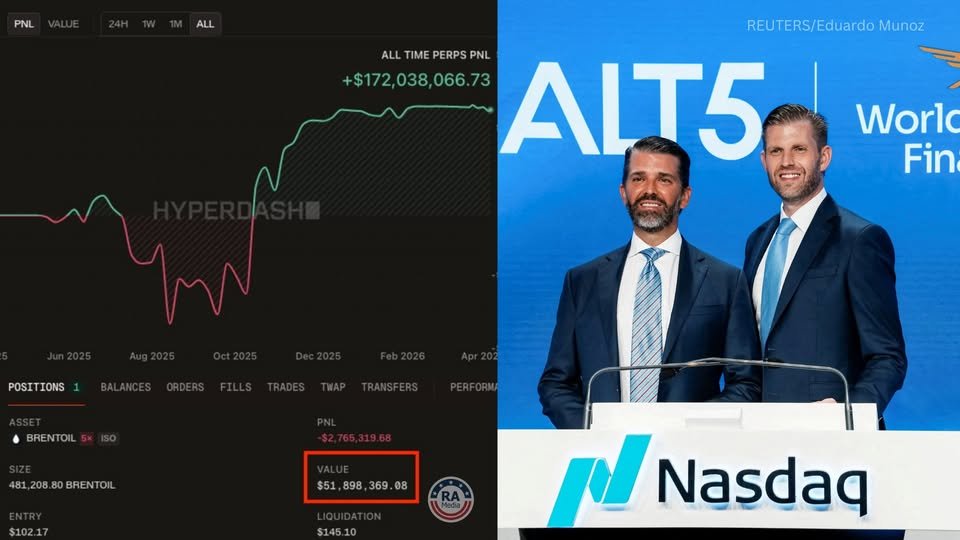
A Trump insider opened a $51,000,000 oil short position — hours before Trump announced a ceasefire with Iran. This guy is now 16 for 16. $170 million in profit. A perfect streak.
This is not a talented trader.
"We placed the bet." "The ceasefire dropped." "We cashed out." Sixteen times in a row.
That is not skill. That is not instinct. That is not research.
That is someone who knows what is coming before it comes.
Think about what that actually means. A private individual is placing a $51 million bet that oil prices are about to collapse — hours before a sitting president announces a ceasefire that collapses oil prices. Not once. Sixteen times. Zero losses.
There are only two explanations and both should terrify you.
Either someone inside the White House — or with direct access to it — is leaking ceasefire negotiations to traders before diplomats, before the press, before the American people hear a single word. That is insider trading. That is corruption. That is a federal crime.
Or the timing of the announcement itself is being shaped around the trade. Which is worse.
This is not a genius investor who reads the news faster than you do. The news hadn't happened yet. He wasn't reading the news. He was getting a phone call.
While Americans were watching the ceasefire announcement and feeling relieved — somebody already knew. Somebody had already bet $51 million on it. And somebody was already counting their winnings.
You are not watching a free market. You are watching a White House with a side hustle. Via~ Really American

English

NEW: A stunning new report claims that the Pentagon summoned Pope Leo XIV’s top American diplomat and threatened him after the U.S.-born pontiff gave his January state-of-the-world address.
Leo used the address to denounce a world ruled by “a diplomacy based on force” and “zeal for war.”
thelettersfromleo.com/p/the-pentagon…
English
Henry Alwyn Wootten retweetledi

New observations are forcing us to revise a long-standing assumption about the early universe.
For decades, the standard picture was that shortly after the Big Bang the cosmos was dominated almost entirely by simple, primordial gas, mainly hydrogen, with very little complexity. Dust, which is made of heavier elements like carbon, silicon, or iron, was expected to appear much later, only after multiple generations of stars had lived and died and enriched their surroundings.
What researchers are now finding is more nuanced. Using a combination of observations at different wavelengths, including far-infrared and radio data that are sensitive to cold dust, astronomers are able to see through the limitations of optical observations and directly measure how much dust is actually present in very distant, early galaxies.
These measurements reveal that the early universe was not uniformly dust-rich, as some earlier interpretations suggested, nor completely pristine. Instead, there is a surprising diversity: some massive galaxies formed very early already contain significant amounts of dust, often hiding ongoing star formation, while others at similar epochs are almost dust-free and have already stopped forming stars altogether.
A key implication is that previous observations may have been biased. Dust can obscure starlight, making actively star-forming galaxies appear faint or even “dead” in optical and near-infrared surveys. By incorporating longer wavelengths, astronomers can distinguish between galaxies that are genuinely inactive and those whose activity is simply hidden behind thick dust. This resolves part of the confusion around early massive galaxies that seemed too evolved too quickly.
More broadly, the results indicate that galaxy evolution in the first couple of billion years after the Big Bang was neither uniform nor slow. Some systems rapidly built up dust and continued forming stars in heavily obscured environments, while others quenched star formation early and ended up unusually dust-poor for their mass. Rather than a simple, homogeneous early universe, the emerging picture is one of rapid and diverse evolutionary pathways, with dust playing a central but highly variable role in shaping what we observe.
👉 share.google/Z1Imtug7Q8Zxl8…

English
Henry Alwyn Wootten retweetledi