backupyourmind

1.3K posts

backupyourmind banner
backupyourmind

backupyourmind

@backupyour8715

Official X account of the Back Up Your Mind blog

Katılım Nisan 2023
535 Takip Edilen63 Takipçiler
JH
JH@CRUDEOIL231·
I think way too many ppl are delusional about this idea of letting Iran control the SoH, having the US pull out, and just letting Iran set up a toll booth. Where does Saudi’s power actually come from? It’s not just because they’re rich. Their entire influence comes from being the world’s only swing Producer. We need oil, and Saudi controls that market. If Iran takes over the SoH, they become the most powerful, one of a kind Global Swing Producer in history. If they don’t like the oil price? They can just "adjust" the traffic in a strait that handles ~20mb/d to swing prices however they want. If the UAE gets on Iran’s bad side? "No passage for UAE tankers." If Kuwait tries to build a bypass? "Fine, the SoH is closed starting today. Let’s see if you can finish that bypass—which takes years—without making a single dime." By letting Iran control that flow, the US is effectively making Iran the ultimate energy gatekeeper. The entire regional hegemony shifts to Iran. Saudi and the UAE lose everything. Think about it—if you were MBS, would you let this happen? Let’s say the US pulls out this week. The US started this mess, and now the GCC has to just sit there and watch their power handed over to Iran? Let me give you a reality check for Americans: Imagine Mexico now controls the North American continent. "Want to fly to the UK? Get Mexico’s permission. Want to import jet fuel from Asia? Pay Mexico a toll and take the route they tell you to. Did you dare to criticize Mexico? Now, no container ships can enter your waters. You can’t say a word against the great President of Mexico." It sounds like a fantasy, but that’s the reality for the GCC. If the US tries to run away? If I were the GCC, I wouldn’t let them leave. I’d grab them by the hair and drag them back to clean up the mess they made. I’ve said before that this is an existential issue for Iran and Israel. Well, Iranian control of the SoH is an existential issue for every other GCC nation. And the GCC has leverage. They have massive wealth invested in the West, huge U.S. asset holdings, decades of lobbying networks, and they are the biggest donors for Trump’s terms. And of course they have oil. Do you really think Brent would stay below $100/bbl if the GCC teamed up and cut just 3mb/d for six months? Even the most optimistic guy knows the answer is zero chance. They don't even need a fancy excuse: "Oh, since the US gave up on us and Iran owns the SoH, it's not safe. We have to cut production. Sorry!" Within months, the US would be begging to come back. It’s just pushing the Middle East into an even bigger pit of fire. Thanks for listening to my TED Talk :) #oott #iran
English
438
681
5.2K
1.5M
backupyourmind retweetledi
roon
roon@tszzl·
shoutout to kurzweil who was doing “straight lines on graphs” before it was cool and managed to predict the timeline to certain ai capabilities extraordinarily well
roon tweet media
Joel Becker@joel_bkr

first ever blog post from me: “straight lines on graphs” as a researcher at @METR_Evals i’ve had hammered into me again and again that AI progress is (not only rapid) but remarkably _regular_. this intuition then suggests a bunch of useful mental models which aren’t obvious without the initially counterintuitive starting place. i focus on “jagged capabilities” a la @emollick, acceleration from RL a la METR/@EpochAIResearch, and compute slowdowns a la @whitfill_parker as case studies. (but there are many other phenomena i mentally organize in this way!) i don’t expect this post to convince people who are suspicious of this intuition about its value — i think this wouldn’t have worked for me when i was starting out skeptical! but i hope it gives a sense of some helpful basic tools that people focused on AI use to understand the past + future. post linked below.

English
68
92
1.5K
105.8K
backupyourmind retweetledi
Utah teapot 🫖
Utah teapot 🫖@SkyeSharkie·
some people on this website don't seem to understand that cutting yourself off from opposing viewpoints because you're concerned about radical fringes around those viewpoints is one of the main contributing factors to growing radicalization, by training the algorithms on social media to isolate opposing worldviews, you promote insular bubbles... you can't stop cults if you try to create punitive social structures for everyone who might look vaguely similar to them, that is, in fact, how cults are empowered
English
13
11
83
1.7K
backupyourmind retweetledi
Roko 🐉
Roko 🐉@RokoMijic·
Claude, Grok and ChatGPT are all very capable at uncreative/standard stuff but they all lack a sort of "sensible" intelligence when they go outside the training data. I'm not talking about Einstein level insights. I'm talking about things that are just very obvious within the context you are discussing. I had this problem with Claude opus 4.6 with extra thinking today discussing the colonization of Mercury 1. It didn't realize that solar collectors on Mercury won't work at night 2. I reminded it of that. "Okay!" It budgets for 24 hours of battery storage power. 3. I reminded it that Mercury's day is not 24 hours. "Ah! Okay". Need 88 Earth days. Says it's impossible. 4. I suggest using satellites to reflect sunlight onto the night side. "Ah! Okay you're absolutely right". Suggests satellites with a 200km orbit, since there's no atmosphere. 5. I remind it that from 200km you cannot reflect sunlight onto the dark side because the planet itself is in the way. "Ah okay, you're absolutely right". Suggests satellites at 50,000km. 6. I remind it that reflected light will be very diffuse as it spreads out, most is wasted. It suggests using a curved mirror to focus the light 7. I remind it that a curved mirror cannot focus light into a beam smaller in angular size than the Sun itself, because of conservation of etendue. "Ah yes! ... you're absolutely right". We agree that maybe 500km is about right. 8. It then calculates the area of the dark side that can be illuminated from a 500km satellite... but it only does it from a satellite exactly on the equitorial plane and only from one direction (only the dusk side). 9. I remind it that this is too conservative and to consider all angles. "Ah yes..." It then does the calculation correctly. So in some sense it DID know the answer!! But it says there's a small remaining region of darkness about 10° of lat and long that cannot be reached. I agree. It suggests that that area will be dark for 88 days so it can't work because batteries don't last that long. 10. I remind it that, because the planet is spinning relative to the Sun, that spot will *not* be stationary. It will be a moving zone that only lasts a few days. "Ah yes of course..."
English
23
4
131
7.9K
Bushels 🌾 Barrels 🛢 & Bullion 💰
As I’ve repeatedly said, there are essentially two potential outcomes: One is that Trump walks away, surrendering control of the Strait to Iran and effectively snuffing out the Petrodollar system. The other, which may be inevitable even in the first scenario, is that the US puts boots on the ground in an attempt to recapture control of the Strait. Either way, I’d read this note if you haven’t already.
Bushels 🌾 Barrels 🛢 & Bullion 💰@BuBarrelBull

America Celebrates 250 years (and the end of Pax Americana) This note is about the US and the implications of another war in the Middle East, but first, some history: In 1956, Britain and France conspired with Israel to seize the Suez Canal from Egypt’s Nasser. It was a classic imperial move, the kind that had worked for a century. Except this time, Eisenhower said no. He threatened to dump U.S. holdings of sterling on the open market, which would have collapsed the pound overnight. Britain folded within days. France folded with it. That moment, more than any other, marks the true end of British imperial primacy. Not the World Wars, not the independence movements, not the Commonwealth. The moment a U.S. president made a phone call and the pound buckled. Reserve currency status doesn’t just reflect economic power. It is economic power, and when it goes, everything goes with it. It is also worth noting the bitter irony that in 1956 it was Israel’s adventurism that helped expose the limits of British power and accelerate the pound’s decline. History has a way of rhyming. The pound’s vulnerability at Suez didn’t emerge overnight. It had been building for decades, through two world wars that bled Britain fiscally dry, through the steady accumulation of the world’s gold by the United States, and through the slow recognition that the guarantor of global trade had changed addresses. Bretton Woods in 1944 formalized what was already true: the dollar was now the anchor of the global monetary system, convertible to gold at $35 an ounce, with every other currency pegged to it. It was an elegant system. It was also a system that required the United States to run perpetual trade surpluses and maintain fiscal discipline, neither of which proved politically sustainable. By the late 1960s the U.S. was spending heavily on Vietnam and the Great Society simultaneously, and foreign central banks, led by a deeply skeptical De Gaulle, began converting their dollar reserves into gold at an accelerating pace. France literally sent warships to New York to bring gold home. On August 15, 1971, Nixon closed the gold window. The dollar would no longer be convertible. Bretton Woods was dead. What replaced it was Kissinger’s deal: the petrodollar. The deal struck with Saudi Arabia in 1973 and 1974 was simple and profound. Oil would be priced exclusively in dollars. In exchange, the U.S. would provide security guarantees to the Gulf monarchies. You want energy, you need dollars. You need dollars, you hold Treasuries. You hold Treasuries, you finance American deficits. The gold standard was replaced not with nothing, but with oil and aircraft carriers. It worked because it rested on one non-negotiable guarantee: America would secure global trade routes, keep the sea lanes open, and ensure the free flow of energy to allies and adversaries alike. The Strait of Hormuz. The South China Sea. The Red Sea. These were never just geography. They were the load-bearing walls of the entire dollar architecture. And this is the thing people consistently fail to appreciate: commodities and geopolitics have always been linked. Most wars throughout history are, at their core, about securing access to resources. Energy. Grain. Metals. The players change. The underlying logic never does. Fast-forward to February 2022. Russia invades Ukraine. The U.S. and Europe respond by freezing $300 billion in Russian sovereign reserves. Swift expulsion and asset seizures. Just like that, we answered a question every central bank on earth had been too polite to ask out loud: what happens if America decides your dollar reserves are no longer yours? Biden gave them the answer. Loudly. This was not just a sanctions regime. This was a fundamental break in the trust architecture that underpins reserve currency status. The dollar’s value as a reserve asset was always partly about neutrality, the assumption that it was beyond politics. We torched that assumption. Every non-Western central bank quietly updated its threat model that week. If it can happen to Russia, it can happen to anyone who finds themselves on the wrong side of Washington. Subsequent uses of financial sanctions against various actors only compounded the damage, each one further eroding the perception that the dollar was a neutral settlement medium rather than a political weapon. The de-dollarization trend and the de-globalization trend are not separate stories. They are the same story. When the guarantee of free trade breaks down, countries retrench. When the reserve currency gets weaponized, countries diversify. When the hegemon’s will to enforce the rules-based order wavers, everyone starts making contingency plans. We are now deep inside that dynamic. The Houthis have been attacking commercial shipping in the Red Sea for over a year. Iranian proxies armed with Iranian-supplied missiles. The U.S. response has been airstrikes that changed nothing. Global shipping rerouted around the Cape of Good Hope, adding weeks and billions in costs. The Strait of Hormuz carries roughly 1/5 of the world’s petroleum liquids and it is now de facto under the control of the IRGC. When asked about it, the current U.S. administration has been explicit: that’s other countries’ problem. Let that sink in. The Strait of Hormuz, the single most important chokepoint in the entire petrodollar architecture, the physical artery through which the dollar’s claim to reserve status is literally pumped, and the position of the United States government is a shrug. If the U.S. cannot credibly guarantee the Strait stays open, the petrodollar system loses its central physical premise. You cannot price oil in dollars if you cannot guarantee the oil moves. At the same time, Trump has made clear he wants to withdraw from NATO commitments, remove troops from Germany, and generally signal that the American security umbrella is no longer a given but a transaction. NATO without credible U.S. commitment is just a bureaucracy. U.S. troops in Germany are not just a tripwire against Russian aggression, they are the physical embodiment of the guarantee that underwrites European confidence in dollar-denominated trade and finance. Remove them and you don’t just weaken European security. You weaken the entire signaling architecture that tells the world the American system is worth buying into. Meanwhile in the Pacific, the U.S. has drawn down defensive assets across Southeast Asia, leaving Taiwan and Japan increasingly exposed at precisely the moment China is conducting its most aggressive military posturing in decades. Every ally in the region is asking the same question Europe is asking: is the guarantee real? And they are all beginning to arrive at the same uncomfortable answer. Meanwhile we are signaling to Europe and to Ukraine that support has a political price and an expiration date. Every one of those signals is read by every finance ministry and central bank on the planet. The question they are all asking is whether the guarantee is real. The answer is becoming less clear by the month. Here is what makes this moment uniquely dangerous and what most mainstream commentary refuses to confront directly. The United States government has, to a degree without modern precedent, allowed its foreign policy in the Middle East to be effectively captured by a foreign government. The unconditional support for Israel, regardless of the conduct of its military operations, regardless of the cost in American credibility, regardless of the alienation of Arab partners whose cooperation the petrodollar system literally depends upon, has gutted America’s ability to act as a neutral and trusted arbiter of global order. And, to be clear, I am not arguing that American interventionism is the right path forward. But unconditional support of Israel, executed recklessly, is absolutely disastrous. Eisenhower could call Britain and France off Suez in 1956 because the world believed America was acting in the interest of global stability rather than a particular ally. That credibility is gone. When the U.S. vetoes ceasefire resolutions at the UN while simultaneously claiming to be the guarantor of a rules-based international order, the cognitive dissonance is not lost on the Global South, on Arab oil producers, or on the central banks quietly reducing their Treasury holdings. A hegemon that cannot be trusted to act with even a semblance of neutrality is not a hegemon. It is an Israeli puppet. And puppets do not get to set the terms of global finance. So what fills the void? Not the yuan. Not yet, anyways. China’s capital account is closed. There is no deep, liquid, freely convertible yuan bond market for the world to park reserves in. The yuan cannot replace the dollar for the same reasons the dollar couldn’t have replaced the pound in 1930, the institutional architecture doesn’t exist yet, and China is not trusted. You don’t replace a weaponized reserve currency with someone else’s weaponized reserve currency. But here is where it gets interesting: countries that want to transact with each other in oil, in commodities, in bilateral trade, don’t need a reserve currency. They need a settlement medium. And gold, the asset with no counterparty, no issuer, no sanctions risk, is reemerging as exactly that. Central bank gold demand has hit multi-decade highs three years running. Russia and China conduct the overwhelming majority of their bilateral trade in national currencies supplemented by gold reserves. The BRICS have advanced a hybrid digital settlement mechanism backed by physical gold, now in pilot phases for cross-border transactions. India, the Gulf states, and much of the Global South have followed suit in various degrees. This is not theoretical. It is happening. Gold makes structural sense in a fragmented world because it cannot be frozen, it cannot be sanctioned, and it has no political allegiance. It is the asset that sits outside the system, which is precisely why every nation building a parallel financial architecture is accumulating it. The 1970s swap of gold for oil as the dollar’s backing was always a political arrangement. We are watching its reversal in slow motion. Here is the strategic reality the West refuses to say out loud: Russia, China, and Iran understand supply chain vulnerabilities in ways that Western governments, captured by short-term political cycles and decades of globalization orthodoxy, have consistently failed to. China has spent 20 years building commodity self-sufficiency. Domestic rare earth processing. Long-term oil contracts with Russia, Iran, and Saudi Arabia priced outside the dollar. Port infrastructure from Djibouti to Pakistan to Sri Lanka. Control over the processing of the critical minerals, lithium, cobalt, rare earths, that every advanced weapons system and clean energy technology depends upon. The Belt and Road isn’t an aid program. It’s a parallel trade and settlement architecture being built in plain sight. Russia, despite sanctions, has reoriented its entire commodity export infrastructure eastward and built payment systems that bypass Swift entirely. Iran has spent decades developing asymmetric capabilities specifically designed to threaten the chokepoints the petrodollar depends on. These are not accidents. These are strategies. Coherent, long-horizon, supply-chain-aware strategies pursued by adversaries who understood that the real battlefield was always logistics and monetary architecture, not just military hardware. And here is the painful corollary: the United States’ ability to respond militarily or industrially to a major conflict is far more constrained than the public appreciates. Decades of offshoring have hollowed out the defense industrial base. Shipbuilding capacity is a fraction of what it was in World War II. Ammunition production, exposed dramatically by the Ukraine war, is running well below what sustained high-intensity conflict would require. And critically, the United States is dependent on China for the processing of the rare earth minerals and critical materials that go into precision munitions, electronics, and advanced weapons platforms. We have, with remarkable lack of foresight, handed our primary strategic adversary leverage over our ability to rearm. If a serious conflict erupts in the Taiwan Strait or the Persian Gulf, the supply chain constraints on the U.S. military response would become visible very quickly, and that visibility itself would be destabilizing in ways that are difficult to fully model. Now layer on the fiscal reality. The United States is running deficits in excess of $1.8 trillion annually, carrying over $36 trillion in total debt, with interest payments now exceeding the entire defense budget. The Iraq War cost an estimated $2 to $3 trillion over two decades. A serious military confrontation in the Persian Gulf or Taiwan Strait, against a near-peer adversary with the capability to sink carrier groups and disrupt satellite communications, would cost multiples of that, and would need to be financed at interest rates far above the near-zero environment that made the post-2008 debt accumulation painless. There is no fiscal headroom for another generational war. The bond market knows this. Foreign central banks know this. And adversaries who have studied American fiscal trajectories know this too. The drive toward de-globalization flows from the same source as de-dollarization, as countries unwilling to depend on American guarantees that seem less ironclad than before race to onshore supply chains, secure friendly energy sources, and develop parallel payment rails. China and its partners embraced this with characteristic foresight. The West, still deeply integrated into just-in-time global networks and politically unable to have honest conversations about strategic dependency, is playing catch-up. We are way behind. And we are distracted. 2026 is the 250th anniversary of the United States. This moment may well be remembered not as a celebration of enduring liberty but as the year the long arc of American hegemony reached its visible inflection point. Previous reserve currency transitions followed a consistent pattern: military overextension, fiscal deterioration, loss of trade route control, erosion of allied trust, and the emergence of a credible alternative architecture. Check, check, check, check, and check. The American empire was always an empire of systems, financial, military, institutional. Its genius was making those systems feel like global public goods rather than instruments of U.S. power. Free trade. Dollar liquidity. Security guarantees. For a long time they were both. When you start weaponizing the systems, when you subordinate them to the interests of a single foreign ally, when you shrug at the Strait of Hormuz and pull troops from Germany and leave Taiwan exposed, you reveal the seams. And once seen, they cannot be unseen. The Strait of Hormuz is not a shipping lane. The Red Sea is not a regional conflict. Taiwan is not a sovereignty dispute. NATO is not a relic. They are all load-bearing elements of the same structure. The world is watching whether the guarantees are real. The dollar’s premium, the “exorbitant privilege”, is priced on the assumption that they are. If they’re not, that premium disappears, and with it the ability to run deficits, export inflation, and fund ourselves at the expense of everyone else. Course correction remains possible. First, the US must start divorce itself from Israel. That will require a regime change here, not overseas. Next comes strategic investment in domestic industrial capacity and critical mineral independence, through a foreign policy that can again be trusted to reflect something broader than the interests of a single lobbying apparatus. But the momentum toward self-reliance and alternative arrangements gathers strength with each passing disruption. The commodities markets, ever pragmatic, are already casting their votes. 250 years in, the American century may be ending not with invasion or defeat, but with the quiet, devastating withdrawal of trust. That’s how empires end.

English
16
66
744
273.4K
backupyourmind
backupyourmind@backupyour8715·
The most obvious way to understand human evil is to understand interface economics.
Aakash Gupta@aakashgupta

The reason software eats RAM is the same reason factories used to dump chemicals in rivers. The cost is externalized. Every mass of inference compute shows up on an engineering manager's AWS bill, broken down to the cent, reviewed quarterly. Every mass of RAM consumed on YOUR machine shows up nowhere in anyone's budget. Chrome could cut memory usage by 60% tomorrow and Google's revenue wouldn't move a single basis point. Docker's 2GB idle footprint costs Docker Inc. exactly $0. Electron's 500MB todo list costs the Electron team exactly $0. The user paid for the RAM. The user pays the electricity. The user deals with the fan noise. The company ships faster because they chose the laziest possible runtime. The token-optimization obsession makes this even clearer. Companies optimize inference cost because inference cost hits their margins. They'll spend six months shaving 200ms off a model response. They won't spend six days reducing a desktop client's memory footprint because that memory belongs to someone else's hardware. This is why the 16GB vs 32GB debate is a trap. You're asking consumers to buy more expensive hardware to subsidize the software industry's refusal to optimize for a resource they never have to pay for. The market will never fix this on its own. The people writing the checks and the people running out of RAM are on opposite sides of the transaction.

English
0
0
0
9
Daniel Foubert 🇵🇱🇫🇷
When the strategic reserve runs out, the global economy BURSTS because a supply crisis is much worse than just a price shock. We could see MASSIVE supply chain disruption and INSANE inflation. In an extreme case where 20% of global oil is lacking, it means that: - Plastic production falls by 15-20% within weeks, disrupting packaging, electronics casings, medical supplies, and consumer goods globally. - Fertiliser output drops 15%, threatening the 2026 harvest across South Asia and Africa and creating famine risk by 2027. - Jet fuel availability falls 18%, grounding an estimated 30% of long-haul flights and collapsing air freight capacity for semiconductors, pharmaceuticals and fresh produce. - Synthetic rubber production down 20%, halting tyre manufacturing within 60 days and cascading into automotive and logistics. - Pharmaceutical manufacturing disrupted by 25% as petrochemical solvents, capsule casings and sterile packaging feedstocks run short. - Asphalt supply collapses 30%, freezing road construction and maintenance globally. - Synthetic textile production falls 20%, hitting fast fashion, industrial fabrics and military equipment supply chains. - Detergent and cleaning product output down 20% as surfactant feedstocks dry up. - Paint and coating production drops 25%, stalling construction and automotive manufacturing. - Adhesives and sealants fall 30%, disrupting electronics, aerospace and packaging assembly lines. - Container shipping rates triple within a fortnight, choking the 80% of world trade that moves by sea. - Global food prices spike 40-60% within 90 days as fertiliser, packaging, refrigeration and transport costs compound simultaneously. - Electricity in oil-dependent nations rationed within 30 days, triggering blackouts across Pakistan, Bangladesh and sub-Saharan Africa. - Automotive production halts within 45 days as rubber, plastics and paint supply chains simultaneously fail. - Hospital supply chains face critical shortages of IV bags, syringes, and sterile packaging within 60 days. And that's just oil... Iran could give the global economy a heart attack and use it to get everything it wants.
English
27
226
920
55.3K
the.PM
the.PM@thePM_001·
@richardhirschs1 The situation is slightly "better" than anticipated by most, because the current human population of the planet is roughly 25% lower than most assume.
English
2
0
2
815
Dr Richard Hirschson
Dr Richard Hirschson@richardhirschs1·
I’m afraid you cannot model the oil shock that is currently unfolding. No one’s portfolio is protected. No one’s food and fuel security is guaranteed. The global wealthy will be relatively spared, but this will affect all of us, wherever we may live. This is a global catastrophe. This is the Great Depression meeting the GFC and the Stagflationary 70’s, all at once. Hundreds of millions of people will be pushed over the poverty line. Let’s all pray this madness ends soon. x.com/richardhirschs…
Pete Wargent@PeteWargent

Middle East Crisis Update A materially bigger and more persistent shock westpaciq.com.au/economics/2026…

English
6
85
501
34.5K
backupyourmind retweetledi
Gavin
Gavin@GavMcCracken·
Schizophrenics have been right about every major conspiracy theory for years. Psychopaths have been taking major losses on the frontlines lately. 5 years ago you were sent to an insane asylum for suggesting the elites had pedophilia trafficking rings. We're making progress.
Gavin tweet media
Glizzy Gulper@0xGoyim

@GavMcCracken @toiletkingcap @taobanker schizos are in control

English
61
588
3.9K
108.7K
backupyourmind retweetledi
nic carter
nic carter@nic_carter·
it hasn't sunk in for most people. we already live in a post-scarcity society. UBI is already here. basic package: disability, medicaid, food stamps etc bonus package: literally getting paid for staying at home and hanging out with your relatives extra bonus: if you are willing to commit fraud, pretend your kids are autistic and get paid for that. get paid for watching your neighbor's kid. pretend you are taking care of your grandma. fake hospice clinic. fake rehab clinic. fake therapy clinic. giga bonus: during a time of crisis take advantage of PPP or CARES and open a fake business and get paid for existing people are shocked when they learn that defense is the FIFTH largest line item in the budget. ahead of defense: social security ($1.6T), interest on debt ($1.1T) medicare ($1T), medicaid + ACA ($1T), AND THEN defense ($0.9T) complain about defense all you like, but healthcare fraud is a way bigger factor. hundreds of billions per year. this is only going to get worse, because the fraud is a structural part of the system – payouts to client groups in exchange for votes (normally D). in the US, only 47% of the population actually works (fully 14% of the population is working age and does not work). retirees are 18% and children 22%. the system I described above subsidizes 50m non-working people absolute minimum, but really it's far more because people that are paid to stay home and take care of their relatives are considered "workers" of that 47% of "actual workers" maybe one third does real work, the rest are shuffling papers around or doing fake email jobs. so you have, rough math, 50 million actual workers supporting 300 million dependents. that's the nature of the economy today. it will only accelerate. eventually you will have 10 million using AI tools to do all the work and 340 million dependents. the reason no one roots out the fraud is because it's the system that keeps our extremely fragile polity intact. the fraud is the UBI. the purpose of the system is what it does. of course, it's a deeply unfair system, because you are allowed to commit fraud if you are a politically protected client group of the democrats. DOGE was killed faster than any government program ever, because it attempted to root out the fraud. if you are honest and unwilling to commit fraud, you are a huge loser in this system. your neighbor will have their mortgage subsidized by some government program. they will get favorable SBA loans due to DEI. they will open a fake hospice or autism clinic. they will get paid for taking care of their neighbor's kid and vice versa. the primary skill in the labor market is learning how to extract money from state and federal government programs, not gaining skills or making yourself employable. if you are just trying to work an ordinary wagie job you are a huge sucker. you are paying 40-50% effective all in taxes to everyone else who is a net taker. the sad part is because AI is such a substantial productivity boost, it will actually keep this system going for a while longer, and maybe in perpetuity. AI boosts the 15% of the population that is actually productive so much that the remaining 85% can coast by. no one in charge will change this because they can't think of anything else. the political costs of a real UBI program are too great and we don't have the money for it anyway. so we will keep this covert fraud-based UBI program running indefinitely. unfortunately, if you are an honest wagie, you lose.
English
592
5K
23.8K
71.1M
backupyourmind retweetledi
dr. jack morris
dr. jack morris@jxmnop·
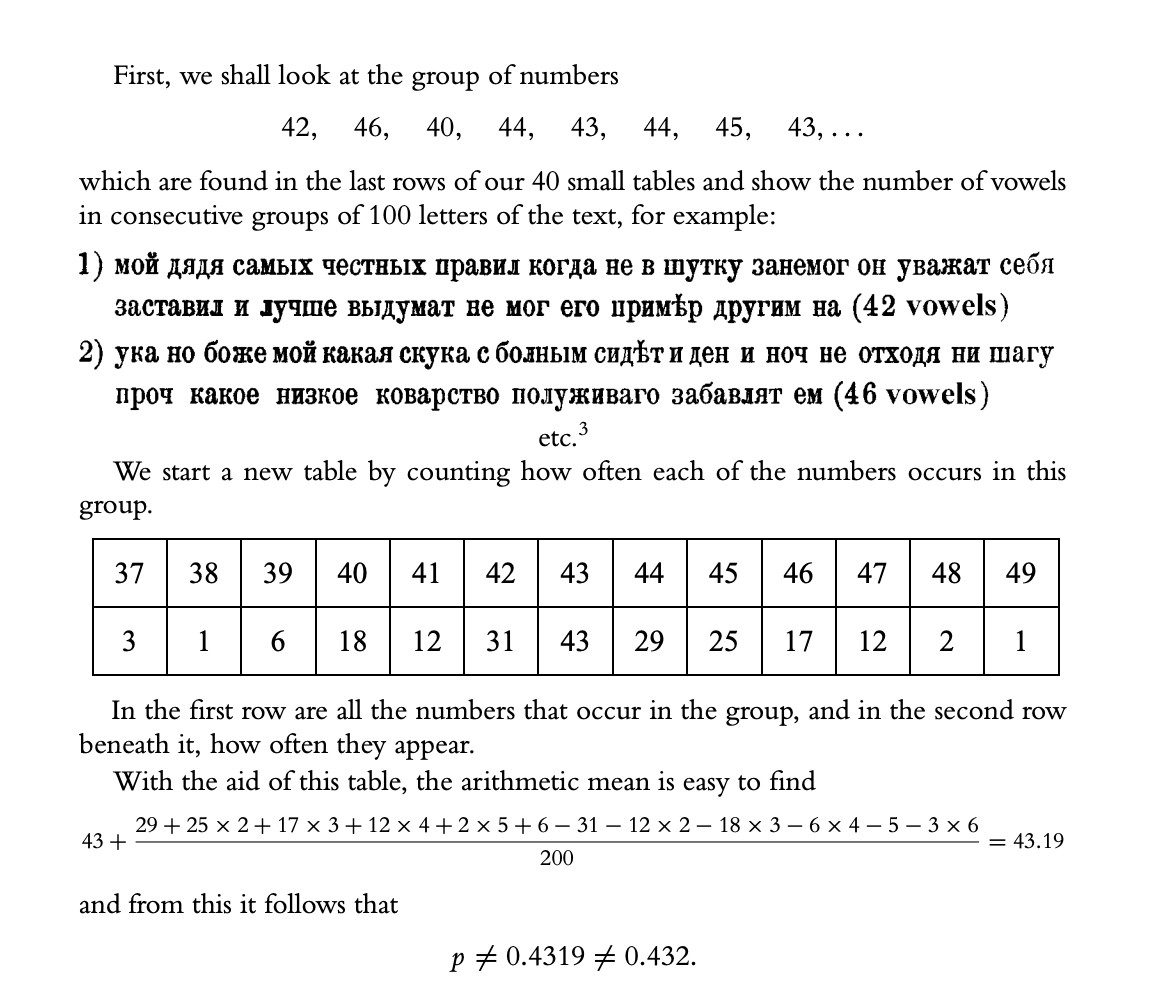
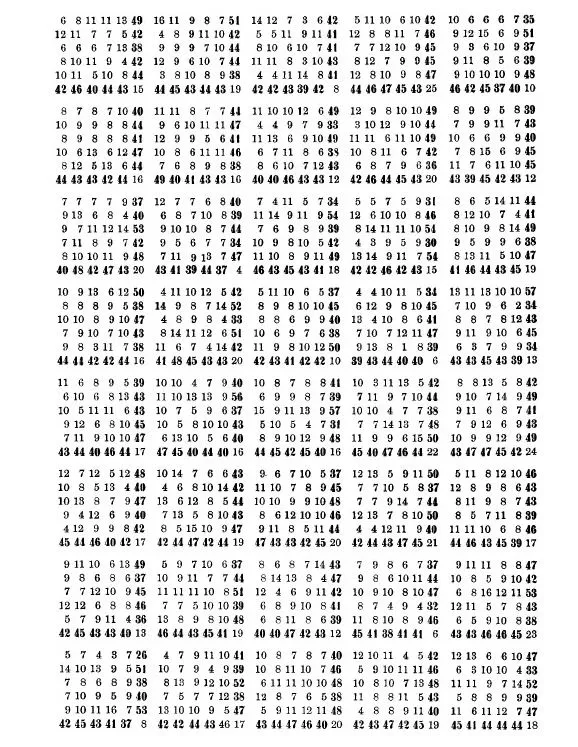
Hate to break it to you, but the first LLM was created by Andrey Markov in 1913. he tallied up 20,000 letters from a famous novel and computed p(vowel | vowel) p(consonant | vowel) p(vowel | consonant) p(consonant | consonant) basically 'training' a bigram by hand
dr. jack morris tweet mediadr. jack morris tweet media
David Pfau@pfau

Oh god are we really doing this? Jeff Dean trained an n-gram model on the entire internet in 2007. Jelinek coined the term "language model" in the '70s. It's called "Claude" because Claude Shannon was estimating the entropy rate of the English language in 1951!

English
91
459
6.1K
366.3K
backupyourmind
backupyourmind@backupyour8715·
@escapefrommelos Maybe they need to make the war more tasteful and refined? Could hire a boutique PR consultancy to calibrate the killing methods to eject rose petals and hide the gore with glowing sprinkles.
English
0
0
0
7
Melian Refugee
Melian Refugee@escapefrommelos·
two things that “radicalized” me about this useless stupid war: 1) these videos are often posted with masturbatory glee 2) the victims are always uniformed but very often unarmed and without helmets… almost like they’re PoWs who have been released and hunted on video for sport
𝚂𝙽𝙸𝙿𝙴𝙳™@The_Banned_Vids

Feels like a predator playing with prey before the inevitable🇷🇺 Historical Footage shows a Ukrainian FPV drone chasing a lone Russian soldier in the field!

English
1.3K
2.6K
36.5K
1.7M
J. Otto Pohl
J. Otto Pohl@JOttoPohl1·
Once again the absolute shortest history possible of the ethnic Germans in the Russian Empire and USSR. The Russian Germans are the descendants of those German speakers from Central Europe who settled in the Russian Empire during the 18th and 19th centuries. It does not include the much older Baltic German population in Estland, Livland, and Kurland, present day Estonia and Latvia.  The German immigrants that founded the various Russian German settlements came to the Russian Empire to take advantage of privileges and opportunities not available in their home states. The very large number of German communities in the Russian Empire differed significantly from each other in geographical settlement, confession and dialect. Russian German colonies existed along the Volga and Black Sea regions and in Central Russia, and later the Caucasus, Volhynia, Bessarabia, the Urals, Siberia and Central Asia. Both the Tsarist Russian and Soviet governments classified all of these settlers as “Germans,” even those descended from immigrants originating from Holland, Switzerland, Austria and France on the basis that they spoke a German dialect. On 22 July 1763, Empress Catherine II issued a manifesto offering free transport to Russia, free land, freedom of religion, temporary exemption from taxes, local self government, interest free loans and permanent freedom from conscription to all Christian foreigners. The Russian government sent out agents and scouts to publicize this manifesto throughout Europe. Most of the foreigners taking up this offer came from the German speaking states of Central Europe. In particular, a large number of immigrants initially came to the Russian Empire from Hesse. The Seven Years War had meant high taxes, religious persecution and military conscription for them. The Volga region of the Russian Empire near the city of Saratov contained the earliest and largest concentration of German settlers and their descendants. Responding to the invitation by Catherine II, between 1764 and 1774, over 23,000 settlers established 66 Lutheran and 38 Catholic colonies along the Volga River. This initial population would eventually grow to more than 600,000 people by the late 19th century. The second large area of settlement for ethnic Germans in the Russian Empire appeared along the Black Sea region, in what is today southern Ukraine. The first settlements in Ukraine can be dated back to 1765 in the area near Kiev. Mennonites from West Prussia began settling the region in 1789. By 1810, nearly 18,000 Mennonites had settled in southern Ukraine. The devastation to the German speaking states of Central Europe caused by the Napoleonic Wars from 1804 to 1815 spurred a mass exodus eastward. The settlement of the Black Sea region by immigrants from Baden, Württemberg and Alsace continued to the late 1850s and involved over 100,000 people. Natural population growth increased the number of German colonists in the Black Sea region to over half a million people before the end of the Russian Empire. The final large waves of German immigrants from Central Europe into the Russian Empire settled in Volhynia in what is today northwestern Ukraine.  After the defeat of Napoleon, the Kingdom of Poland came under Russian rule. Known as Congress Poland, it had a large German population, many of whom later migrated to Volhynia. This region had earlier been annexed to the Russian Empire from Poland. The Volhynian Germans purchased land confiscated from Polish nobles by the Tsarist government following the Polish uprisings of 1830 and 1863. Between 1831 and 1880, over 170,000 German settlers from Poland and northern Germany arrived in Volhynia. After 1881, new German immigration into the Russian Empire remained very limited. The land tenure system of the various German colonists varied dramatically depending upon where they settled. The initial settlements in the Volga moved to communal farming similar to the Russian mir. Here the German village elders periodically redistributed strips of land among the families in the colony on the basis of how many agricultural laborers they had. In the Black Sea colonies,  individual families maintained ownership and farming of the land. These plots could not be subdivided and were usually inherited by the youngest son. The other sons had to purchase new lands to farm. In the Volga and Black Sea regions, the Russian Germans lived in closed settlements defined by confession.  Each village centered on a single church and had a school.  The Volhynian Germans in contrast purchased or more often leased individual households and farms mixed among the native population. Community ties among the Volhynian Germans thus tended to be much weaker than among most other German colonists. The various German colonies in the Russian Empire generally prospered for most of the 19th century. During the 1870s, the Russian government revoked many of the privileges of the Russian German colonists and reduced them to the legal status of freed serfs. Combined with economic difficulties, this motivated considerable emigration to the Western hemisphere. Between 1874 and 1915, over 185,000 Russian Germans immigrated to the US alone. Many others migrated from the Volga and Black Sea regions to Asian areas of the Russian Empire. Mennonites from the Black Sea and Volga regions established the first Russian German settlements in Central Asia in 1882. Russian German Lutherans and Catholics as well as Mennonites later established other colonies in Kazakhstan, Central Asia, the Urals and Siberia. This migration grew rapidly in the early 20th century. By 1914, there were over 75,000 Russian Germans in Siberia alone. The situation of the Russian Germans reached a nadir during World War One, when the Tsarist regime deported some 200,000 Germans from Volhynia, Poland, Bessarabia and other western areas of the Russian Empire to the Volga and Siberia. Only the overthrow of the Tsarist government in February 1917 prevented the total dispossession of the Russian Germans. During the 1920s, the Soviet government established a number of national administrative territories for the Russian Germans in order to support cultural institutions such as German language schools, media, publishing and arts. The largest and most important of these territories was the Volga German ASSR (Autonomous Soviet Socialist Republic). Originally founded as the Volga German Labor Commune on 19 October 1918, Moscow upgraded this administrative unit to an ASSR on 20 February 1924. This territory had a population of 366,685 Russian Germans by 1939. The Soviet government also created eleven smaller national districts in Ukraine, Crimea, the Kuban, Siberia and Azerbaijan for other Russian German communities. The mid and late 1920s were generally a period of cultural and economic growth for the Russian Germans. During the 1930s, Soviet policies became increasingly repressive toward the Russian Germans. In 1930 and 1931, Russian-Germans made up a disproportionately large number of kulaks deported to special settlements during collectivization. In 1935 and 1936, the Soviet government deported German communities on the borders of Poland to eastern Ukraine and Kazakhstan. Finally, during 1937 and 1938 the NKVD (Peoples Commissariat or Internal Affairs – political police) launched a “German Operation” as part of the Great Terror. The “German Operation” accounted for 38,000 out of around 75,000 Russian Germans arrested and 29,000 out of around 46,000 Russian Germans executed during these years. Simultaneously, the Soviet government eliminated all German national districts and their institutions outside of the Volga German ASSR. The Stalin regime came to view the Russian-Germans as an internal enemy nation during the 1930s. In the summer of 1941, following the Nazi attack on the USSR, the NKVD began the systematic deportation of the Russian German communities living in the European areas of the USSR to regions east of the Urals. In total, the Stalin regime forcibly relocated a recorded 799,459 Russian Germans from their homelands in the Volga, Ukraine, Caucasus, and other regions to Kazakhstan and Siberia by 1 January 1942. The NKVD classified the Russian German exiles as special settlers and confined them to restricted areas. They could not leave their assigned locality even for short periods of time without NKVD permission. The NKVD controlled their housing and work assignments and enforced a separate and unequal legal and administrative system upon them. The deported Russian Germans also suffered from severe material deprivation in Siberia and Kazakhstan. Large numbers perished from malnutrition, disease and exposure due to a lack of proper food, housing, clothing and medicine. The deportation ushered in a decade of misery for the Russian Germans. During 1942 and 1943, the Stalin regime subjected the Russian Germans to additional forced relocation and forced labor.  The NKVD transported over 50,000 Russian Germans from southern to northern Siberia to work in fishing camps. They also mobilized over 315,000 Russian German men and women into forced labor detachments to work in industrial construction, felling timber, coal mining and oil extraction in the Urals and other regions. Collectively known as the labor army (trudarmiia) these detachments employed the majority of the able bodied Russian German adult population. Over 182,000 of these individuals worked in Gulag camps and most of the rest in the commissariats of coal and oil under NKVD supervision. Hunger, unsanitary living conditions, and exhausting labor led to the death of around 60,000 to 70,000 Russian Germans conscripted into the labor army. The Soviet government began to dismantle the labor army in 1946. Those discharged from the labor army became reclassified as special settlers, but often remained attached to the same economic enterprises. In 1945 and 1946, two other categories of Russian Germans came under special settlement restrictions. The first group consisted of 203,796 Russian Germans repatriated to the USSR from what had been Nazi controlled territory. The second group represented 105,817 of the 209,581 Russian Germans living east of the Urals before 1941. The Soviet government placed almost all the Russian Germans in Kazakhstan and Central Asia under special settlement restrictions. Only a little over 100,000 Russian-Germans in Siberia and the Urals remained outside this system. The harsh conditions of deportation, exile and forced labor during the 1940s led to the premature death of around 245,000 Russian Germans.  They remained under special settlement restrictions until after Stalin’s death. Only on 13 December 1955, did the Soviet regime remove the last Russian Germans from the special settler rolls. They could not, however, return home or receive compensation for lost property or suffering. After World War II, the Soviet government refused to allow the Russian Germans to return to their previous areas of settlement. They continued to suffer from discrimination in education and employment due to their German ancestry. A lack of German schools and other institutions in a predominantly Russian language environment led to an increasing loss of the German language and culture among younger Russian Germans. From 1964 to 1967, a small movement composed of Russian German activists sought to lobby the Soviet government to recreate the Volga German ASSR. This movement, however, failed to achieve any substantial results. A more vigorous movement to address the problems of continued discrimination and acculturation arose in 1972. The proposed solution of this movement was emigration out of the USSR and settlement in West Germany. The movement of Russian Germans to leave the USSR and settle in Germany had limited success until 1987. Pressure by Russian-German activists and the West German government only managed to convince the Soviet regime to allow the emigration of 63,204 people between 1971 and 1980.  From 1981 to 1986, the Soviets only allowed 9,417 Russian Germans to emigrate. On 1 January 1987, Mikhail Gorbachev repealed all restrictions on emigrating out of the USSR. Since this time more than two million Russian Germans and their family members have left the USSR and its successor states and settled in Germany. New restrictions passed by the German government on 1 January 2005 later reduced Russian German migration from the former USSR to Germany to only a few thousand a year. Attrition of deaths of old people exceeding births have continued to reduce the ethnic German population in Russia. The 2010 Russian census listed nearly 400,000 ethnic Germans. The 2021 census recorded about half that many. In Kazakhstan in contrast the population grew from 178,000 in 2009 to 226,000 in 2021 due to both natural population growth and people of mixed heritage switching their identification from Russian to German. The Russian Germans have lived in the territory of the former Russian Empire now for nearly two and a half centuries. During this time they experienced both prosperity and extreme repression. This repression reached its height during World War Two with the mass deportation of the Russian Germans to Kazakhstan and Siberia. This experience greatly alienated the Russian-Germans from the Soviet regime. This alienation led to a massive emigration out of the Soviet Union to Germany when the opportunity presented itself in the late 1980s. Less than a quarter of the 1989 population remains in the Russian Federation and Kazakhstan. Bibliography Auman, V.A. and Chebotareva, V.G., eds. 1993. Istoriia rossiiskikh nemtsev v dokumentakh (1763-1992 gg.). Moscow: MIGP. Berdinskikh, V.A. 2005. Spetsposelentsy: Politcheskaia ssylka narodov Sovetskoi Rossii. Moscow. Novoe literaturnoe obozrenie. Bugai, N.F., ed., 1992. Iosif Stalin – Lavrentiiu Berii: “Ikh nado deportirovat’” Dokumenty, fakty, kommentarii. Moscow: Druzhba narodov. Bugai, N.F., ed. 1998.  “Mobilizovat’ nemtsev v rabochie kolonny…I. Stalin”: Sbornik dokumentov (1940-40-e gody) Moscow: Gotika. Eisfeld, Alfred. 2003. Die Aussiedlung der Deutschen aus der Wolgarepublik 1941-1957. Munich: Osteuropa-Institute. Kabuzan, V.M.  2003. Nemetskoiazychnoe naslenie v rossiiskoi imperii I SSSR  v xviii-xx vekakh (1719-1989 gg) istoriko-staticheskoe issledovanie. Moscow: RAN. Krieger, Viktor, et al.  2006. Deutsche aus Russland gestern und heute: Volk auf dem Weg. Stuttgart: Landsmannschaft der Deutschen aus Russland. German, A.A. and Kurochkin, A.N.  1998. Nemtsy SSSR v trudovoi armii (1941-1955). Moscow: Gotika. Okhotin, N. and Roginskii, A. 1999.  ‘Iz istorii ‘nemtskoi operatsii’ NKVD 1937-1938 gg.’ In I.L. Schcherbakova. (ed.), Nakazannye narod: Repressi protiv rossiiskikh nemtsev. Moscow: ‘Zve’ia.’ Stricker, Gerd.  2000. ‘Ethnic Germans in Russia and the Former Soviet Union’ In Stefan Wolff (ed.), German Minorities in Europe: Identity and Cultural Belonging. NY: Berghahn Books.
English
4
42
330
14.1K
backupyourmind retweetledi
Sci-Fi World Museum
Sci-Fi World Museum@hollywoodscifi·
We lost some followers who said they weren't going to follow us because we will not shame nor ostracize some of our donors and supporters, because they do sex work. But in one day, we gained over 3,000 new followers. So I guess we're doing something right!
English
132
348
8.2K
146.5K
backupyourmind retweetledi
Rand
Rand@rand_longevity·
@tszzl yep humans are gonna get used to AI faster than any other tech
English
1
2
18
710
backupyourmind
backupyourmind@backupyour8715·
@GDRvisuals Very good photo, in the USA that building would be an extremely dangerous place to be.
English
0
0
0
61
backupyourmind retweetledi
Roko 🐉
Roko 🐉@RokoMijic·
I think you can unironically disassemble Mercury in 1 earth year. No nanotech. Just robots and big planetary infrastructure. The first entity to do this will have an insurmountable lead in everything. It won't quite be a full Dyson swarm, more like 1% of a swarm.
English
22
2
105
8.6K