
badex
38K posts



badex retweetledi

badex retweetledi

I don't think people realize just how extraordinary what we're witnessing with Iran is.
I was arguing with a dear journalist friend of mine yesterday who was telling me that Iran was winning, yes, but only on the strategic level, not tactically.
The type of thing a skinny kid getting stuffed in lockers in highschool tells himself to make himself feel better: "These people will BEG to work for me in ten years. Everyone knows jocks peak in highschool. They'll literally beg." 😏
I think that's precisely wrong, and that's what makes the Iran war different. As of now, Iran is in fact holding its own tactically too.
Think about other U.S. wars of aggression these past few decades. Take Vietnam, Afghanistan, Libya, Iraq, Serbia, etc. (the list is unfortunately very long). The pattern was roughly always the same with an immense power differential between aggressor and victim. These wars were, by and large, imperial: the empire attempting to crush a much weaker people whose only realistic recourse was guerrilla resistance. And that is when they actually had the will to resist: some - like Libya - barely even bothered, just resigning themselves to their fate (despite being, at the time, the richest country in Africa).
As spectators of these wars, if you had any moral sense, the dominant emotion was a kind of helpless disgust: you were watching a giant stomp through someone else's house.
Sure, the U.S. actually lost many - if not most - of these wars, famously replacing the Taliban with the Taliban or being expelled with their tail between their legs from Vietnam, but the power differential was no less real for it.
It's just that power doesn't always guarantee victory: sometimes the giant can't kill everyone, and eventually tires of trying. But the “victories” won this way were always pyrrhic at best: the people endured, yes, but what they were left with was a country in ashes that takes decades to rebuild. Meanwhile, in the grand scheme of things, the giant walked away with little more than a bruised ego.
Iran is - remarkably - proving to be an entirely different beast: when others were merely surviving a giant, Iran appears to be able to compete with one.
What just happened over the past 48 hours is the best illustration of this. You had the President of the United States issue a formal ultimatum: reopen the Strait of Hormuz within 48 hours or we "obliterate" your power grid.
Iran's response was essentially: we dare you, if you do this we'll make all your Gulf allies uninhabitable within a week.
And, as we saw, Trump backed down: pretexting non-existent "VERY GOOD AND PRODUCTIVE CONVERSATIONS" with Iran, he said his ultimatum no-longer applied (or, rather, became 5 days). Adding he now envisaged the Strait of Hormuz being “jointly controlled by me and the Ayatollah.” To the amusement of Iran’s diplomacy (x.com/IraninSA/statu…).
That, folks, is a textbook tactical victory. It is, remarkably, Iran demonstrating in this instance that it had escalation dominance over the United States of America. That is, the ability to credibly threaten consequences so severe that the US - for perhaps the first time since the Cold War - found it preferable to stand down.
That's no skinny kid being locked in a locker dreaming of revenge fantasies. That's the kid grabbing the bully's wrist mid-shove and watching his face change.
And it's not the only tactical victory in this war so far. Take the episode over the Israeli attack on Iran's South Pars gas facility. Iran had warned that if that happened U.S. allies in the region - including Israel - would face a symmetrical response.
And they delivered: famously devastating Qatar's Ras Laffan facility - which produced roughly 20% of global LNG supply - and leading, according to Qatar themselves, to a $20 billion loss of annual revenue for the next 5 years (oilprice.com/Latest-Energy-…).
Not only that but they also managed to hit Israel's Haifa refinery (aljazeera.com/news/2026/3/19…), one of the country's most strategic and protected sites.
The result was Trump distancing himself from the South Pars attack, saying that Israel had "violently lashed out" unilaterally and that "NO MORE ATTACKS WILL BE MADE BY ISRAEL pertaining to this extremely important and valuable South Pars Field." Israel then said it wouldn't strike Iran energy sites anymore (bloomberg.com/news/articles/…).
From where I stand, that's another tactical victory. It is, at least, Iran demonstrating that is can fight back **symmetrically** against the U.S. and its allies. Not through asymmetric resistance with IEDs hidden in the roadside or traps hidden in the jungle, but eye for eye, and against some of the most heavily protected sites on the U.S.'s side.
That's qualitatively different from any other adversaries the U.S. has directly fought in recent wars.
There's plenty more, such as the pretty relevant fact that Iran has gained control of the single most strategic energy chokepoint on earth and the U.S. is finding it impossible to break that control.
To the point where Trump has been reduced to publicly begging China - of all countries - for help, which given Trump's ego mustn't have been easy to do. Only to be told no. By China. And by everyone else he asked.
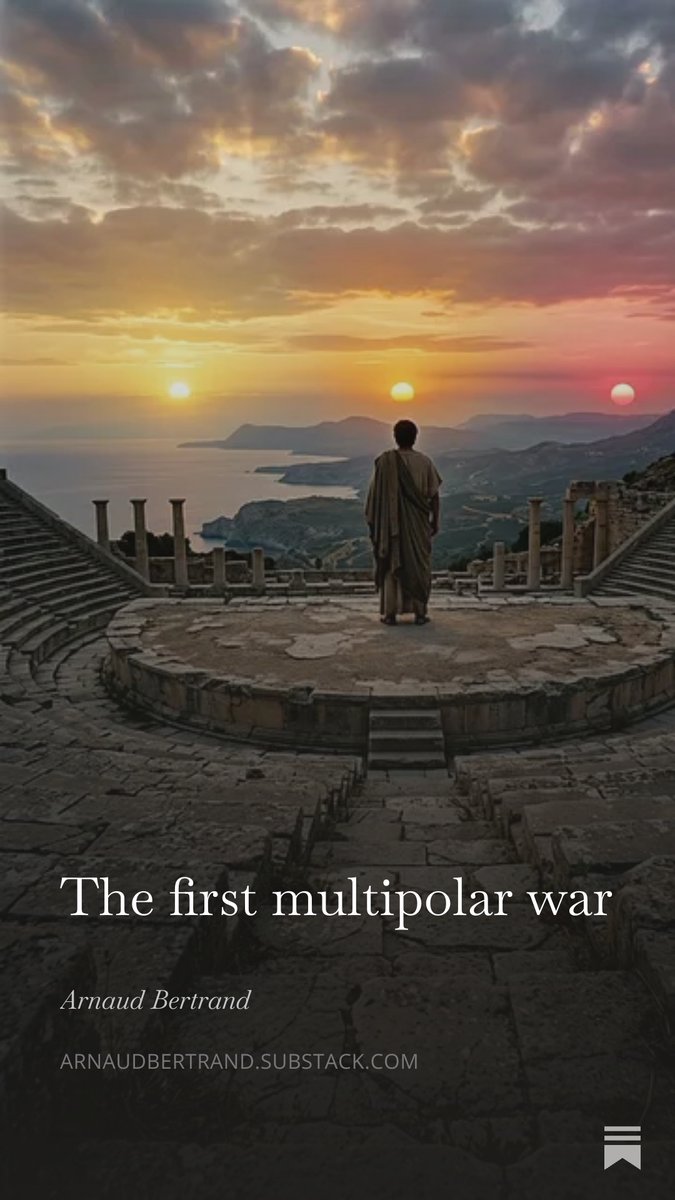
This is the topic of my latest article: how this is, in fact, the first genuine "multipolar war."
First, in the narrow sense: because Iran is revealing itself to be a genuine pole of power - not a superpower, but an actor that cannot be submitted, which is all multipolarity is.
And second, because the war itself is accelerating multipolarity everywhere else: the U.S. has never been more isolated, never looked weaker and its security guarantees have never been more hollow.
In my article I lay out the full scoreboard - military, economic, political - and explain why this war has already changed the world, regardless of how it ends.
Enjoy the read here: open.substack.com/pub/arnaudbert…
English

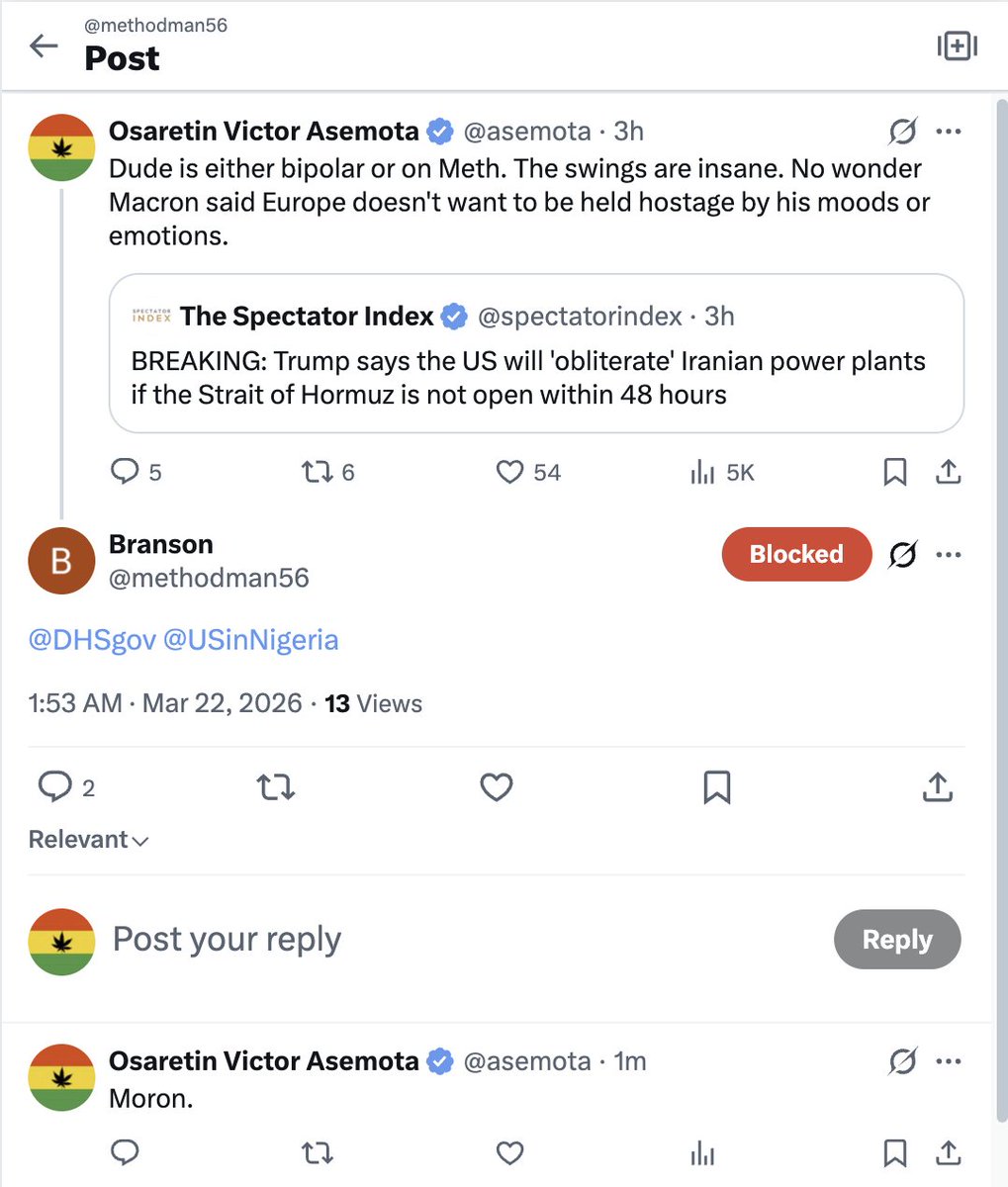
I blocked this fool. Many Nigerian Trumpists have a mental problem.
English
@kennybadex Welcome to the world of hapless American owners. Y’all had it good with Roman
English


@badex Not going to hold my breath. People don’t even read their own emails.
English
You can’t spin war. Didn’t work in ‘nam. Sure as hell not working now. People who don’t remember history are doomed to what?
English
Like many west Africans with the Self awareness of a potato
Devin Nunes' Cattle Dog 🇺🇦 🇪🇺🇺🇸🇨🇦@Kaos_Vs_Control
Pete Hegseth: The problem with Iran is it spends money on weapons and missiles instead of improving life for their people. Self awareness of a potato
English

@james_acton32 This kind of thinking perplexes me. Is there nothing else an Iranian govt can focus on other than nuclear weapons? How about electricity provision and rebuilding their economy? The imagination deficit here may be your own
English

Unless we get lucky and a pro-U.S. government forms (here's hoping!), the new Iranian regime seems pretty likely to draw two conclusions.
1. Get nukes ASAP. Kim Jong-un has them and is thriving. Saddam, Gaddafi, and Khamenei don't and they aren't doing so well.
(1/2)
English

The cost of building 10 Dangote refineries !!!!
10 of the largest single train refineries in the world.
Let that sink in..
$200B to fix small dick energy..
Disclose.tv@disclosetv
NOW - Hegseth confirms the Pentagon is seeking about $200,000,000,000 billion for the Iran War: "It takes money to kill bad guys."
English
badex retweetledi

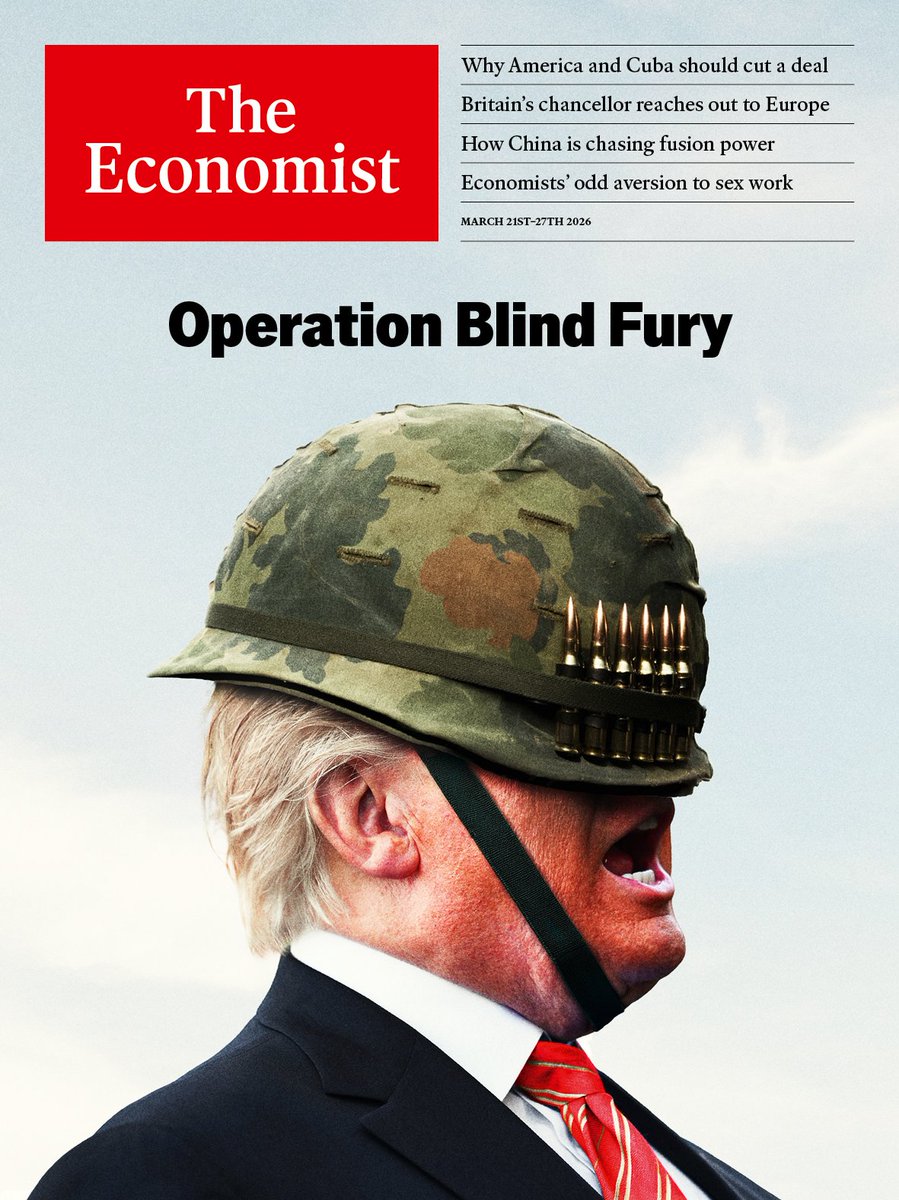
The reckless campaign against Iran will weaken America’s president. That will make him angry. Be warned: he makes a very bad loser econ.st/4lA7lEQ
English