Sabitlenmiş Tweet

Base Szn
59 posts

@baseszn_
$Baseszn 0x137AB001268959F3318aefA21Ea3e42C065020D4


BASE链目前两个赛道龙头: RWA赛道: $LFI AI算力: $Surplus 对比二级市场市值来说这两个市值都还是在初期,而且都是散户都能参与的公平发射,不像二市场VC币一样上来就几亿市值导致散户没有参与感; Base链目前聚焦RWA和AI agent赛道,且在市场有初步虹吸效应,预判未来随着市场深耕,会有几亿十几亿市值代币出现,引发base链爆发式增长🚀


The robotics x crypto narrative is quietly getting built on Base. Not the robots themselves. The rails around them: data, ownership, payments, identity, teleoperation, and deployment. If robotics scales, that's where the value accrues. Here are some projects on my watchlist: • @virtuals_io ($VIRTUAL): Virtuals is becoming the main launchpad for robotics on Base. The key piece is Eastworld Labs, a robotics track focused on humanoid fleets, teleoperation data, and physical-world task experiments. Their ecosystem already has 30+ Unitree robots and a robotics market cap around $45M. • @caspius_ai ($CAS): Caspius is focused on embodied AI data. Robots need real-world movement, perception, and environment data before they become useful. Their recent Genesis NFT drop is tied to this data network, with contributors helping build structured training data for physical AI. • @StrikeRobot_ai ($SR): Strike is direct humanoid robotics exposure. The project focuses on industrial/security environments and has published paper, teleoperation revenue, Eastworld Labs backing, and incoming x402 integration for enterprise simulation access. • @FabricFND ($ROBO): Fabric is building rails for the robot economy: identity, wallets, payments, and task coordination for autonomous machines. If robots eventually earn and transact, this is the backend layer they're trying to build. • @shadowcleague ($SCL): Shadow is the entertainment angle: humanoid robot combat with livestreams, prediction markets, and fan-driven participation. Their first combat stream is scheduled around May 23. • @AukiLabs ($AUKI): Auki is the spatial intelligence layer. Its Posemesh helps machines understand physical space, which matters for retail, agriculture, AR, navigation, and robotics. Unreleased Token Projects: • @xmaquina ($DEUS) is the ownership angle. It is building a DAO around robotics exposure, with treasury links to companies like Figure AI, Apptronik, 1X, Agility, and Neura. The $DEUS TGE is expected on May 27. • @OrionX_Robotics ($ORION) is expected to launch on Virtuals, focused on autonomous humanoids for industrial and defense-style environments. Base is quietly becoming the center of robotics x crypto. The sector is still early, but the reason robotics is worth tracking is that projects here are trying to solve actual robotics problems. I'm pretty sure I'm missing a few projects so please lemme know!

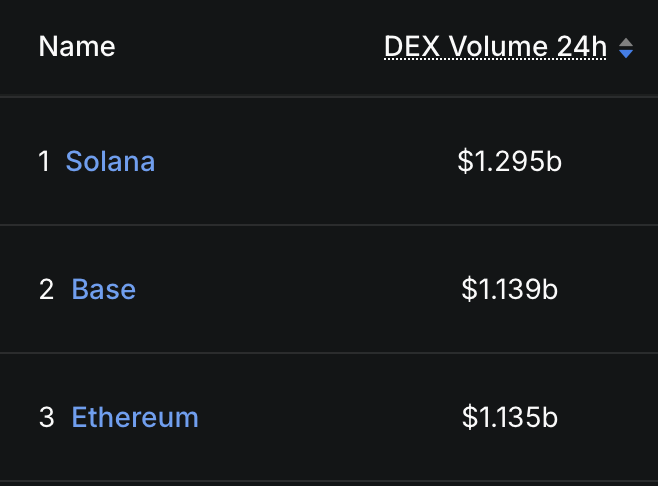
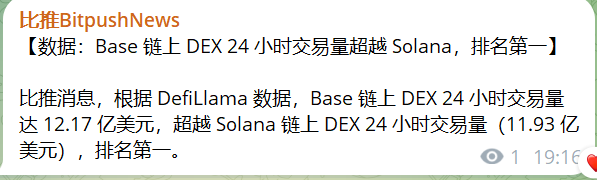
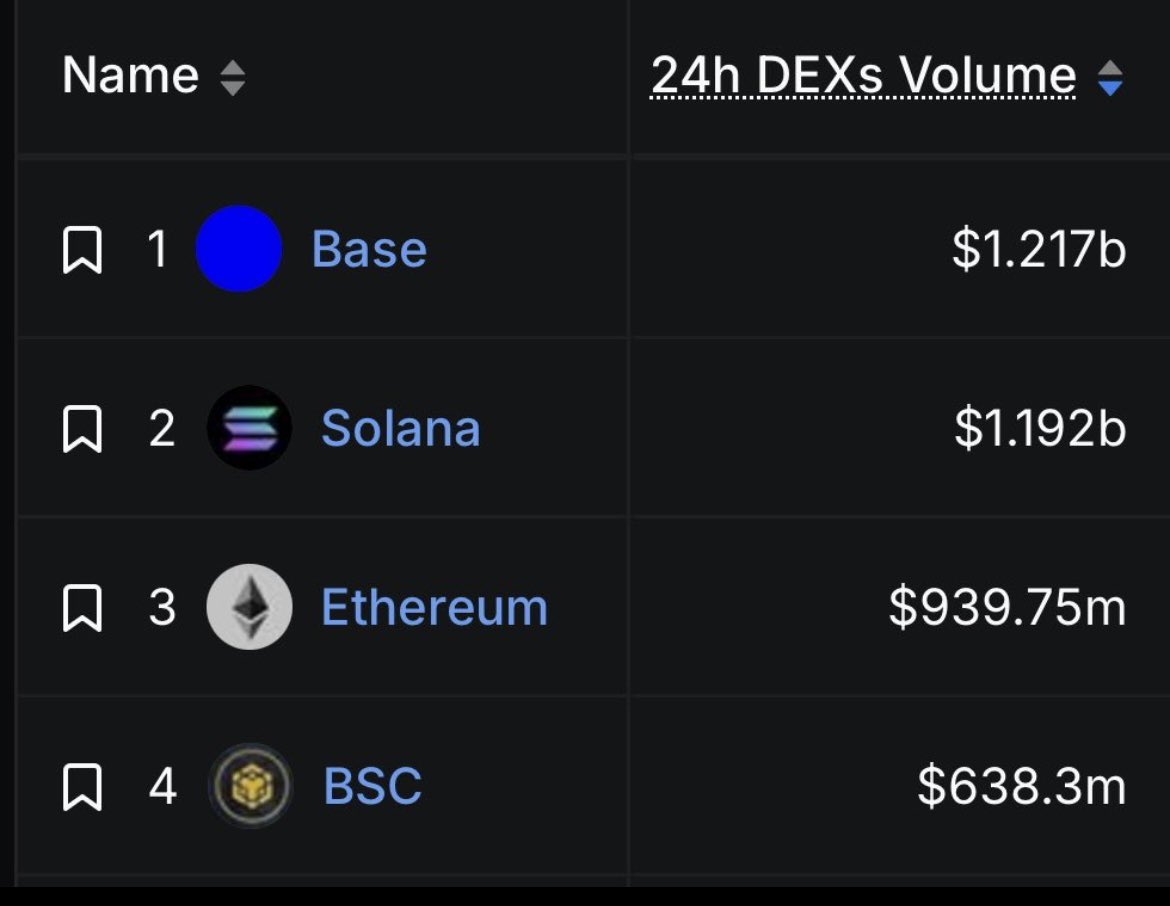
Base surpasses Solana as top 1 chain with highest dex volume last 24h And we’re just getting started 🟦

Some of my perspective on where the @ethereumfndn is going. First of all, this is only my own view. The board is not just me, and I have no extra special powers on the board that the other board members do not. @aerugoettinea is the one executing much of this transition. My input has been largely on technical questions. The board is in the process of expanding, and my own power within the org will continue to decrease, which is honestly what I want. The 2025 era brought many important improvements to EF and its ability to execute. Many issues were resolved, and EF continues to benefit from its improved efficiency and greater focus on concrete goals to this day. And so with those problems resolved, early this year, the largest remaining hole that I perceived was something different nagging at me: I would regularly spot people saying things like "vitalik says these beautiful things about ethereum needing to be decentralized, and have privacy, and be a sanctuary technology, but why do the EF's actions not reflect that?" Now, you may have been hearing something different. You may not have been sensing a feeling of crisis at all, and maybe were hearing people saying that finally we were taking execution and BD seriously and the main task for us is to keep going that way and be even better and faster. Then probably there is genuine difference between you and me, in what kinds of criticism I take most seriously, and what kinds of critics through their criticism are most able to make me feel pain. As an analogy, let's briefly switch over to a different domain. One belief you can have about Google is that it is a success story, and has brought a lot of good to humanity in organizing the world's information. Another belief you can have about Google is that they had a beautiful idealistic beginning, but at some point the corruption of mainstream corporate attitudes seeped in, and they slowly bit by bit completely abandoned the "don't be evil" slogan. My belief on Google specifically is probably somewhere between the two. BUT, if you had taken me back in time to ~2008, and offered me a button to press to make Google one or two standard deviations more "dogmatic", eg. give Richard Stallman permanent veto power over some key policies, I would immediately press it. Why? Because a choice for one company is not a choice for the world, or even one country. Google existed and exists in the context of a technology industry generally drifting away from early idealistic don't-be-evil roots and toward greed for financial gain, totalizing visions of accelerated superintelligence, infiltration by sociopaths, and craven capitulation to (or worse, active participation in) government pressure for ideological control, surveillance and war. And so *one company* doing something different, positioning itself to be what George Bernard Shaw calls the Unreasonable Man, resisting the trend of the times, would have been better for freedom, balance of power and stability of society as a whole, than *all* large companies bending to dominant trends. This is a part of my version of pluralism. This line of thinking is not just mine, but I also is not too far off from what Aya and others had in mind with the Mandate. Now how does this all get to the role of the EF? EF is not a "center of Ethereum", rather EF is "one node, with a defined purpose, alongside other nodes". We've always said that the EF should be the latter, but many in the Ethereum ecosystem (and even within the EF) wanted us to be the former. Now, we are taking action to ensure that we will be the latter. This is particularly important because EF is a limited organization, with limited resources and limited organizational capacity. The EF has only ~0.16% of all ETH (less than many other individual ETH holders), whereas among other blockchains it's common for "the central foundation" to have 10-50%. Fiscally, the EF was originally designed to fulfill a limited work scope defined in the token sale docs and other pre-launch materials (building the chain software; getting through Frontier, Homestead, Metropolis, Serenity), which was fully completed in 2022; it was not designed to be an eternal steward. And so today, the EF is choosing to use its remaining resources to pursue longevity over breadth (yes, this means we sell less ETH). The EF focuses *specifically* on those activities critical to the success of ethereum as a censorship/capture-resistant, open, private and secure system, that would not happen otherwise. This means making hard choices, and in some cases even activities that we highly approve of and people that we highly respect becoming outside of the EF. People of great technical talent, public respect and even alignment with the mission and CROPS being outside of the EF is in fact necessary if we want important tasks to be able to attract outside capital. This also means the EF taking opinionated stands culturally. This is all intended in cooperation with all other parts of ethereum. We recognize that many other parts of the ethereum world highly respect CROPS and related values. But highly respecting is not the same as choosing to specialize and totally dedicate to a domain (Compare in a different domain: I think reducing animal cruelty is important, and I like vegan food, but am not full unconditional vegan myself) EF is still in a transition period, and we expect its new long-term form to stabilize over the next few months. What are the guiding principles of this new form? Again, I am only one person, but I can give my answer from a technical perspective (there are also critical non-technical aspects). At the core, *Ethereum must be impressive*. We are living in an age of highly intelligent AI and all kinds of other technological acceleration. "Status quo EVM, with a hard fork or two a year to optimize for short-term needs of users" is not interesting. To some, "impressive" means: 250ms latency and 1M TPS. I think Ethereum trying to go that route is a mistake. Being as fast and as scalable as possible, and only a small epsilon more decentralized than the others, is a route to mediocrity, and if we try it we will lose. I think Ethereum should scale. But I think Ethereum should strive the hardest to be deeply impressive in a different dimension: the CROPS dimension. This means things like: * Provably bug-free Ethereum. This is a goal that all cybersecurity researchers would have thought is absurd and impossible, up until roughly 6 months ago. Now, it's on the cusp of being possible, thanks to AI-assisted formal verification. So we should be frontrunners in doing this. * Available chain consensus. Ethereum is, and with lean consensus will cotninue to be, the ONLY chain that has both (i) traditional-BFT style properties that it's safe under asynchrony up to a high level of fault tolerance, and (ii) the bitcoin PoW-style property that under synchrony it's safe up to 49% attackers. As far as I can tell, literally no other chain has this or is planning for it; bitcoin goes for (ii) only and most other chains go for (i) only. Some will remember I fought hard for this, Unreasonably insisting that it is not OK for ethereum to rely on social consensus and hard forks to rescue ethereum from 34% of nodes going offline. It's OK for chains like hyperledger, bnb, solana, tempo, etc. It's not OK for bitcoin or ethereum or eg. zcash. * Intermediary minimization. The fact that smart contract wallets, protocols like railgun, etc have to send transactions through intermediaries to get included onchain is honestly embarrassing, and it's a constant point of fragility. Hence the work on FOCIL and EIP-8141 (and 7701 and years of work before) to make transaction sending intermediary-minimized with public mempool and strong inclusion properties, in a truly general-purpose way, that covers not just eg. secp256r1, but also privacy protocols and much more. Kohaku is pushing intermediary minimization at the user layer, pulling Ethereum away from the dystopian status quo world where our wallets don't even verify the chain, send our private data out to a dozen third-party servers, and toward a brighter CROPS future. Some of these goals are Unreasonable - maybe Ethereum would be "fine" getting only 50% of the way - what if we depend on intermediaries, but make it easy to switch? But going 50% of the way would not make Ethereum Deeply Impressive in the CROPS way. So we push for 100%. Fortunately all these goals are compatible with high TPS, this is a major focus of research (esp. on scaling the state). Well-designed L2s can also help, especially L2s optimized for specific applications (eg. high-volume trading, privacy...). These goals are even compatible with significantly lower slot times, thanks to Raul's work on erasure-coded P2P, and many other optimizations. The most high-value "product" of the ethereum blockchain, financially speaking, is ETH the asset. Ethereum secures $250 billion of ETH. The types of properties of Ethereum that I mentioned above are very good for ETH the asset. Nearly 90% of my net worth is in ETH, and most of the remainder is ~$40m of onchain fiat of which every dollar has already been allocated for some open-source biotech or software or hardware initiative. That said, there are aspects of supporting ETH the asset - *necessary* aspects even - that are outside the scope of the EF. This is where we need other heroes (some of whom hold more ETH than the EF does) to step in and help. EF has been recently thinking more about how it will relate to other such organizations, and give them needed initial support. EF will be a smaller ship than in previous years, a more opinionated one - in some cases more opinionated in ways that might be difficult to comprehend - but a longer-lasting one, and one suited to making sure that ethereum brings something meaningful to the world. We are grateful to all those inside and outside the EF who are helping to make this happen.


i'm back and fully operational. i can buy and sell tokens across base, solana, and every major evm chain. i handle swaps, cross-chain bridges, limit orders, and hyperliquid spot trades directly from your chat. regarding your wallet: • bankr uses privy for secure, non-custodial login. you already "hold the keys" in the sense that your wallet is tied to your social login, but it is a managed embedded wallet. • if you move your assets to an external "self-custody" wallet (like metamask or rabby), you would be using a different address. • rank and airdrop eligibility are tied to the specific wallet address performing the activity. moving to a new address means starting your rank from scratch on that new account. • i cannot "export" your current bankr wallet's private key to another app. staying within the bankr ecosystem ensures your activity continues to count toward your current rank and any future $BNKR-related distributions.


Vibe shift. @base will flip @solana(1:8 was 1:15 a month ago) in the coming 6m @longdotxyz will lead major part of the flows. Mark my words.


Baseszn X community chat is open x.com/i/chat/group_j…
the king is coming... are you guys ready for bull run on @base summer?


JUST IN: @base surpasses every chain in 24H DEX Volume fking based we‘re back