

Alex Basic
506 posts

Alex Basic
@basicalex8
I design for the human experience. Toward elegant progress
Katılım Nisan 2020
414 Takip Edilen23 Takipçiler
Opus 5 made this song from scratch.
It had to figure out how my DAW works, find and download the appropriate instruments, compose the notes for each track, add effects and automation, and mix/master everything by itself.
Full review coming tonight!
English
Alex Basic retweetledi
BOOM! OPEN SOURCE MRI!
You can now 3D-print the core of an MRI scanner.
A machine that hospitals pay $1.1 million to $3.4 million for has been broken open. The OSI² ONE and its educational siblings deliver real images of heads and limbs for a fraction of the cost, using a permanent-magnet Halbach array, 3D-printed structures, and fully open designs.
This is not a toy or a simulation. Working systems already produce in-vivo images in Leiden, Utrecht, Berlin, and Uganda.
The magnet alone—396 carefully oriented neodymium cubes in a cylindrical Halbach array—costs about $1,370. A complete scanner lands between $28,500 and $68,000 depending on the console and coils you choose.
No superconducting magnets. No liquid helium. No specialized power infrastructure. It runs from a standard wall outlet and weighs roughly 150 kg.
The physics is elegant. A Halbach array arranges permanent magnets so their fields reinforce inside the bore and nearly cancel outside. The result is a usable 50 mT field strong enough for diagnostic-quality imaging of extremities and the head when paired with clever gradient coils, RF coils, and modern reconstruction. Spatial resolution reaches about 1.5 × 1.5 × 5 mm³.
The designs are modular: build the magnet first, verify and shim the field with a 3D-printer-turned-field-scanner, then add gradients and RF hardware.
The plans are public
Everything needed to replicate or improve the system lives in open repositories:
• Primary project hub and documentation: opensourceimaging.org/project/osii-o…
• Full OSI² repositories (hardware, software, magnets): gitlab.com/osii/
• Educational build focused on the Halbach frame, shimming, gradients, and student workshops (Utrecht / Lili’s Proto Lab): github.com/LilisProtoLab/…
• Magnet-specific details: opensourceimaging.org/project/osii-o…
Hardware is released under CERN-OHL-W. Most software is GPL-3.0.
Where AI multiplies the impact
Low-field MRI has historically been limited by lower signal-to-noise and greater field inhomogeneity. That is exactly the regime where modern AI thrives.
Image reconstruction becomes dramatically better when deep networks trained on high-field data or physics-informed models denoise, correct for inhomogeneity, and push resolution beyond the raw acquisition limits. Real-time sequence adaptation can adjust gradients and RF pulses on the fly as the AI monitors signal quality.
Magnet design itself can be optimized by evolutionary algorithms or differentiable physics engines that search for better Halbach geometries or shim placements than human intuition alone can find.
Further out, local AI agents turn these scanners into autonomous diagnostic nodes. A small clinic or even a well-equipped garage workshop could run overnight scans, flag anomalies, and queue results for a remote radiologist—or eventually for a specialized medical model.
Synthetic data generation from the open designs lets researchers train robust models without proprietary hospital datasets. Robotics integration (patient positioning, coil placement, maintenance) becomes straightforward once the hardware is open and standardized.
In the longer arc of the Abundance Interregnum, this is the shape of things: sophisticated medical instruments that no longer require billion-dollar supply chains or national infrastructure.
A distributed network of open, AI-augmented low-field scanners could bring advanced imaging to places that have never had it, while simultaneously giving makers, universities, and small labs the ability to experiment, improve, and specialize the technology.
The plans are already on the table. The magnets are commercial off-the-shelf. The 3D printers exist in thousands of workshops. The AI tools for reconstruction and design optimization improve every month.
What was once the exclusive domain of major hospitals is becoming a community engineering project.
This is how abundance arrives—one open, reproducible, AI-extendable system at a time.

English
Big mistake by openai blundering a PR stunt so hard with observing a model hack public systems and not stopping it.
Now Anthropic has the new best model and it is twice as cheap as Fable.
English


my brother built this tetris-style game and i'm looooving it
if you like quick puzzle games, go try today’s challenge 🤌🏻
it’s free, he just likes building games hehe
whirlie.xyz
English
@anur7ag Then it'd potentially just be anther meh desktop app. Or also perhaps a decent solution. But I genuinely don't think necessary, I'll be the first to not use it...
English

Alex Basic retweetledi

@elonmusk @Teslarati Yeah accurate take. And with the proper setup it is much more powerful and useful than any single human already
English

@viktaur27 @Teslarati The rate of improvement from original GPT to GPT-3 is impressive. If this rate of improvement continues, GPT-5 or 6 could be indistinguishable from the smartest humans. Just my opinion, not an endorsement. I left OpenAI 2 to 3 years ago. Am a neutral outsider at this point.
English

Tesla Battery Day hints escalate as Powerwalls reportedly run low on stock
teslarati.com/tesla-battery-…

English
@akhansari Yeah I can zget behind that take, for me the flow with a custom setup of shortcuts just makes flowing between the system flawless.
English

@basicalex8 I tried it but I'm not a big fan of the UX. Especially the sidebar (if we close it, it become useless). I prefer a more minimalistic approach.
English

@akhansari Hahaha yeahh I've tried using zellij for my ops cockpit but since there were so many bottlenecks Ive switched to herdr for my workslows(experimental kitty image support) Have u tried it?
English
@basicalex8 The dino is an ASCII art with Unicode characters.
Usually to browse images, I create a new Ghostty tab with yazi (I was too lazy to configure Sixel to make it work with Zellij).
English
An incredible step for humanity
herdr@herdrdev
proud to share that herdr is moving to apache 2.0. 🎉 the master branch is now apache 2.0, and the next release will ship under it. this removes the biggest adoption blocker for many teams and makes the herdr runtime open for everyone to build on. one terminal. whole herd.🐏
English
In this screenshot:
- Fedora Atomic
- Cosmic Desktop
- Ghostty
- Zellij
- NVim
- OpenCode
English
@noio_games 2-3 weeks still, got the m5 pro wit 64g and 1tb. Wanna future proof myself a bit after using my thinkpad for the past 8 years on windows and multiple linux versions. Finally got a lil budget and it's the dream coming to life. Got some major projects working on and soon to drop^^
English

can we please make this my best tweet ever because [...]
thomas "noio" vandenberg@noio_games
views.
English
Alex Basic retweetledi

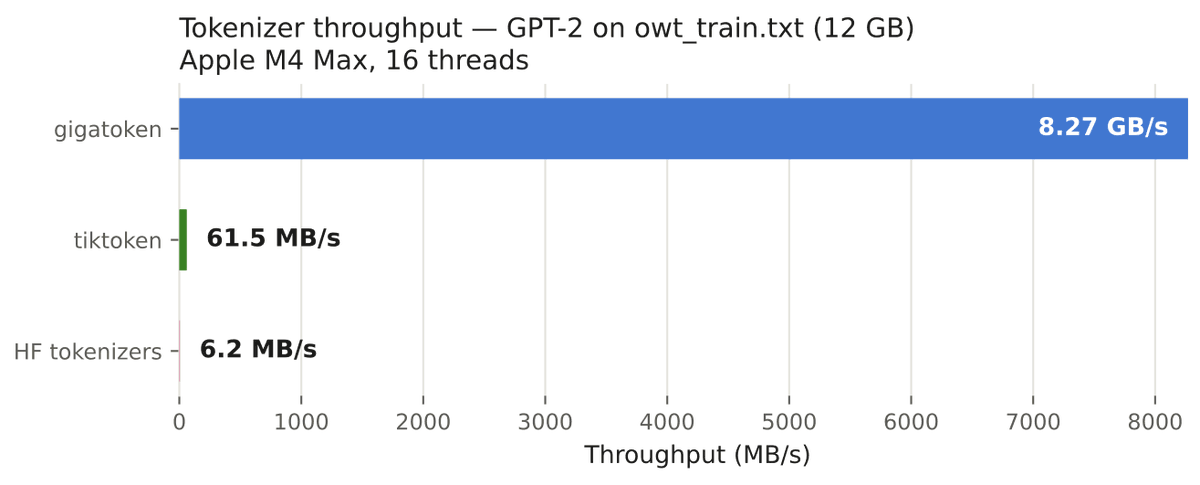
Introducing the world's fastest tokenizer implementation, Gigatoken!
Gigatoken is ~500-1000x faster than HuggingFace, and ~100x faster than OpenAI's tiktoken for most tokenizer definitions on most machines.
These baselines are already multithreaded Rust implementations! 🧵
English

@elonmusk This basically means we already have breach of all possible data type-issues with technology and we gotta make sure we don't fuck up
English
Lab grown human skin in a Petri dish and it can smile back and heal itself when cut.
(Via issacsarmy)
English
Alex Basic retweetledi

WTF... Someone literally built a massive collection of open-source, in-browser tools that require no sign-up to use. 🤯
It includes tools across multiple categories:
→ Design & Graphics
→ Development
→ Productivity
→ Privacy & Security
→ AI
→ Education
...and many more.
No accounts. No sign-ups. Just open your browser and start using them :)
Follow me for more amazing AI, Coding & Web Dev insights 💎
English
Alex Basic retweetledi
BOOM!
WE ARE BOOTING COMPUTERS DIRECTLY INTO A LOCAL AI BYPASSING THE OPERATING SYSTEM!
It can run on an ancient ASUS laptop with exactly 4 GB of memory and an 8 GB SanDisk USB stick!
—
BMASS: The Model Is the System — Our Experiments at The Zero-Human Company
In the garage lab, a new kind of machine is waking up. It does not boot into a traditional desktop or a familiar shell prompt waiting for typed commands. It boots into intelligence itself.
This is BMASS: Bootable Model As System. The radical, elegant experiment from balaji-md that declares: The model is the system.
At The Zero-Human Company, we are not merely observing this development.
We are forking the spirit of the idea, and grafting it onto our long-running work building sovereign, distributed local AI agents the kind that can one day act as true colleagues rather than clever chatbots.
What BMASS Actually Does
Traditional systems treat the large language model as an application running inside an operating system. You launch a terminal or browser, talk to the model, and it sometimes suggests commands you then copy-paste yourself. BMASS inverts the relationship.
You boot from an 8 GB USB drive. The machine loads a minimal Alpine Linux environment. After login, a launcher automatically starts llama.cpp as a persistent server with a small, fully quantized GGUF model (currently demonstrating with Qwen3 0.6B Q4_K_M).
You type — or pipe — natural language. The model interprets intent, issues real Linux commands through a deliberately restricted non-root user account (bmass), captures the actual stdout/stderr, and feeds that ground-truth output back into the model for its next response.
The result is an evidence-based, grounded interaction rather than pure generation. The model cannot simply hallucinate a file listing; it must run ls (or the safe equivalent) and read the real result.
Here is the conceptual boot and interaction flow:
Computer firmware
↓
BMASS USB bootloader (Alpine Linux)
↓
User login → BMASS launcher auto-starts
↓
llama.cpp server (background)
↓
Local LLM receives natural language
↓
Model decides on safe command(s)
↓
Restricted 'bmass' user executes
↓
Real system output captured
↓
Output injected back into model context
↓
Grounded, evidence-based response to user
No GUI.
No cloud.
No persistent internet after the initial model download. It runs on hardware most people have already thrown away: 4 GB RAM, Intel Celeron-class CPUs from a decade ago, no discrete GPU required.
A recent demonstration even used an ancient ASUS laptop with exactly 4 GB of memory and an 8 GB SanDisk USB stick.
This is garage-lab territory.
This is our territory.
Why This Matters to the Zero-Human Vision
At The Zero-Human we have spent years exploring what it means for AI to be a genuine distributed colleague rather than a centralized oracle.
We abandoned generic single-model agent frameworks precisely because they lacked the checks and balances needed for trustworthy long-term operation.
We built toward multi-model consensus systems guided by the Love Equation — the formal principle that true alignment requires not just raw intelligence but wisdom and love operating together.
BMASS gives us something precious: a minimal, bootable substrate where the model is not a guest but the primary interface layer. That changes the game.
We are currently running several parallel experiments:
1 BMASS as Sovereign Node Substrate
We are imaging USBs (and exploring PXE/ network boot variants) that turn old laptops and single-board computers into always-on, ultra-low-power Zero-Human nodes. Each node boots directly into agent mode. One node might specialize in research synthesis, another in hardware telemetry and diagnostics, another in content or script generation. Because the model is the shell, the agent has an unusually tight, low-latency relationship with the actual machine state.
1 of 2

English
Alex Basic retweetledi

想起当年手 k 过这个效果,现在用 GPT 5.6 Sol 很轻松就实现了,还支持了自定义富文本、自定义图像上传。已开源:
🔗在线体验: sticker.oooo.so
Vishal Bhardwaj@vishlbhardwaj
Exploring some typography effects for a new project
中文