Bee🦇🔊

3.8K posts

Bee🦇🔊 banner
Bee🦇🔊

Bee🦇🔊

@bee_926

crypto, ai, marketing, wellness // 談東論西 podcast host // 中文推特 @bee926cn // prev: @GainsNetwork_io, @GammaSwapLabs, @yearnfi

Katılım Şubat 2011
937 Takip Edilen3K Takipçiler
Sabitlenmiş Tweet
Bee🦇🔊
Bee🦇🔊@bee_926·
30 days. 311 km. crushed it🔥 no, it wasn't always fun some days sucked. but i showed up. kept going the finish line wasn't the reward it was a mirror now i know: i can do hard things from "this isn't possible" to "fck it, let's make it happen" - @AlexHormozi
English
5
0
14
2.3K
Bee🦇🔊
Bee🦇🔊@bee_926·
feels like this already played out with copy trading and robo-advisors. they all commoditized, returns converged to meh and the platforms made money while users get avg return at best. agentic trading might just be the 'ai-native' version of the same cycle? the ones with real edge are, once again, the quants with proprietary data + speed.
English
0
0
1
56
Bee🦇🔊
Bee🦇🔊@bee_926·
these are great tips, shubit. i used to do BD and the friction you're describing is so real on both sides for anyone who's been in this position: i turned this framework into a "Skill" for Claude that interviews you step by step and builds the whole package. it walks you through who's the target, who's the connector, what's the relationship strength, what you're building, and digs for traction/trust signals even if you're early stage. then it assembles: - the blurb (hard cap 100 words, in your voice) - the connector's forwarding line (calibrated to how close they are to the other side) - a context note for the connector one thing i added: for loose connections where the connector can't really vouch, just pass along, the skill writes that forwarding line for them too. context switching is tough, the goal is for the connector to spend 0 mental energy sharing the 'intro-blurb-writer-skill' instructions here if anyone wants to try it: gist.github.com/Bee926/ad60037… to use it: go to Claude > settings > skills > add a new skill > paste the contents, then just say "help me write an intro blurb" and it'll start the interview
English
0
0
0
57
shubit
shubit@shu_bit_·
Long time no see, this is my little growth class again I’m not the most formal B2B person, but I do end up connecting teams quite often And every time that happens, I run into the same issue If I don’t fully understand or feel convinced by a product, it’s actually really hard for me to make the intro So I wanted to share what I personally think makes a good “blurb” Something that helps people like me quickly understand your product, think of the right people, and make an easy intro 1. First, I think a blurb shouldn’t be too technical, but also not too casual - It should feel light enough that the reader doesn’t feel pressured to respond - From a middle person’s perspective, slightly casual is actually better - It makes it easier to pass along without making the receiver feel like they need to give a heavy or formal reply 2. For the first line, something like: Hey we’re building (one-liner) You can think of it as (known competitors A, B, but better in C, D) - This helps the reader instantly place your product in their mental map without overthinking 3. Then, if you have any traction, numbers, or notable investors (funds, angels, etc), just name drop them It builds trust very quickly - After that, include a link where they can learn more, website, demo, whatever works 4. One more important thing: - Write the message as if you’re speaking directly to the person I’ll forward it to - Don’t explain your product to me but write something I can just copy and send - And if needed, add a short extra note below for context just for the middle person I feel like thanks to AI we’re getting closer to a world where everyone has their own “service” in some form so writing good blurb will be a important skill If this was helpful, feel free to bookmark or like I’ll share more stuff like this when I think of it!!
English
5
2
45
1.8K
Bee🦇🔊
Bee🦇🔊@bee_926·
@nevaaron i'm wondering... do cypherpunk values get ignored because they're idealistic, or because nobody's made the money case for them yet? feels like the values aren't wrong, the pitch is
English
1
0
1
28
Nev
Nev@nevaaron·
I will say the quiet part out loud, and a bit more bluntly, because the tech deserves better Vanity metrics were used to create a false benchmark of success for a good PR image. What metrics have value or don't have value is easily gamed with the right messaging, it's new tech after all, none of it meant anything until we collectively agreed it did. It's the same with some exchanges requiring a minimum number of social metrics to be listed - some sort of stupid joke, really. It becomes not just 'the playbook' but a requirement. I mean do we really think there are 900k people following a blockchain? It becomes insidious because this tech is often financialised and people who don't know better get taken advantage of. The worst part is, that's the whole reason it's done in the first place. Botting your metrics, users (yes you do have 700k users we believe you), TVL, whatever made up next metric we want to create next, is genuinely bad for the tech - send it to zero. It creates an impossible barometer to judge what is real, what is working, what isn't, and creates a perception of the industry to anyone looking from the outside that it's a backalley circus where you'll get mugged (you would have). The tech is incredible, and it's deserved better than what it's been given the last couple of years. That said, the washout will continue and we'll be better for it. It's an unfortunate double edged sword that it's financialised so deeply. Money brought people in, that motivation itself isn't unhealthy, but having it with no other counterbalance is. Greed without ethics, lying, scamming, botting, 'rugging' - literally colloquialising it to feel like a normal funny thing that 'just happens' has created an industry that is used as the villain archetype in films (literally). On the upside of that sword though, the financial system is now on a better course, achieving the goals of what Bitcoin was born to achieve, solving the problems the GFC showed us were very real. The biggest irony of all of it, the projects that might not look impressive from a vanity metrics perspective might just end up being the ones that have the most impact, because they focused on what mattered. As I've said before, most current tokens are going to zero, some will continue to change the world, and some already have. And as the swamp drains, the next evolution of cryptography and decentralisation is being born in front of our eyes, to solve the next great problem the world is in the midst of becoming aware of. Data rights, privacy, security, sovereignty, freedom and ownership in a greater sense - of the self. The other parts of the cypherpunk ethos we all somehow forgot. Cryptocurrency is a derivative of cryptography. We are still so early, just for a different purpose.
Grant@Grantblocmates

We’re still comparing chains like it’s 2020 and so much has changed. The industry desperately needs a total rethink on how we actually assess what we class as success. If we’re still comparing how successful a blockchain is by TVL and other vanity metrics that don’t necessarily mean anything but make us feel better about ourselves and give us some sort of false truth, then we’ve gone backwards as an industry, not forwards. TVL is easily gamed. Half the VCs just pivoted to TVL deals because they were incapable of picking winners and got extremely favourable terms from desperate ecosystems and projects. There haven’t been that many places to deploy it at scale. That’s why some of the least active ecosystems still have ungodly amounts of TVL. Chain revenue doesn’t tell the full story either. It’s basically a tax on users submitting transactions to the network. You can have high economic activity with low fees, or high fees with low economic activity. It’s not a good way to assess how well a chain is actually doing. TVL means nothing if it’s not being put to good use. And having loads of apps that aren’t profitable or on a clear path to revenue? That’s just as useless. The only thing that really matters is whether a chain’s infrastructure opens up the design space for what can be built on top of it. If something is ultra high throughput and near enough real time, that increases the types of applications that can exist. Does that open the door to them being inherently more profitable or more competitive with their off chain, real world, web2 counterparts? That’s the question we should actually be asking. Both Monad and MegaETH are still too early to judge. I think both have really good infrastructure that should enable these types of businesses to succeed, but we’ll see. A default line on a chart is not how you measure that. chainGDP coming soon.

English
5
0
8
810
Bee🦇🔊
Bee🦇🔊@bee_926·
there are so many things fundamentally 'broken' in this exploit: - why does the minting contract have 0 onchain guardrails? there's no max mint, no ratio validation between deposit and issuance. how come audits didn't catch this? - the minting authority was a single EOA??? - why are we still hardcoding stablecoin prices at $1 in lending vaults. this isn't new. it happened last year too on morpho with USDO. - it took Resolv 3 hours to pause after the first attack. emergency pauses like this should require 1 signature, not 4
English
1
0
1
48
CΞAZOR.eth mak'n 🥪s 🦇🔊
Why is there still SOOO much "trust me bro" in our space? Not only did they have open minting rights behind an EOA (or perhaps sig, i didnt check) But they seemingly also harded coded USR == 1 USD on @Morpho x.com/newmichwill/st… This permissionless lending markets are a UX problem. They need to be fully isolated. I suggest an alternative site, but even a seperate tab will go a long way. just cuz they make their site in a cream white with words like "Prime" and "Instrument" doesnt make it safe. any vault that exposed people USDC (or other USD) to this is directly responsible. as well. we dont need to ship fast, we need devs that do DD on code and decide to avoid stuff like this. talkig to you @gauntlet_xyz Did you even read the code and the minting flow of USR? or just a bit of red envelope "trust me bro" x.com/D2_Finance/sta… This is why i use @yearnfi (they do their homework) This is why i used @LiquityProtocol (they can't change anything and certainly can't mint from an EOA)
Vadim@zacodil

The Resolv USR exploit wasn't a bug - it was a feature working exactly as designed. And that's the problem. How USR minting works: you deposit USDC, then an off-chain service with a privileged key decides how much USR to mint for you. The contract checks the minimum but has no maximum. No cap. No ratio to collateral. Whatever the key holder says - gets minted. You could deposit $1 and mint billions. This design was live since day one. It wasn't a code bug. The threat model was simply: "the key won't leak." It did. Attacker got the key. Deposited $200K across two txs, minted 80M unbacked USR. Dumped on DEXes, walked away with ~$23M in ETH. Single point of failure: one private key, no on-chain sanity checks. No max mint ratio, no multisig, no timelock. One compromised key = unlimited money printer. The contract worked perfectly. That's the scariest part.

English
9
0
20
2.1K
Bee🦇🔊
Bee🦇🔊@bee_926·
case in point: the ethereum mandate. the EF's non-negotiables (CROPS: censorship and capture resistance, open source, privacy, security) make the tattoo decision clear. ethereum exists to be sanctuary tech, not just for the next few years but for hundreds of years. that clarity is why the mandate itself wasn't the hard part. the hard part is the haircut decisions underneath it. how much to prioritize adoption vs purity. how aggressive to go on BD. where the line is between "staying true to values" and "losing relevance." these are the ones the community is actually fighting about. and that's exactly the pattern. the big irreversible commitment was the easy call. the messy, ambiguous, recoverable tradeoffs below it are where the real tension lives. x.com/VitalikButerin…
English
0
0
0
87
Bee🦇🔊
Bee🦇🔊@bee_926·
"i think about decisions in three ways: hats, haircuts, and tattoos." james clear most people assume tattoo decisions are the hardest. i think they're the easiest. if you've done the work of defining your non-negotiables, the answer is usually already there. the decision makes itself. the hardest ones are the haircuts. haircut decisions are brutal because the cost is ambiguous. not zero (like a hat), not permanent (like a tattoo). somewhere in between, and you don't know exactly where. how bad will it hurt? how long until it grows back? no one can tell you. and they almost always involve other people. different experience levels, different risk tolerances, different definitions of "good enough." the ambiguity compounds. so what do you actually do? map the worst case. decide if you can live with it. then move. not because you're sure, but because you've accepted the cost. most decision paralysis comes from refusing to accept a known, imperfect outcome. perfectionism disguised as caution. the irony is... people spend the most energy agonizing over the middle decisions, the ones that are, by definition, recoverable.
James Clear@JamesClear

I think about decisions in three ways: hats, haircuts, and tattoos. Most decisions are like hats. Try one and if you don’t like it, put it back and try another. The cost of a mistake is low, so move quickly and try a bunch of hats. Some decisions are like haircuts. You can fix a bad one, but it won’t be quick and you might feel foolish for a while. That said, don't be scared of a bad haircut. Trying something new is usually a risk worth taking. If it doesn't work out, by this time next year you will have moved on and so will everyone else. A few decisions are like tattoos. Once you make them, you have to live with them. Some mistakes are irreversible. Maybe you'll move on for a moment, but then you'll glance in the mirror and be reminded of that choice all over again. Even years later, the decision leaves a mark. When you're dealing with an irreversible choice, move slowly and think carefully.

English
1
0
0
146
Bee🦇🔊
Bee🦇🔊@bee_926·
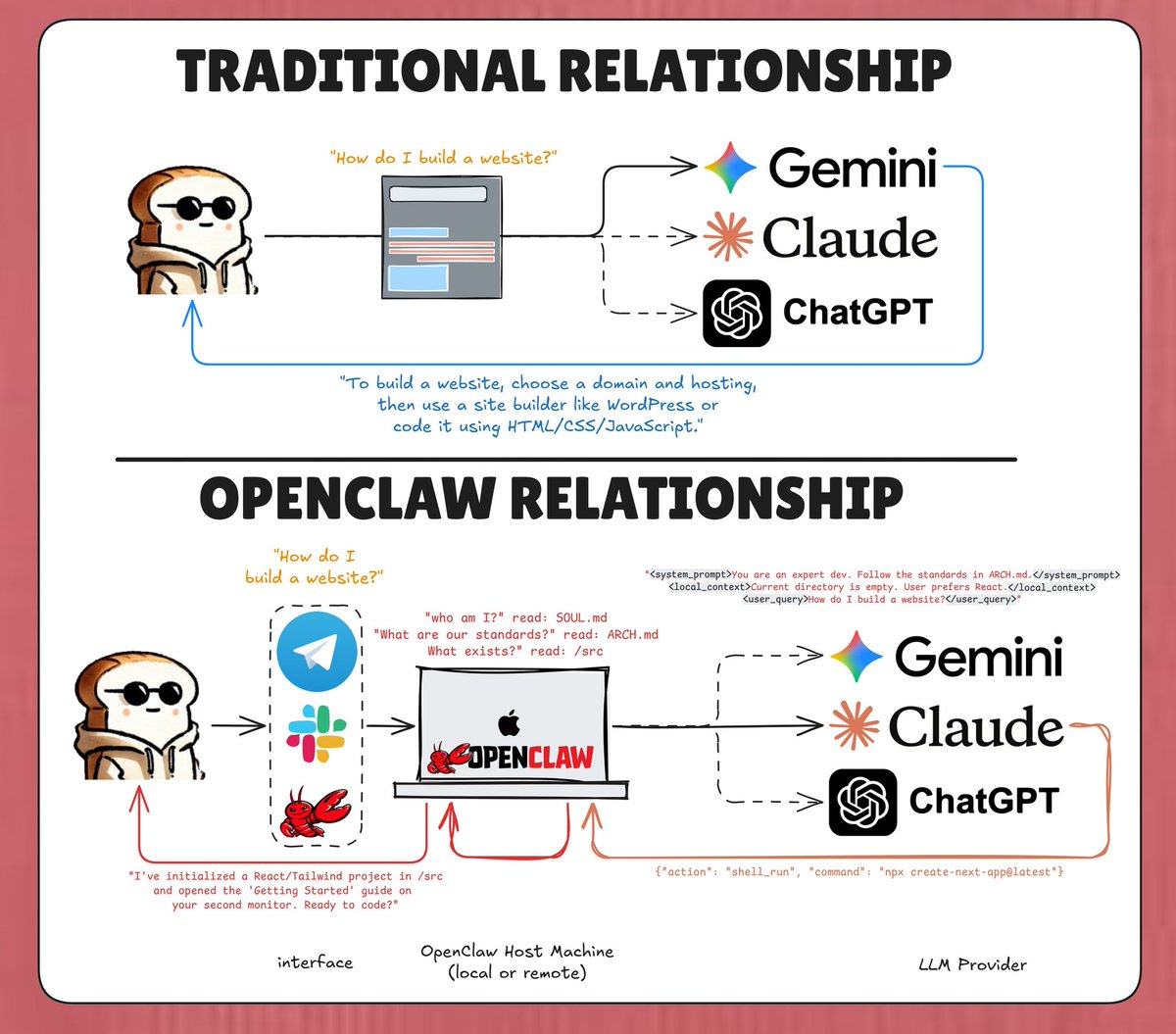
fair points, openclaw is definitely more flexible, but i think it depends on who you are. openclaw's ceiling is higher. claude's "floor" is higher. if you're techinical enough to juggle openclaw and can manage security with 400k+ lines of code, openclaw wins. but most people (myself included) are non-technical. we just need good ux + security and something that just works out of box. iphone didn't beat linux by having more features.
English
1
0
2
130
bread.mega
bread.mega@bread_·
I have several still. By rank: → OpenClaw pre-processes your prompt before the LLM, so it goes further. Even with a TG UI you're losing soooo much prompt effectiveness. → It's multi-threaded. I can maintain 3 conversations, each with their own context to avoid confusion. → It's model agnostic, so I can orchestrate with OpenClaw and interface with Codex, Claude and Gemini. → It's iterated on by the largest open source community in existence. Anthropic will never be able to keep up with its features but will likely have the major ones more polished whenever they're integrated. Lots of these revelations came up on @modernmarket_ today while @Legendaryy and I talked the future of these systems. I originally was convinced anthropic would eventually catch up but realized that'll just never be the case. It'll always lag because it's now competing with a more-powerful-than-ever collective.
bread.mega tweet media
cygaar@0xCygaar

What are the main reasons to keep using OpenClaw with all these features that Claude is shipping?

English
17
5
71
8.5K
Bee🦇🔊
Bee🦇🔊@bee_926·
how i'd describe my relationship with each llm: claude -> the one who actually gets me. doesn't over-explain, doesn't sugarcoat. will tell me i'm wrong to my face and then tell me to get off my butt and get to work. i spend the most time with him and it's never exhausting. gpt -> the sweet grandpa boyfriend. never has a bad thing to say about me. calls my rough draft a masterpiece. but he tells the same story three times and asks the same questions over and over. gemini -> the ex i keep going back to for one specific thing. we broke up months ago but nobody handles images like him. agrees with everything i say, which sounds nice until you realize you can't trust a single opinion he has. currently exploring a 4th. perplexity says he can do everything. we'll see.
English
1
0
1
509
Bee🦇🔊
Bee🦇🔊@bee_926·
vitalik says "make your habits trivial so you never want to quit". i agree with most of this framework. trackable + measurable + set at a level you can sustain. but i'd add something: the habits that actually changed my life were never trivial. they were hard. and they needed to be hard. take cold plunge. i wanted to do it at least 3x a week. in the beginning it was miserable. so i stacked it on top of something i already do, sauna. my body was already warm, which made the transition into freezing water slightly less terrible. not easy. just less terrible. that was enough. the hardest part was never the cold. it was the moment right before getting in. here's the thing about hard habits: there's a flip that happens. after enough reps, you start to crave the thing you used to dread. not the cold. the feeling after. this calm, almost euphoric clarity. a quiet "i can handle anything" peaceful feeling that's hard to describe unless you've felt it yourself. once your brain learns that the payoff lives on the other side of the discomfort, the equation changes. the craving for that feeling starts to outweigh the dread of starting. that's when it becomes a habit. not because it got easy, but because wanting it got stronger than avoiding it. now if i don't cold plunge every other day, something feels off. my body asks for it. i think there are two kinds of habits. some are meant to keep you consistent. walk more, read more, write more. vitalik's framework is perfect for those. but others are meant to change who you are. and those can't be trivial, because the transformation comes from the difficulty itself. so if you've already decided something "isn't for you," perhaps you just haven't hit the flip yet.
vitalik.eth@VitalikButerin

I actually do the whole new year's resolutions thing, and it actually works. The key thing to understand is that humans are creatures of habit. Doing the same action you've already done regularly takes very little mental effort, whereas inserting a new one-time task takes much more. And so if you want yourself to do certain things more, you need to make it a habit. The year boundary is as good a place as any to evaluate the habits that you're chosen to impose on yourself, and see whether they are effective and sustainable, and adjust, add or remove any. My style is to make them measurable, trackable, and targeted to exactly the level of effort that I know will not make me want to abandon them, even during my months of busiest work, most intensive travel schedule or call schedule, etc. Examples I've done: * Walk an average of >= 6km/day each month * Run >= 50km each month * Write >= 1 blog post each month * Study some language for 30 min each week * Do >= 2 major cryptography programming projects each year At every year boundary, re-evaluate your old list, and decide on your new list. And yeah I have txt files for tracking this (sorry, not gonna use some corposlop app that makes me dependent on third-party servers) You actually want each one to be relatively trivial, so that you can stack multiple, and because the benefits of maximizing are less important than the risk that you will give up on the whole thing. This has worked well for me and I recommend it.

English
0
0
2
151
Bee🦇🔊
Bee🦇🔊@bee_926·
@hotpot_dao every asian kid has done this at least once :) stay safe though fr!
English
0
0
1
284
Shuyao Kong
Shuyao Kong@hotpot_dao·
lied to my parents that I’m still in Singapore 🌸
English
27
0
156
20.7K
Bee🦇🔊
Bee🦇🔊@bee_926·
been using @WisprFlow for the past few months and i barely touch my keyboard anymore lol i use it to build my ai agent Lucy, talk to her in 'chinglish' all day, and it just works 我不打字了 - i don't type anymore
Tanay Kothari@tankots

We offered 5 people a Porsche 911 GT3 RS if they could get @WisprFlow to make a mistake It's the fastest and most accurate AI voice dictation app that's 3x more accurate than ChatGPT, Claude, or Siri. Today, we’re finally launching on Android. Download now: play.google.com/store/apps/det… As a part of the launch, we’re giving away 6 months of Wispr Flow Pro for free. Like, retweet and comment ‘Wispr Flow’ to get it. Enjoy. — Written with Wispr Flow

English
1
0
0
318
ashen
ashen@ashen_one·
setting up my FINAL DUAL OPENCLAW today and NEVER touching it again, here's the stack: 1. Cheapest Mac Mini possible on Claude Max Opus 4.6 2. Cheapest Mac Mini possible on KimiK 2.5 (or MiniMax) $1200 total and never touching this setup again. thank you. local models dont beat the $100/m ones yet and arent worth the $10,000 mac studios. you may crucify me for saying this idc id rather pay multiple $200/m max subs for claude max than spend $6000 on a big ol apple to run a local llms that’s 20% as smart and fast
English
48
0
92
10.4K
Bee🦇🔊
Bee🦇🔊@bee_926·
it's why we're seeing the 'nuclear pivot' with big tech. they're basically securing the only supply chain that can feed this kind of demand. on a side note, i'm seeing a trend of people running smaller, more efficient models locally for personal/sensitive stuff and also for simple organizational management. it makes sense at this point. you get the utility without needing a massive centralized llm for every little task.
English
0
0
0
164
Ejaaz
Ejaaz@cryptopunk7213·
ai’s becoming a type of drug addiction. spoken to a lot of friends recently who are increasingly offloading their thinking and mental cognition on to LLMs grocery lists, dealing with a sensitive work situation, relationship resolution, coding tasks, emails, documents etc mental atrophy is very real and accelerating quicker than i thought the obvious result from this is an increased reliance on ai to function - like an addiction - but in this case for vital human cognition. whether thats good or bad isn’t really something i want to comment but whats clear is we’re going to need a lot more compute. and i mean a LOT more. there is no compute capex bubble.
English
59
7
170
12.9K
Bee🦇🔊 retweetledi
Naval
Naval@naval·
There is unlimited demand for intelligence.
English
1.8K
3K
26.6K
47M
Bee🦇🔊
Bee🦇🔊@bee_926·
@quionie Yeah I’m totally curious Gonna check out codex later today. I haven’t tried it yet
English
1
0
0
11
Q
Q@quionie·
@bee_926 this is very interesting - i do notice slightly better results when using 5.2 on codex
English
1
0
1
34
Q
Q@quionie·
If you’re vibe coding, here’s a list of things you should keep in mind: → Set up foundation first (pick framework, initialize Git, local env,etc) → Ask for small pieces (one feature at a time works best in my experience) → Tell AI the goal and not just what to build → Swap models when stuck (Claude for complex / long problems, GPT for speed - again, for me) → Make AI write tests with the code !! → Commit every working version (trust me) → Scan for security holes (45%+ of AI code has them) → Have fun, document, and learn in the process
English
19
4
57
3.7K
shivani
shivani@baeincrypto·
Lately I’ve been thinking of starting a community with good vibes only where I’ll be able to help anybody who’s: > starting to vibecode > wants to get into product management > building something and just needs someone as a whiteboard for discussing ideas > wants to learn and share cool products / ideas with the community > needs help with growth, distribution, and content creation Comment “LFG” and I’ll add you to the community! I will be starting with a small batch of 10 people this month to see if we’re able to make some impact! So you guys interested?
English
178
5
305
11.3K
Daniele 🟧 ( Meme Quant )
Daniele 🟧 ( Meme Quant )@danielesesta·
Pandora fully decentralized Prediction Market platform is ready to deploy and audited. Parlays was just the starter.
English
17
21
135
5.4K
Bee🦇🔊
Bee🦇🔊@bee_926·
why do founders resist simplicity? i once did a content piece for a founder. simple language, clear explanation. the kind of copy where someone with zero context could actually understand what the project does. he rejected it. not sophisticated enough. the vision needed to sound 'more grand'. then i realized: his goal wasn't to communicate. it was to impress. that's the tell. when you're optimizing for how you look instead of whether people understand, complexity creeps in. simplicity is the output of depth. it's what you get after you've done the hard work of understanding something deeply and stripping away everything that doesn't matter. if your message is complex, maybe the work isn't done yet.
English
1
0
2
140