Bekezela Gumbo

2.1K posts

Bekezela Gumbo banner
Bekezela Gumbo

Bekezela Gumbo

@bekegumbo

African transitologist, believer of four key transition enablers in Africa: --youth, internet, consociationalism and Agency.

Zimbabwe Katılım Temmuz 2014
356 Takip Edilen201 Takipçiler
Sabitlenmiş Tweet
Bekezela Gumbo
Bekezela Gumbo@bekegumbo·
“If I have seen further, it is by standing on the shoulders of giants.” Congratulations, my brother and fellow thinker. Your journey is a testament to the power of collaborative intellect and scholarly humility. May your pen never tire, and your mind never rest. 🖋️📘
Pedzisai Ruhanya@PedzisaiRuhanya

University of Johannesburg has appointed me as a Senior Research Associate with the Faculty of Humanities' School of Media and Communication. To my research colleagues; Prof @admire2mare, Dr @trustmatsilele, Dr @bekegumbo, Dr @GadzikwaW, Dr AlexanderRusero, Dr @Hutsuro thank u

English
0
0
2
33
mmatigari
mmatigari@matigary·
Gift Ostallos Siziba has a habit of throwing around mindless and substance-less phrases to sound sophisticated like “as a student of modern scientific thought” 🤣🤣🤣 Zero meaning. The chap is an empty vessel🤣🤣
mmatigari tweet media
English
341
37
244
65.9K
Bekezela Gumbo retweetledi
Pedzisai Ruhanya
Pedzisai Ruhanya@PedzisaiRuhanya·
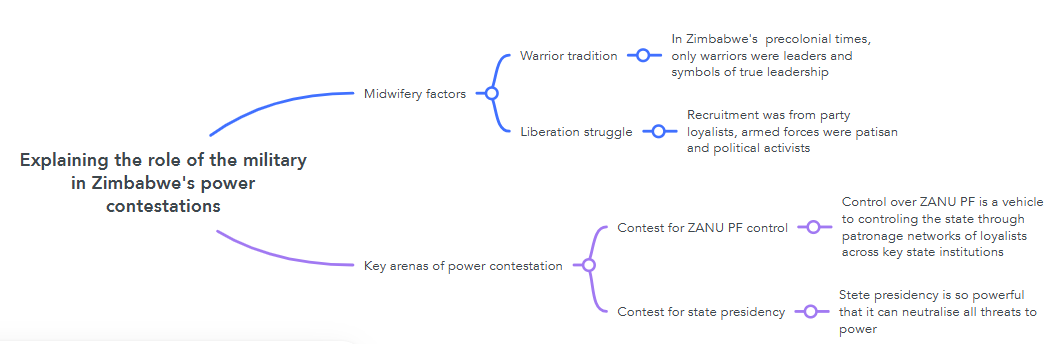
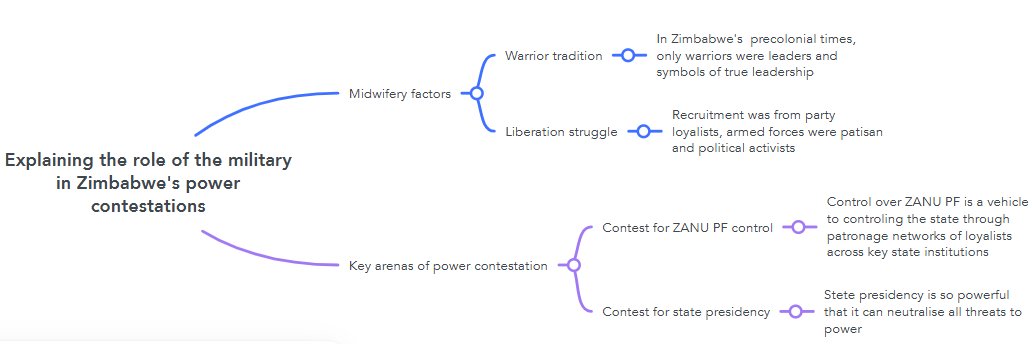
...The position of war veterans and the military must be understood in the context of the liberation entitlement doctrine. This doctrine portrays the ruling ZANU-PF and its liberation war veterans as the sole givers and guarantors of independence...(Gumbo, 2020; Ruhanya, 2020) .
English
1
7
14
3.5K
Zenzele
Zenzele@zenzele·
In 1999, Zimbabwean soldiers found themselves surrounded by Rwandese-backed Congolese rebels in Ikela, DRC. They endured a harrowing siege for months, relying on airdrops for supplies. Their rescue came from a courageous team of commandos led by Major Piki. Today, I interviewed one of the soldiers who lived through the experience. Don't miss this incredible story of bravery and dedication—subscribe to CITEZW on YouTube.
Zenzele tweet media
English
164
245
1.1K
212.1K
Bekezela Gumbo
Bekezela Gumbo@bekegumbo·
Understanding a Securocratic state.
Bekezela Gumbo tweet media
English
0
0
0
121
Bekezela Gumbo
Bekezela Gumbo@bekegumbo·
@BaShonaBaShona @ProfJNMoyo @Mavhure I like this critical decolonial Africa studies stance. But it's important to also acknowledge the reality, Zim universities need lots of shaping up to produce solution holders that can drive vision 2030. Producing mazhanje juices and celebrating such is too low.
English
0
0
2
158
BaShona.
BaShona.@BaShonaBaShona·
Who is doing the rankings? Is it not the same Western barometer that always labels Africa as a dark continent? They will tell us that Africa is too corrupt, yet America is the most corrupt country in the world. They will say people in Africa are not happy, yet people in the West are not happy. I doubt these statistics, Professor. Chinese universities should be in the top 3 and top 5 based on their economic development, which has already surpassed that of the United States. These statistics are just a narrative being pushed by white supremacy.
English
26
1
16
8.1K
Prof Jonathan Moyo
Prof Jonathan Moyo@ProfJNMoyo·
WORLD UNIVERSITY RANKINGS 2025: AFRICA DROPS WHILE ZIMBABWE HITS ROCK BOTTOM The number of African universities in the top bands of the world university rankings has dropped from 75 in 2024 to 73 in the 21st edition of the Times Higher Education World University Rankings for 2025 in which Zimbabwe has only one out of its 20 universities, the University of Zimbabwe which has hit rock bottom by dropping from the 1,201 - 1,500 joint band in 2024 to poorly and embarrassingly rank in the lowly 1501+ band. Even universities south of the Limpopo River, which have been doing well in recent years, did not stand their ground in the 2025 rankings with none of them improving from their 2024 positions; while seven of them dropped in their rankings. Save for the notable exception of four universities in Egypt and one in Morocco, universities elsewhere across Africa did not fare any better, as they too either maintained or dropped from their 2024 rankings. Internationally, Oxford University continued to rule the roost at the top, for the ninth year running, while the Massachusetts Institute of Technology came second, toppling Stanford University, which dropped to number six. Two Chinese universities, Tsinghua University and Peking University made their top 10 bid conspicuous; with a good run at numbers 12 and 13 respectively. Below are the world’s top 20 universities: 1. University of Oxford (United Kingdom) 2. Massachusetts Institute of Technology (United States) 3. Harvard University (United States) 4. Princeton University (United States) 5. University of Cambridge (United Kingdom) 6. Stanford University (United States) 7. California Institute of Technology (United States) 8. University of California, Berkeley (United States) 9. Imperial College London (United Kingdom) 10. Yale University (United State) 11. ETH Zurich (Switzerland) 12. Tsinghua University (China) 13. Peking University (China) 14. The University of Chicago (United States) 14. University of Pennsylvania (United States) 16. Johns Hopkins University (United States) 17. National University of Singapore (Singapore) 18. Columbia University (United States) 18. University of California, Los Angeles (United States) 20. Cornell University (United States) Some 2,860 universities from 133 countries and territories submitted data for the 2025 world rankings reckoning; but only 2,092 of these qualified to be ranked, while 768 did not qualify and were thus given a ’reporter’ status; which is equivalent to a certificate of participation. Out of the 2,092 universities that were ranked, 135 are African from 19 countries in the continent, broken down as follows: Egypt (35), Algeria (26), Nigeria (21), South Africa (14), Morocco (12), Tunisia (8), Ghana (4), Botswana (2), Kenya (2), Tanzania (2), with one each from the DRC, Ethiopia, Mauritius, Mozambique, Namibia, Rwanda Uganda, Zambia and Zimbabwe. Below are Africa’s top 20 universities within the continent (showing their world ranking): 1. (180) University of Cape Town (South Africa) 2. (301–350) Stellenbosch University (South Africa) 3. (301–350) University of the Witwatersrand (South Africa) 4. (401–500) Mohammed VI Polytechnic University (Morocco) 5. (401–500) University of Johannesburg (South Africa) 6. (501–600) Egypt-Japan University of Science and Technology [E-JUST] (Egypt) 7. (501–600) University of KwaZulu-Natal (South Africa) 8. (601–800) American University in Cairo (Egypt) 9. (601–800) Future University in Egypt (Egypt) 10. (601–800) Kafrelsheikh University (Egypt) 11. (601–800) Mansoura University (Egypt) 12. (601–800) University of Pretoria (South Africa) 13. (601–800) University of the Western Cape (South Africa) 14. (801–1000) Al-Azhar University (Egypt) 15. (801–1000) Cairo University (Egypt) 16. (801–1000) Covenant University (Nigeria) 17. (801–1000) North-West University (South Africa) 18. (801–1000) University of Cape Coast (Ghana) 19. (801–1001) University of Tunis El Manar (Tunisia) 20. (1001–1200) Ahmadu Bello University (Nigeria) While the University of Cape Town remains Africa’s top ranked university, and the only one among the world’s top 200 universities, it has dropped to number 180 in the 2025 rankings, from number 167 in 2024. Out of the world’s top 500 universities, Africa has only five — four of them from South Africa, namely; University of Cape Town, University of the Witwatersrand Stellenbosch University, and the University of Johannesburg; while the fifth is from Morocco, the Mohammed VI Polytechnic University; which is a new entrant in the rankings, and the best ranked university in North Africa. Notably, as mentioned above, none of the usually high performing South African universities improved from their previous rankings. However, it is also notable that South Africa increased its total number of ranked universities with the entrance of Sefako Makgatho Health Sciences University in band 1,201 – 1,500 and the University of Fort Hare in the 1,501+ band. Other notable new African entrants in the world university rankings from our part of the continent are the DRC’s University of Kinshasa, the University of Rwanda and Kenyatta University in Kenya, all of which ranked — better than the University of Zimbabwe — in the 1,500+ band. Out of the 768 universities that did not qualify for ranking in the basket of the 2,860 universities from 133 countries and territories that submitted data for the 2025 world rankings — which were given a ’reporter’ status or certificate of participation — 151 are from 17 African countries: Algeria (56), Angola (20), Egypt (12), Kenya (12), Libya (8), Ghana (4), Morocco (4), Somalia (3), Tunisia (2), and one each from Burkina Faso, Ethiopia, Malawi, Mauritius, Sudan, Tanzania and Zambia. This means Africa had 151 unranked universities from 17 countries, and 135 ranked universities from 19 countries; bringing the total number of African universities that submitted data for the 2025 world rankings to 286. For ease of reference, below is comprehensive and detailed breakdown of the African participation in the 21st edition of the Times Higher Education World University Rankings for 2025 in which Zimbabwe has just one out of its 20 universities, the University of Zimbabwe which has hit rock bottom by dropping from the 1,201 - 1,500 joint band in 2024 to poorly and embarrassingly rank in the lowly 1501+ band. The breakdown has been computed from the Times Higher Education World University Rankings for 2025, whose link is given at the foot of this write up. Link: World University Rankings 2025 - Africa docs.google.com/spreadsheets/d… Tellingly, and worryingly, universities in Zimbabwe that don’t feature at all in the overall world university rankings include all of them minus the University of Zimbabwe: Africa University African Women University Arrupe Jesuit University Bindura University of Science Education Catholic University of Technology Chinhoyi University of Technology Great Zimbabwe University Gwanda State University Harare Institute of Technology Lupane State University Manicaland State University of Applied Sciences Marondera University of Agricultural Science & Technology Midlands State University National University of Science and Technology (NUST) Reformed Church University Solusi University Zimbabwe Ezekiel University Zimbabwe National Defence University Zimbabwe Open University. This is awful. Something is wrong here, and it needs to be corrected as a matter of urgency, in the national interest. What is going on? Too many good for nothing universities with nothing to write home about to justify their existence as institutions of higher learning and advanced research. These universities must shape up or ship out. Universities that do not leave up to the minimum standard of performance have no right to exist, they should be deregistered. Situations or circumstances that are arresting advanced research at Zimbabwe’s institutions of higher education — for them to stand up and be counted among the world’s best — do not require rocket science to understand. Consider the following: Firstly, there’s no public funding of research. Zimbabwe will not industrialise nor modernise without a knowledge based and knowledge driven economy. Put differently, Zimbabwe will not become an upper middle income country without a knowledge based and knowledge driven economy. Still in other words, vision 2030 is impossible to achieve without such an economy. Conversely, you cannot have a knowledge economy when there’s no public funding of knowledge generation at the country’s institutions of higher education through advanced research. Secondly, Zimbabwe’s universities are principally and notoriously text-book based, higher education teaching institutions; they are yet to transform into higher education research institutions whose strategic purpose is not to teach from textbooks but to teach from the generation of knowledge — intellectual property — through advanced research. This transformation will not happen unless and until there’s requisite public funding of advanced research at the country’s universities commensurate with societal needs. Thirdly, public funding of advanced research at universities should not only come from the state but it should also from the private sector. Zimbabwe’s private is not known for the pursuit of excellence or for funding the creation of patented intellectual property at institutions of higher education for the betterment of lives and livelihoods as part of their business models. Far from it. In Zimbabwe business is synonymous with making predatory profits in the crudest of ways. What have the likes of Innscor, Delta, Econet and Old Mutual done for the pursuit of excellence or knowledge generation in Zimbabwe? What is their relationship with institutions of higher education in the country? As if this is not bad enough, in Zimbabwe you get people who style themselves as leading business tycoons whose sense of philanthropy is to donate vehicles or give money to individuals who should be making their own money to buy themselves cars or whatever, and who do not do anything for society or any community. This kind of philanthropy is nothing but nauseating corruption. Otherwise, take a look the philanthropy that is practiced in enlightened societies, there’s no better philanthropy than supporting research and development at institutions of higher education. Fourthly, Zimbabwe’s institutions of higher education themselves, are their own worst enemies. Witness how many of them are busy competing with primary schools making mazhanje juice or competing with polytechnics doing basic reverse engineering projects on things like tram concepts — claiming to be building innovation hubs — when they’re supposed to be doing advanced research to generate ground breaking intellectual property to produce fresh engineering solutions to community and societal problems. It is plain wrong and even intellectually criminal to celebrate such embarrassing mediocrity as innovation. Fifthly, and last but not least, public discourse in Zimbabwe is never about ideas; it’s always about personalities, about good guys and bad guys — praising some and cancelling out others — and never about good ideas and bad ideas. This explains why there’s no fact-checking culture in Zimbabwe, and why public debate is not evidence based. It’s invariably about mumbo jumbo politics. Truth be told, it is very difficult and even impossible for institutions of higher education to thrive in a society whose public discourse is about good guys versus bad guys; and not about good ideas versus bad ideas. This rot is totally unacceptable! Link: World University Rankings 2025 timeshighereducation.com/world-universi…
English
254
207
471
124.6K
Oppah Muchinguri-Kashiri (ZANUPF Nat. Chairman)
As the ZANU PF National Chairman, I am pleased to share our strategic direction for the upcoming 21st Annual National People’s Conference. The gathering, which will be held from October 22 to 27 at the Zimbabwe International Trade Fair grounds in Bulawayo, marks a significant moment for our nation as we push forward towards achieving Vision 2030. This is also a unique opportunity for Bulawayo to demonstrate its capacity to host large-scale national events and showcase its vibrancy and readiness for greater things. In preparation for this conference, the National Co-ordinating Committee, which I chair, has made critical decisions aimed at ensuring an impactful and efficient conference. One of the key measures we have taken is to reduce the number of delegates attending this year, drawing lessons from best practices we observed in other progressive nations like China. This year’s conference will not follow the traditional format where every member of the party attends. We have opted to limit participation to Politburo members, Central Committee members, National Consultative Assembly members, and senior provincial and district executives. This will ensure that the discussions and resolutions are rich in content, driven by critical thinking and rigorous debate, thus creating meaningful outcomes that will influence the course of our national policies. The reduced number of attendees also reflects our commitment to safety. With fewer delegates traveling to Bulawayo, we will significantly minimize road traffic accidents, which is a priority for the party and the nation. Our conference theme, “Industrialise, Modernise Towards Vision 2030,” aligns perfectly with the nation’s developmental goals. As we look to industrialize and modernize Zimbabwe, key sectors such as the economy, agriculture, and food security will be at the forefront of our discussions. Together, we will chart a path that delivers prosperity to our people and restores our country’s position of dignity and self-reliance. I can report with pride that we are nearly 95 percent prepared for the conference. Our third meeting as the National Co-ordinating Committee has ensured that all logistical matters are in place. This committee is comprised of all relevant departments, whose expertise is crucial in delivering a successful and productive conference. At this important gathering, our Minister of Finance, Economic Development, and Investment Promotion, Professor Mthuli Ncube, will present a comprehensive report on the state of our economy. His insights will be instrumental in guiding our future economic strategies. Similarly, the Minister of Mines and Mining Development, Cde Winston Chitando, will provide an update on the mining sector, while our Minister of Lands, Agriculture, Fisheries, Water, and Rural Development, Dr Anxious Masuka, will give a detailed report on the state of agriculture, including this year’s challenges, such as the drought that severely affected our country. Our Government, under the capable leadership of the Minister of Public Service, Labour and Social Welfare, Cde July Moyo, has already initiated interventions to ensure that no Zimbabwean will starve, and this will be discussed in detail. This year’s conference is not just a gathering of party members but a critical policy review platform. We will take a hard look at our policies and refine them to ensure that they are in line with our national goals, particularly economic growth and sustainable development. The outcomes of this conference will set the tone for ZANU PF’s continued leadership as we drive towards Vision 2030. Together, as one united party, we will steer our nation towards a prosperous future. I look forward to the rich debates and forward-thinking resolutions that will come out of this conference, and I am confident that it will be a significant milestone in Zimbabwe’s journey towards greatness.
Oppah Muchinguri-Kashiri (ZANUPF Nat. Chairman) tweet media
English
134
51
204
59.3K
Bekezela Gumbo retweetledi
Lloyd Msipa
Lloyd Msipa@LloydMsipa·
In our candid chat Elder Gumbo also waded into the @waltermzembi & @Hon_Kasukuwere matter. @ZANUPF_Official is keen to get selected former members exiled or expelled to write letters as a condition for re-admission.Yours truly included. All have dismissed this conditional re- admission Elder Gumbo speaks to this!
Barking, London 🇬🇧 English
79
142
307
110.3K
Bekezela Gumbo
Bekezela Gumbo@bekegumbo·
@InfoMinZW When you let abattoirs rob farmers all offalls, head, and legsof their cattle free of charge ....later on, they make money out of them
English
1
0
0
366
Ministry of Information, Publicity & Broadcasting
#PostCabinetBriefing Cabinet wishes to advise the nation that in light of the climate-induced drought in the form of El Nino, various measures are being instituted to guarantee food security for all and ensure that no one dies of hunger. Among other issues discussed, Cabinet discussed the importance of considering more hectarage for growing rice in view of increased rice consumption by the citizens. Cabinet also emphasized the need to support and promote local wheat production with the aim to swap wheat for maize in order to meet maize demand for the nation. In light of the foregoing, Cabinet has approved as follows: i. the Food Security Outlook Report to March 2025 to facilitate winter cereals production planning; ii. the food security strategy based on the comparative and competitive advantages of wheat this winter; iii. that the consumption of 7.5kg per person per month be used immediately for social welfare and be adjusted after October to 8.5kg per person per month; iv. the purchase of local grain at import parity price of US$390 per tonne to mop up excess local grain; V.duty waiver on the importation of rice and potato seed; vi. importation of Genetically Modified stock feed, under strict supervised milling and distribution; vii. duty free importation of maize, rice and cooking oil by households with effect from July 2024; viii. re-activation of the Grain Mobilisation Committee to monitor private sector imports as well household imports.
Ministry of Information, Publicity & Broadcasting tweet mediaMinistry of Information, Publicity & Broadcasting tweet mediaMinistry of Information, Publicity & Broadcasting tweet mediaMinistry of Information, Publicity & Broadcasting tweet media
English
56
34
88
50.2K
Bekezela Gumbo
Bekezela Gumbo@bekegumbo·
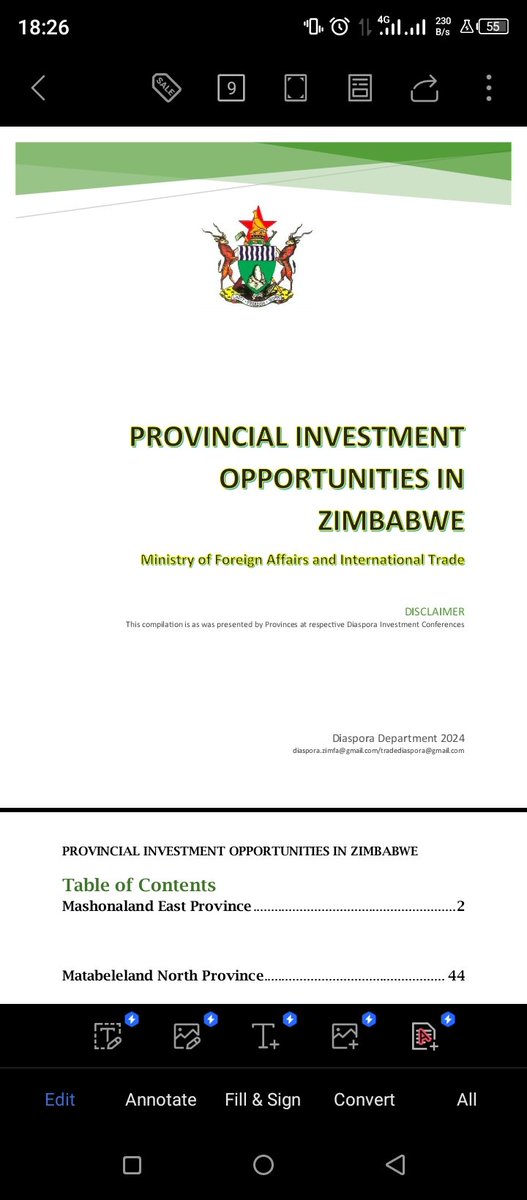
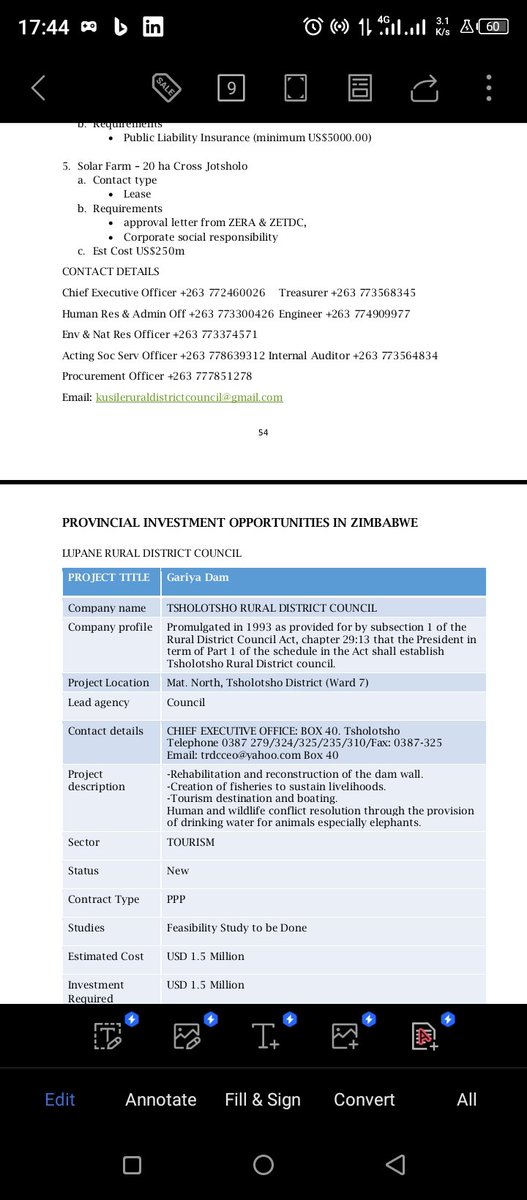
Can someone please correct page 54 of @MoFA_ZW "provincial investment opportunities" document. 1. Tsholotsho RDC is not Lupane RDC. 2. There is no RDC called Lupane RDC in Zimbabwe.
Bekezela Gumbo tweet mediaBekezela Gumbo tweet media
English
0
0
0
45
Senator Sengezo Tshabangu
Senator Sengezo Tshabangu@SengezoTsh17075·
Yesterday I had a nice time at Babourfields where our Highlanders team hosted and won a match against Dynamos,people where happy to meet their senator, torch bearer and Champion in the fight for transparency,we'll keep on fighting until we attain the great Joshua Nkomo's Visión.
Senator Sengezo Tshabangu tweet mediaSenator Sengezo Tshabangu tweet media
English
199
7
69
21K
Bekezela Gumbo
Bekezela Gumbo@bekegumbo·
@S_Harudzibwi The car gifting scheme is not random but calculated. It has potential to create a strong force for swaying public perception...
English
1
0
1
425
Mohamed Saleh
Mohamed Saleh@msaleh1982·
The project is based on novel datasets on (1) Egyptian members of parliament from 1824 to 2020 that I digitized from primary and secondary sources, and (2) Egyptian parliamentary speeches in 1866-1882 and 1924-1952. Using DID, ML, and historical evidence.
English
2
0
3
674
Mohamed Saleh
Mohamed Saleh@msaleh1982·
I am happy to announce that I have been awarded the British Academy Mid-Career Fellowship for 2024/25. This will give me the time to complete my project on "Intra-Elite Conflict and the Reluctant Democratization of MENA."
English
19
4
157
20.8K
Bekezela Gumbo
Bekezela Gumbo@bekegumbo·
@Realbeefactor They are spot-on. The approach has never worked and will not work. But it will water-down the issues and postpone the real nation-building.
English
1
1
2
211
BrightoNcube
BrightoNcube@Realbeefactor·
The Zimbabwe Communist Party (ZCP) says the planned Gukurahundi hearings, which chiefs are spearheading with the government, will not yield the desired results and instead called for an international commission to investigate the atrocities. ZCP General Secretary, Ngqabutho Nicholas Mabhena, said first, the chiefs were incapable of leading the process; secondly, the exclusion of Midlands provinces sent a wrong signal; third, attempts to label Gukurahundi as something other than a genocide were disturbing, while attempts to bar the media was suspicious, yet the program was supposed to be open, transparent, and inclusive. “We note the ongoing consultations with traditional chiefs over Gukurahundi, but as the ZCP, we reject the government approach and call for the establishment of an International Commission to investigate the circumstances that led to the genocide,” Mabhena told CITE in an interview. “We do not believe that the Zanu PF government is capable of investigating its crimes.” The ZCP general secretary said the ‘rightful’ body with a constitutional mandate to deal with such issues was the National Peace and Reconciliation Commission (NPRC), before its tenure ended and was moved to the Zimbabwe Human Rights Commission (ZHRC). “We also note with concern that our traditional leaders are assigned the task of dealing with the legacy of Gukurahundi, which is outside their capacity and their mandate,” Mabhena stated. Mabhena questioned why the government had excluded Midlands provinces, yet the province also experienced attacks and needed healing. cite.org.zw/zcp-rejects-gu…
English
1
3
13
1.3K
dhonzamusoro007
dhonzamusoro007@dhonzamusoro007·
One key, self-delighting narrative in the opposition: THEY THINK ZANU PF RULES BECAUSE OF THEIR OWN WEAKNESSES, NOT BECAUSE OF THE SHEER MIGHT OF ITS VISION AND HISTORY FOR AN INDEPENDENT, SOVEREIGN ZIMBABWE. They think they are divinely anointed to end ZANU PF rule. Vachasvinura!!!
Caston Matewu 🇿🇼@cmatewu

If we don’t deal with our differences in the opposition, ZANU Pf misrule will continue. Unity of purpose is critical; the status quo only guarantees ZPf another term beyond 2028.

English
8
4
14
4.1K