Ben Bartling

697 posts

Ben Bartling

Ben Bartling

@benbartling

Code-first founder, no funding rounds, just software that earns its keep.

Milwaukee, WI Katılım Temmuz 2009
131 Takip Edilen509 Takipçiler
Ben Bartling
Ben Bartling@benbartling·
In the age of agents, the whole company lives in the repo. Marketing site. Docs. Changelog. Wiki. Decisions. All markdown. All in the same diff. One agent can read, build, and compound across the whole thing. bartling.io/blog/the-compo…
English
0
0
1
26
Ben Bartling
Ben Bartling@benbartling·
@Shpigford I noticed you are using Rails and Inertia in your skills. How are you liking this stack? I have a large codebase that is Rails, Hotwire, ViewComponent. It has a minimal frontend right now, as it's mainly an API. We are considering expanding the frontend, but the current stack doesn't feel well suited for our AI friends. @inertiajs @rails @evilmartians
English
1
0
2
131
Ben Bartling
Ben Bartling@benbartling·
@levie The companies that figure out how to productize pieces of this process will mint. We need layers of abstraction and products to own pieces of it. It’s still way too much for most companies to implement, let alone maintain, with or without outside help.
English
0
0
0
326
Aaron Levie
Aaron Levie@levie·
The jump from working with a chatbot to having an agent that actually helps automate a process requires a real amount of work. Most companies will need to have dedicated people that are responsible for bringing automation to their teams, instead of leaving this up to every individual employee. Partly because the work is more technical than we imagine today, and partly because it’s just hard to do this as a side project. The job spec is to map out new workflows with agents, implement new systems to deploy agents, make sure the agent has all the right (up to date) context to work with, wiring up internal systems to connect to the agents, creating evals for the agents, figuring out where the human is in the loop, managing the system when there are new upgrades, helping with the change management of the existing business process, and so on. These jobs may come from IT or engineering, or live directly in the business function itself. They’ll be called different things depending on the company, and in some sense it’s the future of software engineering that you’ll see a huge growth of in non-tech companies. Most companies will have to be hiring for this now or in the future, and it’s another example of the kind of new jobs that will be created in AI.
Harry Stebbings@HarryStebbings

What Role Does Not Exist Today But Will Be So Common in Five Years Time: "500K-1M jobs will be created for agent operators. This person will be somewhat technical. They will be deep in the AI world. They're gonna have to understand MCPs and CLIs and they are going to have to know how to write skills. It's going be this group of people that will know how to go into your marketing team or your legal team, or your operations team, or your life sciences research team and this is the person that is basically going to enable that function to get leverage from agents." @levie Where is this right? Where is this wrong? @jasonlk @gregisenberg @amasad @AnjneyMidha

English
119
150
1.1K
292.4K
Ben Bartling
Ben Bartling@benbartling·
@jonhainstock Also worth a look at Conductor or Superset. Nice flows for booting up worktrees with setup and isolated run scripts.
English
0
0
1
33
Jon Hainstock
Jon Hainstock@jonhainstock·
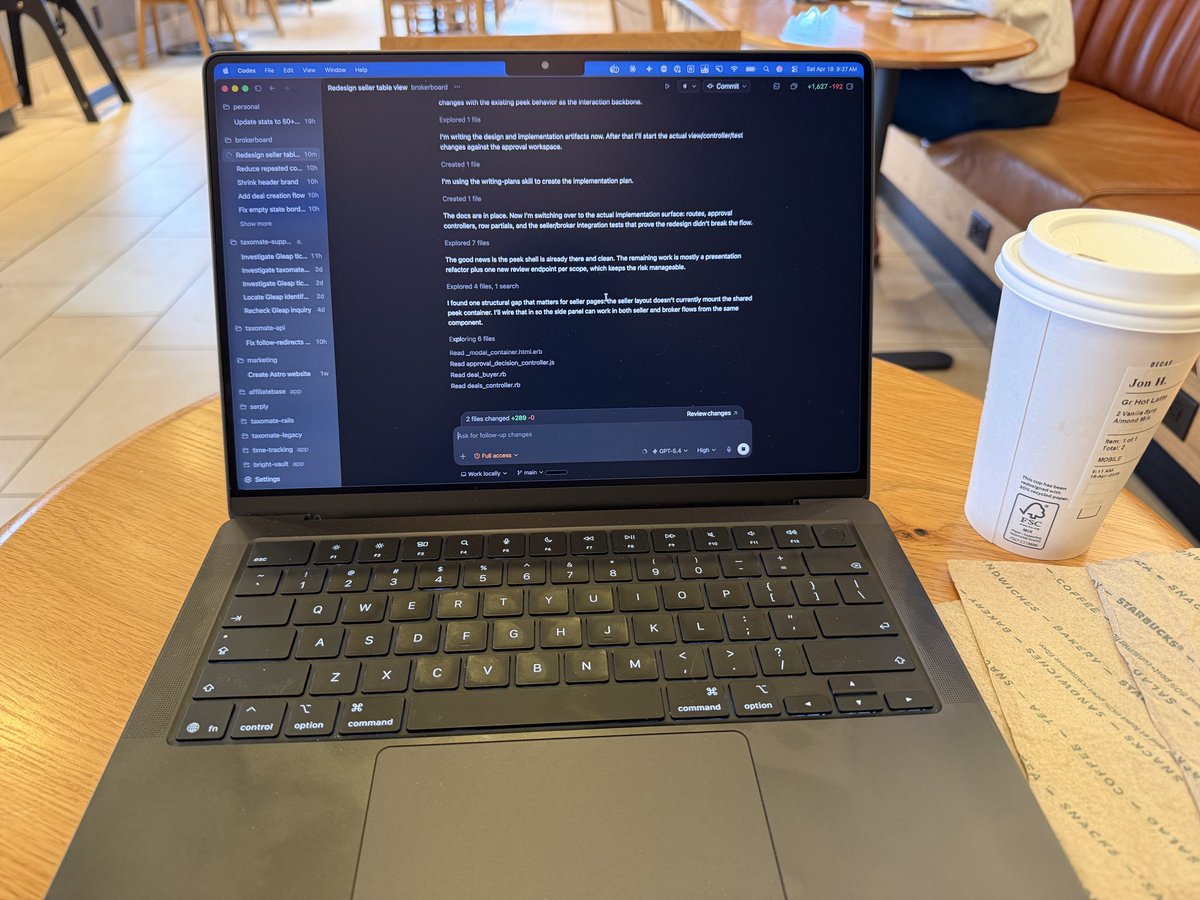
Anyone else vibing this morning? Codex is still my favorite for coding, despite how bad it is at design.
Jon Hainstock tweet media
English
2
0
3
589
Todd Saunders
Todd Saunders@toddsaunders·
Just met with a group of blue collar builders in a vacuum store… I never thought I would be talking AI with folks in the trades on a Saturday in a vacuum store…. (yes i did) I’m now even more convinced that the future of vertical software will be built by the trades themself.
Todd Saunders tweet media
English
9
1
37
2.5K
Ben Bartling
Ben Bartling@benbartling·
I met with a mid-market manufacturing company yesterday. They make hinges and casters for automotive and industrial. The CEO explained the RFQ process and it was clear the whole thing should be taken over by AI. Currently it’s 5 CSRs and a team of engineers manually responding to each request. They only win 15% of them this way, and each one can take a day to multiple weeks to respond to. I’m urging them to just start building. It could be the single most impactful thing they do this year.
English
0
0
1
149
Ben Bartling
Ben Bartling@benbartling·
@Shpigford This looks cool. I just started using Obsidian for my personal knowledge base. I don't touch it, but Claude organizes it for me. Why should I switch to Clearly from Obsidian?
English
1
0
0
120
Josh Pigford
Josh Pigford@Shpigford·
hot on the heels of v2 is v2.1 of clearly.md! lots of nice little quality-of-life features + performance improvements.
Josh Pigford tweet media
English
10
2
48
5K
Ben Bartling
Ben Bartling@benbartling·
I wonder how much of this is capacity related (actual downtime in this case) vs. internal errors being raised somewhere down the stack (could also be capacity related, but not on the initial request). The internal errors aren't getting picked up by an uptime status monitoring tool.
English
0
0
0
140
Ben Bartling
Ben Bartling@benbartling·
@toddsaunders @ZacOHara T: How are you coming up with these ideas? Z: It's the pain of the company. This is what matters now.
English
2
0
4
335
Todd Saunders
Todd Saunders@toddsaunders·
I keep saying the same thing and people keep not believing me.... So here's another one. @ZacOHara's family runs a $100M+ commercial roofing business. North Shore Masonry was a "side project" for the family, but since Zac took over, it's becoming a massive business. 5 months ago Zac couldn't find the terminal on his Mac... he had no idea what the "terminal" even was. Now his entire company runs on AI software he built himself. He built an AI agent named Mason... with his 58 year old dad who "still types with 2 fingers." Here's what Mason does: > Dad texts a photo of a business card. Mason researches the company, starts a cold email campaign, and launches a nurture sequence automatically. > Their coordinator Courtney used to hand type every lead into two different systems while on the phone. Now she gets off a call, sends the transcript to Mason, and he pulls every detail, builds the estimate, sets the task, creates the to-do for the salesman. Each call saves 8-10 minutes. She's setting 1.5x the leads she was before. Their salesmen were writing bid requests at 6:30 PM exhausted after a full day in the field. Mason writes the bid requests now. But the part that blew my mind was a feature he built with OpenClaw. A salesman sends a photo of a wall and says "I'm not sure what to do here." Mason identifies it as a historic building in Chicago, recommends Type O mortar, and advises that the lintel needs attention. Zac and his family are the future of software. THE BUILDERS ARE BUILDING!
English
18
21
426
64.3K
Ben Bartling
Ben Bartling@benbartling·
I have a similar fear. The smart companies and consultants will be targeted with what agents are worth deploying. 80/20 applies as always. In time, more abstraction will come into play which will make it easier and cheaper to spin up agents. This will reduce the professional services tax for the mid-market. We saw this with SaaS vs. on-prem custom solutions.
English
0
0
0
29
James Dim
James Dim@jamesvdim·
This is exactly why the "AI agent" bubble will burst for mid-market companies first. They can't afford the professional services tax you're describing. We aren't just selling code; we’re selling a massive change-management project disguised as software. Do you think vendors will eventually have to bake those "forward deployed" costs into the subscription, or will consulting fees eventually dwarf the actual SaaS spend?
English
1
0
6
374
Aaron Levie
Aaron Levie@levie·
One corollary to the fact that AI agents take real work to setup in company at scale, is that the role of the forward deployed engineer -or whatever it gets called in the future- isn’t going away any time soon. When a vendor sells any kind of agents into an organization, you’re no longer just selling a software tool that gets implemented and you’re done. You’re fundamentally selling some form of the actual workflow being done by your technology. This is far closer to a customer buying from a professional services firm than implementing traditional technology. This will almost always require a deep understanding of the domain that the customer operates in, the ability to help a customer wire up their systems to support the agents, make sure all the context is setup in the right way, and help provide change management to actually get the company to adapt its business processes. The ability to do this across customers, figure out best practices in a specific industry and customer segment, take new features back to go build in the product, and so on is going to be key. There’s no shortcut to getting this work done by the enterprise, and the vendors are going to have to do a lot of this or risk low adoption. Finally, this is a big opportunity for existing and next gen professional services companies. There are all new practice areas emerging in every system integrator and consulting firm just to do this kind of work, and this is going to continue to be in demand for quite some time. Yet another example of jobs that aren’t actually going away.
Aaron Levie@levie

The more enterprises I talk to about AI agent transformation, the more it’s clear that there is going to be a new type of role in most enterprises going forward. The job is to be the agent deployer and manager in teams. Here’s the rough JD: This person will need to figure out what are the highest leverage set of workflows on a team are (either existing or new ones) where agents can actually drive significantly more value for the team and company. In general, it’s going to be in areas where if you threw compute (in the form of agents) at a task you could either execute it 100X faster or do it 100X more times than before. Examples would be processing orders of magnitude more leads to hand them off to reps with extra customer signal, automating a contracting review and intake process, streamlining a client onboarding process to reduce as many straps as possible, setting up knowledge bases than the whole company taps into, and so on. This person’s job is to figure out what the future state workflow needs to look like to drive this new form of automation, and how to connect up the various existing or new systems in such a way that this can be fulfilled. The gnarly part of the work is mapping structured and unstructured data flows, figuring out the ideal workflow, getting the agent the context it needs to do the work properly, figuring out where the human interfaces with the agent and at what steps, manages evals and reviews after any major model or data change, and runs and manages the agents on an ongoing basis tracking KPIs, and so on. The person must be good at mapping the process and understanding where the value could be unlocked and be relatively technical, and has full autonomy to connect up business systems and drive automation. This means they’re comfortable with skills, MCP, CLIs, and so on, and the company believes it’s safe for them to do so. But also great operationally and at business. It may be an existing person repositioned, or a totally net new person in the company. There will likely need to be one or more of these people on every team, so it’s not a centralized role per se. It may rile up into IT or an AI team, or live in the function and just have checkpoints with a central function. This would also be a fantastic job for next gen hires who are leaning into AI, and are technical, to be able to go into. And for anyone concerned about engineers in the future, this will be an obvious area for these skills as well.

English
102
62
819
170.4K
Ben Bartling
Ben Bartling@benbartling·
@vishivishx @levie @Accenture Tell us more. How is it going? Are clients adopting solutions and seeing value? Or, is it mostly readiness studies and hypothetical still?
English
1
0
1
27
Vishnu
Vishnu@vishivishx·
@levie This is exactly what I've been doing @Accenture for our clients - Forward Deployed Agent Engineering!
English
1
0
2
283
TalkOma
TalkOma@yourchioma·
@levie This reinforces something important: AI doesn’t remove work, it shifts it. The real leverage is in people who can bridge product, process, and people. 😊
English
2
0
1
85
Ben Bartling
Ben Bartling@benbartling·
This is a natural transition for all the engineers that are going to need/want to pivot out of traditional software development. The consulting firms that are going to thrive here are not your existing management consultant types. The next gen technical shops that are truly AI first thinkers will shape this.
English
1
0
1
283
Ben Bartling
Ben Bartling@benbartling·
AI has reshaped software forever, but devs are taking it in stride. We're wired for constant change. New tools, new paradigms, ship and adapt. Most of us are embracing it. I worry about every other industry. The resistance will be stronger there, and the reckoning harder.
English
0
0
2
34