Barry Hott ☄️@binghott
You can spend millions per month with literally 1 CBO.
I know I'm gonna catch heat from the sweaty ABO fans and the ABO gurus everyone loves to glaze but...
I'm mostly a CBO maxi now 😱
(Btw, stick around for the reasons CBO doesn't work too)
Should you even listen to me?
Welp.
I've been doing this FB ad stuff for 18+ years (and still am in the weeds today so I don't lose touch). I've studied literally billions of dollars worth of ads. Annnnd I just love this stuff and love talking about it.
Also, I used to be a huge ABO maxi. I get it! But things have changed and I adapted!
Here's a real example from a brand I started working with in April:
In March they were spending 6 figures across 9 separate campaigns.
NINE!
The full sweaty routine, trying and failing to media-buy their way to a million-dollar spending month. And those 9 campaigns were quietly competing against each other in the same auctions and fragmenting all the data.
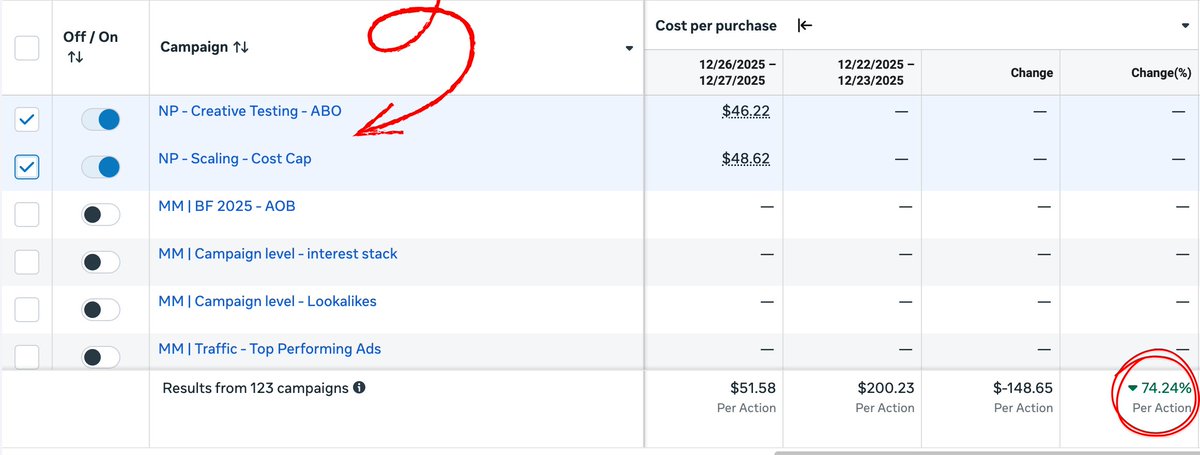
Last 30 days? Over $1.5M in spend through 1 CBO campaign, running on Incremental Attribution.
And their cost per conversion actually dropped 5% while scaling.
Fewer campaigns. More spend. Cheaper conversions.
Annnnd, most importantly, every minute less wasted on sweaty media-buying baloney can be spent on the things that actually move the needle, and those benefits compound.
The best thing a media buyer can do in 2026 and beyond is...
Spend less time on media buying
and
Spend more time on anything else that matters to your (potential) customers and your business: creative, products, offers, copywriting, CRO, landing pages, etc.
CBO helps you do that. Let me explain why.
With CBO, you let the system do what it wants to do, and then you can study it, empathize with it, criticize it, and use your human context to modify it if/as necessary.
Empathize with it because the system is trying to solve a problem you can't fully see. When you understand what it's actually optimizing toward, you stop fighting it and start steering it.
Meta has more data about your ads than it reports, meaning it has more and better data than you do.
Ever wonder why Meta spends more on stuff with a lower ROAS or higher CPA than others?
That's either the breakdown effect or it's optimizing for something you can't see. (Or a combination of both)
You can't see if or how any users have seen or interacted with any other ads before they click the link.
But Meta can.
In the age of advanced AI machine learning post-Andromeda Meta advertising, if you think the only thing that matters is the last ad a user clicked before they got to your site, or that only link clicks matter and no other on-Meta actions matter, then you're simply not living in reality.
This is also why I run Incremental Attribution on that CBO. It tells Meta to optimize toward the conversions it actually drove, not every last-touch conversion it can take credit for.
Better signal in, better optimization out.
CBO plus human inputs via cost caps and/or budget mins and maxes is the way to go.
Best of both worlds.
This works best the more data you feed Meta, so you need a lower CPA and/or high spend. The more data the system has, the more I generally trust it.
Consolidation = more data for Meta to optimize.
The worse/less data that you give Meta or the more you fragment your account, the less you should trust it to optimize on your behalf effectively.
Now, the honest part. CBO is not magic and it does have real weaknesses:
1. CBO optimizes to cost, not profit. Mix products with different margins in one campaign and it'll happily pour budget into cheap, low-value conversions. Feed it value signals or it'll work against you. (Or otherwise apply your own context via cost caps and budget controls)
2. Budget flows to whatever the system likes, so if you need guaranteed spend on a new product or geo, it'll fight you. (That's what the budget mins/maxes are for!)
3. Low-volume accounts don't give it enough to chew on. If you're not feeding it much, it can't optimize much.
4. It's scary and hard to move from a fragmented setup, especially if you've been using it for years. Consolidating resets learning. There's a real short-term cost while it re-figures things out. It's worth it, but don't panic on day 2.
Soooo when is ABO still right? Lower-spend or lower conversion volume accounts, or any time you simply can't get good data into Meta. Or if you're optimizing for something without deeper data being sent at all like reach, brand awareness, or link clicks.
ABO is also fine if you can mostly consolidate into as few campaigns and ad sets as possible, buuuut the reported data can still be misleading and cause a media buyer to optimize in the wrong direction.
And look, I'm not saying this is the exact RIGHT/BEST way to run EVERY account or business. It's not.
CBO is probably the easiest and smartest for most businesses, and it frees up a lot more time and resources to focus on the most important stuff.
It helps that this business has basically one main product, so consolidating into a single campaign is clean and easy. No mixed margins, no ten SKUs fighting for budget. If your catalog is more complicated, your setup probably needs to be too.
But if it can work for a business spending this kind of money, it might work for yours too. Just because you CAN over-optimize and manually control every little thing, doesn't mean you should.
This CBO plan will never work for YOU if you:
1. Have zero trust in Meta (I'm not saying you should 100% trust Meta all the time. Please don't! Buuut you need to be able to trust it at least a little bit)
2. Don't care or understand that overlapping campaigns and ad sets impact each other
3. Think you have more/better data than Meta's system (you don't! Seriously, you don't! Click data only tells one part of a complicated journey)
4. Think you're smarter than Meta's system (you're not!)
5. Give Meta bad/wrong signals/data to optimize from
6. Refuse to believe that there are other bigger things to focus on more than media buying
And here's the thing sooo many media buyers (and gurus!) don't want to hear or admit: they think their media buying is the reason it's all working.
It usually isn't.
It's the excellent creative, the strong offer, the dialed-in landing page, the actual product people want. The media buyer is often just along for the ride on top of a great machine, taking credit for the engine someone else built.
The best media buyers I know are the first to admit this.
Oh, and this post isn't a pitch. I'm not gating any of this behind a signup. I just want you to squeeze the best performance you possibly can out of your ads.
But if you take one thing from all of this, take this: the biggest swings in your ad performance usually aren't coming from media buying at all.
They're coming from your website and the world around it. A landing page change. A new product launch. A price update. A broken checkout. A competitor's promo. A holiday. A news cycle.
That stuff moves your numbers way more than which campaign structure you picked.
It's the entire reason I'm building URLLove.It Because most people are staring at their ad account hunting for an answer that actually changed on their website three days ago, and they never even noticed.
TL;DR: Consolidate or die.
Feed it good signal (Incremental Attribution helps). Steer with cost caps and budget mins/maxes instead of babysitting. Then go spend your time on creative and offers, and alllll the stuff that actually moves the business.
If you run ABO and you're winning, or you think I've got any of this backwards, come at me. Reply, quote it, tear it apart. I'll take any and all of it.
One fair ask though: if you've never actually run a full consolidation, all the way down to 1 or 2 campaigns, I'll still read your take, but know that I'm going to weight it differently than someone who's actually tried it and watched what happened.
That's not me dodging the argument. It's the opposite. Go run it. Give Meta the data, give it a real shot, and then come tell me everything I got wrong. That's the feedback I want most, because that's the feedback that can actually change my mind.
Opinions from the sideline are welcome. Opinions from the field are gold.
And if any of you want to actually hash this out live, a space, a call, a recorded chat, whatever, I'm in. I'd love to sit across from someone who disagrees and see what I'm missing.