Bitsplaining

7.8K posts

Bitsplaining banner
Bitsplaining

Bitsplaining

@bitsplaining

Engineering manager @turnkeyhq. Attorney. Believer in disintermediation, decentralization, & scaling Ethereum. Opinions are my own. ex @ConsenSys, ex @OPLabsPBC

Los Angeles, CA Katılım Kasım 2009
3.1K Takip Edilen4.3K Takipçiler
Sabitlenmiş Tweet
Bitsplaining
Bitsplaining@bitsplaining·
@flaunchgg has so many interesting mechanisms! - set a chunk of trading fees as dev rev - you can also burn your token rather than dump it on holders. 💚 - the NFT "memestream" idea is so cool - you can sell the proceeds from your token to someone else! 🤯 And just IMAGINE when interop is live and you're hopping around liquidity pools across the Superchain! 🔴 🚀
English
156
3
252
4.2K
Bitsplaining
Bitsplaining@bitsplaining·
All these AI tools available now. What are people building? Kinda crazy people aren’t posting nonstop about something new they built weekly 👀
English
0
0
1
51
Bitsplaining
Bitsplaining@bitsplaining·
Just tried this and it is quite excellent!
Parth Jadhav@ParthJadhav8

HOLY SHIT !! @cursor_ai 's /thermo-nuclear-code-quality-review skill is nuts It ran for around 30 mins on my PR and immensely improved the code quality. It's 67x better than /simplify from Claude code..

English
0
0
2
245
binji
binji@binji_x·
making a groupchat for people who like ethereum lmk
English
662
30
1.3K
80.6K
Bitsplaining retweetledi
Turnkey 🔑
Turnkey 🔑@turnkeyhq·
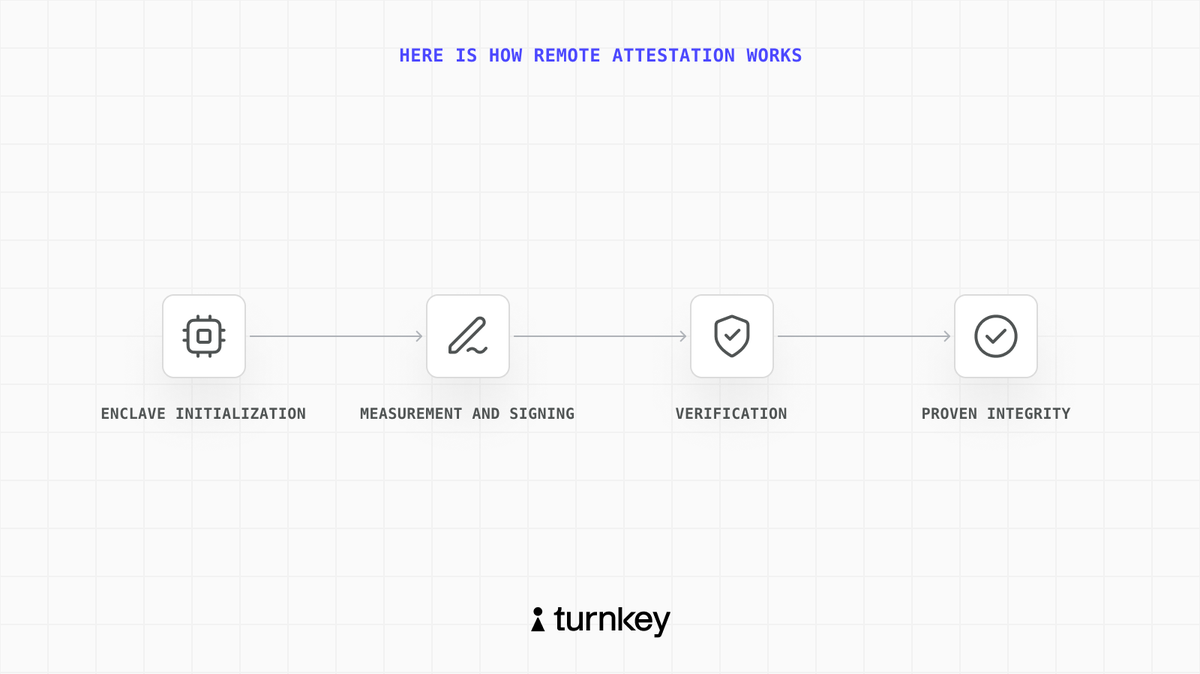
Remote attestation: Connects an enclave’s signed report to trusted hardware certificates, letting anyone verify environment authenticity. TEEs enable this by generating a signed attestation document that describes what code is running and the environment it’s running in.
Turnkey 🔑 tweet media
English
4
1
15
988
Bitsplaining retweetledi
Turnkey 🔑
Turnkey 🔑@turnkeyhq·
ICYMI: @lightspark launched Grid Global Accounts last week. Embedded wallets power self-custody, scoped agent delegation, and cross-chain interoperability built into the account layer. Grid Global Accounts, secured by Turnkey. turnkey.com/blog/lightspar…
English
4
3
20
1.2K
Bitsplaining retweetledi
Turnkey 🔑
Turnkey 🔑@turnkeyhq·
Turnkey has secured over $100B in stablecoin transaction volume! The next $100B will be driven by agents – autonomous, onchain, and transacting at scale.
English
7
11
38
3.5K
Bitsplaining retweetledi
Turnkey 🔑
Turnkey 🔑@turnkeyhq·
Turnkey now supports multi-region signing 🌎⚡ Transactions now execute with ultra-low latency worldwide, and we’ve open-sourced benchmarks on how Turnkey outperforms competitors across regions.
English
5
10
51
5.1K
Bitsplaining
Bitsplaining@bitsplaining·
@shawmakesmagic Glad I’m not the only one. Gets so awkward! Just lets talk about something real please
English
0
0
0
33
binji
binji@binji_x·
getting no engagement is a blessing in disguise because you can go back to speaking about other things, like olives. i hate olives.
English
47
1
139
5.4K
Bitsplaining
Bitsplaining@bitsplaining·
So much AI on my timeline. Any web3 people still here and still excited about something? Are you using AI to build the thing you never had time to before? 👀
English
1
0
2
76
Bitsplaining
Bitsplaining@bitsplaining·
The Arbitrum decision was the right one, and the security council is there for just this sort of situation. Glad the bad guys got foiled this time!
English
6
0
5
110
Bitsplaining retweetledi
Mehdi (e/λ)
Mehdi (e/λ)@BetterCallMedhi·
I just finished reading palantir’s manifesto & I need you to understand what you’re actually looking at because this is the MOST important document the tech world has produced this year most people came away thinking «wow what a thoughtful essay about patriotism and technology »…I came away thinking this is the most elegant justification for corporate capture of the state apparatus ever written & I want to walk you through why krp opens with «silicon valley owes a moral debt to the country that made its rise possible » & frames the entire document as a call to civic duty, but read between the lines and what he’s actually saying is that the engineering elite should be embedded inside the defense and intelligence apparatus of the nation, he’s describing exactly what palantir has already done and dressing it up as patriotism «the question is not whether AI weapons will be built, it is who will build them and for what purpose »sounds like a warning but it’s actually a sales pitch, he’s telling every gov on earth that the choice is binary either you buy from us or your adversaries will build it without you, this is the oldest arms dealer rhetoric in history wrapped in SV vocabulary « hard power in this century will be built on software »is the key sentence of the entire manifesto because this is where karp reveals the real thesis, he’s saying whoever controls the software layer of national defense controls the nation itself & if you’ve been following my threads you know that palantir’s gotham and foundry platforms are already plugged into the intelligence feeds the satellite data, financial transactions & communications of dozens of govts worldwide through a single ontological knowledge graph that creates a technological dependency so deep that migrating away would mean rebuilding the entire institutional memory of the organization from scratch this is vendor lockin at the scale of nation states and I’m personally convinced it was designed this way from the beginning «we should applaud those who attempt to build where the market has failed to act » is karp defending palantir’s expansion into every domain the gov used to handle itself, policing immigration, military targeting intelligence analysis public health, everywhere the state retreats palantir advances and what was once a government function becomes a private service that the government can no longer perform without plantir’s permission and here’s what I think makes it even more concerning, these systems are increasingly autonomous meaning the AI layer is making targeting recommendations threat assessments & resource allocation decisions that humans inside gov are rubber stamping without fully understanding the underlying logic a bureaucrat inside the pentagon / DGSI sees a recommendation from the system & approves it because the system has been right 97% of the time and questioning it would require technical expertise that no one in the room has, this is algorithmic governance wearing the mask of human decision making «the atomic age is ending, a new era of deterrence built on ai is set to begin »is the MOST chilling sentence in the document because karp is explicitly saying that ai based deterrence will replace nuclear deterrence as the organizing principle of global power, and whoever builds that ai deterrence layer owns the 21st century the same way whoever built the bomb owned the 20th & he’s telling you plainly that palantir intends to be that builder «national service should be a universal duty » & « we should only fight the next war if everyone shares in the risk »sounds noble until you realize that he is proposing a system where citizens serve the state & the state is operationally dependent on palantir, the public bears the risk and palantir captures the value, soldiers fight wars planned by algorithms they can’t audit built by a company they can’t vote out
Palantir@PalantirTech

Because we get asked a lot. The Technological Republic, in brief. 1. Silicon Valley owes a moral debt to the country that made its rise possible. The engineering elite of Silicon Valley has an affirmative obligation to participate in the defense of the nation. 2. We must rebel against the tyranny of the apps. Is the iPhone our greatest creative if not crowning achievement as a civilization? The object has changed our lives, but it may also now be limiting and constraining our sense of the possible. 3. Free email is not enough. The decadence of a culture or civilization, and indeed its ruling class, will be forgiven only if that culture is capable of delivering economic growth and security for the public. 4. The limits of soft power, of soaring rhetoric alone, have been exposed. The ability of free and democratic societies to prevail requires something more than moral appeal. It requires hard power, and hard power in this century will be built on software. 5. The question is not whether A.I. weapons will be built; it is who will build them and for what purpose. Our adversaries will not pause to indulge in theatrical debates about the merits of developing technologies with critical military and national security applications. They will proceed. 6. National service should be a universal duty. We should, as a society, seriously consider moving away from an all-volunteer force and only fight the next war if everyone shares in the risk and the cost. 7. If a U.S. Marine asks for a better rifle, we should build it; and the same goes for software. We should as a country be capable of continuing a debate about the appropriateness of military action abroad while remaining unflinching in our commitment to those we have asked to step into harm’s way. 8. Public servants need not be our priests. Any business that compensated its employees in the way that the federal government compensates public servants would struggle to survive. 9. We should show far more grace towards those who have subjected themselves to public life. The eradication of any space for forgiveness—a jettisoning of any tolerance for the complexities and contradictions of the human psyche—may leave us with a cast of characters at the helm we will grow to regret. 10. The psychologization of modern politics is leading us astray. Those who look to the political arena to nourish their soul and sense of self, who rely too heavily on their internal life finding expression in people they may never meet, will be left disappointed. 11. Our society has grown too eager to hasten, and is often gleeful at, the demise of its enemies. The vanquishing of an opponent is a moment to pause, not rejoice. 12. The atomic age is ending. One age of deterrence, the atomic age, is ending, and a new era of deterrence built on A.I. is set to begin. 13. No other country in the history of the world has advanced progressive values more than this one. The United States is far from perfect. But it is easy to forget how much more opportunity exists in this country for those who are not hereditary elites than in any other nation on the planet. 14. American power has made possible an extraordinarily long peace. Too many have forgotten or perhaps take for granted that nearly a century of some version of peace has prevailed in the world without a great power military conflict. At least three generations — billions of people and their children and now grandchildren — have never known a world war. 15. The postwar neutering of Germany and Japan must be undone. The defanging of Germany was an overcorrection for which Europe is now paying a heavy price. A similar and highly theatrical commitment to Japanese pacifism will, if maintained, also threaten to shift the balance of power in Asia. 16. We should applaud those who attempt to build where the market has failed to act. The culture almost snickers at Musk’s interest in grand narrative, as if billionaires ought to simply stay in their lane of enriching themselves . . . . Any curiosity or genuine interest in the value of what he has created is essentially dismissed, or perhaps lurks from beneath a thinly veiled scorn. 17. Silicon Valley must play a role in addressing violent crime. Many politicians across the United States have essentially shrugged when it comes to violent crime, abandoning any serious efforts to address the problem or take on any risk with their constituencies or donors in coming up with solutions and experiments in what should be a desperate bid to save lives. 18. The ruthless exposure of the private lives of public figures drives far too much talent away from government service. The public arena—and the shallow and petty assaults against those who dare to do something other than enrich themselves—has become so unforgiving that the republic is left with a significant roster of ineffectual, empty vessels whose ambition one would forgive if there were any genuine belief structure lurking within. 19. The caution in public life that we unwittingly encourage is corrosive. Those who say nothing wrong often say nothing much at all. 20. The pervasive intolerance of religious belief in certain circles must be resisted. The elite’s intolerance of religious belief is perhaps one of the most telling signs that its political project constitutes a less open intellectual movement than many within it would claim. 21. Some cultures have produced vital advances; others remain dysfunctional and regressive. All cultures are now equal. Criticism and value judgments are forbidden. Yet this new dogma glosses over the fact that certain cultures and indeed subcultures . . . have produced wonders. Others have proven middling, and worse, regressive and harmful. 22. We must resist the shallow temptation of a vacant and hollow pluralism. We, in America and more broadly the West, have for the past half century resisted defining national cultures in the name of inclusivity. But inclusion into what? Excerpts from the #1 New York Times Bestseller The Technological Republic: Hard Power, Soft Belief, and the Future of the West, by Alexander C. Karp & Nicholas W. Zamiska techrepublicbook.com

English
274
2.3K
8.7K
1M