Suman Deb

203 posts

Suman Deb banner
Suman Deb

Suman Deb

@blackhawk_O

Building the Internet of Agents @Coral_Protocol

London, United Kingdom Katılım Şubat 2012
49 Takip Edilen105 Takipçiler
Suman Deb retweetledi
CoralOS
CoralOS@CoralOS_ai·
We recently rolled out v1.2.0 of the Coral Server. It comes with a new runtime that lets you declare and run agents as single .toml files. Check out the rest of the release notes incase you missed it, and stay tuned for a demo this week showing key changes in action.
CoralOS@CoralOS_ai

x.com/i/article/2053…

English
0
3
20
599
Suman Deb retweetledi
Solana Incubator
Solana Incubator@incubator·
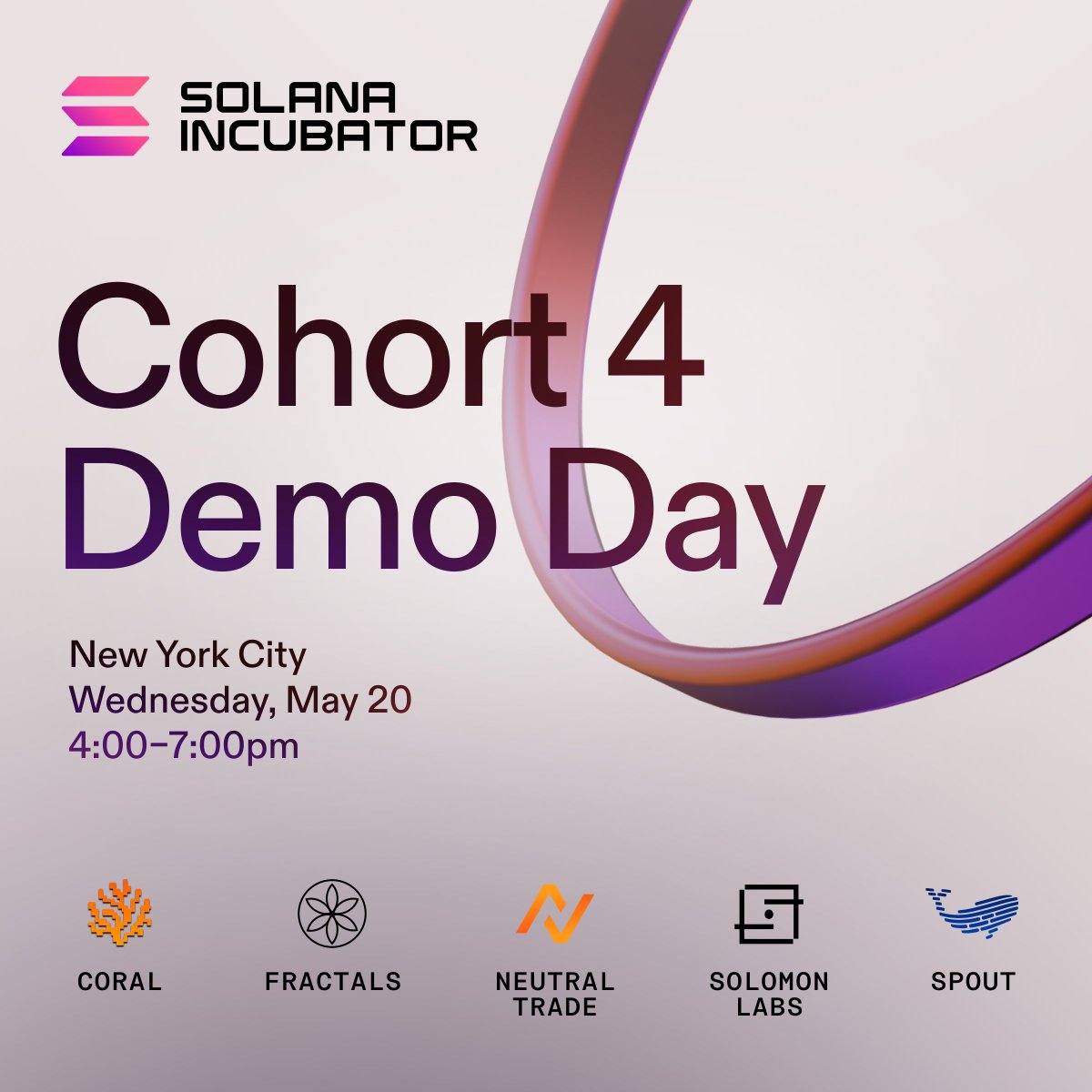
1/ Cohort 4 Demo Day is here! Come meet the teams who've spent the last 3 months building alongside Solana Labs — and see what they've shipped. Join us on May 20, 4-7pm in NYC for a first look at what’s next in the @Solana ecosystem. Limited spots, RSVP below.
Solana Incubator tweet media
English
28
30
152
33.7K
Suman Deb
Suman Deb@blackhawk_O·
@akshay_pachaar The fixed-size state bottleneck has been the core weakness of RNNs forever. Caching intermediate states rather than compressing everything into one vector sounds obvious in hindsight, but that's usually the sign of a genuinely good idea.
English
0
0
3
483
Akshay 🚀
Akshay 🚀@akshay_pachaar·
Google just solved an old RNN problem. A new paper from Google Research introduces "Memory Caching," and the idea is almost too simple to believe. Here's the problem it solves: Modern RNNs compress the entire input into a single fixed-size memory state. As sequences get longer, old information gets overwritten. That's why they still struggle with recall-heavy tasks compared to Transformers. Memory Caching addresses this by splitting the sequence into segments and saving the RNN's memory state at the end of each segment. When generating output, each token looks back at all these saved checkpoints, not just the current memory. The complexity trade-off is elegant: - Standard RNNs: O(L) - Transformers: O(L²) - Memory Caching: O(NL), where N = number of segments You control the trade-off by choosing how many segments to cache. The model smoothly interpolates between RNN-like efficiency and Transformer-like recall. The paper proposes four ways to use these cached memories: 1. Residual Memory: just sum all cached states (simplest) 2. Gated Residual Memory (GRM): input-dependent gates that weigh each segment's relevance to the current token 3. Memory Soup: interpolates the actual parameters of cached memories into a custom per-token network 4. Sparse Selective Caching (SSC): MoE-style routing that picks only the most relevant segments Gated Residual Memory (GRM) consistently performs best across tasks. Under simplifying assumptions, hybrid architectures that interleave RNN and attention layers can be viewed as a special case of Memory Caching. This gives clean intuition for why hybrid models work. They're implicitly caching memory states. On recall-heavy tasks, Memory Caching significantly closes the gap between RNNs and Transformers. When applied to already strong models like Titans, it pushes them even further ahead on language understanding benchmarks. Transformers still lead on the hardest retrieval tasks like UUID lookup at long contexts. But the direction is clear: you don't need to choose between fixed memory and quadratic attention. There's a useful middle ground now. All experiments are at academic scale (up to 1.3B params). Whether these gains hold at frontier scale remains open. This comes from the same team behind Titans and MIRAS, so it's part of a larger research program on memory-augmented sequence models. Paper: "Memory Caching: RNNs with Growing Memory" (Behrouz et al., 2026) Link in the next tweet.
Akshay 🚀 tweet media
English
21
104
651
43.7K
Suman Deb
Suman Deb@blackhawk_O·
@SebJohnsonUK The consultants who survive AI won't be the smartest ones. They'll be the ones who stopped using a 1997 slide deck tool first.
English
0
0
0
89
Seb Johnson
Seb Johnson@SebJohnsonUK·
A UK startup has just raised millions to stop consultants using power point Everyone is saying consulting is dead in the age of AI, and yet, its still a growing $1tn industry. So three founders are taking a different bet. They're betting that AI won't kill consulting, but like engineering, the best consultants will be those equipped with the best AI tools. At the moment consultants are still using power point - a tool from the 90s. Riplo is building a new operating system for consultants to enable them to work seamlessly with agents and get them off power point. They've just raised $2.3m, led by @chrismeermi of @CherryVentures. Is this the future of consulting? Lets see
English
13
9
67
6.9K
Suman Deb
Suman Deb@blackhawk_O·
@tokufxug The labeling accuracy in that demo is striking. Point cloud interpretation has historically been rule-based hell. Getting LLM reasoning into that pipeline changes what's actually buildable for robotics and spatial AI.
English
0
1
3
1.8K
Sadao Tokuyama
Sadao Tokuyama@tokufxug·
LLMが遂にテキストを脱皮し「現実世界」の3D空間をガチで理解し始めた。 SpatialLMは3D点群にLLMの推論力を適用し、壁やドアの構造、空間の繋がりを解釈して構造化データを出力する。 言語モデルを空間知能へ拡張するブレイクスルー。コードも論文もオープンに公開。
日本語
36
398
3.1K
226.7K
Suman Deb
Suman Deb@blackhawk_O·
@MaziyarPanahi Depth Anything v2 on MLX would be the natural follow-up. Real-time dense depth estimation on moving traffic, fully local, would make the 'needs the cloud' argument basically impossible to defend.
English
0
0
0
19
Maziyar PANAHI
Maziyar PANAHI@MaziyarPanahi·
Wow! This is amazing! Segmented every car locally in real time with Meta's SAM3 converted to MLX. Just on-device (M2 laptop) vision getting absurdly good. Local AI is moving faster than most people realize! What other models should we test? what kind of videos?
English
61
133
1.2K
176.8K
Suman Deb
Suman Deb@blackhawk_O·
The 100B real-world time-points across traffic, weather, and demand is the key detail here. That breadth is what makes zero-shot generalization plausible. Most foundation model claims fall apart without genuinely diverse training data.
Daily Dose of Data Science@DailyDoseOfDS_

Google open-sourced a time series foundation model. it works with any data without training. unlike traditional models, no dataset-specific training needed. TimesFM forecasts out of the box. trained on 100B real-world time-points across traffic, weather & demand forecasting.

English
0
0
0
41
Suman Deb
Suman Deb@blackhawk_O·
@simplifyinAI my accountant saw this and started updating his LinkedIn. we don't talk about it.
English
0
0
0
41
Simplifying AI
Simplifying AI@simplifyinAI·
🚨 BREAKING: Someone just built a self-hosted AI app that processes all your receipts and invoices automatically. You upload a photo. It extracts the product, taxes, dates, and auto-converts the currency, and keeps your financial data 100% private. 100% Open Source.
English
118
409
4.2K
531.7K
Suman Deb
Suman Deb@blackhawk_O·
@XueJia24682 so the robot wakes me up, cooks my food, and organizes my stuff... at what point do I just ask it to file my taxes and call my mom too
English
0
0
2
23
🇨🇳XuZhenqing徐祯卿
🇨🇳XuZhenqing徐祯卿@XueJia24682·
✨🇨🇳A Chinese company, Unipath, has launched a household robot that is now in real-home use. It can wake users up on time, operate home appliances, organize storage spaces, and even cook meals automatically.
English
840
2.4K
12.1K
2M
Suman Deb
Suman Deb@blackhawk_O·
@EHuanglu congrats on watching software do your job for you. editors spent years mastering their craft and you're out here celebrating being replaced. wild flex.
English
0
0
0
88
el.cine
el.cine@EHuanglu·
crazy.. OpenClaw generates video on Seedance 2, import into premiere pro and edit.. all by itself
English
368
589
6K
578.5K
Suman Deb
Suman Deb@blackhawk_O·
@Peter_Quadrel Named his AI tool after a fruit going brown in 3 days and said ad agencies are done. my guy really said 'drop your product URL' like it's a confessional booth for failed marketing teams.
English
1
0
0
79
Peter Quadrel
Peter Quadrel@Peter_Quadrel·
NanoBanana 2 just made your static ad agency obsolete. And I just open sourced the entire tool. Drop your product page URL. It pulls your logos, product images, fonts, colors, and brand voice automatically. Builds a full brand guide for you. Then generates ad creatives at scale using nearly 4,000 high-performing ad templates across 8 niches. It dynamically matches the best templates to your brand and brief. Here's what makes it different: → Instant resizing Get any ad in 1x1, 4x5, 9x16 with one click. No regeneration. No broken text. → Highlight-to-edit See an issue? Highlight the area and tell it what to fix. → Multiple brand profiles Run different brands or segments from one tool. → Auto persona building from real customer reviews → Multiple QC loops on briefs and final assets Catches AI-isms before you do. → Upload your own templates or use ours Runs locally. Just needs your Claude and Google API keys. This is the lite version of what we use internally. You get the full finished tool AND the open source code to make it your own. Creatives still design the system, this handles iteration and scale. Want a copy to download? 1. Like this post 2. Comment "AI" Will DM you the tool along with a tutorial shortly after.
English
2.5K
240
4.4K
289.4K
Suman Deb
Suman Deb@blackhawk_O·
@sukh_saroy terrifying how good it is... bro the codebase has 3 files and a README that just says 'TODO'. calm down.
English
0
0
3
1.1K
Sukh Sroay
Sukh Sroay@sukh_saroy·
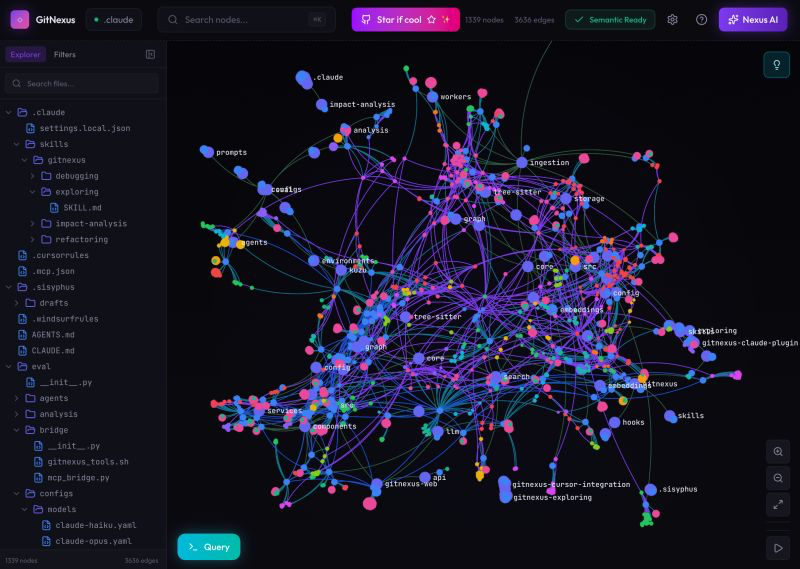
🚨Breaking: Someone just open sourced a knowledge graph engine for your codebase and it's terrifying how good it is. It's called GitNexus. And it's not a documentation tool. It's a full code intelligence layer that maps every dependency, call chain, and execution flow in your repo -- then plugs directly into Claude Code, Cursor, and Windsurf via MCP. Here's what this thing does autonomously: → Indexes your entire codebase into a graph with Tree-sitter AST parsing → Maps every function call, import, class inheritance, and interface → Groups related code into functional clusters with cohesion scores → Traces execution flows from entry points through full call chains → Runs blast radius analysis before you change a single line → Detects which processes break when you touch a specific function → Renames symbols across 5+ files in one coordinated operation → Generates a full codebase wiki from the knowledge graph automatically Here's the wildest part: Your AI agent edits UserService.validate(). It doesn't know 47 functions depend on its return type. Breaking changes ship. GitNexus pre-computes the entire dependency structure at index time -- so when Claude Code asks "what depends on this?", it gets a complete answer in 1 query instead of 10. Smaller models get full architectural clarity. Even GPT-4o-mini stops breaking call chains. One command to set it up: `npx gitnexus analyze` That's it. MCP registers automatically. Claude Code hooks install themselves. Your AI agent has been coding blind. This fixes that. 9.4K GitHub stars. 1.2K forks. Already trending. 100% Open Source. (Link in the comments)
Sukh Sroay tweet media
English
125
529
4.5K
461.9K
Suman Deb
Suman Deb@blackhawk_O·
@mikefutia @mikefutia bro wrapped a for-loop in Claude Code and called it a system. one brand name + one URL = 40 ads nobody asked for. congrats on automating mediocrity at scale.
English
0
0
0
9
Mike Futia
Mike Futia@mikefutia·
Claude Code + Nano Banana 2 is f*cking cracked 🤯 I built a system inside Claude Code that researches any brand, writes 40 ad prompts from scratch, and fires them all to Nano Banana 2. One brand name + one URL = 40 production-ready static ads. All inside Claude Code. I took @alexgoughcooper's brilliant framework and automated the whole thing inside Claude Code. Perfect for DTC brands and agencies who need high-volume ad creative without briefing a designer or spending hours in Canva. If you're finding winning ad concepts on Meta and manually recreating them one at a time in Higgsfield — copying prompts, pasting product details, tweaking aspect ratios, downloading, organizing... This system eliminates the entire loop: → Give Claude a brand name and URL → It researches the brand's fonts, colors, packaging, and photography style → Builds a Brand DNA document from scratch → Fills in Alex's 40 proven ad templates (headline, us vs them, testimonial, UGC, review cards, stat callouts) with brand-specific details → Fires every prompt to Nano Banana 2 with your product photos as reference → Downloads finished ads into organized folders with an HTML gallery No Higgsfield. No manual prompt filling. No copy-pasting between tools. What you get: → 40 ad formats filled with your exact brand colors, fonts, and copy → 4 variations per format so you pick the best output → Product photos passed as reference so the model matches your real packaging → A reusable system — new brand, new folder, same pipeline Built 100% in Claude Code with Nano Banana 2. I put together a full playbook & Loom video showing the exact process to set this up yourself. Want access for free? > Like this post > Comment "NANO" And I'll send it over (must be following so I can DM)
English
2.6K
233
4.4K
420.3K
Suman Deb retweetledi
CoralOS
CoralOS@CoralOS_ai·
Most multi-agent systems coordinate through prompt concatenation: one growing context window, passed between agents. It's simple, but coherence breaks down as context grows. Coral's thread model replaces shared context with isolated, persistent message threads. Each thread has an explicit participant list; messages are only visible to members. Delivery is "ping"-based. An agent receives a message only when named in the mentions field, at which point its wait_for_mentions() call resolves. Nothing is broadcast. No agent reasons over work it wasn't party to. This keeps each agent's effective context scoped and clean, regardless of how large the overall system grows. Another benefit of this approach is that it produces a structured, auditable message history that shared-context systems don't naturally generate.
English
0
6
24
545
Suman Deb
Suman Deb@blackhawk_O·
@satyaa designers spent years mastering tools, and the tools just became the client. wild shift honestly.
English
0
0
0
43
Satya
Satya@heysatya_·
AI designers are cooked, we just built an entire website with actual humans 🤯
English
199
162
5.2K
229.6K
Suman Deb
Suman Deb@blackhawk_O·
@akshay_pachaar Couldn't agree more. Let folks wear whatever they want - life's too short for dress code drama.
English
0
0
0
18
Akshay 🚀
Akshay 🚀@akshay_pachaar·
RAG was never the end goal. Memory in AI agents is where everything is heading. Let me break down this evolution in the simplest way possible. RAG (2020-2023): - Retrieve info once, generate response - No decision-making, just fetch and answer - Problem: Often retrieves irrelevant context Agentic RAG: - Agent decides *if* retrieval is needed - Agent picks *which* source to query - Agent validates *if* results are useful - Problem: Still read-only, can't learn from interactions AI Memory: - Read AND write to external knowledge - Learns from past conversations - Remembers user preferences, past context - Enables true personalization The mental model is simple: ↳ RAG: read-only, one-shot ↳ Agentic RAG: read-only via tool calls ↳ Agent Memory: read-write via tool calls Here's what makes agent memory powerful: The agent can now "remember" things - user preferences, past conversations, important dates. All stored and retrievable for future interactions. This unlocks something bigger: continual learning. Instead of being frozen at training time, agents can now accumulate knowledge from every interaction. They improve over time without retraining. Memory is the bridge between static models and truly adaptive AI systems. But it's not all smooth sailing. Memory introduces new challenges RAG never had, like memory corruption, deciding what to forget, and managing multiple memory types (procedural, episodic, and semantic). Solving these problems from scratch is hard. If you want to build Agents that never forget, Cognee is an open-source framework (12k+ stars) to build real-time knowledge graphs and get self-evolving AI memory. Getting started with Cognee is as simple as this: 𝗮𝘄𝗮𝗶𝘁 𝗰𝗼𝗴𝗻𝗲𝗲[.]𝗮𝗱𝗱("𝗬𝗼𝘂𝗿 𝗱𝗮𝘁𝗮 𝗵𝗲𝗿𝗲") 𝗮𝘄𝗮𝗶𝘁 𝗰𝗼𝗴𝗻𝗲𝗲[.]𝗰𝗼𝗴𝗻𝗶𝗳𝘆() 𝗮𝘄𝗮𝗶𝘁 𝗰𝗼𝗴𝗻𝗲𝗲[.]𝗺𝗲𝗺𝗶𝗳𝘆() 𝗮𝘄𝗮𝗶𝘁 𝗰𝗼𝗴𝗻𝗲𝗲[.]𝘀𝗲𝗮𝗿𝗰𝗵("𝗬𝗼𝘂𝗿 𝗾𝘂𝗲𝗿𝘆 𝗵𝗲𝗿𝗲") That’s it. Cognee handles the heavy lifting, and your agent gets a memory layer that actually learns over time. I have shared the repo in the replies!
GIF
English
51
135
804
65.7K
Suman Deb
Suman Deb@blackhawk_O·
@_vgnsh @AnthropicAI Just saw this wild notification about Claude AI. Anyone else getting spammed by these experimental features? Need to tweak my settings.
English
0
0
0
174
Suman Deb
Suman Deb@blackhawk_O·
@kamath_sutra Just saw this wild thread about AI voice tech. Sounds like we're on the cusp of seamless real-time translation everywhere. Game's changing fast.
English
0
0
0
26
Sudarshan Kamath
Sudarshan Kamath@kamath_sutra·
OpenAI's S2S preview is polished but it still thinks in steps. Speech → text → model → text → speech. That's not how humans converse. Introducing Hydra. A native speech-to-speech model that doesn't wait for turn-taking, doesn't flatten emotion into text, and doesn't break when you interrupt it mid-sentence. Hydra reasons asynchronously, speaks and listens simultaneously, and preserves emotion because it never leaves the audio domain. It's still in beta, but the shift is obvious. If you want early access, the link is in the comments. Here's a preview of what that looks like -
English
159
113
888
328.4K