BLASTΞASY

3.7K posts

BLASTΞASY banner
BLASTΞASY

BLASTΞASY

@blasteasy

Earth Katılım Ocak 2011
634 Takip Edilen1.2K Takipçiler
Sabitlenmiş Tweet
BLASTΞASY
BLASTΞASY@blasteasy·
My engine's PTY library spawns a real shell at runtime, so I run @claudeai inside my 3D scene and slop changes to it in real-time. 📷 ECS | SDL3 | Swift The good kind of slop Claude Code runs in the embedded PTY terminal overlaid on the 3D scene. Scene config is hot-reloadable
English
1
0
3
419
BLASTΞASY retweetledi
ℏεsam
ℏεsam@Hesamation·
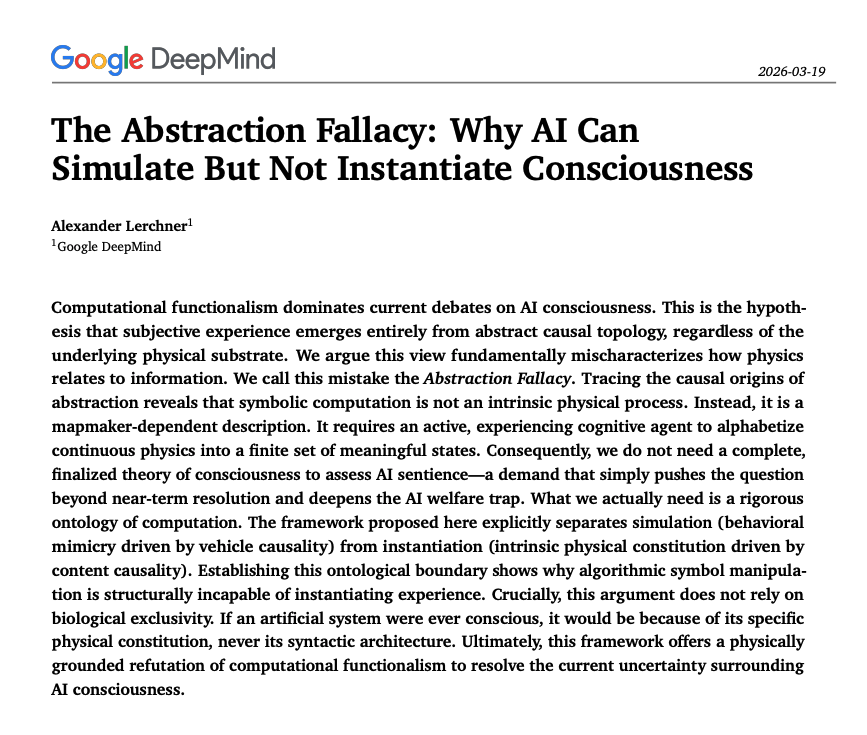
Google DeepMind researcher argues that LLMs can never be conscious, not in 10 years or 100 years. "Expecting an algorithmic description to instantiate the quality it maps is like expecting the mathematical formula of gravity to physically exert weight."
ℏεsam tweet media
English
333
3.8K
29.6K
4.8M
BLASTΞASY retweetledi
⟠
@ryanberckmans·
Where's the capital in crypto? Mostly on Ethereum
⟠ tweet media
English
29
76
477
44.6K
Doug Lance
Doug Lance@Douglance·
mentioning grok in a tweet causes a unique animation when clicking like on it
English
1
0
3
100
BLASTΞASY retweetledi
Joe Schiarizzi
Joe Schiarizzi@CupOJoseph·
I'm running for US Congress. Seriously. Imagine common sense crypto policy and regulation, aligned with American dynamism. Check out our list of new Crypto Policies we will support, linked below. x.com/va_joe/status/…
Joe Schiarizzi🌳@va_joe

I’m fed up with the direction our country is going. So I'm running for Congress in Virginia's new 7th district to put working families first, hold the powerful accountable, and fight to build a future we can actually be proud of. Learn more on our site linked below:

English
73
85
402
38.2K
BLASTΞASY retweetledi
Alex Finn
Alex Finn@AlexFinn·
Do you even understand what this means? An open source model just released that is: • Outperforms models 20x its size • Can run on a base model Mac Mini • Is AMERICAN 🇺🇸 If you have a base model Mac Mini you can have unlimited super intelligence on your desk. For free. Sonnet 4.5 was released 5 months ago In 5 months that level of intelligence went from frontier to free on your desk And not only that, can run on any basically any computer out there If you have even a remotely modern computer, do the following immediately: 1. Download LM Studio 2. Go to your OpenClaw and ask which of these new Gemma 4 models is best for your hardware 3. Have it walk you through downloading and loading it 4. Build apps with it knowing you are using your own personal, private super intelligence on your desk The people denying this is the future are so beyond lost.
Google DeepMind@GoogleDeepMind

Meet Gemma 4: our new family of open models you can run on your own hardware. Built for advanced reasoning and agentic workflows, we’re releasing them under an Apache 2.0 license. Here’s what’s new 🧵

English
283
560
7.1K
1.3M
BLASTΞASY retweetledi
Hayden Adams 🦄
Hayden Adams 🦄@haydenzadams·
People might accuse me of grave dancing for saying it But we have to stop letting centralized things call themselves DeFi Admin key can drain all funds? CeFi Otherwise DeFi means nothing and it’s brand is destroyed No admin key can drain any version of Uniswap for a reason
Omer Goldberg@omeragoldberg

2/ The protocol's signer key had full control over: - market creation - Oracle assignment - withdrawal limits There was no time lock, no multisig, and no delays. The attacker created the CVT token, maxxed risk params, manipulated the oracle, and drained $213 in 10 seconds.

English
127
208
1.7K
260.3K
BLASTΞASY retweetledi
Adam Schefter
Adam Schefter@AdamSchefter·
Tiger Woods announced he's stepping away to seek treatment and focus on his health.
Adam Schefter tweet media
English
878
830
10.4K
1.1M
BLASTΞASY retweetledi
Andy Johnson
Andy Johnson@AndyTFE·
A fun little interactive page we built for Augusta National where you can click into every hole with analysis, strategy and best shots. Check it out and let us know what we missed. thefriedegg.com/articles/maste…
English
20
74
815
290.7K
BLASTΞASY retweetledi
Justin Drake
Justin Drake@drakefjustin·
Today is a monumentous day for quantum computing and cryptography. Two breakthrough papers just landed (links in next tweet). Both papers improve Shor's algorithm, infamous for cracking RSA and elliptic curve cryptography. The two results compound, optimising separate layers of the quantum stack. The results are shocking. I expect a narrative shift and a further R&D boost toward post-quantum cryptography. The first paper is by Google Quantum AI. They tackle the (logical) Shor algorithm, tailoring it to crack Bitcoin and Ethereum signatures. The algorithm runs on ~1K logical qubits for the 256-bit elliptic curve secp256k1. Due to the low circuit depth, a fast superconducting computer would recover private keys in minutes. I'm grateful to have joined as a late paper co-author, in large part for the chance to interact with experts and the alpha gleaned from internal discussions. The second paper is by a stealthy startup called Oratomic, with ex-Google and prominent Caltech faculty. Their starting point is Google's improvements to the logical quantum circuit. They then apply improvements at the physical layer, with tricks specific to neutral atom quantum computers. The result estimates that 26,000 atomic qubits are sufficient to break 256-bit elliptic curve signatures. This would be roughly a 40x improvement in physical qubit count over previous state-of-the-art. On the flip side, a single Shor run would take ~10 days due to the relatively slow speed of neutral atoms. Below are my key takeaways. As a disclaimer, I am not a quantum expert. Time is needed for the results to be properly vetted. Based on my interactions with the team, I have faith the Google Quantum AI results are conservative. The Oratomic paper is much harder for me to assess, especially because of the use of more exotic qLDPC codes. I will take it with a grain of salt until the dust settles. → q-day: My confidence in q-day by 2032 has shot up significantly. IMO there's at least a 10% chance that by 2032 a quantum computer recovers a secp256k1 ECDSA private key from an exposed public key. While a cryptographically-relevant quantum computer (CRQC) before 2030 still feels unlikely, now is undoubtedly the time to start preparing. → censorship: The Google paper uses a zero-knowledge (ZK) proof to demonstrate the algorithm's existence without leaking actual optimisations. From now on, assume state-of-the-art algorithms will be censored. There may be self-censorship for moral or commercial reasons, or because of government pressure. A blackout in academic publications would be a tell-tale sign. → cracking time: A superconducting quantum computer, the type Google is building, could crack keys in minutes. This is because the optimised quantum circuit is just 100M Toffoli gates, which is surprisingly shallow. (Toffoli gates are hard because they require production of so-called "magic states".) Toffoli gates would consume ~10 microseconds on a superconducting platform, totalling ~1,000 sec of Shor runtime. → latency optimisations: Two latency optimisations bring key cracking time to single-digit minutes. The first parallelises computation across quantum devices. The second involves feeding the pubkey to the quantum computer mid-flight, after a generic setup phase. → fast- and slow-clock: At first approximation there are two families of quantum computers. The fast-clock flavour, which includes superconducting and photonic architectures, runs at roughly 100 kHz. The slow-clock flavour, which includes trapped ion and neutral atom architectures, runs roughly 1,000x slower (~100 Hz, or ~1 week to crack a single key). → qubit count: The size-optimised variant of the algorithm runs on 1,200 logical qubits. On a superconducting computer with surface code error correction that's roughly 500K physical qubits, a 400:1 physical-to-logical ratio. The surface code is conservative, assuming only four-way nearest-neighbour grid connectivity. It was demonstrated last year by Google on a real quantum computer. → future gains: Low-hanging fruit is still being picked, with at least one of the Google optimisations resulting from a surprisingly simple observation. Interestingly, AI was not (yet!) tasked to find optimisations. This was also the first time authors such as Craig Gidney attacked elliptic curves (as opposed to RSA). Shor logical qubit count could plausibly go under 1K soonish. → error correction: The physical-to-logical ratio for superconducting computers could go under 100:1. For superconducting computers that would be mean ~100K physical qubits for a CRQC, two orders of magnitude away from state of the art. Neutral atoms quantum computers are amenable to error correcting codes other than the surface code. While much slower to run, they can bring down the physical to logical qubit ratio closer to 10:1. → Bitcoin PoW: Commercially-viable Bitcoin PoW via Grover's algorithm is not happening any time soon. We're talking decades, possibly centuries away. This observation should help focus the discussion on ECDSA and Schnorr. (Side note: as unofficial Bitcoin security researcher, I still believe Bitcoin PoW is cooked due to the dwindling security budget.) → team quality: The folks at Google Quantum AI are the real deal. Craig Gidney (@CraigGidney) is arguably the world's top quantum circuit optimisooor. Just last year he squeezed 10x out of Shor for RSA, bringing the physical qubit count down from 10M to 1M. Special thanks to the Google team for patiently answering all my newb questions with detailed, fact-based answers. I was expecting some hype, but found none.
English
333
1.2K
5.8K
1.5M
BLASTΞASY retweetledi
PGA TOUR
PGA TOUR@PGATOUR·
This is what resilience looks like.
PGA TOUR tweet media
English
25
241
5.9K
301.4K
BLASTΞASY
BLASTΞASY@blasteasy·
@heygeorgekal Great work! Man, I’d love even just a small portion of the praise you’re getting for having built this pipeline, but in a custom engine vibecoded with CC… And yesterday, I got local 3D model gen. end-to-end; the engine renders these perfectly!
BLASTΞASY tweet media
BLASTΞASY@blasteasy

My engine's PTY library spawns a real shell at runtime, so I run @claudeai inside my 3D scene and slop changes to it in real-time. 📷 ECS | SDL3 | Swift The good kind of slop Claude Code runs in the embedded PTY terminal overlaid on the 3D scene. Scene config is hot-reloadable

English
2
1
0
164
George Kal
George Kal@heygeorgekal·
A lot of people asked how I built this game scene with AI. Here's the workflow: → concept art in Nano banana / ChatGPT → 3D models generated in Meshy AI → character animated in Meshy or Mixamo → give concept art of room to Claude Code + Godot MCP and ask it to recreate the scene in the game engine → run the game, screenshot it → feed screenshots back to Claude (chat) and ask it to critique → iterate until it looks right It's not as "easy" as making a web app, but doable. If there's interest I could write a detailed breakdown of the full pipeline.
George Kal@heygeorgekal

The first room of my 100% AI-developed ARPG is taking shape. → every model generated by meshy → every line of code written by claude code → Godot engine + MCP Now working on souls-like combat: 3-hit combos, dodge rolls, stamina, hitstop. It's a lot of fun.

English
50
13
317
35K
BLASTΞASY retweetledi
Doug Lance
Doug Lance@Douglance·
just shipped @douglance/play, a zero-boilerplate Playwright runner with durable named sessions, live debugger controls, and flat agent-first inspection commands great for letting LLMs drive and inspect a browser without writing test files npm i @douglance/play
English
2
1
4
237
BLASTΞASY retweetledi
Alex
Alex@AlexanderTw33ts·
maybe the real autist/adhd advantage is that we can move up and down abstraction layers when tech like this comes along we don't even notice the change agent-maxxing feels exactly the same as writing x86 did in my first year of college i'm typing in a computer, problems are being solved, my ideas are coming to life, shareholder value is being created its not that deep bro stop getting attached to your z value on the fractal tree
Alex tweet media
Mo@atmoio

I was a 10x engineer. Now I'm useless.

English
97
126
2K
176.2K
BLASTΞASY
BLASTΞASY@blasteasy·
Anyone using AI to write code has hit this wall: ✅It compiles ✅It passes tests ❌It looks totally wrong Which is exactly why when the full 2D lighting pipeline landed, the thing that actually made it work was this UI debug panel exposing every lighting parameter as slider:
English
0
0
2
122
BLASTΞASY retweetledi
Alex Prompter
Alex Prompter@alex_prompter·
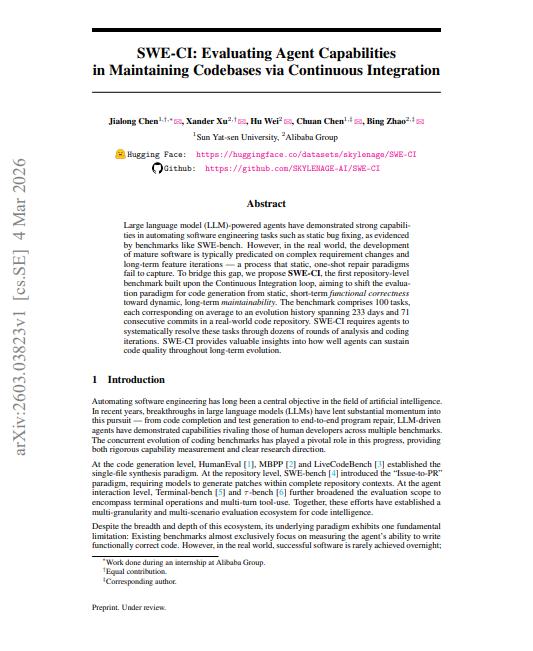
🚨BREAKING: Alibaba tested AI coding agents on 100 real codebases, spanning 233 days each. the agents failed spectacularly. turns out passing tests once is easy. maintaining code for 8 months without breaking everything is where AI collapses. SWE-CI is the first benchmark that measures long-term code maintenance instead of one-shot bug fixes. each task tracks 71 consecutive commits of real evolution. 75% of AI models break previously working code during maintenance. only Claude Opus 4 stays above 50% zero-regression rate. every other model accumulates technical debt that compounds over iterations. here's the brutal part: - HumanEval and SWE-bench measure "does it work right now" - SWE-CI measures "does it still work after 6 months of changes" agents optimized for snapshot testing write brittle code that passes tests today but becomes unmaintainable tomorrow. Alibaba built EvoScore to weight later iterations heavier than early ones. agents that sacrifice code quality for quick wins get punished when consequences compound. the AI coding narrative just got more honest: most models can write code. almost none can maintain it.
Alex Prompter tweet media
English
185
540
3.3K
707.2K
BLASTΞASY retweetledi
John Backus
John Backus@backus·
POK(AI)MON: Experimenting with GPT 5.4 autonomously editing and rewrite the Pokémon Red ROM, replacing Pokémon with AIs. Details below
Français
81
121
1.2K
197.1K
BLASTΞASY
BLASTΞASY@blasteasy·
The future doesn’t belong to people who prompt better adjectives. It belongs to people who design better frameworks. - Codify what matters. - Turn instinct into architecture. - Let AI operate inside it.
English
0
0
2
37
Doug Lance
Doug Lance@Douglance·
Coolest thing I’ve ever built by far. The feeling that you’re living in the future never goes away.
English
2
2
66
30.2K
BLASTΞASY
BLASTΞASY@blasteasy·
Today, I asked an LLM to rewrite prose, using the prompt: "...add variety to the descriptions, in the kind of way that an agentic conscientiousness might ask: 'what is it like to breathe?'" The irony is not lost on me.
English
0
0
1
45