

Aashutosh Vijayant
1.3K posts

Aashutosh Vijayant
@blubz
Dabbler, Dilettante, Dreamer
Hong Kong Katılım Mart 2008
2.4K Takip Edilen329 Takipçiler
Aashutosh Vijayant retweetledi

Finance will never not be weird to me because you have people asking questions like “even with perfect future simulation, how should motor actions be decoded? Is pixel reconstruction really the best objective, or shall we go into alternative latent spaces? How much robot data do we need, and is scaling teleoperation still the answer?”.
And then you’ve got a guy in an excel model like “EPS is 0.01 below my estimate” and that’s the one that determines the daily change in value for that company.
Jim Fan@DrJimFan
English

You read about index rebalance strategies everywhere, and it seems like a hedge fund darling, why?
It's one of the few systematic* strategies that are extremely scalable (you can run BILLIONS in capacity), and where the economic rationale for working is easily understood.
Index rebalance is all about predicting how much dollar flow is going into a stock relative to its average daily traded dollar volume. A high dollar flow relative to its usual traded dollar volume will mean the stock price will go up, and vice versa. It is beautifully simple conceptually, but VERY difficult to get right practically. A lot of PMs talk a big game about index rebal, but actually getting it right and managing your risks is NOT easy. Especially when so much of your gross returns can show up as momentum and short interest factors!
---
I write below about a foundational methodology, a starting point for thinking systematically about index changes. You’ll build more sophisticated signals over time, but this framework captures the core mechanics.
This methodology on systematic index change prediction crystallizes an approach many quant shops have traded for years.
Comment AND retweet on THIS post to get a chance for a free article!
English
You've read it somewhere, run PCA for "statistical factor analysis"; but material on this is either so shallow that it's meaningless (run pca and the eigenvectors are factors), or so dense that you'll need a PhD in Statistics to parse it.
This is the most information dense article on why PCA can actually extract factors, and how to reason about it.
Happy to share the article with some people who comment and retweets!
English
Aashutosh Vijayant retweetledi

In today's episode of programming horror...
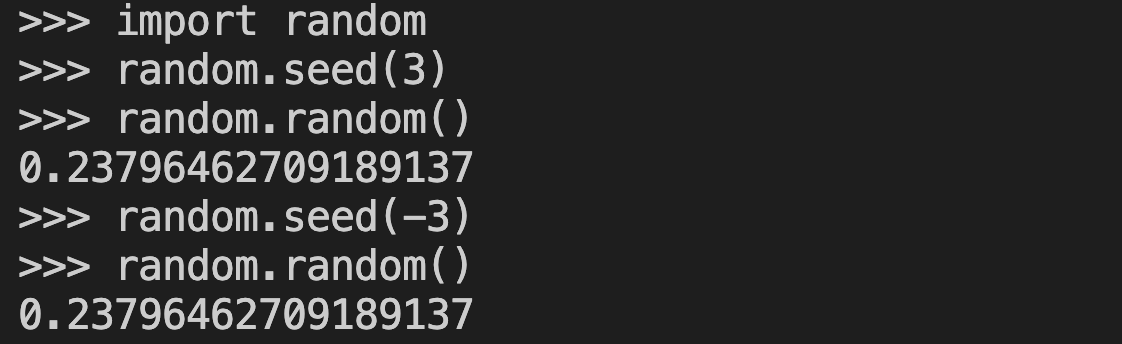
In the Python docs of random.seed() def, we're told
"If a is an int, it is used directly." [1]
But if you seed with 3 or -3, you actually get the exact same rng object, producing the same streams. (TIL). In nanochat I was using the sign as a (what I thought was) clever way to get different rng sequences for train/test splits. Hence gnarly bug because now train=test.
I found the CPython code responsible in cpython/Modules/_randommodule.c [2], where on line 321 we see in a comment:
"This algorithm relies on the number being unsigned. So: if the arg is a PyLong, use its absolute value." followed by
n = PyNumber_Absolute(arg);
which explicitly calls abs() on your seed to make it positive, discarding the sign bit.
But this comment is actually wrong/misleading too. Under the hood, Python calls the Mersenne Twister MT19937 algorithm, which in the general case has 19937 (non-zero) bits state. Python takes your int (or other objects) and "spreads out" that information across these bits. In principle, the sign bit could have been used to augment the state bits. There is nothing about the algorithm that "relies on the number being unsigned". A decision was made to not incorporate the sign bit (which imo was a mistake). One trivial example could have been to map n -> 2*abs(n) + int(n < 0).
Finally this leads us to the contract of Python's random, which is also not fully spelled out in the docs. The contract that is mentioned is that:
same seed => same sequence.
But no guarantee is made that different seeds produce different sequences. So in principle, Python makes no promises that e.g. seed(5) and seed(6) are different rng streams. (Though this quite commonly implicitly assumed in many applications.) Indeed, we see that seed(5) and seed(-5) are identical streams. And you should probably not use them to separate your train/test behaviors in machine learning. One of the more amusing programming horror footguns I've encountered recently. We'll see you in the next episode.
[1] docs.python.org/3/library/rand…
[2] #L321C13-L321C30" target="_blank" rel="nofollow noopener">github.com/python/cpython…
English
Aashutosh Vijayant retweetledi

Aashutosh Vijayant retweetledi

@FoxNews You spend a lot of time arguing and fighting over politicians and they just get along hahahahaha. Everyone left and right should stop taking politicians’ sides so seriously.
English
Aashutosh Vijayant retweetledi

I have finally understood the meaning of ETH's logo.

English
Aashutosh Vijayant retweetledi

The dean of the university asks the head of the physics department: "Why do you need such expensive equipment? Why can't you take a cue from the math department? All they ask for is pencils, paper, and wastebaskets! Or the philosophy department? All they ask for is pencils and paper!"
English
Aashutosh Vijayant retweetledi
@raindrop_fallin the most difficult thing to balance is the knowledge that the largest gains in technology are made independent of whether the stock market is going up or not
English
Aashutosh Vijayant retweetledi

@sundarpichai Get in anon, we're climbing the Kardashev scale.
English
Aashutosh Vijayant retweetledi

The main breakthrough of GPT-5 was to route your messages between a couple of different models to give you the best, cheapest & fastest answer possible.
This is cool but imagine if you could do this not only for a couple of models but hundreds of them, big and small, fast and slow, in any language or specialized for any task - all at inference time. This is what we're introducing with HuggingChat Omni, powered by over 100 open-source models including gpt-oss, deepseek, qwen, kimi, smolLM, gemma, aya and many more already!
And this is just the beginning as there are over 2 millions open models not only for text but image, audio, video, biology, chemistry, time-series and more on @huggingface!

English
Aashutosh Vijayant retweetledi

An exciting milestone for AI in science: Our C2S-Scale 27B foundation model, built with @Yale and based on Gemma, generated a novel hypothesis about cancer cellular behavior, which scientists experimentally validated in living cells.
With more preclinical and clinical tests, this discovery may reveal a promising new pathway for developing therapies to fight cancer.
English
Aashutosh Vijayant retweetledi

Freeport has declared force majeure at Grasberg — and with good reason.
This will shake both copper and gold balances. Let me explain why.
Grasberg is a giant. One of the largest mines on earth, producing ~1.7bn pounds of copper (≈2% of global supply) and ~1.6Moz of gold pa (≈1.5% of global supply).
Think of it as a vast underground city: 28,000 employees, 250 km of tunnels across dozens of levels. Each year, 35–40 km of new tunnels are added — roughly the length of Switzerland’s Gotthard Base Tunnel (57 km), the world’s longest rail tunnel.
At its heart lies the Grasberg Block Cave (GBC), which accounts for ~70% of reserves and output. Other sections include Big Gossan and Deep MLZ.
On Sept 8, disaster struck: ~800,000 tons of wet material suddenly rushed in, flooding multiple underground levels. The mud hit GBC directly — the very core of Grasberg’s production.
A catastrophic failure. How was this even possible?
Block caving itself may become central to the story. Out of more than 12,000 active mines worldwide, only ~20 have ever used block caving — a handful do so today - El Teniente in Chile; Oyu Tolgoi in the desert in Mongolia; Cadia East & Northparks, both Australia; Palabora, SA; who else? That’s <0.1% of all mines.
None do so or did in the past within a similar rainy climate as Grasberg does.
Block Caving is an extremely rarely applied mining method, reserved for very large, low-grade underground ore bodies which themselves are exceptionally rare. Most mining is open-pit, stoping, or cut-and-fill.
Block Caving has economic appeal — low cost per ton — but the geotechnical risks are likely immense. Once caving starts, the process is essentially an engineered collapse of the mountain. What could possibly go wrong?
That’s why this accident isn’t just a local disaster IMHO. It could become a case study for the entire mining method. Perhaps it wasn’t well understood how block caving behaves under Indonesia’s heavy rainfall and complex geology? I don’t know — but I wouldn’t be surprised if that proves decisive.
My view? By year-end, Freeport will be fortunate just to understand the mechanics of this accident. Until then, production forecasts are pure guesswork.
Such a failure should (a) have been impossible, and (b) means operations can only restart once it’s crystal clear why it happened and how it can be prevented from happening again.
Analysts say full recovery is likely by 2027. That’s total nonsense. Nobody really knows. A true “known unknown.”
What is known: any company with less strength and brainpower than Freeport McMoRan would likely go bankrupt from this. Think Victoria Gold — a minor heap leach pad slide sank it within weeks.
Mining companies get hit twice: revenues vanish while capital costs to fix the damage soar, and regulators delay re-issuing permits until safety is proven. And this accident involves death. It’s a total nightmare.
My view? This is no quick fix. With infrastructure damaged, safety paramount, at least two confirmed dead and five still missing, investigations ongoing, potential class actions looming, and permitting hurdles ahead, the road back for Grasberg will be long and uncertain.
The only good news: Grasberg adds too much to the GDP of Indonesia to not fix this nightmare.

English
Aashutosh Vijayant retweetledi

I think about this student's email every day.

English
Aashutosh Vijayant retweetledi


Aashutosh Vijayant retweetledi

Do not forget. It’s about control of the Fed. This is a very dark day.
Claudia Sahm@Claudia_Sahm
“This is a new attempt of the administration to gain more control over the Fed,” said Claudia Sahm, “They’re pulling as many different levers as they can find to get that control.” bloomberg.com/news/articles/…
English
Aashutosh Vijayant retweetledi

The #1 reason Gen AI is failing in large companies is that they have NO CLUE how to apply AI
- They won't use SOTA models for "security" reasons
- some of them are on-prem dinosaurs
- They have data in legacy systems
- can't upgrade and adapt quickly
They end up trying some basic thing on a half-dead Llama fine-tune, and then declare AI is failing 🤷♀️
English