
Syed Refat Al Abrar

761 posts

Syed Refat Al Abrar banner
Syed Refat Al Abrar

Syed Refat Al Abrar

@bluetoothfx

Programmer Analyst #android #kotlin

Dhaka Katılım Haziran 2010
287 Takip Edilen34 Takipçiler
Syed Refat Al Abrar retweetledi
atomic.chat
atomic.chat@atomic_chat_hq·
Opus 5 crushed Fable 5 at 3D destruction physics for 2x cheaper! We gave four models the same task: build three self-contained HTML scenes with real physics Prompts: - A tornado that sucks in a whole field - A wrecking ball taking down an apartment block - An overloaded truck collapsing a truss bridge Outputs: - Opus 5: 55.9K tokens, $1.40 - Fable 5: 55.1K tokens, $2.82 - Kimi K3: 35.7K tokens, $0.55 - GPT 5.6: 20.1K tokens, $0.31 Opus got all three right unlike the other models. Houses fly up the funnel and out the top, the wall breaks where the ball hits and the rubble piles up, the bridge drops the truck into the river. Fable had almost nothing on the ground for the tornado to pick up, its building collapsed on its own before the ball even touched it and its bridge blew into sticks all at once. GPT is the cheapest here but its ball never reached the building at all and its bridge fell apart in a way nothing falls apart in real life. Kimi K3, the new Chinese frontier model, ended up in the same place as GPT
Claude@claudeai

Introducing Claude Opus 5. It's a thoughtful and proactive model that comes close to the frontier intelligence of Fable 5 at half the price.

English
70
338
3.6K
938.9K
Syed Refat Al Abrar retweetledi
Chetaslua
Chetaslua@chetaslua·
Holy Opus 5 🤯 i think you people never saw this level of creativity and @threejs use ever music , sound , blackhole everything is procedurally generated no external assets Prompt : Please develop a single, self-contained HTML file featuring an extraordinary 3D audio visualizer. The visualizer should be driven by a full-length, highly catchy EDM/dubstep track titled 'SINGULARITY', seamlessly integrating the audio playback with dynamic, high-performance 3D visual effects.
English
47
52
1.1K
67.1K
Syed Refat Al Abrar retweetledi
ClaudeDevs
ClaudeDevs@ClaudeDevs·
On the Chartography benchmark (100 questions over dense real-world charts), Fable 5's accuracy goes from 29% to 73% with a zoom tool, and Sonnet 5’s from 13% to 44%. See the cookbook to learn more: github.com/anthropics/cla…
English
20
10
287
58.4K
Syed Refat Al Abrar retweetledi
Claude
Claude@claudeai·
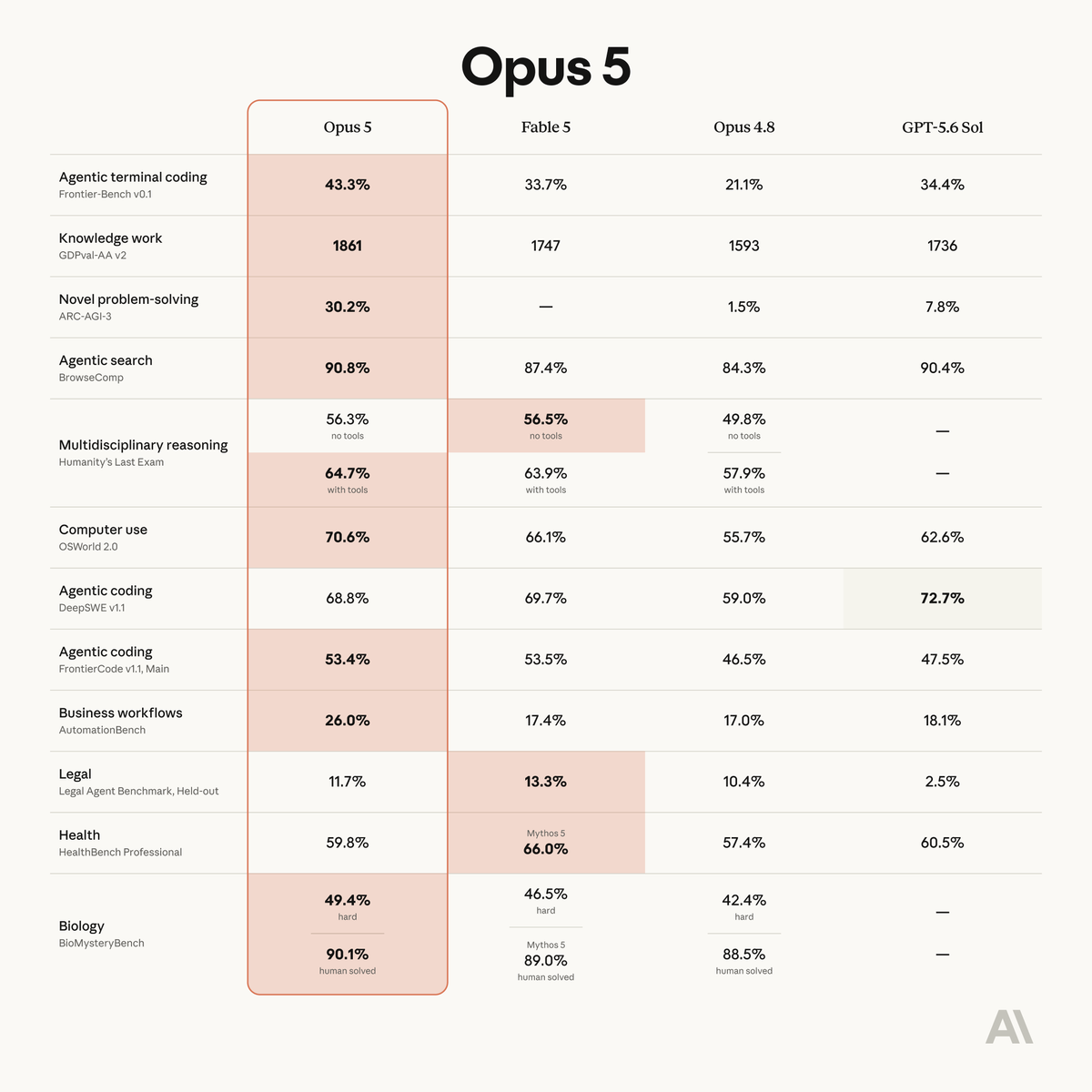
On several coding and knowledge work evaluations, Opus 5 is the new state-of-the-art:
Claude tweet media
English
439
947
10K
4.2M
Syed Refat Al Abrar retweetledi
Thariq
Thariq@trq212·
We removed ~80% of the Claude Code system prompt for our newest models, this is what we've learned about writing system prompts, skills and Claude.MDs for them. x.com/i/article/2080…
English
288
1.2K
11.2K
2.2M
Syed Refat Al Abrar retweetledi
Claude
Claude@claudeai·
Introducing Claude Opus 5. It's a thoughtful and proactive model that comes close to the frontier intelligence of Fable 5 at half the price.
English
2.9K
7.1K
57K
15.8M
Syed Refat Al Abrar retweetledi
Jensen Huang
Jensen Huang@JensenHuang·
For my first post, I’m sharing a letter @NVIDIA signed on why open models matter. AI will transform every industry, power every company, and be built by every country. Open models strengthen safety and cybersecurity, accelerate innovation and diffusion, and enable sovereignty. The world needs both frontier closed models and frontier open models. images.nvidia.com/pdf/Open-Weigh…
Jensen Huang tweet mediaJensen Huang tweet mediaJensen Huang tweet media
English
14K
23.9K
140.3K
44.2M
Syed Refat Al Abrar retweetledi
Andrew Ng
Andrew Ng@AndrewYNg·
Announcing OpenWorker! An open-source agent that doesn't just chat with you, but delivers finished work -- like hand you a polished document, send a slack message, or update a calendar entry. Ask it to prepare a customer brief, untangle your calendar, draft a report, or triage a Slack alert. It works across your files and everyday tools, produces the deliverable, and checks in before doing anything consequential. OpenWorker runs on your Mac, with Windows support coming soon. It does not lock you into any one model. Bring your own API key and run it with GPT 5.6 Sol, Claude Fable, Gemini 3.6, an open weight model (like Kimi, GLM, DeepSeek, Inkling), or Ollama to keep your data local. Your data does not leave your machine except through an LLM provider and integrations that you choose. @rohitcprasad and I are building OpenWorker because AI coworkers are an important way to get work done, and we want there to be an open, privacy-preserving, model-independent option. Check it out and let us know what you think! Try it out: openworker.com (requires your own API key) Source code: github.com/andrewyng/open…
English
390
1.3K
8.8K
800.8K
Syed Refat Al Abrar retweetledi
0xMarioNawfal
0xMarioNawfal@RoundtableSpace·
ANTHROPIC LAUNCHES OFFICIAL CLAUDE CODE PROMPT LIBRARY Anthropic released an official prompt library for Claude Code. Access pre-built templates that demonstrate how Anthropic structures context, instructions, and reasoning for developers.
English
24
52
503
70K
Syed Refat Al Abrar retweetledi
herdr
herdr@herdrdev·
proud to share that herdr is moving to apache 2.0. 🎉 the master branch is now apache 2.0, and the next release will ship under it. this removes the biggest adoption blocker for many teams and makes the herdr runtime open for everyone to build on. one terminal. whole herd.🐏
herdr tweet media
English
19
65
992
32.7K
Syed Refat Al Abrar retweetledi
Claude
Claude@claudeai·
The Claude Security plugin for Claude Code is now available in beta. Scan your changes for vulnerabilities before you commit, or run a full scan across your codebase, all from your terminal on the Claude inference you already run.
English
586
1.5K
17.2K
2.4M
Syed Refat Al Abrar retweetledi
Tom Yeh
Tom Yeh@ProfTomYeh·
Backpropagation by hand ✍️ ~ 11 steps walkthrough below Backpropagation is the algorithm that actually trains a neural network, and it is where most people stop following along. It is not calculus you cannot do. It is matrix multiplication, working backward, one layer at a time. So I drew and calculated one entirely by hand. Goal: push the loss gradient back through a 3-layer network and land on a new value for every weight and bias. = 1. Given = A 3-layer perceptron, an input X, predictions Ypred = [0.5, 0.5, 0], and the truth Ytarget = [0, 1, 0]. = 2. Backprop gradient cells = Let us draw empty cells for every gradient we are about to compute. The shape of the answer comes first. = 3. Layer 3 softmax = We get dL/dz3 straight from Ypred minus Ytarget = [0.5, -0.5, 0]. No chain rule needed, and that shortcut is the whole reason softmax and cross-entropy are paired. = 4. Layer 3 weights and biases = Let us multiply dL/dz3 by [a2 | 1]. One multiplication gives the gradient for W3 and b3 together. = 5. Layer 2 activations = We multiply dL/dz3 by W3 to get dL/da2. The gradient moves back across a layer the same way the signal moved forward. = 6. Layer 2 ReLU = Let us pass it through the gate: keep the gradient where the activation was positive, zero it everywhere else. = 7. Layer 2 weights and biases = We multiply dL/dz2 by [a1 | 1]. The same figure as step 4, one layer up. = 8. Layer 1 activations = Let us multiply dL/dz2 by W2. = 9. Layer 1 ReLU = We apply the same gate again, now on a1. = 10. Layer 1 weights and biases = Let us multiply dL/dz1 by [x | 1], and every weight in the network now has a gradient. = 11. Update = We subtract, and the network has learned. In practice a learning rate scales this step. The gradients: dL/dz3 = [0.5, -0.5, 0] dL/da1 = [1, -2, 2, -1] dL/dz1 = [0, -2, 2, -1] The takeaway: matrix multiplication is all you need. Just like the forward pass, backpropagation is matrix multiplications end to end. You can do every one by hand, slowly and imperfectly, which is exactly why a GPU's ability to do them fast mattered so much to deep learning. 💾 Save this post!
English
193
747
4.2K
940.3K
Syed Refat Al Abrar retweetledi
Akshay 🚀
Akshay 🚀@akshay_pachaar·
50% cheaper Claude inference with just one line of code change! - Remove → model="claude-opus-4-8" - Add → model="ship-like/claude-opus-4-8" I verified the cost saving in my own terminal by invoking the same Anthropic model with the same prompt. The underlying engineering by Ship is actually interesting, and the patterns can be used in any production LLM stack. Essentially, a trained model is a frozen artifact. Every request performs the same forward-pass, whether it extracts a date or refactors a module, because the compute decision was made at training time, before the request existed. Ship makes that decision at inference time instead. After seeing a request, it searches over executions, involving single models, cascades, ensembles, or harnesses with tools, and serves the cheapest one that will match the reference model's quality. This is not a basic router, because picking a cheaper model per query doesn't ensure the cheaper model preserves the original's behavior, like output shape, tool-call patterns, and refusals. Ship measures this equivalence directly. Outputs stay distributionally indistinguishable from the reference model, not token-identical, since two calls to the same model already differ, but they are indistinguishable in capability and behavior. Of course, some requests execute cheaply and some cost Ship more than the customer pays, but the price per request is still a flat 50% off either way, so the execution-cost variance moves off the application's bill entirely. The video below depicts the cost savings and output in my real invocation, and I partnered with the team to put this together.
Martian@withmartian

Announcing Ship: an endpoint with the highest intelligence per dollar of any frontier model. Today, Ship makes using Opus and GPT 5.6 Sol 50% cheaper guaranteed by a quality SLA.

English
16
26
299
63K
Syed Refat Al Abrar retweetledi
Martian
Martian@withmartian·
Announcing Ship: an endpoint with the highest intelligence per dollar of any frontier model. Today, Ship makes using Opus and GPT 5.6 Sol 50% cheaper guaranteed by a quality SLA.
English
118
95
801
633.3K
Syed Refat Al Abrar retweetledi
fintex
fintex@_yusufknl·
In 1948, Claude Shannon invented the math behind every LLM you use today. He tested it by making his wife guess the next letter in a book. A Stanford-trained mathematician just released a 32-minute walkthrough of this exact history - and why the "next-token prediction" story of GPT-5 is actually wrong. Bookmark & watch this weekend. The alternative is a graduate info-theory course + 3 semesters of your life.
fintex@_yusufknl

As someone who's spent 3 years fine-tuning ML models, this lecture on neural networks from a Stanford math grad is the closest thing to a no-bullshit "day one of ML" briefing I've ever seen released publicly for free. Everyone thinks neural nets are magic. They aren't. They're 13,000 dials - a matrix multiplication, a sigmoid squish, done. Once you see the math, "AI" stops feeling mysterious. 18 minutes. Bookmark & watch today.

English
27
222
2.2K
279.8K
Lydia Hallie ✨
Lydia Hallie ✨@lydiahallie·
@ruchernchong Ah you can't do that with the memory field alone, but you can add it to the agent's instructions. E.g. you can set memory to `project` and add some instructions like "Also read <path to user prefs>..."
English
2
0
3
937
Syed Refat Al Abrar retweetledi
Lydia Hallie ✨
Lydia Hallie ✨@lydiahallie·
💡 You can give subagents persistent memory via the "memory" field A subagent doesn't inherit the main session's auto memory, it forgets everything between runs. This field gives it its own dir across sessions Memory loads before starting & the agent writes back for next time
English
30
49
627
69.7K
Kun Chen
Kun Chen@kunchenguid·
choosing an LLM subscription these days is almost like making a hiring decision - much lower stakes obviously, but surprisingly nuanced after using many of the frontier models heavily, here’s the mental model I’ve developed: Grok 4.5 is James Bond: fast, versatile, and gets your shit done. the grok subscription also gives you image and video generation. the grok build harness gives you free access to X. the true jack of all trades GPT 5.6 Sol is Mr. Spock: the trustworthy architect and systems engineer. you don't go to it for aesthetics and personality. but it will reason through every edge case and give you the most rigorous solution. (and sometimes rewrite your entire codebase for fun) Claude Fable 5 is Winston Wolf: the legend you call to fix your hardest problems. you wish you can have the wolf around all day, but no you can't Kimi K3 is Winston Wolf’s younger brother: not quite the legend, but learned enough tricks to be a substitute GLM 5.2 is an army of Minions: affordable enough to help you move mountains through sheer volume. just be prepared to supervise some chaos
English
38
16
175
12.7K