
Sabitlenmiş Tweet
Earth
5.6K posts


Earth retweetledi

This week, @cerebras IPO'd in one of the largest technology IPOs in history.
We didn't get here alone.
There are many people and companies to thank.
To our families. It is not easy to be married to someone trying to build a company. The hours are long and so are the years. Their patience knew no bounds.
To our team. They bet big chunks of their careers on 5 guys who said we could solve a problem nobody had solved in 75 years.
There were 18 months between 2017 and 2019 when we couldn't make a single chip work. We were burning $8M a month. Every six weeks we'd sit with our board and say: not yet. Not yet. Not yet.
The team stayed steady. They solved problems nobody else could.
When our first wafer worked in August 2019, the technology was solved. But it was still 2019. OpenAI was nascent. There was no Anthropic. AI was still a parlor trick.
Then the models got good enough to be useful.
In some areas, necessary.
And when something becomes useful, speed is everything. Our business exploded.
To our early investors - @benchmark, @FoundationCap, @EclipseVentures, @coatuemgmt, @AltimeterCap and many more - whose support never wavered through years of challenges.
To TSMC, who agreed to work with us when we were a 40-person team with big ideas.
To our earliest customers - Argonne, Sandia, GSK - who bet on us when the product was raw and the roadmap unproven.
To Peng at G42, their Chairman, and the leadership of the UAE, who believed in us when many people were afraid.
And to many others not mentioned who contributed in ways large and small.
We say thank you.
Today starts a new chapter for us.
But it is still, just the beginning.
Photo Credit: @Nasdaq / Vanja Savic

English
Earth retweetledi

Earth retweetledi
We founded @cerebras with a vision to forever change AI compute.
Yesterday we went public on the @Nasdaq, an important step towards that goal.
Today our AI super computer solution was the centerpiece of a collaboration between the Governments of the UAE and India.
We are honored and humbled.

English
Earth retweetledi

I'm traveling the world for a bit, starting with China but then hopping around the globe, anywhere. Open to any adventure. No plans, only a backpack. Hoping to meet & get to know humans from all walks of life. The pic is from a long hike on the Great Wall. For me, as a fan of history, this was an epic experience.
In China, first I'm visiting a few big cities & talking to engineers at the heart of China's AI revolution. After that, if feeling crazy enough, I'm hitchhiking (first time) across rural China for a few weeks. Hitchhiking because I think it's the best way to meet rural folks who I would otherwise never get the chance to meet. I hope to do the same in US and other places.
I have a request, if you have a travel recommendation, fill out the form(s) below if you feel like it. Or share with folks who might have advice about such travel.
Form 1 - travel recommendation:
If you can, recommend to me an interesting place I should visit anywhere in the world. For this, fill out form 1. Not touristy stuff, but something off the beaten path, that tourists may not know about, but is legendary. It could be as remote as meeting a herder in the mountains who is a local legend. Asia, Middle East, Europe, India, South/North America, Africa, Australia, anywhere. In China, I'm hoping to visit maybe Heibei, Shanxi, Shaanxi, Gansu, Sichuan, Yunnan, etc, so recommendations for spots to visit are helpful.
Form 2 - coffee:
If you want to grab a coffee with me anywhere in the world, fill out form 2 (please don't use form 1 for that).
Anyway, I hectically tossed stuff in backpack. Realizing I don't have a clear plan of any kind, which is probably the only way to do it. LFG.
Love you all ❤️

English
Earth retweetledi

If you get this, you're a legend.
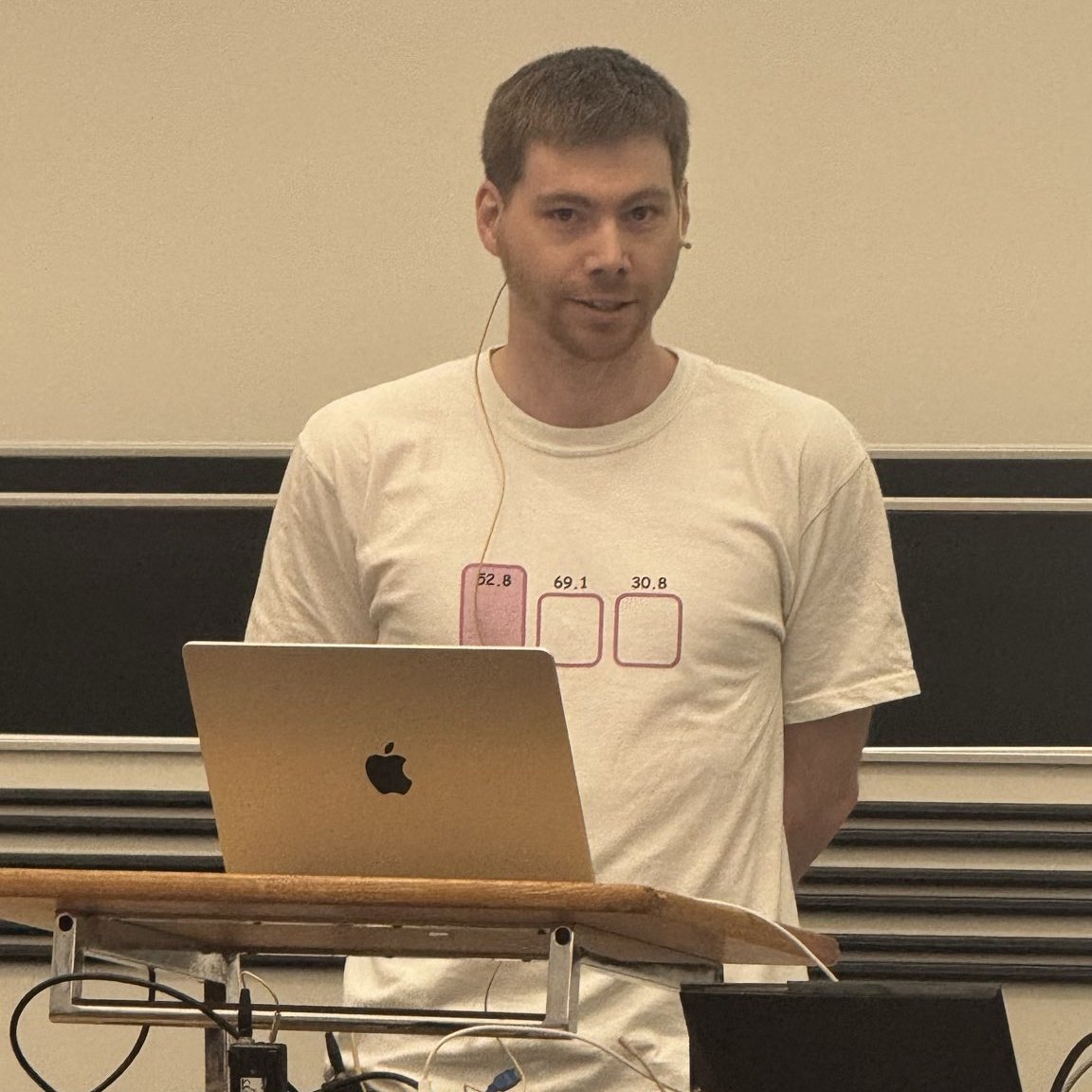
Kosta Derpanis (sabbatical in Zurich)@CSProfKGD
GREAT lecture by @giffmana 💪
English
Earth retweetledi

☀️ Today in Utqiagvik (the northernmost city in the United States), the sun rose above the horizon at 2:57 AM and won’t set again for 84 straight days or until August 2nd! Here's a look at a timelapse showing the sunset and sunrise this morning. #akwx
English
Earth retweetledi

Drive up the scariest road to the summit of Pikes Peak 🏔️!
FSD 14.3.2 did amazing today, not one disengagement! I’ll be honest - on some parts I had my hand on the wheel 😳.
I didn’t have my GoPro, so I used my iPhone. 2X speed.
Enjoy the snow ❄️ Happy Mother’s Day! 💐
English
Earth retweetledi

Earth retweetledi

OpenAI shipped a new speech-to-speech model today: gpt-realtime-2
This is the first speech-to-speech model good enough to use in my voice agents that do "real work."
Or real play, for that matter. Here's gpt-realtime-2 as the brain of the ship AI in Gradient Bang.
The voice-to-voice response and tool calling times here are unedited, so you can see exactly what the interaction with the model is like in an agent with a very complex system instruction and frequent tool calls.
(I did clip out the subagent task execution segments, after gpt-realtime-2 starts a subagent via a tool call. Subagents in this config used gpt-5.2 "medium" effort.)
English
Earth retweetledi


Earth retweetledi

Nvidia - jensen was 30 when he founded it
SpaceX - elon was 30 when he founded
Openai - sam altman was 30
Anthropic - dario was 37
Google - larry and sergey were 23 and 25
Apple - steve jobs was 21
Microsoft - bill gates was 19
Amazon - jeff bezos was 30
Facebook - zuckerberg was 19
English
Earth retweetledi

Earth retweetledi

Earth retweetledi

🇨🇳 China put a giant 3D illusion on a skyscraper that makes it look like the building is melting into liquid metal.
No AI. Just LED technology so good your brain can't process it's not real.
English

Earth retweetledi

It is a source of continuous delight to watch the AI community rediscover the fundamentals and the dynamics of software engineering as they take those things and embellish them with AI adjectives, making them sound all fresh and new and sparkly while in truth, those fundamentals remain, well, fundamental.
Remove AI from the discourse below, and what Andrew promotes are things one heard all the time as we saw - starting decades ago - the transition from assembly language to FORTRAN and COBOL, from structured to object-oriented, from waterfall to agile.
The past, as is said, does not repeat itself but rather rhymes.
Don’t get me wrong: I celebrate what Andrew et al are doing: developing software-intense systems that are meaningful and that endure requires intention and discipline, and I embrace that.
Two dangling threads before I close:
I don’t grok the semantics of “traditional teams”. The cosmos of computing is so wide and deep and diverse and crosses so many domains, I conclude that “traditional teams” is what one says when their experience is in a relatively narrow space, and they are witnessing a shift from what they grew up with in the Valley in particular, where web-centric systems of global elastic scale remain the primary focus.
Second, I am dismayed at the focus on speed. If you are driving head long Thelma and Louise style toward an IPO then certainly speed will be a critical factor. But for most of the domain of computing, for systems that are meaningful and that endure, other factors are far more important: correctness, repeatability, safety, maintainability, these dominate, and as such, don’t be distracted by the noise and smoke and heat and light of an AI first style that may get you out of the starting gate quickly, but will fail you in the ultra marathon of most development.
Andrew Ng@AndrewYNg
AI-native software engineering teams operate very differently than traditional teams. The obvious difference is that AI-native teams use coding agents to build products much faster, but this leads to many other changes in how we operate. For example, some great engineers now play broader roles than just writing code. They are partly product managers, designers, sometimes marketers. Further, small teams who work in the same office, where they can communicate face-to-face, can move incredibly quickly. Because we can now build fast, a greater fraction of time must be spent deciding what to build. To deal with this project-management bottleneck, some teams are pushing engineer:product manager (PM) some teams are pushing engineer:product manager (PM) ratios downward from, say, 8:1 to as low as 1:1. But we can do even better: If we have one PM who decides what to build and one engineer who builds it, the communication between them becomes a bottleneck. This is why the fastest-moving teams I see tend to have engineers who know how to do some product work (and, optionally, some PMs who know how to do some engineering work). When an engineer understands users and can make decisions on what to build and build it directly, they can execute incredibly quickly. I’ve seen engineers successfully expand their roles to including making product decisions, and PMs expand their roles to building software. The tech industry has more engineers than PMs, but both are promising paths. If you are an engineer, you’ll find it useful to learn some product management skills, and if you’re a PM, please learn to build! Looking beyond the product-management bottleneck, I also see bottlenecks in design, marketing, legal compliance, and much more. When we speed up coding 10x or 100x, everything else becomes slow in comparison. For example, some of my teams have built great features so quickly that the marketing organization was left scrambling to figure out how to communicate them to users — a marketing bottleneck. Or when a team can build software in a day that the legal department needs a week to review, that’s a legal compliance bottleneck. In this way, agentic coding isn’t just changing the workflow of software engineering, it’s also changing all the teams around it. When smaller, AI-enabled teams can get more done, generalists excel. Traditional companies need to pull together people from many specialties — engineering, product management, design, marketing, legal, etc. — to execute projects and create value. This has resulted in large teams of specialists who work together. But if a team of 2 persons is to get work done that require 5 different specialities, then some of those individuals must play roles outside a single speciality. In some small teams, individuals do have deep specializations. For example, one might be a great engineer and another a great PM. But they also understand the other key functions needed to move a project forward, and can jump into thinking through other kinds of problems as needed. Of course, proficiency with AI tools is a big help, since it helps us to think through problems that involve different roles. Even in a two-person team, to move fast, communication bottlenecks also must be minimized. This is why I value teams that work in the same location. Remote teams can perform well too, but the highest speed is achieved by having everyone in the room, able to communicate instantaneously to solve problems. This post focuses on AI-native teams with around 2-10 persons, but not everything can be done by a small team. I'll address the coordination of larger teams in the future. I realize these shifts to job roles are tough to navigate for many people. At the same time, I am encouraged that individuals and small teams who are willing to learn the relevant skills are now able to get far more done than was possible before. This is the golden age of learning and building! [Original text: deeplearning.ai/the-batch/issu… ]
English
Earth retweetledi

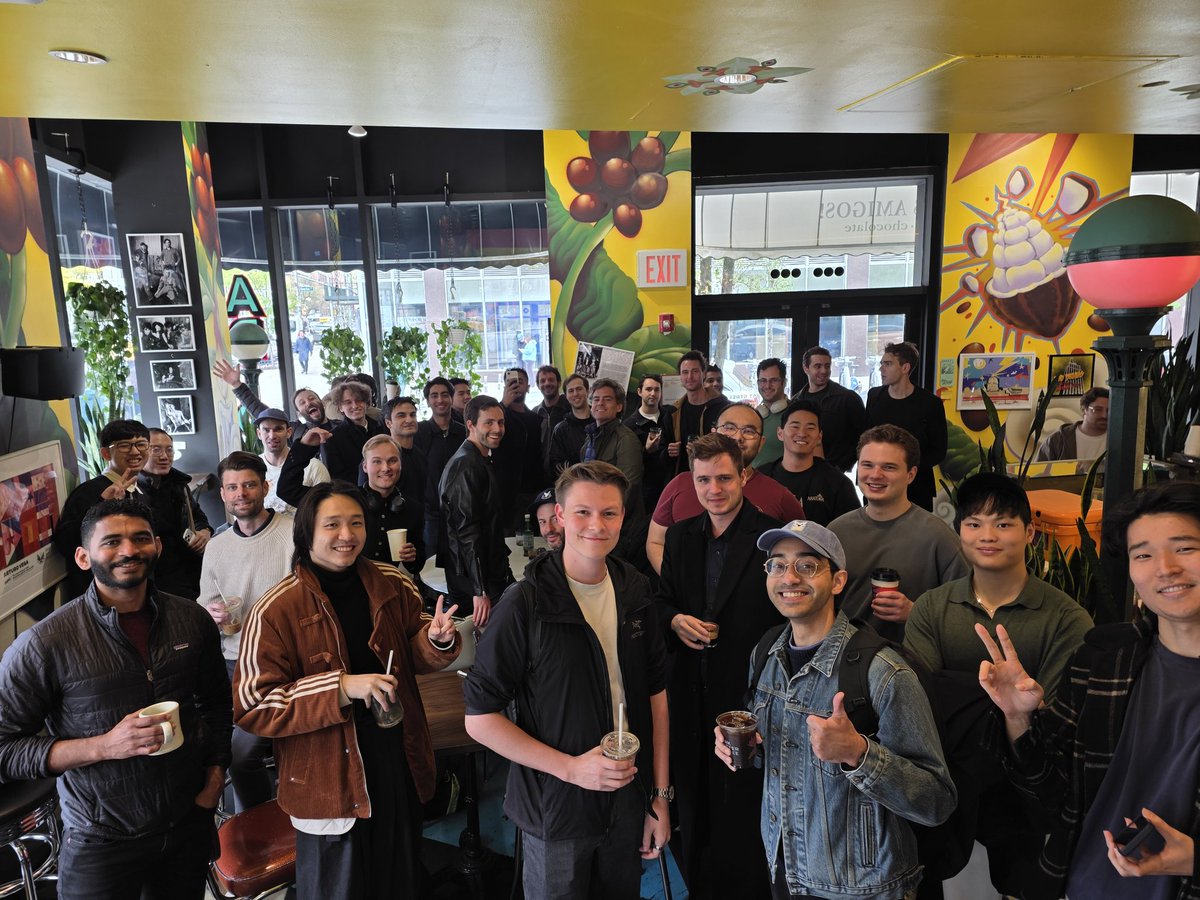
3 hr notice I had over 50 people come to the coffee shop incl a guy who brought his GPU for me to sign.
Crazy!
Dylan Patel@dylan522p
If anyone wants to meet in New York City today, I'll be at Dark Matter Coffee, NYC, from 11:00AM to 12:30! maps.app.goo.gl/jsEibm89kF2AfB…
Manhattan, NY 🇺🇸 English
Earth retweetledi

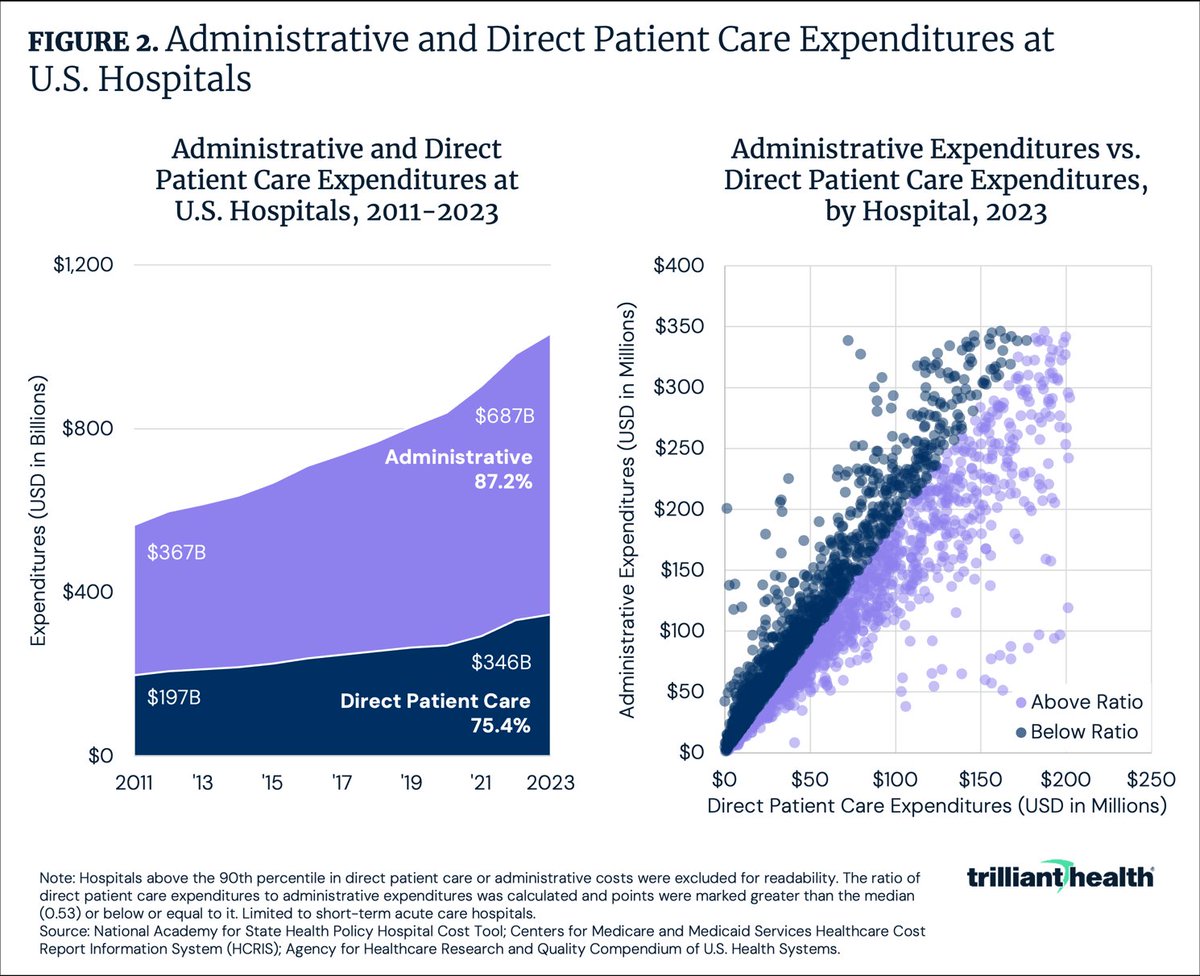
Healthcare administration costs should never exceed patient care costs.
English
Earth retweetledi


Earth retweetledi

Every cheap dopamine hit is paid back with interest. Andrew Huberman put the rates on paper. Chocolate 55% above baseline. Sex 100%. Nicotine 100%. Cocaine 225%. Amphetamine 1000%. Read that list as the size of the interest payment that follows each one.
Dopamine operates on a peak-trough system. Every spike above baseline is paid back with a dip below it. The bigger the peak, the deeper and longer the trough. Your brain is defending equilibrium.
A cocaine hit at 225% above baseline produces a physiological deficit below baseline when it wears off. Normal rewards can't clear the new floor.
Then the receptors downregulate. D2 density drops with repeated exposure. You have fewer receivers. The next hit registers at a smaller fraction above a lower baseline. Same money, less feeling, deeper crash. Compound interest on the original spike.
Now the "cheap" part, which is the whole mechanism. The dopamine release curve has two phases: anticipation and consumption. Earning something loads most of the dopamine into anticipation, spread across hours or days. Your brain evolved for that curve. Anticipation IS the reward architecture.
Scrolling, porn, pills, and slot machines collapse anticipation to zero. The full curve compresses into a single sharp spike. Same total dopamine, completely different shape. The compressed shape triggers receptor downregulation.
Huberman's line: any high amount of dopamine that comes to you without effort will eventually destroy you.
The mechanism explains why. Effort is the biological rate limiter that keeps dopamine release slow enough for baseline to survive. Take the rate limiter off, and your baseline is the currency cheap dopamine actually costs.
English