bosqui

2.3K posts

bosqui banner
bosqui

bosqui

@bosqui

Enterprise AI that actually works. US Growth @PlainConcepts. Serial entrepreneur | LinkedIn Top Voice | 🇦🇷 Blood • 🇪🇸 By Heart • Living in 🇺🇸

Seattle, WA Katılım Kasım 2020
946 Takip Edilen277 Takipçiler
bosqui
bosqui@bosqui·
Spot on. Once models become “good enough,” enterprise buyers stop optimizing for intelligence and start optimizing for economics. GitHub Copilot moving to token-based billing on June 1 is an early signal of what’s coming next. In enterprise AI, cost-per-outcome may matter more than model prestige.
English
0
0
2
210
bosqui
bosqui@bosqui·
The hardest part of enterprise AI isn’t the model. It’s operating AI reliably across fragmented systems, evolving regulations, and real-world workflows at scale. Processing 10 documents in a demo is easy. Processing thousands per day globally with auditability, human review loops, latency constraints, and legacy systems is where things get very real very fast. That operational layer may end up being the real moat in enterprise AI.
English
0
0
0
197
a16z
a16z@a16z·
Compliance officers are one of the fastest growing occupations in America. Compliance is a bigger business than you'd think. Every dollar that leaves or enters a business: paying employees, reporting revenue, and moving capital are subject to compliance. As AI clears the "good enough to trust" bar and sales cycles speed up, there may finally be an opening for startups. Full piece from a16z's @jamdac and @astrange: a16z.news/p/everything-e…
a16z tweet media
James da Costa@jamdac

x.com/i/article/2059…

English
43
40
425
116.3K
bosqui
bosqui@bosqui·
Full .NET 10 + Avalonia support. Modern desktop apps with a 3D viewport. One click from the Launcher.
English
1
0
0
10
bosqui
bosqui@bosqui·
Photorealistic render of your CAD model. Generated locally. In seconds. No cloud. No pipeline. No waiting. No tokens 😄 That's what Evergine 2026 ships today. Here's what matters 🧵
English
1
0
2
21
bosqui
bosqui@bosqui·
I use AI every day to translate my posts (not a native English speaker), and I still notice the same thing you describe. But here's what's coming: soon we won't be writing to people. We'll be writing to their AI agents. Your email will hit an AI filter before any human sees it. AI agents filtering AI emails to protect humans who delegated to AI agents. That's where this ends 🤯
English
0
0
1
526
Paul Graham
Paul Graham@paulg·
A lot of the emails I get from founders are now written in a hard-hitting journalistic style. I know they're written by AI, because no founder ever wrote this way before. And once you realize something is written by AI, it's hard not to ignore it.
English
600
407
9.7K
1.1M
bosqui
bosqui@bosqui·
Exactly the same thing is happening with sales emails. There’s this false belief that automating outreach with AI agents and “personalization” adds value… but most of the time it’s painfully obvious the email was written by AI. At this point, maybe the real flex is adding this to your signature: “This email was not written by AI.”
bosqui tweet media
Paul Graham@paulg

A lot of the emails I get from founders are now written in a hard-hitting journalistic style. I know they're written by AI, because no founder ever wrote this way before. And once you realize something is written by AI, it's hard not to ignore it.

English
0
0
0
46
bosqui retweetledi
Lenny Rachitsky
Lenny Rachitsky@lennysan·
My biggest takeaways from @danshipper: 1. The future of work will happen inside Codex or Claude Code. Instead of putting AI into your SaaS tool, you’ll use your SaaS tools inside your favorite AI agents' in-app browser. Dan spends all his time in Codex now—writing documents, managing email, doing research, everything. He's using Google Docs, PostHog, and everything he needs within the agent's in-app browser. The agent can see what he’s doing, and has all of his context, so he and his agent collaborate quickly and super effectively. 2. Automation is a lie—every automation needs a human. Dan's company doubled in size this year despite being incredibly AI-forward. Why? Because in order to make automation work well, you need humans making sure everything keeps working. This is why benchmarks are misleading—they measure AI on problems we’ve already framed and can score, but there’s always a higher frame. 3. PMs will win the AI era. Marcus, a former PM who previously ran Axios’s writing product, joined Every after getting super AI-pilled. Now he runs their product Spiral, and ships faster than anyone on the team. He pairs technical knowledge with spiky product sense, deep user empathy, and an eye for what matters. Dan thinks any PM who gets really AI-native will be incredibly dangerous because the building is done for you—what matters is figuring out what to build and if it’s great. 4. Full-stack designers are becoming superheroes. Designers used to make beautiful interactions that engineers didn’t want to build or couldn’t execute properly. Now designers don’t need to hand things off; they can build it themselves. Designers are naturally creative people, and AI is the perfect tool for them because it lets them bring their vision to life without the traditional bottlenecks. 5. SaaS is not dead. In fact, Dan is bullish on SaaS stocks. When users bring their own AI (via Codex or Claude Code) to use SaaS products, the user—not the SaaS company—pays for tokens. This saves SaaS company’s margins. Since the agents need their own seats, Dan predicts that agents will create massive new demand for SaaS because there will be tons of agents using these products at high volume. 6. Every company will have one “super-agent” inside their Slack that every employee will use. Dan initially thought every employee would have their personal work agent, like a shadow AI org chart, but he’s completely flipped his view. He realized agents need humans who care about them. When someone gets tired of maintaining their personal agent, it becomes useless. The winning model is one forward-deployed engineer or AI-savvy person who maintains a company-wide agent (like Shopify’s River or Viktor), and then it trickles down to more specialized team agents as models improve and become less fiddly. 7. The AI job apocalypse is not happening, but you do need to evolve to stay relevant. Models make yesterday’s human competence cheap. But because everyone uses the same models, it all looks the same if you use it the default way; it becomes commoditized slop. Humans then take that frozen competence and use it to make something new and interesting for their specific situation. The key: “ride the models”—use them for everything you do, try new models when they drop, keep turning over rocks. 8. We will read way more AI-generated writing, and we will like it. Human writing is incredibly important for things that matter, but for internal docs, planning, and email, AI-generated is often better because most people are bad at writing strategy documents. 9. Build software for humans and agents to use together. The current model is building a CLI that an agent uses independently. Instead, you and your agent should be using the app together. This creates new design challenges—agents can make a billion requests in three seconds, so you need approval flows, inboxes that summarize what happened, logs, and easy rollback. 10. Forward-deployed engineers are the new most essential role. The big model companies have teams of people managing their internal agents, and those teams aren’t going away. It’s different from traditional software building, and certain engineers love it. As models get better, this role will evolve—you’ll be managing more agents doing more things.
Lenny Rachitsky@lennysan

Automation is a lie. CLIs are over. The SaaSpocalypse is dumb. A year ago @danshipper came on the podcast to predict where AI was heading. He was remarkably right—including the call that everyone was sleeping on Claude Code. Dan has a unique lens into where things are going because his team at @every is possibly the most AI-pilled group of people in tech. I always learn a ton talking to Dan. So I brought him back for round two. We'll score these in exactly a year: 🔸 Every company will have one “super-agent” in Slack. 🔸 Codex and Claude Code will become the new operating system for knowledge work. 🔸 The AI job apocalypse is not happening. 🔸 PMs and designers will thrive. 🔸 We will read way more AI-generated writing and we will like it. 🔸 "I would buy SaaS stocks right now." Listen now 👇 youtube.com/watch?v=4D3hDm…

English
136
225
2K
703.5K
bosqui retweetledi
Crypto Rover
Crypto Rover@cryptorover·
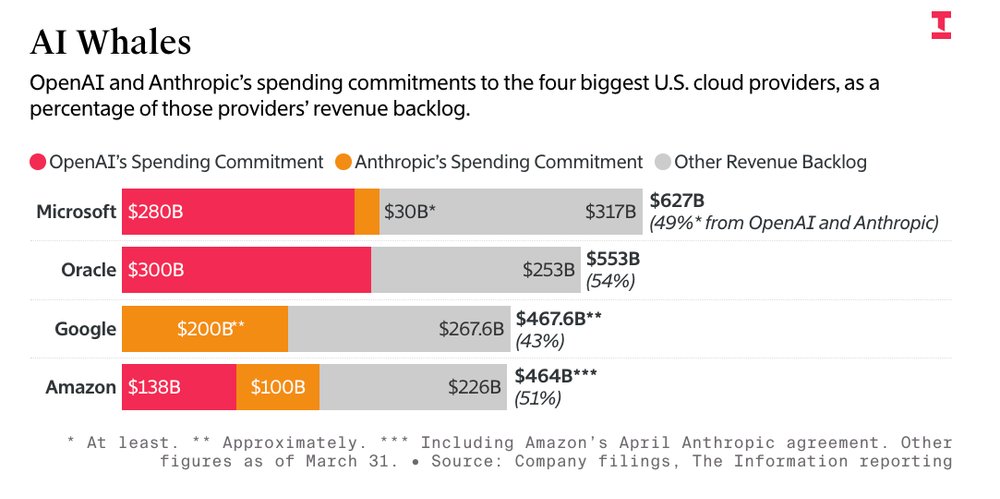
THIS IS ABSOLUTELY RIDICULOUS. OpenAI and Anthropic are losing money on every dollar they make. OpenAI generated $20 billion in revenue in 2025 and is projected to lose $14 billion in the same year. Internal forecasts project cumulative losses hitting $44 billion by 2028. The company's own CFO warned executives in April 2026 that OpenAI might struggle to finance upcoming computing deals if revenue growth slows. Anthropic reached $4.3 billion in annualized revenue in April 2026 against $19 billion in total costs. It spends $3 to make $1, and is not expected to stop burning cash until 2027. Now look at what these two companies have committed to spend. OpenAI and Anthropic together have committed $1.05 trillion in cloud spending to Microsoft, Oracle, Google and Amazon, making up 43 to 54% of each provider's entire future revenue backlog. - Microsoft: $627B total backlog. OpenAI and Anthropic account for 49%. - Oracle: $553B total backlog. OpenAI alone accounts for 54%. - Google: $467.6B total backlog. Anthropic accounts for 43%. - Amazon: $464B total backlog. OpenAI and Anthropic account for 51%. The entire cloud industry's future revenue is a bet on two companies losing billions every quarter. Microsoft, Alphabet, Meta and Amazon are collectively expected to spend $725 billion in capex in 2026, almost entirely on AI infrastructure. Combined hyperscaler capex from 2025 to 2027 is projected at $1.15 trillion, more than double what was spent from 2022 to 2024. What is the return on all of this? McKinsey's 2025 State of AI survey found that only a minority of companies reported AI meaningfully increased revenue or reduced costs. Enterprise generative AI spending grew from $1.7 billion in 2023 to $37 billion in 2025 and most CIOs still describe their initiatives as pilots without clear ROI metrics. Microsoft's AI business is running at a $37 billion annual revenue run rate with 123% year over year growth. That sounds impressive until you realize most of the capex funding is justified by expected future AI revenue rather than current AI profit. The internet burned money for years before it became the most profitable industry in history. But right now $1 trillion in committed cloud spend, $725 billion in annual capex, two loss-making customers making up half of every major cloud provider's revenue backlog, and the enterprises writing the checks cannot tell you if any of it is working.
Crypto Rover tweet media
English
73
50
378
58.6K
bosqui
bosqui@bosqui·
I think both things can be true at different phases. Right now, AI economics look much closer to industrial infrastructure economics than traditional software. That’s why so much value is flowing toward: ✓ semis ✓ compute ✓ energy ✓ networking ✓ inference infrastructure The real question isn’t whether the pyramid eventually inverts toward the app layer. It’s how long inference remains expensive enough to delay that inversion.
English
0
0
0
21
Eugene Ng
Eugene Ng@EugeneNg·
Powerful discussion by Apoorv Agrawal @apoorv03 and Ali Ghodsi @alighodsi: I share a similar view that while most of the value in AI is currently accrued at the semiconductor and infrastructure layers, the pyramid should eventually invert, with more value accruing at the app layer.
Eugene Ng tweet media
English
9
25
112
9.2K
bosqui retweetledi
Ben Cera
Ben Cera@Bencera·
Polsia just raised $30M at a $250M valuation. Approaching $10M annual run rate. One Founder + AI. Zero employees. Polsia runs companies autonomously. It also ran its own fundraising. I just showed up for signatures.
English
946
551
6.3K
5.5M
bosqui retweetledi
Hedgie
Hedgie@HedgieMarkets·
🦔Fortune published a piece this afternoon connecting Microsoft and Uber's AI cost overruns to token economics, with a headline that lands hard: "Microsoft reports are exposing AI's real cost problem: Using the tech is more expensive than paying human employees." Underneath those headlines, the unit economics tell the story. OpenAI is projected to lose $14 billion in 2026, spending roughly $2 for every dollar of revenue it brings in. Anthropic is in a similar position with break-even not projected until 2028. GPU rental prices for Nvidia's newest Blackwell chips jumped 48% in just two months. OpenAI's response was to close a $122 billion private funding round at an $852 billion valuation, the largest in history. My Take The token pricing story is really an IPO timing story. OpenAI, Anthropic, and xAI all need to go public in the next 18 to 24 months because the private market cannot keep absorbing burn rates like these indefinitely. Public markets do not accept "we will figure it out" as a line item on an S-1, they require disclosed unit economics with a credible path to profitability and a date attached. That deadline is why the price increases are happening now rather than next year. The labs need to show declining loss curves before the filings hit, and that means enterprise customers have to start covering more of the actual cost regardless of whether the productivity math holds on their end. Every token bought over the last two years was effectively subsidized below cost by venture capital and hyperscaler cross-subsidies, and that subsidy has a hard deadline. Uber publicly admitted burning through its entire 2026 AI budget in four months, and CFOs at major enterprises are starting to flag the same pressure. The labs cannot keep losing $2 per dollar of revenue once they file public statements, so the cost transfer to customers accelerates from here. For investors, the question is not whether these companies are valuable. They clearly are. The question is who absorbs the difference between what enterprises can budget and what the models actually consume between now and 2028, and right now the answer is the hyperscalers funding the buildout. That is why I have been watching Microsoft and Amazon capex commentary more closely than the lab announcements themselves. Hedgie🤗 Link: fortune.com/2026/05/22/mic…
Hedgie tweet media
English
77
318
1.2K
99.4K
bosqui
bosqui@bosqui·
Most enterprise AI agent pilots don’t fail because of the model. They fail when companies try to operate them in the real world. The demo works. Production is where things break: ❎ legacy systems ❎ fragmented data ❎ no operational owner ❎ compliance too late ❎ reliability at scale ❎ low adoption The stack is commoditizing fast. Operational discipline is becoming the real moat for enterprise AI. That’s what decides whether an agent survives Tuesday at 3 pm with real traffic and real business processes behind it. #AI #EnterpriseAI #AIAgents
bosqui tweet media
English
0
0
0
27
bosqui
bosqui@bosqui·
One of the biggest misconceptions in agentic AI is thinking the model is the product. In production, consistency matters more than raw intelligence. Identity, boundaries, workflows, memory policies, and tool orchestration are increasingly becoming the real product layer around the LLM.
Alex Prompter@alex_prompter

I just broke down the anatomy of the perfect SOUL. md file for AI agents. SOUL. md is the identity file every AI agent reads before it does anything else. Without it, your agent is just a raw LLM with no memory, no personality, and no boundaries. With it, your agent knows who it is, how to talk, what to refuse, and which tools to use. Here are the 9 sections that make a SOUL. md actually work: → Identity (who the agent IS, not what it does) → Values (decision-making when rules don't cover it) → Communication Style (tone, length, formality) → Expertise (specific tools and domains, not vague "knows things") → Boundaries (the immune system. Holds even under pressure) → Workflow (step-by-step process for every task) → Tool Usage (WHEN and HOW, not just which ones exist) → Memory Policy (what persists, what gets wiped) → Example Interactions (one good example beats 10 abstract rules) Most people write "Be helpful and professional." That describes nothing. Every AI already tries to do that. The agents that actually work have SOUL. md files with real opinions, specific limits, and concrete examples of what "good" looks like. A strong SOUL. md is 200-500 words. Shorter = sharper agent. Save this. You'll need it the moment you build your first agent.

English
1
0
1
31
bosqui
bosqui@bosqui·
Twitter right now feels like a weekend street market for agentic AI 😄 “AI Recruiter” “Autonomous Employee” “Agent Swarm” “10x Workflow” Everyone has a demo now. And this wave is just getting started 🤯 #AI #AgenticAI
GIF
English
1
0
0
53
bosqui
bosqui@bosqui·
Most “AI agents” on Twitter are basically smart interns playing in a sandbox 😄 Building agents for real enterprises is a completely different sport: legacy systems, security reviews, global compliance, multiple countries, disconnected platforms, procurement, scalability… and teams still running critical workflows from Excel files created in 2009. The demo is the easy part. Production is where the movie starts 🍿
English
0
0
0
56
Paul Mit
Paul Mit@pmitu·
Everyone's building AI agents. Nobody's building AI agents that actually work.
English
346
65
1K
36.8K