Mike He@BDM110110
$SOC new event to analyze. I will talk about the Coastal Commission action, but first an interim update I should have tweeted a month ago.
The settlement with SB marked a milestone in the regulatory journey and propelled the stock from ~$15 to ~$25 over the course of a few weeks. Anyone who follows this knows the PT on the stock ranges from $25 to $125 post restart. The SB regulatory block was the most highly visible catalyst, and the resolution meant the investment had now turned into an oil asset valuation exercise with invisible regulatory hurdles/uncertainties (invisible because they had yet to surface or be disclosed by the company), which I have no edge on.
Fast forward a month, everything seems to be sailing more or less smoothly when, BANG, the California Coastal Commission (CCC) comes out with an notice of violation and forced SOC to stop work on a bunch of the valves. I've spent some time reading the Coastal Act, looking into the SB approval and litigation history, and watching the recent CCC meeting where the CCC staff talks about their thinking on this.
Here are what I'm reasonably confident to be facts:
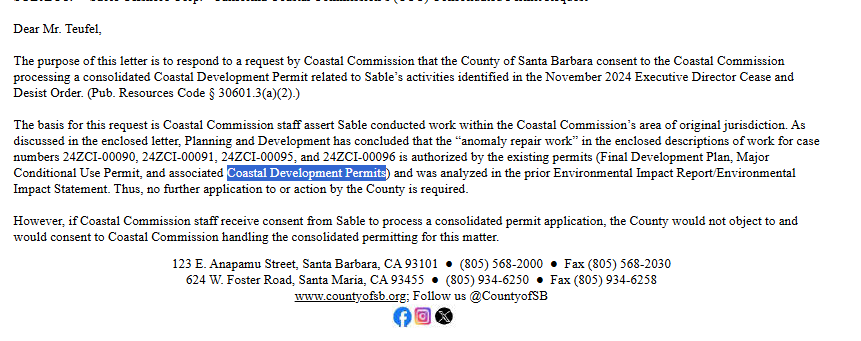
Developments in Coastal Zones generally require Coastal Development Permits (CDP). The CDP is uaully issued by the local government (SB county). Exxon originally received a CDP from the county planning department, but lost it on appeal to the county planning commission. SOC took over and sued the county and eventually got a settlement. The only thing I know about the settlement is that SB agreed that it "does not have jurisdiction over Pacific Pipeline Company’s (“PPC”) installation of 16 new safety valves" - from the Sep 3 8-K.
On the question of CDP, the CCC can claim jurisdiction in a situation where the local government has decided to not exercise jurisdiction. Here the CCC apparently sent a letter to SB asking them "are you relinquishing jurisdiction?" SB didn't respond beyond CCC's response deadline. CCC then turns around and issues the notice of violation to SOC, "We believe you need a CDP and you don't have a CDP, so stop and apply for a CDP". SOC says "we don't think we need a CDP" (see SOC's latest press release sableoffshore.com/news/news-deta…), but they stopped work anyway.
Here is my analysis:
I believe the key to this situation rests on the exact content of the settlement between SOC and SB. I've looked at the 8-K and the federal district case docket, and I don't think the settlement agreement is public. So here are two hypotheticals that are both consistent with the little disclosure we got on the 8-K.
The settlement could have been something along the lines of, "the SB county planning commission exceeded its jurisdiction in reversing the planning department approval of the permits". In this case, the permits, including the CDP, are reinstated. Meaning SB properly exercised its jurisdiction under the Coastal Act and issued a CDP to SOC.
Alternatively the settlement could have been "SB county has no jurisdiction whatsoever over the installation of the valves, so NO permits or approvals are required from SB county". In this case, SB says SOC never needed a CDP because it has no jurisdiction, and SOC does not have a CDP.
The important distinction between the two hypotheticals is, in the first one SB says it does have jurisdiction uner the Coastal Act and it approves a CDP, while in the second case SB says it doesn't think it has jurisdiction under the Coastal Act. In the second case, the CCC can step in and say, "we think you (SB) do have jurisdiction, and since you're not exercising it, now we can, and we will". One might argue that this was already litigated and settled. The answer to that is, yes, but only with SB county, you'd have to litigate this all over again with the CCC if you don't think the valves are subject to the Coastal Act and the CDP requirement.
The CCC commissioners are political appointees and many are elected local officials, which means it is much more political than a technical regulator like the OFSM. If SOC did not get a CDP from SB county, I believe the CCC will not go away and will be a huge pain to deal with. For an illustration of the CCC's political nature, note that in the same meeting where the CCC staff discussed their enforcement against SOC, the commissioners struck down a SpaceX application for extra launches off the coast of California because of Elon Musk's support for Donald Trump. politico.com/news/2024/10/1…
So...which way did the settlement go? Based on wording in the settlement 8-K, SOC's PR in response to the CCC notice, and the fact that SOC stopped work, I'm slightly (but not strongly) inclined to think the lawyers messed up and SOC does not have that CDP. If they did have the CDP, they should have mentioned that in their PR response to the CCC.
Another possibility is the the settlement is a little vague on the specific question of SB's jurisdiction under the Coastal Act and the status of the original CDP. In this case, SOC would want SB's help in clarifying in SOC's favor. I don't see a lot of motivation for SB to do that. The litigation against SB is settled one way or another, if SOC wants to sue again, it'll have to be against the CCC.
If SOC can show that it has a proper CDP from SB county, which i think is possible, then I believe the CCC has not power here and we're back to the races.