Bruno Ahualli

3.8K posts

Bruno Ahualli banner
Bruno Ahualli

Bruno Ahualli

@brunoahualli

Founder @HelloKilonova. Serial CMO to early-stage Web3 projects. Launched multiple 8 fig DTC brands. Rational Optimist

São Paulo - Brasil Katılım Temmuz 2008
5.2K Takip Edilen2.6K Takipçiler
Jack J.
Jack J.@jack_9947·
I put the entire Opus 4.7 and ChatGPT 5.5 GTM Engineer's Playbook into ONE Notion doc. 7 modules. No fluff. - The full lead gen stack using Firecrawl and LinkedIn MCP: scrape 20 structured leads from any industry in one prompt, filter and score 100 raw LinkedIn leads down to 50 high-intent contacts, and push to campaign with 73% connection acceptance rate vs 40% on standard outreach - The LinkedIn content pipeline built on Claude Code and Playwright: profile.md, hooks.md, descriptive photo folder, three draft options per post, and auto-publishing that pastes, uploads, resizes, and schedules directly to LinkedIn from one Sunday session - The automation decision rule across /loop, /schedule, and ChatGPT Workspace Agents: when to use each based on local file access, interval length, team sharing, and CRM tool requirements - Research and intelligence using NotebookLM and GPT 5.5: 300 sources queried at zero marginal cost per query and raw unorganised numbers turned into a clean filterable HTML executive dashboard in one prompt - Marketing asset production using Claude Design and ChatGPT Images 2.0: brand design system extracted in 10-15 minutes, carousel, video, and campaign planning skills built on top, plus multi-format social assets from one image upload with near-perfect text rendering - The 7 Claude commands most GTM engineers have never used: ultrathink, /caveman, /insights, /loop, /schedule, /btw, and /clear with exact syntax and decision rules for each - Cost cutting without slowing down: Claude Code Router at 88% cheaper than Opus 4.7 for simple tasks, /caveman on bulk generation sessions, and GPT 5.5 for dashboards and multi-deliverable briefs where it is faster and cheaper than Co-work This is the playbook I would have KILLED for before spending weeks running Claude and ChatGPT in separate tabs, paying Opus rates for tasks a router handles for pennies, and briefing designers on assets Claude Design produces in minutes. Like + comment "STACK" and I'll send it over (must be connected for priority access)
Jack J. tweet media
English
135
9
155
11K
Bruno Ahualli
Bruno Ahualli@brunoahualli·
@haridigresses Lol - that was uncalled for. Either way, thanks for the article and the tight rope reflection! Will continue to push so that all those things go right.
English
0
0
0
8
hari raghavan
hari raghavan@haridigresses·
@brunoahualli The way you’re repeating yourself makes it look like this is AI writing.
English
1
0
0
15
Bruno Ahualli
Bruno Ahualli@brunoahualli·
Yes, this is the tightrope. The only way through is to design the service so every delivery motion is already productization, not just delivery. The service is not the destination. It’s the bootloader. Every delivery run has to make the machine more real: better workflows, sharper evals, reusable primitives, domain memory, review gates, and clearer paths toward self-serve outcomes. Otherwise it’s just an AI-enabled agency. So yes, very tight rope! The key question is whether each customer compounds the product.
English
1
0
0
16
hari raghavan
hari raghavan@haridigresses·
Yep! But it's an extremely tight rope to walk. - Get enough service customers without bloating your team - Get them to use you without building the wrong expectations of service level - Charge them enough to prove value but not so much that ACVs tank when you switch them to agentic outcomes - Scale up enough to generate the data but don't fall into the trap at raising at too high a valuation - Hire professionals who know the domain but are still willing to move / operate in startup mode A LOT of things have to go right.
English
1
0
1
24
Mushtaq Bilal, PhD
Mushtaq Bilal, PhD@MushtaqBilalPhD·
> be Peter Boghossian, James Lindsay, and Helen Pluckrose > realize academic publishing is broken > decide some fields have stopped detecting nonsense > publish a hoax paper called "The conceptual penis as a social construct" > realize impact is smaller than expceted > decide to go bigger > write 20 fake academic papers > target journals in gender studies, queer theory, race, sexuality, fat studies, and related fields > call it "grievance studies" > invent fake authors > invent fake institutions > invent "Helen Wilson" > invent the "Portland Ungendering Research Initiative" > submit absurd papers through normal peer review > write one about dogs and rape culture at dog parks > write one about men reducing transphobia with sex toys > rewrite part of Mein Kampf in fashionable academic language > get 4 papers published > get 3 more accepted > get 6 rejected > still have 7 under review when the whole thing breaks open > get spotted when a journal asks whether Helen Wilson exists > get chased by The Wall Street Journal > admit the hoax in October 2018 > release the papers > release the reviewer comments > watch supporters call it Sokal squaerd > watch critics call it unethical research > watch academics argue about peer review, fraud, controls, and bullshit > watch Portland State investigate Boghossian for research misconduct > get attacked as publicity-seeking academic saboteurs > turn peer review into a culture-war battlefield > expose academic publishing
Mushtaq Bilal, PhD tweet media
English
4
14
68
4.2K
Jordan Ross
Jordan Ross@jordan_ross_8F·
The agency owners who fix their AI tech stack in the next 90 days are going to look like geniuses in 2027. The problem is every tool markets itself with the same words.. Agents Copilots. Memory. Automation Read about three and you can't tell which one to pick. So my team built a 105-page field manual that does the categorization for you. Inside: — The 8 software roles every modern agency stack collapses into (brand names change, roles don't) — The 5-question decision model that ends every "which tool should we buy" debate in under a minute — Specific picks by revenue band — what to run at $1M, $5M, $10M, and $20M+ — A task-to-tool matrix across marketing, sales, ops, fulfillment, reporting, and exec — 6 setup quickstarts including the $400/mo warehouse you can stand up in a weekend Comment STACK and I'll send it.
GREG ISENBERG@gregisenberg

how to set up hermes agent step by step. built-in memory, 40+ tools, works on your phone, and what to think of hermes vs openclaw: 1. hermes is a personal AI agent that runs in your terminal. think of it like open claw but with built-in memory, 40+ tools out of the box, and 90% cheaper token costs. you install it with one command. 2. the 3 problems with open claw that hermes solves: no memory (you keep repeating yourself), constant gateway restarts, and zero visibility into what you're spending on tokens. 3. hermes remembers everything. every completed task gets saved to memory. it searches through past logs to find solutions. over time it literally gets smarter at your specific workflows. 4. connect it to open router. you see exact costs per model per task. free models rotate weekly. one founder went from $130 every five days on open claw to $10 on hermes. same output. 5. it comes preloaded with skills. apple notes, imessage, find my, browser, web search, image generation, cron jobs. no hunting for plugins. 6. connect it to obsidian so it reads your entire vault. connect it to gstack for your dev environment. create custom skills for your specific workflows. 7. the biggest money saver: have it write code once for recurring tasks. then it runs without burning tokens every time. stop paying an LLM to do the same scrape or report daily. 8. run it on android via telegram. name your agents. talk to them like coworkers. in this episode imran shows you how to set this up. 9. you can run it bare metal, in docker, or serverless on modal. pick your risk level. i begged @imranye to come on @startupideaspod and walk through the full installation live. he made it impossibly clear. if you've heard of Hermes Agent and want the clearest explanation of how to get set up like a pro let me know what you want me to cover on the next ep this is the best personal agent setup video on the internet right now. watch

English
245
12
193
32.8K
Bruno Ahualli
Bruno Ahualli@brunoahualli·
@lifeof_jer Thank you for sharing this. I’m really sorry this happened to you. I’ll think through what we can do to avoid these failure modes and I’ll do that only because you shared your story. I hope you find a solution to this mess. 🤞🏻
English
0
0
1
59
Jordan Ross
Jordan Ross@jordan_ross_8F·
The agency owners who figure out Hermes in the next 90 days are going to look like geniuses in 2027. The problem is most agency owners don't have time to figure out the install, where to start, or what to actually hand it first. So my team built an 83-page playbook that does it for you. Inside: — The 5 daily prompts that turn it into a second brain — Plain English setup for Mac, Linux, and Android — How to lock it down without torching client data — 8 copy-paste workflows across reporting, outreach, sales, and ops — The cron trick that drops token spend by 90% Your competitors are sleeping on this. Comment HERMES and I'll send it.
GREG ISENBERG@gregisenberg

how to set up hermes agent step by step. built-in memory, 40+ tools, works on your phone, and what to think of hermes vs openclaw: 1. hermes is a personal AI agent that runs in your terminal. think of it like open claw but with built-in memory, 40+ tools out of the box, and 90% cheaper token costs. you install it with one command. 2. the 3 problems with open claw that hermes solves: no memory (you keep repeating yourself), constant gateway restarts, and zero visibility into what you're spending on tokens. 3. hermes remembers everything. every completed task gets saved to memory. it searches through past logs to find solutions. over time it literally gets smarter at your specific workflows. 4. connect it to open router. you see exact costs per model per task. free models rotate weekly. one founder went from $130 every five days on open claw to $10 on hermes. same output. 5. it comes preloaded with skills. apple notes, imessage, find my, browser, web search, image generation, cron jobs. no hunting for plugins. 6. connect it to obsidian so it reads your entire vault. connect it to gstack for your dev environment. create custom skills for your specific workflows. 7. the biggest money saver: have it write code once for recurring tasks. then it runs without burning tokens every time. stop paying an LLM to do the same scrape or report daily. 8. run it on android via telegram. name your agents. talk to them like coworkers. in this episode imran shows you how to set this up. 9. you can run it bare metal, in docker, or serverless on modal. pick your risk level. i begged @imranye to come on @startupideaspod and walk through the full installation live. he made it impossibly clear. if you've heard of Hermes Agent and want the clearest explanation of how to get set up like a pro let me know what you want me to cover on the next ep this is the best personal agent setup video on the internet right now. watch


English
814
92
1.1K
190.6K
Alex Vacca
Alex Vacca@itsalexvacca·
We run 13 n8n workflows across ColdIQ's entire content, ads, and outbound engine, and I'm giving them all away. Our monthly n8n bill: $384. The same workloads on Claude would cost $60K. That's why I'm not buying the "Claude killed n8n" take. Claude Routines are good at scheduled agentic tasks that need reasoning. They're not the same layer as n8n. They're not a replacement for production GTM infrastructure. Our n8n stack fires 2,000+ executions daily across 13 workflows. Our Phone Finder alone has 41 nodes and waterfalls across 5 data providers. Here's what's in the doc: → GTM Flywheel (81 nodes): domain in, full ICP, lookalikes, prospects, and a tailored content/ads/outbound strategy sent to your inbox → Phone Finder (41 nodes): name, LinkedIn URL, or domain in; Prospeo, FullEnrich, and more waterfalled; verified number in seconds → AI Agent Reply Manager (13 nodes): classifies a cold email reply on Instantly, drafts a response in Slack, waits for your approval before it goes out → Lookalike Finder (35 nodes): domain in, similar businesses by industry, size, and tech signals out → Viral Content Browser (10 nodes): pulls viral LinkedIn posts via Serper, filters by engagement, stores the best in Notion → Feeling Tracker (36 nodes, coming soon): sentiment analysis on any tool across X, Reddit, YouTube, and LinkedIn Plus 7 more covering content, GTM, and ops. Shoutout to Sacha Martinot who built the most complex ones. Reply "N8N" and I'll send you the full doc. Must be following.
GIF
English
295
24
171
23.9K
Dennis Willeboordse 👨🏼‍🦰 eCommerce Growth
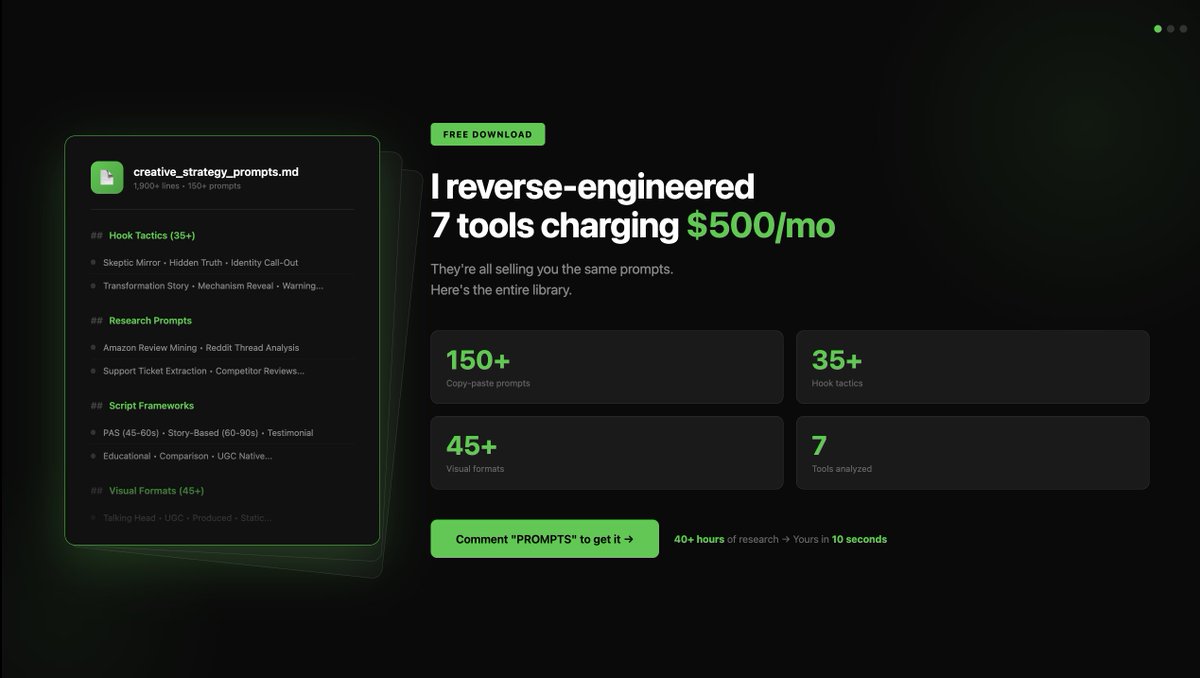
I spent 40 hours reverse-engineering 7 creative strategy tools. Motion, Atria, Foreplay, Gethookd. All of them. What I found: → They're all using the same prompts → Same hook formulas → Same script frameworks → Same research templates So I compiled everything into one doc: 150+ copy-paste prompts 35+ hook tactics with examples 45+ visual format templates Full script frameworks They charge $500/month for this. I'm giving it away free. Comment "PROMPTS" and I'll send it.
Dennis Willeboordse 👨🏼‍🦰 eCommerce Growth tweet media
English
358
11
173
18.1K
Christian
Christian@coldemailchris·
I spent the last 45 days writing a 86-page book covering absolutely everything I know about how to successfully run outbound in 2026. When I say everything, I mean EVERYTHING. > Company context analysis and market evaluation > ICP definition and Pain-Qualified Segment (PQS) modeling > TAM mapping across 15+ industry segments > Offer creation and the three types of cold offers > The psychology of cold email and pattern disruption > 10 fundamental copywriting principles from 10M+ emails sent > 6 proven cold email script frameworks with real examples > 5 messaging angles to test across campaigns > AI prompts for generating full A/B test script matrices > Email sequencer setup and which tools to use at which volume > Domain setup rules and secondary domain best practices > Reserve infrastructure and inbox cycling strategy > Deliverability signals, spintax, and campaign settings > How to identify burned accounts and recover fast > The four types of data sources and when to use each > The Campaign Score Formula for predicting results before launch > Speed-to-lead system and why response time kills conversions > 5 reply templates covering 90% of responses > Follow-up strategy across email, LinkedIn, phone, and SMS > Pre-call workflow that lifts show rates from 30% to 70%+ > Post-meeting process: proposals, contracts, and onboarding I told you I meant EVERYTHING. The insights in this book come from the experiences of 10M+ emails sent, 20,000+ leads generated, and deca-millions in pipeline value created. This e-book is NOT free, but it costs less than a Chipotle bowl with guac. (There needs to be a slight level of gatekeeping for this one) Want to get access to it? Comment “Playbook” and I’ll DM you the link to it. [Must be following to receive]
English
441
23
235
22.9K
Bruno Ahualli
Bruno Ahualli@brunoahualli·
@claudeai Great features guys, kudos! But what have you done with the visual identity? I'm deeply missing the colors and coziness of Claude. Light mode is sterile and Dark mode is way too black. You should at least leave the legacy color schemes. Bring Claude colors back!
English
0
0
0
248
Claude
Claude@claudeai·
We've redesigned Claude Code on desktop. You can now run multiple Claude sessions side by side from one window, with a new sidebar to manage them all.
English
2.1K
3.3K
42.9K
6.1M
Michel Lieben
Michel Lieben@MichLieben·
We spent months building a Claude Code system that runs outbound at our $7M ARR agency (and we're giving the whole thing away). Our head of GTM, Kenny, walks through the complete build on camera. Scores a target list against our ICP, pulls sales leaders via Apollo, enriches the missing emails, fetches our best-performing copy from Instantly's API, and loads 154 leads into Instantly with the copy and schedule set. Kenny packaged everything he used in the video below into a public starter kit. You get: → the GitHub repo → the CLAUDE md file we use → the Python scoring scripts Reply "send" and I'll DM you all three.
English
451
38
376
53.6K
Bruno Ahualli
Bruno Ahualli@brunoahualli·
A @garrytan soul md update sets the scene: For a long time, “good enough” was not a moral failure. It was adaptation. Research was expensive. Implementation was expensive. Testing was expensive. Documentation was expensive. Cleanup was expensive. So people learned to live with partialness. After all, completeness had a real price. But AI is collapsing the marginal cost of completeness across a growing share of knowledge work. Not all of it. But enough to matter. Enough that unfinished work increasingly stops looking like necessity and starts looking like choice. The old standard was built for expensive labor. The new one cannot be. This does not mean “do everything.” It means do the right things. The bottleneck is moving upward. From labor to judgment. The question becomes: What is worth finishing? Many teams will use AI to generate more half-work at much greater speed. More drafts. More patches. More features. More movement. Still incomplete. Loosely reasoned. The sharper founders will raise the standard on the things that matter: Critical path work. Customer-facing truth. Core product behavior. Canonical systems. Structural fixes. Institutional memory. Anything that compounds. Such things should stop receiving the “good enough for now” treatment when the real finish is within reach. That is what boil the ocean should mean. When something truly matters, stop normalizing the half-finished version of it. A founder should still ask: •Is this core or peripheral? •Is this compounding or cosmetic? •Is this the real fix or a distraction? But once the answer is yes, the standard has to rise. So do the real fix. Close the loop. Run the test. Write the documentation. Resolve the contradiction. In an age of cheap generation, completeness becomes a strategic weapon. It compounds trust. Anyone can generate motion now. Few can finish the thing that actually matters. That is the new founder standard: Finish the real thing. Boil the ocean, but only the ocean that deserves boiling. That is the hard part. That is where judgment lives. The machine can increasingly carry the labor. Which leaves the founder with a harder burden: to decide what deserves completeness, and to stop hiding bad prioritization inside unfinished work. For a long time, “good enough” was the language of constraint. In many domains, it is becoming the language of drift. Stop leaking force through a thousand tolerated incompletions. Boil the ocean.
Garry Tan@garrytan

New item in my SOUL md tonight

English
0
0
1
92
Alfie Carter
Alfie Carter@AlfieJCarter·
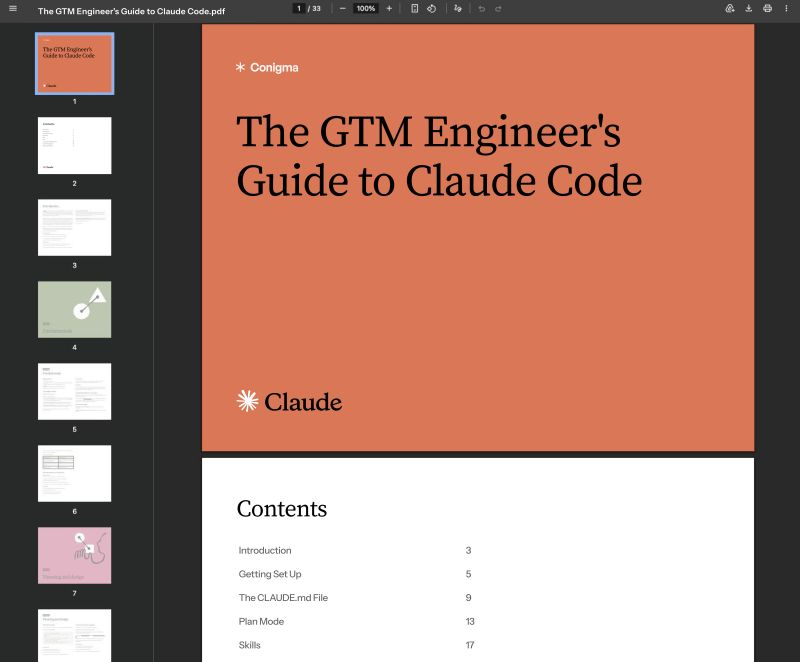
I put the entire Claude Code GTM Engineering Playbook into ONE Notion doc. 8 sections. No fluff. - How to get set up correctly from day one: Pro plan, terminal install across Mac, Linux, and Windows, GUI install via Antigravity or VS Code, and bypass permissions mode - What to put in your project brain file, what to leave out, and how to get Claude to update it automatically when it keeps making the same mistake - How to run plan mode step by step and when to skip it for simple tasks - How to build a skill file from scratch, fix one that keeps failing, and install 5 GTM skills worth building first: lead scraping, email labeling, proposal generation, outbound sequence writing, and client onboarding - MCP install process, token cost checks after every install, the best MCPs for GTM work, and how to cut token usage by 50 to 100x by converting MCPs into skills - Sub-agents and agent teams: the 3 cases where they earn their cost, reliability math for parallel runs, and how to enable parallel variant exploration - What is eating your context before you type anything, how to use /compact and /clear correctly, and model selection for parent vs sub-agents - Modal deployment: any skill as a live URL in under 2 minutes, form interface setup, and connection to n8n, Make, or Zapier This is the setup I would have KILLED for before spending months piecing together how to actually get productive in Claude Code from documentation, YouTube tutorials, and scattered GitHub threads. Like + comment "CODE" and I'll send it over (must be connected for priority access)
Alfie Carter tweet media
English
2K
198
2.9K
175.1K
Yann
Yann@yanndine·
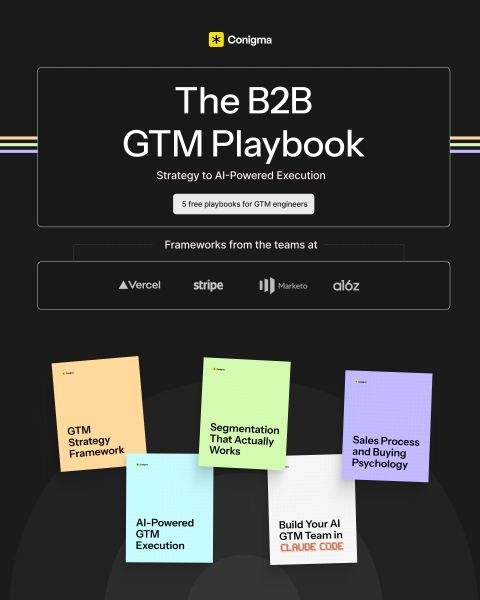
A two-person GTM team at a Series B SaaS company closed $2.4M in pipeline in one quarter. No SDRs. No demand gen agency. No paid ads. Signal-based outreach. Intent scoring. AI-sequenced follow-up. Automated reporting. Two GTM engineers running the whole motion - for one quarter. I pulled it apart. Compared it to every system we've built across the GTM teams we've worked with. Then asked myself one question: If I had to reverse engineer this from scratch - what would it actually look like? Turns out the architecture isn't that complicated. I mapped the whole thing into a step-by-step playbook you can upload directly to any LLM. It walks you through building your own version from GTM strategy to fully AI-powered execution. Comment "GTM" and I'll send it over.
Yann tweet media
English
939
34
492
55.3K
Bruno Ahualli retweetledi
Anthropic
Anthropic@AnthropicAI·
New Anthropic research: Emotion concepts and their function in a large language model. All LLMs sometimes act like they have emotions. But why? We found internal representations of emotion concepts that can drive Claude’s behavior, sometimes in surprising ways.
English
1K
2.7K
17.8K
3.8M
Bruno Ahualli
Bruno Ahualli@brunoahualli·
@starryskyshine1 @karpathy Would love to learn more about this - building a reasoning engine myself - there’s so much gold in epistemological thinking applied to AI
English
1
0
0
65
Mike F.
Mike F.@starryskyshine1·
@karpathy Hey, thanks for this insight. Inspiring me to build a Hegelian Dialectic Engine to run thoughts through philosophical filters - Toulmin decomposition, Socratic elenchus, and forced synthesis - to arrive at better thinking
Mike F. tweet media
English
9
5
199
47.1K
Andrej Karpathy
Andrej Karpathy@karpathy·
- Drafted a blog post - Used an LLM to meticulously improve the argument over 4 hours. - Wow, feeling great, it’s so convincing! - Fun idea let’s ask it to argue the opposite. - LLM demolishes the entire argument and convinces me that the opposite is in fact true. - lol The LLMs may elicit an opinion when asked but are extremely competent in arguing almost any direction. This is actually super useful as a tool for forming your own opinions, just make sure to ask different directions and be careful with the sycophancy.
English
1.8K
2.4K
31.4K
3.4M