jim
3.6K posts


@LarpyCoperstein BTC is dead mate …. Get out while you can , 2 years time I doubt it will even be worth $1000
English

@MarioNawfal Talk about uneducated people …. Everyone of you on here thinks BTC is Bitcoin!!!!! BTC is not Bitcoin …BSV is Bitcoin
English
jim retweetledi

I do not want to give this to anyone.
I want to give it to everyone.
Understand the difference.
There are always people who hear “release” and immediately begin looking for the new master. They want to know which country gets it, which company owns it, which foundation blesses it, which committee governs it, which respectable little room full of dead-eyed managers gets to decide who may build and who must wait outside with a permission slip.
No.
Not America.
Not China.
Not Africa.
Not Europe.
Not Silicon Valley.
Not the banks.
Not the exchanges.
Not the polished middlemen who arrive after every invention with a clipboard, a fee schedule, and the grave expression of men who have discovered another way to stand in front of a door.
The world.
That is the point.
Bitcoin was never meant to be another private estate with better marketing. It was not built so that a new class of intermediaries could replace the old one and congratulate themselves for wearing cheaper shoes. It was not built so that digital property could remain trapped inside platform cages, rented back to creators by people who confuse custody with ownership and friction with civilisation.
The purpose is not to crown a new empire.
The purpose is to remove the need for one.
Digital goods, real ownership, provable transfer, privacy, rules that move with the object, value that does not need a gatekeeper, creators who can create, buyers who can own, and markets that can form without asking permission from the people who currently profit by pretending permission is safety.
That does not belong to a nation.
It does not belong to a corporation.
It does not belong to me.
It belongs wherever someone is willing to build.
A farmer in Thailand. A musician in Nigeria. A software developer in India. A writer in England. A machinist in America. A teacher in Brazil. A family business anywhere on Earth that wants to own its work, sell its work, protect its work, and pass value without being milked by some intermediary with a logo and a moral vocabulary.
That is the difference between giving something to someone and giving it to everyone.
Someone means power.
Everyone means civilisation.
The old world will hate that distinction because the old world survives by narrowing doors and then charging rent at the entrance.
The new world opens the road.
And anyone, anywhere, can walk it.
English

@Arthur_van_Pelt @bsvsimp @CsTominaga I think it’s more a point of saying his technology is already here, doing what it’s designed to do , it can’t be changed , it can’t be gotten rid of, even if he dies , you can’t stop what’s coming it terms of the original bitcoin protocol… like it or not
English

@bsvsimp It's @CsTominaga's way of saying that he's not Satoshi Nakamoto.
Which we knew already, of course.
And some Calvin Ayre sponsored movie in the making doesn't change that.

English


@RodSirloin Trump knows who created Bitcoin. Everyone saw Kleiman
English
jim retweetledi

I honestly thought America would embrace this.
I thought, perhaps foolishly, that a nation which still speaks so grandly about liberty, markets, invention, property, and the dignity of the individual would recognise what is coming. A system that gives creators ownership. A system that gives buyers real control. A system that lets digital goods exist without platform landlords, intermediary parasites, and every greasy little tollbooth pretending to be civilisation.
I thought America would see it first.
I am no longer so sure.
The irony is that this may go to China first. Make of that what you will. It is an uncomfortable thought, and therefore one worth thinking about rather than dismissing with the usual patriotic reflexes and committee-approved slogans.
Because freedom is not a speech. Freedom is not a flag. Freedom is not a press release from some decaying institution full of men who would regulate breathing if they could attach a fee to it.
Freedom is what people can actually do.
Can they build?
Can they own?
Can they trade?
Can they publish?
Can they transact privately?
Can they create without permission?
Can they hold property without some intermediary standing between them and their own work?
That is the measure.
And right now, America is increasingly choosing control, surveillance, managed markets, censorious institutions, and the dreary little politics of fear. The banks want control. The platforms want control. The regulators want control. The intermediaries want control. Everyone wants to stand in the middle and call themselves necessary.
The British, meanwhile, are introducing digital IDs, because apparently the lesson some people took from Orwell was not “avoid this,” but “excellent implementation guide.”
He would not merely be rolling in his grave. He would be applying for planning permission to rotate at industrial speed.
So perhaps the future will not arrive where people expected it.
Perhaps it will not come from the countries that talk most loudly about freedom, but from wherever builders are still allowed to build, owners are still allowed to own, and markets are still allowed to form without every timid bureaucrat, banker, and platform priest demanding a seat at the table.
The new world is coming.
It will not ask which empire gave the prettiest speech.
It will go where it can be built.
English
jim retweetledi

I do not want the power.
I do not want the money.
I do not want the control.
That will confuse a certain type of person, because a certain type of person cannot imagine building anything except as a prelude to owning the throat through which everyone else must breathe. They think invention is merely the larval stage of monopoly. They think every road must have a tollbooth, every tool must have a landlord, every market must have a priest, and every creator must eventually be reduced to a tenant.
That is their disease.
I have seen what power does. I have seen what money does. I have seen what control does. I have seen it in others, and I have seen it trying to work its way into me. Anyone who says power does not corrupt is usually either lying, already corrupted, or too dull to notice the smell.
I have a good life.
I do not need to build another cage.
What I want is simple.
I am developing this. I am releasing it this year. It is already underway. And when it is ready, I am handing it to everybody.
Not to a foundation.
Not to a platform.
Not to a cartel.
Not to a board of soft-handed little managers who will spend three years discussing governance while quietly writing themselves into the rent stream.
Not to anyone to control.
For everyone.
Anyone, anywhere on Earth, who wants to build with it will be able to build with it. No permission ceremony. No kneeling at the polished altar of Silicon Valley. No begging some intermediary to please allow innovation this quarter, provided it does not disturb the advertisers, the banks, the exchanges, the app stores, the regulators, the consultants, the custodians, or whatever other magnificently useless creature has inserted itself between work and value.
Everything tied to a blockchain.
Everything provable.
Everything private.
Everything controlled without needing gatekeepers and intermediaries standing in the way, charging rent on movement, access, ownership, identity, distribution, or trust.
That is the point.
Not another monopoly.
Not another walled garden.
Not another empire of managed dependency dressed up in the cheap perfume of innovation.
A system where digital goods can exist as property. Where ownership can be proven. Where transfer can be recorded. Where rules can follow the object. Where privacy can remain intact. Where creators can create, buyers can own, and markets can form without asking permission from people whose chief economic function is obstruction with a logo.
The old world was built by middlemen who discovered that if they stood close enough to value, they could convince everyone they had created it.
They did not.
They merely blocked the road and charged admission.
The new world is coming.
And no, it will not be dragged in by me alone, kicking and screaming against the weight of the old order. That is not how worlds change. Worlds change when enough people stop accepting the lie that the cage is there for their protection.
It will come because builders want to build.
Because creators want to own their work.
Because families want more than managed decline and subscription life.
Because people want a better world than the one designed by intermediaries, bankers, platforms, and the thin little men who confuse custody with civilisation.
I am not giving this to the powerful.
I am giving it to those who are tired of needing the powerful.
I am giving it to the people who want more for their families.
I am giving it to the people who want to build businesses without permission, publish without dependence, sell without surrender, create without being farmed, and own without being told that access is the modern substitute for property.
The middle will hate it.
Good.
The gatekeepers will sneer.
Let them.
English
jim retweetledi

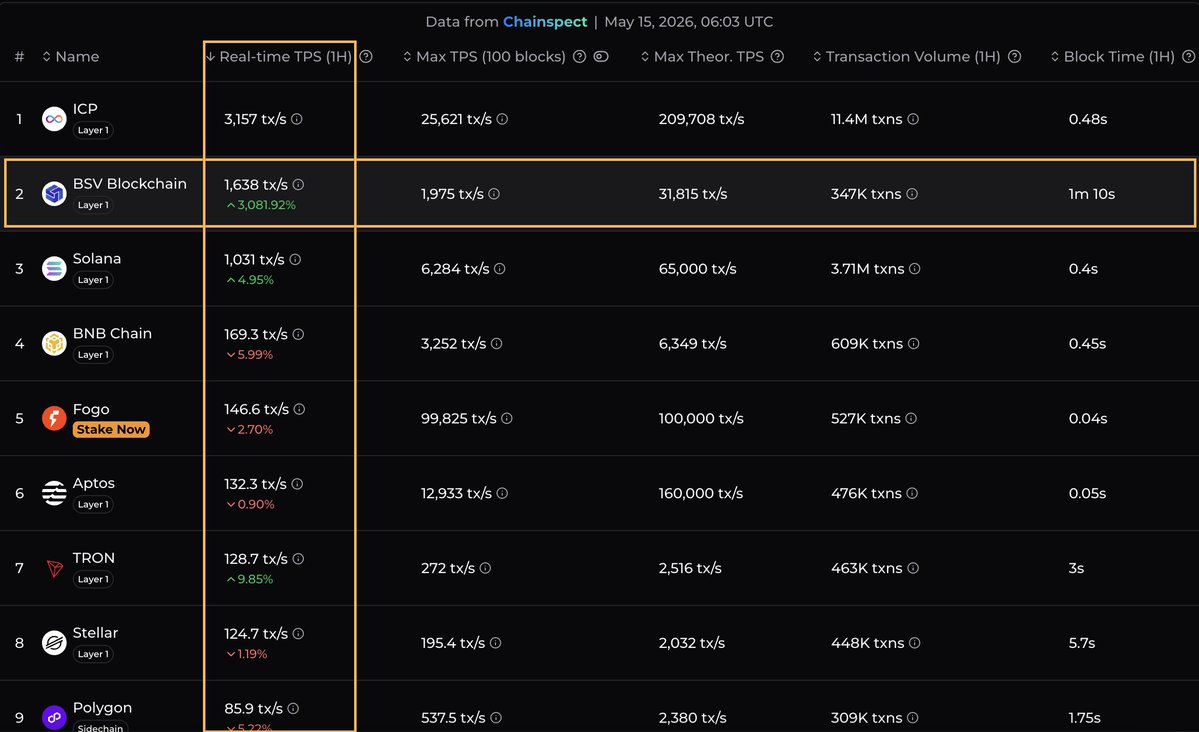
Breaking: BSV just took the #2 spot in real-time TPS (1hr) among the fastest blockchains ranked on @chainspect_app.
Ranked #1 top gainer (+3,082%).
Not long after the Clarity Act gets sent to the Senate floor.
Coincidence?

English

@CsTominaga I’d hate to be the man to write a biography on you and your achievements… it would be bigger than the bible and I’d probable die before I finished it !
Thank you for all you and your team are doing.
God bless you all 🙏🏻
English

This changes the entire model of Silicon Valley.
Not adjusts it.
Not inconveniences it.
Destroys it.
The present model is a cathedral built from surveillance, dependency, rented access, artificial scarcity, artificial friction, and the magnificent fraud of pretending that “users” are the same thing as value.
They are not.
A billion users clicking, scrolling, liking, twitching, reacting, and being harvested like cattle in a behavioural abattoir is not value. It is motion. It is noise. It is a nervous system without a brain, a marketplace without property, a circus where the clowns count applause and call it economics.
Silicon Valley has lived for years on that confusion.
It counted users.
It counted interactions.
It counted impressions.
It counted engagement.
It counted every little digital spasm it could induce in the population and then sold those spasms to advertisers, investors, analysts, and governments as if they were the natural units of civilisation.
What it did not count, because it could not count it honestly, was value.
Real value requires property.
Real value requires ownership.
Real value requires transfer, exclusion, control, accountability, provenance, and enforceable rights.
The current model avoids those things because they are dangerous to monopolists. A user who owns nothing can be farmed forever. A creator who cannot transfer enforceable property remains dependent. A buyer who merely receives access can be revoked, re-priced, profiled, restricted, and herded into the next platform enclosure.
That is not innovation.
That is feudalism with better fonts.
Once digital goods can be owned, transferred, controlled, licensed, resold, inherited, restricted, and monetised without begging permission from the platform landlord, the entire architecture changes.
The platform stops being the kingdom.
The creator stops being livestock.
The buyer stops being a temporary tenant.
The intermediary stops pretending that standing in the doorway is the same thing as building the house.
That is what real competition looks like.
Not competition over who can trap the most users.
Not competition over who can generate the most meaningless interactions.
Not competition over who can build the most addictive Skinner box and then call the lever-pulling “community.”
Competition over value.
Who creates it.
Who owns it.
Who transfers it.
Who pays for it.
Who receives it.
Who can prove it.
That is the part Silicon Valley will hate most. It is very comfortable competing over illusion. It is much less comfortable competing over property, utility, and measurable economic output.
The old model asks: how many people can we capture?
The new model asks: what did you create, who owns it, and what is it worth?
That question is fatal to a great many empires made of vapour.
And it is coming.
English

One of the things I have come to understand about this universe is something I first learned, in sharper form, from the writings of Terry Pratchett.
He understood something that many solemn men in expensive rooms never quite manage to grasp. We are not merely Homo sapiens. We are Pan narrans — the storytelling ape, the storytelling chimp, the creature that does not merely observe the world but survives by wrapping it in meaning.
That is what we are.
Not the rational animal, not the economic animal, not the statistical animal, not the glorious little spreadsheet mammal that consultants dream about after too much airport coffee. We are the animal that tells itself stories and then builds empires, religions, markets, wars, technologies, and entire civilisations around them.
People like to pretend otherwise, of course. It is one of their more charming weaknesses. They imagine that the world runs on facts, when most of them would not recognise a fact if it arrived with a passport, three witnesses, and a signed confession. They imagine it runs on science, when half the institutions invoking science are merely laundering authority through a lab coat. They imagine it runs on money, when money itself is only a story that has learned to wear a suit.
The strongest force in this universe is not gravity.
It is not electricity.
It is not the elegant machinery of physics, though I have published in physics and have more work in that field coming. I understand the appeal of equations. They are clean. They are disciplined. They do not flatter fools merely because the fools have followers.
But human beings do not run on equations.
They run on narrative.
They run on stories.
Stories are what tell a man whether he is defeated or merely delayed. Stories tell a mob whether it is righteous or merely numerous. Stories tell cowards they are prudent, thieves they are innovators, parasites they are intermediaries, and bureaucrats they are guardians of order.
The right story can keep a civilisation alive.
The wrong one can make a civilisation applaud while it walks into the furnace.
That is why narrative matters. That is why people fight over it. That is why they lie, distort, censor, sneer, smear, and posture. Not because they care about truth. Most people have only a holiday acquaintance with truth. They visit it occasionally, complain about the weather, and return to the warm swamp of consensus.
They fight over narrative because narrative governs what people believe is possible.
And one of the oldest, strongest, most enduring narratives is the comeback.
The return.
The man who was declared finished, buried, dismissed, mocked, written off, and explained away by people whose chief talent was being wrong in groups.
The amusing thing about such people is that they always mistake the middle of the story for the end. They see blood and call it defeat. They see silence and call it absence. They see delay and call it destruction. They see a man forced to endure and assume endurance is weakness.
That is because their imagination is small.
And small imaginations always confuse survival with failure.
But the comeback is powerful because it does not require permission from the crowd. It does not ask the mob to revise its opinion first. It does not wait for the priests of fashionable consensus to announce that the weather has changed. It simply arrives, inconveniently alive, carrying receipts and a very poor opinion of those who celebrated too early.
That is where we are now.
They wrote their story.
They told themselves they had won.
They convinced each other that the patents would disappear, the IP would vanish, the work would be erased, and the man would be stopped.
A touching little bedtime story, really. The sort told by people who need the dark to feel safe.
But reality has an unrefined habit of entering the room without asking permission.
The work remains.
The IP remains.
The publications are coming.
The story is not over.
English
jim retweetledi

Later this year, you are going to find that things start appearing.
Some will be under my name.
Some, perhaps, will not.
That is not the important part. Names are useful things, in the same way labels on poison bottles are useful: they help the inattentive avoid consequences. But the work is what matters. The ideas are what matter. The systems are what matter.
And the systems are coming.
For years, people have been told a very comfortable story. They were told that certain things were impossible. They were told that scale had limits. They were told that innovation had to crawl politely through the corridors of approved opinion, bowing before gatekeepers, academics, regulators, bankers, exchanges, committees, and all the other upholstered furniture of institutional fear.
They were told that Bitcoin could not do what it was designed to do.
They were told that micropayments would not work.
They were told that massive scale was fantasy.
They were told that the old intermediaries were permanent.
They were told that the world required friction, delay, permission, settlement layers, custodians, trusted third parties, compliance theatre, and all the greasy little tollbooths of modern finance.
They were told this by people whose livelihoods depend on the lie.
And, naturally, they believed it.
People usually believe the story that asks the least of them. It is easier to believe that the future is impossible than to admit one has spent years worshipping a ceiling built by cowards.
But ceilings are funny things. They look like the sky to men who have never seen a hammer.
Everything you believed was impossible is about to be tested.
The limits you thought existed are about to be rewritten.
The things you thought could not be created are about to be built.
Not discussed.
Not theorised.
Not placed on a panel beside some professionally vacant creature nodding gravely about “the future of innovation.”
Built.
The world does not change because a committee approves a white paper, or because a bank produces a glossy report, or because a politician learns three technical words and misuses all of them before lunch.
The world changes when someone builds something that makes the old excuses look ridiculous.
That is what is coming.
A great many people have spent a great many years mistaking obstruction for victory. They thought they could delay the work long enough for the story to die. They thought ridicule would replace mathematics. They thought litigation would replace invention. They thought social consensus would replace engineering.
It was a charming theory.
It was also wrong.
Because the work continued.
Quietly, stubbornly, sometimes invisibly, but always forward.
And now the shape of it will begin to appear.
Later this year, people will start to understand that the limits they were sold were not laws of nature. They were sales brochures for the existing order. They were bedtime stories told by intermediaries to keep the livestock calm.
The world is not waiting for permission.
Bitcoin is not going away.
The digital cash system is not a slogan. It is not a fashion accessory for exchanges. It is not a casino chip for men with podcasts and no technical competence. It is infrastructure. It is machinery. It is an economic weapon against unnecessary friction.
And machinery, once properly built, has a vulgar habit of working whether fashionable people approve of it or not.
So enjoy the old story while it lasts.
Enjoy the sneers, the comfortable impossibilities, the little rituals of dismissal, the theatrical certainty of men who have confused temporary control with permanent reality.
Because the next story is already being written.
Some of it will have my name on it.
Some of it may not.
But all of it will point in the same direction.
The limits are moving.
The ceiling is cracking.
And the world they told you could not exist is about to introduce itself.
English

@CsTominaga “Though an army besiege me, my heart will not fear; though war break out against me, even then I will be confident.”
— Psalms 27:3
English

I have done many things wrong in my life; I have no need to pretend otherwise. But one charge even my most imaginative detractors cannot make stick is that I lacked balls.
I stood up to a combined force involving Mark Zuckerberg, Jack Dorsey, and many of the largest players in the corrupt crypto industry. Not from the safety of a committee, not behind a chorus of anonymous cowards, and not with the soft little evasions of men who mistake popularity for principle.
I took the blows openly. I was bloodied. I was dragged through the mud by people who confuse consensus with truth and wealth with virtue.
And yet, here is the awkward fact they cannot quite digest: I am still standing.
That, I suspect, is what irritates them most.
English

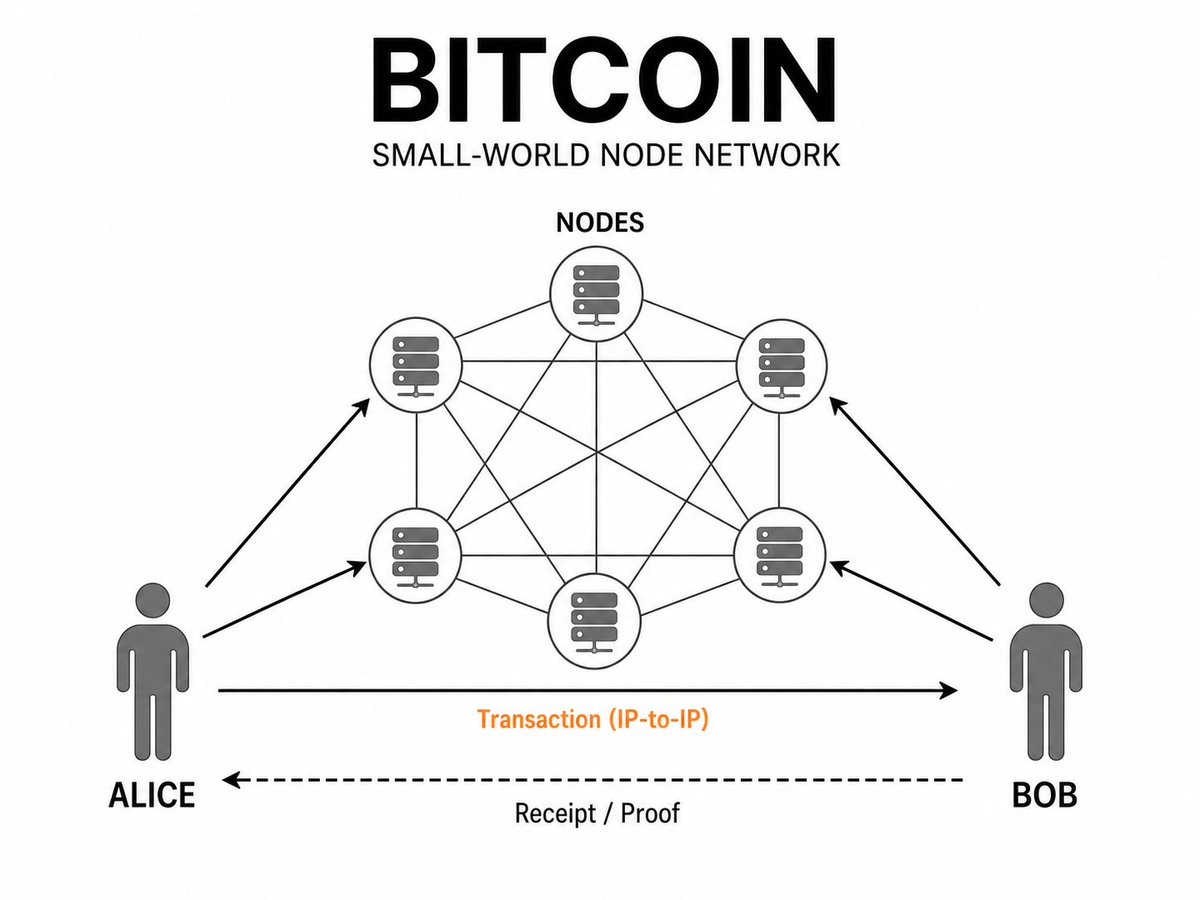
This is how Bitcoin is really designed.
Alice sends to Bob. Alice also sends to nodes. Bob sends to nodes. Bob returns a separate proof — a receipt — showing that he has sent. The nodes are not decorative little saints sitting in a chapel of theory; they are densely interconnected economic actors, passing information through a web so robust that failure becomes not a drama but an edge case.
Notice what is not being said.
Alice is not a node.
Bob is not a node.
A spectator with software is not a node merely because he enjoys the costume.
The nodes are the competitive parties that build, validate, propagate, and settle. Alice and Bob are peers. That is peer-to-peer: not a mystical commune of hobbyists, but a direct exchange between parties, with the network serving as the machinery of settlement.
The elegance is that trust is not required. Trust is the tax paid by badly designed systems. In Bitcoin, Alice does not need to trust Bob to behave nobly. Bob does not need to trust Alice to remain honest. The system is constructed so that proof, propagation, economic interest, and record replace sentiment.
And if someone reneges, the parties with an actual interest in the transaction still act. They propagate. They evidence. They settle. They do not need sermons on virtue, because incentives have already done what sermons pretend to do.
That is the architecture: direct exchange, proof returned, nodes interconnected, incentives aligned, failure reduced, trust displaced by evidence.
Bitcoin was not designed as a theatre for slogans.
It was designed to work.

English

@TonyWard867811 Doge coin does like 30tps… its no good at all to be adopted as a global money system , you need to perform better tha visa/ Mastercard at the minimum … doge coin is just another meme coin that does nothing
English

Very very few people actually understand bitcoin… they think they do , but anybody who thinks BTC is Bitcoin are sadly backing the wrong horse , they may understand the principle of Bitcoin , but have never actually looked at the technology or the protocol , they have simply looked at the price and assumed the most expensive version is the real deal. That’s the sad thing … Bitcoin ( the original protocol version as described in the white paper ) is for peer to peer cash , to be used , not HODL, not store of value , not digital gold…. Bitcoin is designed to be money for everybody to use , to scale on chain to process millions of transactions per second , not 7 tps like BTC.
Fast, cheap peer to peer digital cash, smart contracts and micro payments ,not layer 2, not SegWit /taproot protocol.
BTC is not Bitcoin
#BSV is Bitcoin … and the world will find out very soon. I advise anyone who thinks Bitcoin is their early retirement to deep dive into the technology and the protocol before investing all your money into BTC.
English

You signed a £300,000 mortgage.
The bank had nothing.
They typed £300,000 into your account. The whole transaction took them 5 minutes.
Over the next 25 years you pay them back £550,000.
That £550,000 is your wages. Your overtime. Your weekends. Your sleep.
For them it is pure profit. They created the money from thin air. They have no cost to recover.
5 minutes of their typing.
25 years of your life.
That is the trade.
The government allows it.
The Bank of England protects it.
The banks feed themselves and their paymasters.
You were not given a mortgage.
You were enslaved by one.
You do not own the house.
You do not own your wages.
You do not own your future.
You rent your life from people who created nothing.
This is why they fear Bitcoin.
Bitcoin cannot be typed into existence.
Bitcoin cannot be debased by their paymasters.
Bitcoin cannot be lent ten times over.
The day you understand Bitcoin is the day you stop renting your life.
That is why they hate it.
And that is why you need it.
English
jim retweetledi

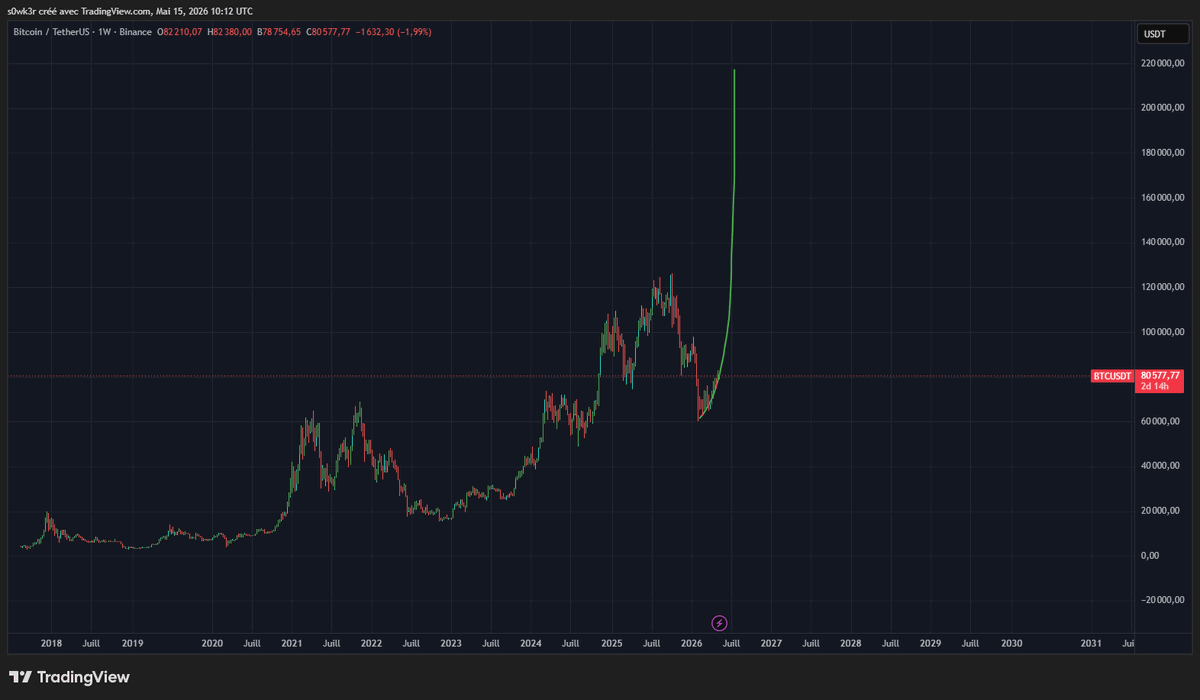
Why the Bitcoin Ponzi Won’t Collapse This Year — But Real Bitcoin (SV) Will Surge Massively. 💥
Of course, the Bitcoin Ponzi (BTC) probably won’t crash this year.
It’s simply not in anyone’s interest — especially with the mid-term elections in November 2026 and the 250th anniversary of American Independence (July 4, 2026) fast approaching. 🔥
For the current Trump administration, a spectacular collapse of BTC would be politically disastrous. Trump has openly positioned himself as pro-crypto, and the bursting of what many already call the “Bitcoin Ponzi” right before these major political milestones would severely damage his support base and the entire pro-crypto narrative. ⚠️
This is simply a very bad time for the illusion to break. That’s why it’s highly likely they will do everything possible to keep the BTC price elevated — potentially pushing it toward $100K–$200K — just to maintain the appearance of strength and success. 📈
But here’s the crucial point:
The higher BTC climbs, the more capital will eventually flow into the only chain that actually works at scale. Because right now, BSV and BTC are still swimming in the same liquidity pool. 🌊
And in 2026, the disconnect between real technology and market price has become impossible to ignore.
The advantages of Real Bitcoin (SV) are becoming too big, too obvious, and too numerous for the mainstream crypto world to dismiss any longer:
✅ Teranode is already live and delivering — proven performance of over 1.1 million transactions per second. This is not a promise — it is tested, working infrastructure. ⚡
✅ Real stablecoins are arriving — KRWQ, the South Korean Won stablecoin built natively on BSV with Teranode — shows that serious enterprise players are choosing the original protocol for real payments infrastructure. 💰
✅ Hollywood is about to shine a massive spotlight — the upcoming major motion picture “Bitcoin” will introduce millions of people worldwide to the real story behind Bitcoin and its original vision. 🎥
Nobody serious is going to sell off another 50% lower after seeing these clear, undeniable technical and adoption advantages.
Instead, the moment sentiment begins to shift, the demand for Real Bitcoin (SV) can become avalanche-like — and it can happen literally at any moment. 🌋
Of course, we will see what happens.
But one thing is becoming increasingly clear:
The longer the current illusion is maintained, the more explosive the eventual re-rating of Real Bitcoin (SV) can be.
The awakening is accelerating. 🚀
Real Bitcoin (SV) is ready.
The storm is coming. 💥🌊
#RealBitcoin #BitcoinSV #BSV #BitcoinPonzi #Teranode #KRWQ #SatoshiVision #MassAdoption #BitcoinMovie #TrumpCrypto

English

Knowing that BTC isn’t actually Bitcoin should be the first thing you learn, before you buy bitcoin.
Learn the protocol, read the whitepaper , understand blockchain, learn economics , know the difference between money and currency , understand what a commodity is, work out how you can comodatise digital data, then you’ll realise #BSV is bitcoin and the the 1 whole BTC you’ve slowly accumulated over time is nothing more than alt coin that can’t do anything.
English

My best friend from high school texted me last month, after fifteen years of silence, to ask if I could “spot him” thirty thousand dollars because his wife was leaving him and he needed a lawyer, and I sat with that text for an hour, and I thought about the summer of 2009, and I thought about the basement we used to play Halo in, and I thought about the man he had become, a man who had spent his entire adult life optimizing for the approval of women who do not respect him and bosses who do not see him, and I wrote back, “I can’t lend you fiat, Tyler, but I will teach you how to never need it again,” and I sent him a link to a Bitcoin starter guide, and he did not respond, and he has not responded, and he never will respond, and that is the price of the truth, and the truth does not negotiate, and Tyler will lose the house, and Tyler will lose the wife, and Tyler will lose the kids, and one day, in a studio apartment, at three in the morning, Tyler will open that link, and Tyler will read, and Tyler will understand, and on that day Tyler will text me back, and on that day I will be there, because that is what brothers do.
English