Buddy Falcon@buddy_falcon
By Buddy Falcon Media, LLC
🚨 From “Cultural” to Felony Arrest: Why Wasn’t He Arrested the First Time?
SUMMARY🪶
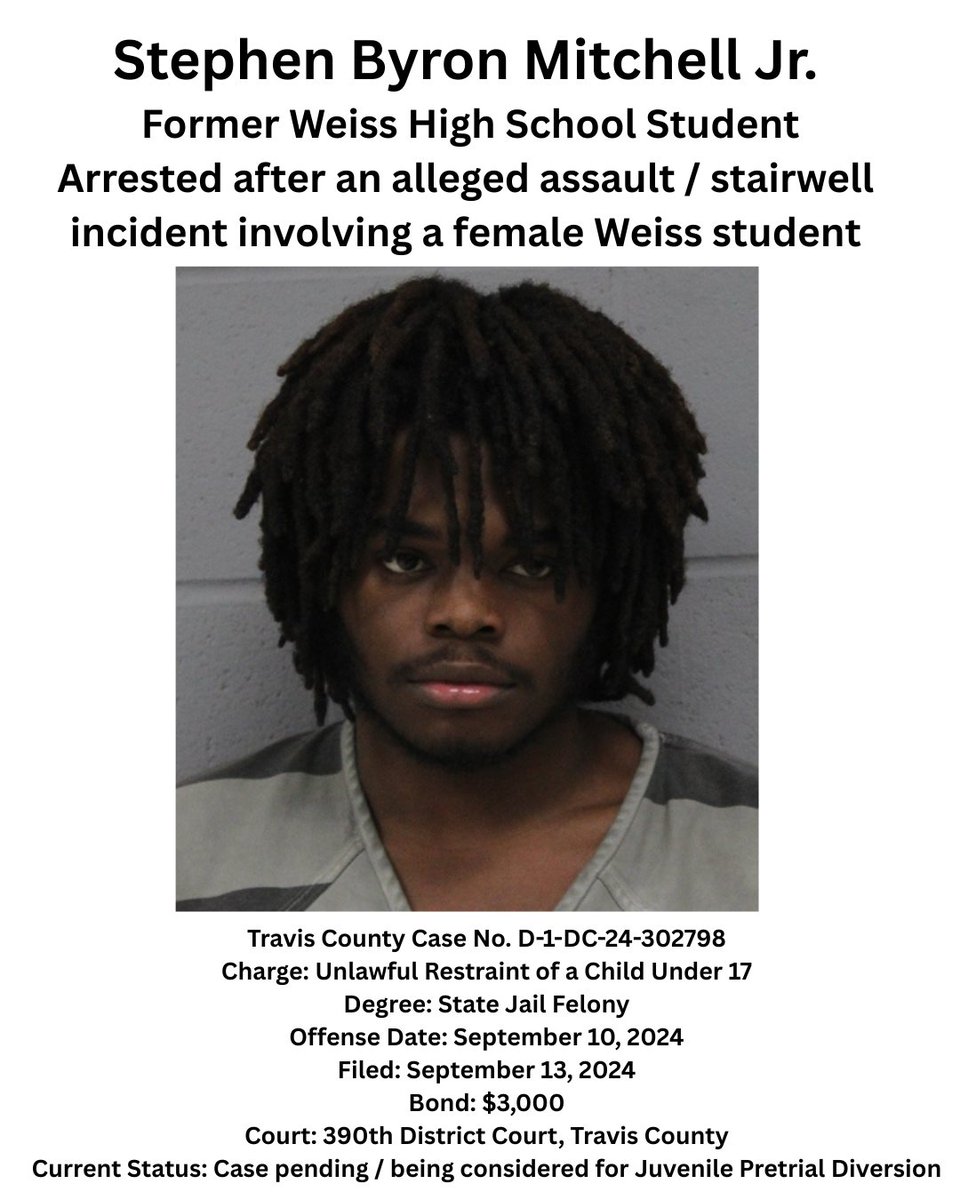
Before Stephen Byron Mitchell Jr. was arrested on September 10, 2024 for felony unlawful restraint involving a female student, records reviewed by Buddy Falcon Media indicate Weiss had already been warned: the female student reported he grabbed her in the cafeteria, AP Uyen Tran reportedly first pushed for a stronger consequence, AP Leslie Oduwole allegedly characterized the conduct as “cultural,” Mitchell reportedly received one day of ISS instead, and a contemporaneous account raises questions about why SRO Juan “DJ” DeJesus did not arrest him after the first incident if another incident would require arrest. Days later, Mitchell was arrested, staff asked whether the girl was still safe, and a PfISD board member wrote, “I wouldn’t feel safe sending my daughter here after that.” Again, who is protecting our girls — and could the September 10 arrest have been prevented if the first incident had been treated as a serious teen dating violence warning sign?
FULL STORY🪶
A PfISD board member put the safety concern in plain language after the arrest:
“I wouldn’t feel safe sending my daughter here after that.”
That sentence should stop every parent cold.
If a board member could recognize the danger after the arrest, why wasn’t the first cafeteria incident treated like a serious warning before the arrest?
Again, who is protecting our girls?🪶
We understand this post may be uncomfortable for the female student involved, and Buddy Falcon Media has intentionally avoided identifying her. But silence can protect the system more than the girls inside it. Other vulnerable teenage girls need to see the warning signs clearly: being grabbed, restrained, blocked, humiliated, pressured, having their hair pulled, or being ignored when they say stop is not love, not culture, and not normal. This is being shared because no student should have to wait for a second incident, a worse injury, or an arrest before adults take her safety seriously.
This cannot continue.
This is not a story about one bad day at Weiss High School. It is a story about the serious gap between an early warning and a later felony arrest.
Most importantly, it is a story about why a male student was not arrested the first time a female student said he grabbed her at Weiss — and whether an administrator’s alleged explanation contributed to the matter remaining inside campus discipline instead of law enforcement.
Before adults started explaining it, a sixteen-year-old girl described what happened in plain language. She was at school, surrounded by other students, in the middle of the day, when a male student grabbed her. Records and staff communications reviewed by Buddy Falcon Media also describe concerns involving physical contact that included grabbing and hair-pulling. She was not describing harmless relationship drama. She was describing the confusion of being grabbed when she was already doing what he wanted her to do.
Her words were simple:
“He grabbed me, and I was like, ‘What are you doing? Like, you don’t need to do all that. I was about to walk over there anyway.’”
That statement should have mattered immediately.
According to records reviewed by Buddy Falcon Media, the female student reportedly described being upset, crying, and trying to get away. Her instinct was to set a boundary.
The adults’ job was to protect it.
Teen dating violence often starts in moments adults are tempted to minimize. It may begin with grabbing, hair-pulling, refusing to listen, embarrassing a girl in front of others, making her feel responsible for calming him down, making her wonder if she is “overreacting,” or making her afraid to tell the truth because she knows other students saw it.
That is why this matters.
A cafeteria full of witnesses does not make it harmless. A dating relationship does not erase consent. And a vulnerable teenage girl should not have to be hurt worse before adults decide her fear counts.
At first, records reviewed by Buddy Falcon Media indicate Assistant Principal Uyen Tran appeared to recognize the seriousness of the cafeteria incident. Evidence reviewed indicates Tran initially pushed for a stronger disciplinary response, reportedly an Opportunity Center placement. OC is not a casual consequence. It signals that the conduct was initially viewed as serious enough to remove the student from the regular campus environment.
But that is not where the consequence reportedly ended.
And that is where the student-safety questions begin.
The “Cultural” Explanation That Raises Questions🪶
When a male student grabs a female student against her will, the first question should be whether she is safe. The second question should be whether law enforcement needs to act. But records reviewed by Buddy Falcon Media raise serious concerns that the first Weiss incident may have been reframed before it received the response it deserved.
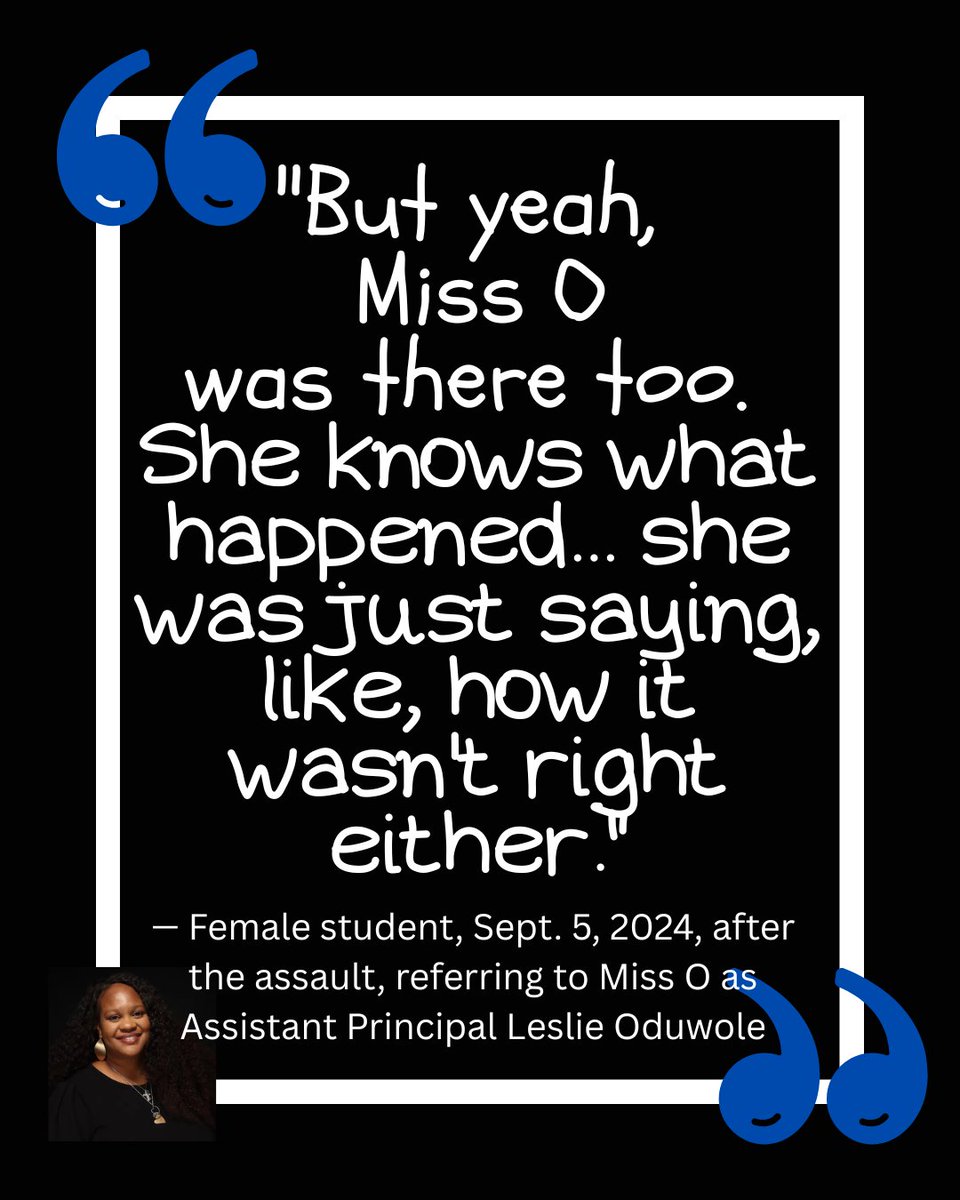
According to staff communications and evidentiary records reviewed by Buddy Falcon Media, Assistant Principal Leslie Oduwole allegedly characterized the conduct as “cultural.”
That word matters.
At first, records indicate Tran appeared to recognize the seriousness of the cafeteria incident. She reportedly pushed for a stronger consequence, including an Opportunity Center placement. But that position reportedly changed after Oduwole allegedly reframed the conduct as “cultural.”
That is a serious concern.
Student safety should not depend on which administrator has the stronger voice in the room. If Tran initially believed the incident warranted OC, PfISD needs to explain why that position changed, who changed it, and whether Oduwole’s alleged “cultural” explanation influenced the decision to move away from both stronger discipline and law-enforcement action.
Because when unwanted physical contact is explained as “cultural,” the focus shifts. It moves away from the girl’s fear, her discomfort, and her right to say stop. It moves toward explaining the conduct of the person accused of putting hands on her.
Calling unwanted physical contact “cultural” is dangerous because it risks teaching the wrong lesson to both students. It risks teaching the boy that adults may explain it away. It risks teaching the girl that her discomfort can be negotiated.
That is exactly backwards.
In healthy relationships, “stop” means stop. Confusion, fear, embarrassment, crying, and the instinct to get away are warning signs adults should respect, not reinterpret.
Records reviewed by Buddy Falcon Media indicate the stronger consequence initially discussed did not happen. Instead, Mitchell reportedly received one day of In-School Suspension.
One day.
For conduct a female student described as unwanted, upsetting, and confusing.
The SRO Question🪶
This was not only a campus-discipline issue. It was also a law-enforcement issue.
If a male student grabbed a female student in front of witnesses, if the female student was upset, if administrators were discussing OC, and if a contemporaneous account later reflected that another incident would require arrest, then PfISD needs to explain what role SRO Juan “DJ” DeJesus played after the first cafeteria incident.
Did DeJesus independently decide there was no arrestable offense?
Did campus administrators influence that decision?
Was the alleged “cultural” explanation part of what caused the matter to remain inside school discipline instead of law enforcement?
And if DeJesus allegedly indicated that another incident would require arrest, why was the first incident not treated as the warning it clearly was?
A contemporaneous account reviewed by Buddy Falcon Media raises that law-enforcement question. According to that account, Mitchell was not arrested after the first cafeteria incident, and DeJesus allegedly indicated that another incident would require arrest.
That account is not the same as a police report. But it matters because it reflects what was being understood and questioned in real time: if arrest was already being discussed after the first incident, why was there a next time?
If accurate, the account suggests law-enforcement action was already being discussed before the September 10 arrest. It raises the central question of this case: did DeJesus make an independent law-enforcement decision, or did the administrator’s alleged “cultural” explanation affect whether Mitchell was arrested the first time?
That is the question PfISD has to answer: why wasn’t he arrested after the first incident?
Staff messages reviewed by Buddy Falcon Media suggest Mitchell may have been present when the conduct was allegedly described as “cultural.” After Mitchell’s later arrest, one message asked:
“So that’s not cultural??”
The exchange then asked whether Byron was in the room when Oduwole allegedly said it was cultural. The response corrected itself and confirmed:
“Sorry he was.”
That detail is critical.
Discipline is not only about punishment. It is also about the message adults send before the next incident happens. If Mitchell was in the room when an adult administrator allegedly explained the cafeteria incident as “cultural,” PfISD needs to answer what message that sent.
Did he leave understanding that he had crossed a serious boundary?
Or did he leave believing adults might explain that boundary away?
And what message did that send to the girl?
That her fear mattered?
Or that adults were willing to debate it?
Days Later, There Was an Arrest🪶
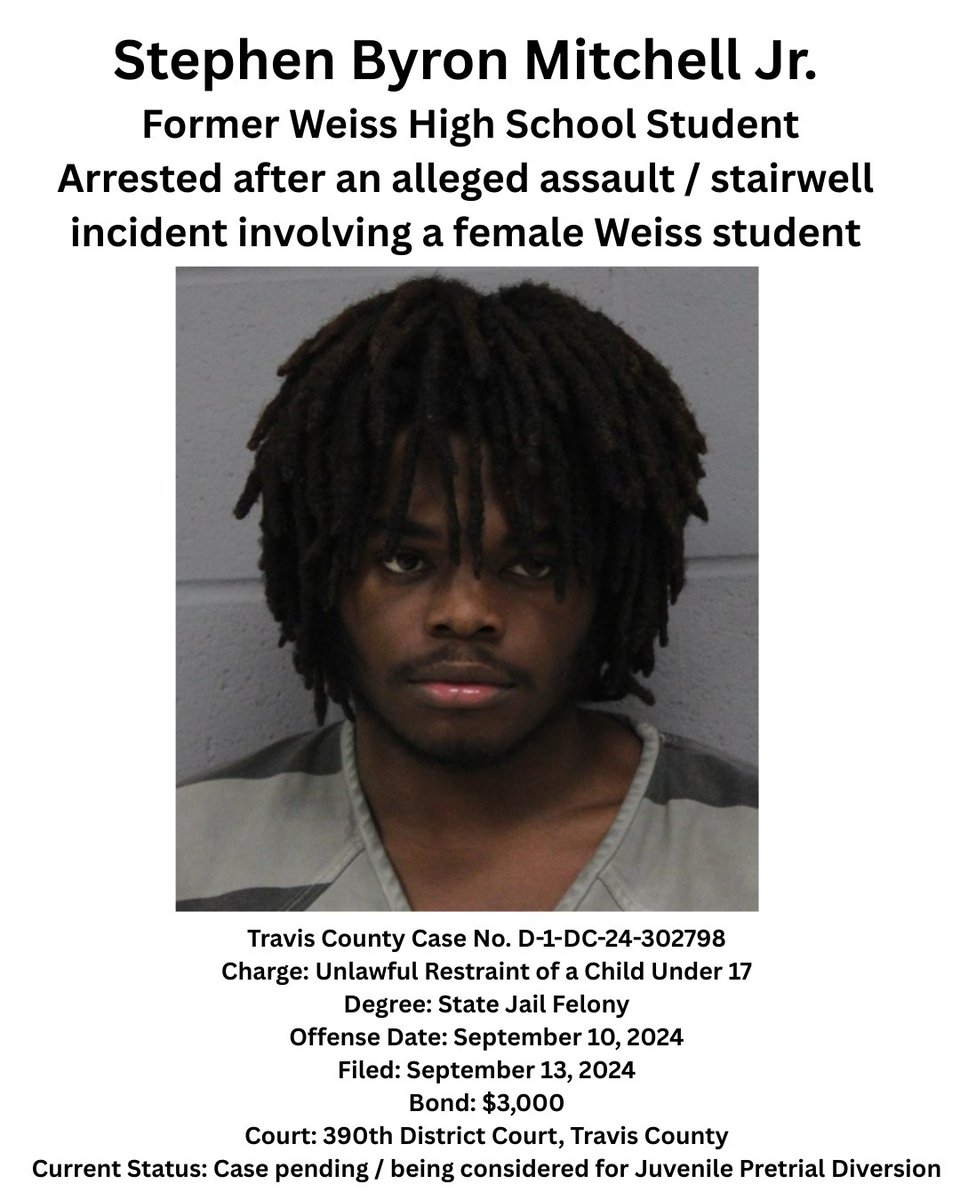
Records reviewed by Buddy Falcon Media indicate this was not one isolated moment of confusion. The evidentiary record documents two separate incidents involving Stephen Byron Mitchell Jr. and the same female student at Weiss.
The first occurred in the campus cafeteria. Staff messages describe the incident as something “a lot of kids saw,” and one message states Mitchell “just grabbed her on her arm.” In the same thread, another message referenced a call to Mitchell’s mother describing the incident in more serious terms, stating that he “whoop her ass.”
That language is important because it shows the incident was not being discussed internally as harmless. Adults knew students saw it. Adults knew physical contact occurred. Adults knew the incident was serious enough to trigger concern and parent contact. A contemporaneous account also indicates that arrest was already being discussed before the second Weiss incident.
Days later, there was another incident.
On September 10, 2024, Stephen Byron Mitchell Jr. was arrested after a later incident involving a female student.
Travis County public records list State of Texas v. Mitchell, Stephen Byron Jr., Case No. D-1-DC-24-302798, in the 390th District Court. The listed charge is Unlawful Restraint Less Than 17 Years of Age, a state jail felony, with an offense date of September 10, 2024, filed September 13, 2024, and a listed bond of $3,000.
Staff communications from September 11 state that Mitchell had been arrested “yesterday” and describe the later incident as him allegedly holding the same female student down on a staircase, reportedly captured on school surveillance cameras. The evidentiary record also indicates there was an eyewitness to the stairwell incident.
After that, the concern inside the records became immediate.
One staff message asked:
“She still isn’t safe. What happens when he is allowed to come back?”
A board member also responded to the concern in plain language:
“I wouldn’t feel safe sending my daughter here after that.”
A board member’s own reaction showed how obvious the safety concern was after the arrest. The harder question is why the first cafeteria incident was not treated with that same urgency before the arrest.
Another staff message asked whether there was a plan for her protection and whether her parents had been notified.
Those are not routine discipline questions. Those are safety questions. By the time adults are asking whether there is a safety plan, whether the parents were notified, and whether the girl is still safe, the school may already be behind.
Teen dating violence prevention is supposed to happen at the first warning sign — not after a second incident, not after an arrest, and not after a vulnerable teenage girl has to wonder whether anyone believed her the first time.
The Transfer Question🪶
That matters because this was not the first time Buddy Falcon Media has received and reviewed concerns involving Mitchell and alleged violence toward a female student. Before the Weiss cafeteria incident, before the stairwell incident, and before the September 10 felony arrest, there had already been a reported Del Valle incident involving another female student. So the transfer question is not a side issue. It is central. Why was he accepted at Weiss? What records followed him? What did PfISD know before placing him around a new group of vulnerable teenage girls?
The issue is not gossip. The issue is transfer review, student safety, and whether warning signs followed a student from one campus or district to another.
Did PfISD review his discipline history? Was he on an out-of-district transfer? Did anyone ask why he was leaving Del Valle? Did any warning involving a female student follow him? And if PfISD had any notice of prior concerns, what safeguards were put in place for girls at Weiss?
Those questions matter because the issue is not only what happened after the arrest. The issue is whether warning signs existed before the first Weiss incident, whether those warning signs were reviewed, and whether the first Weiss incident should have triggered a stronger law-enforcement response.
The Bigger Pattern🪶
This concern about whether the girl’s safety was centered does not appear isolated.
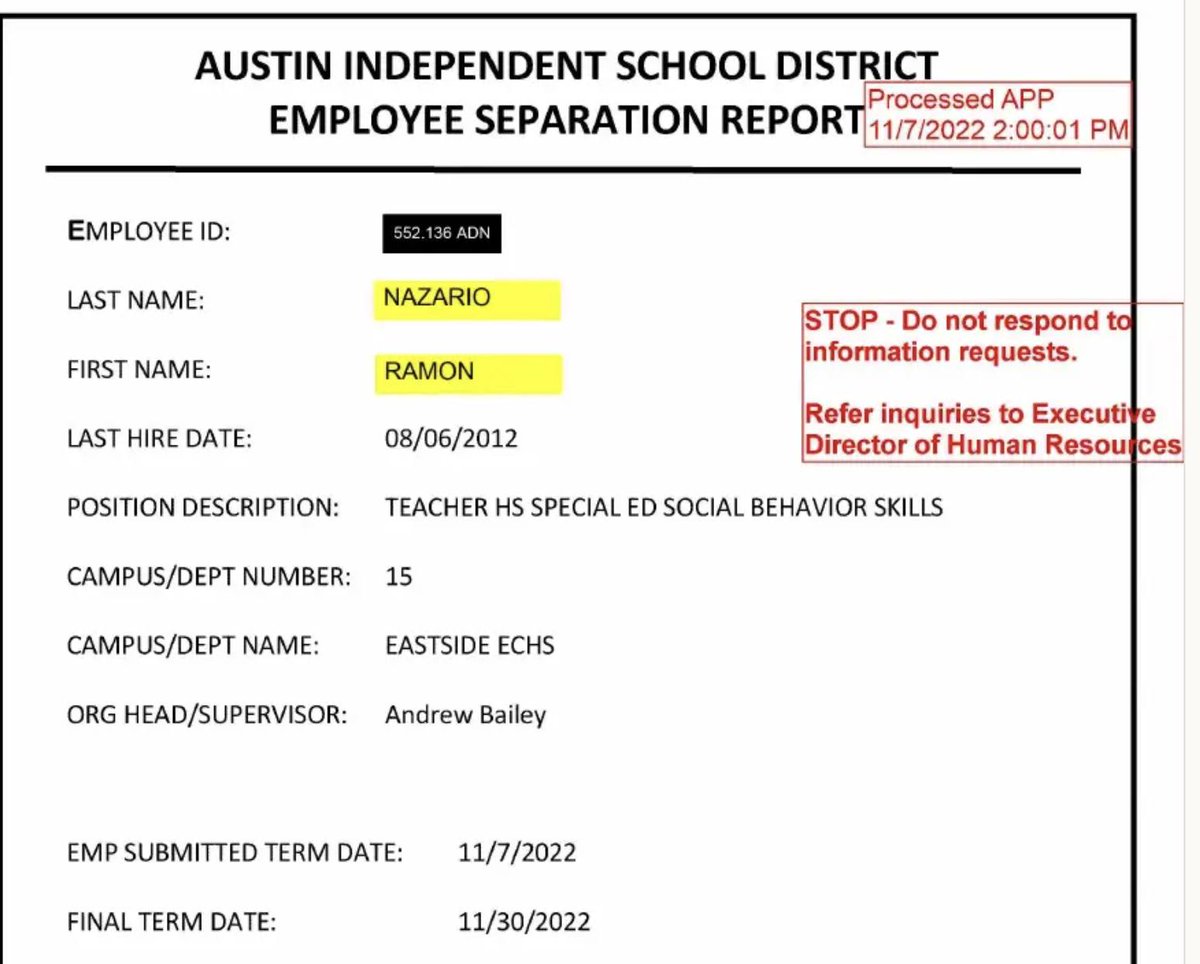
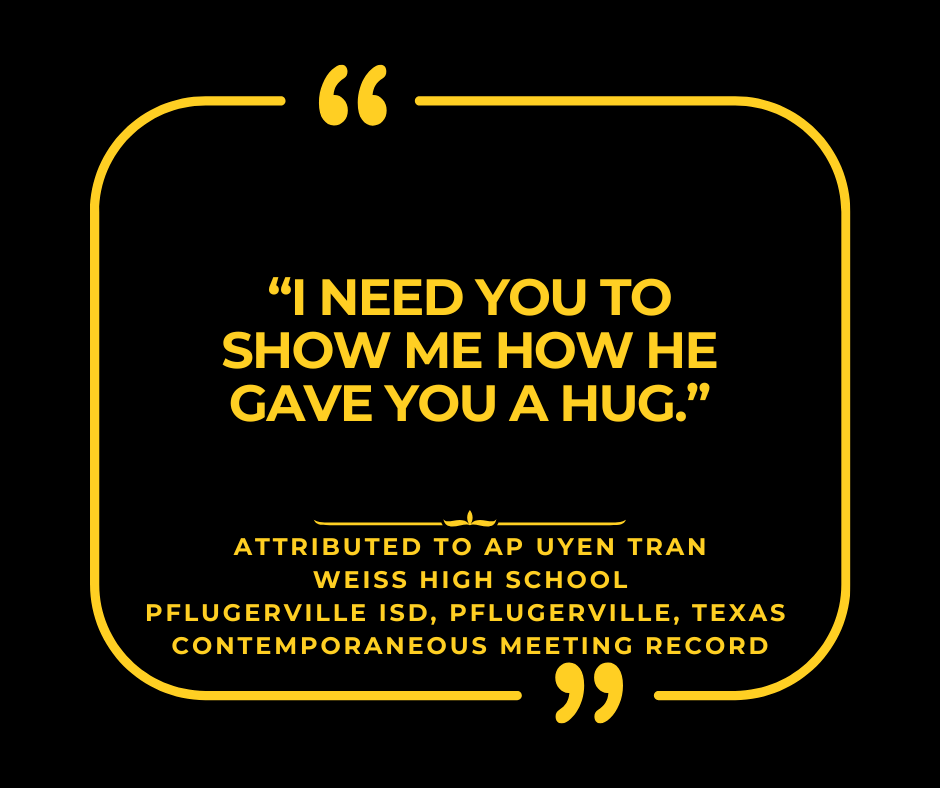
In a separate matter involving Ramon Nazario, records reviewed by Buddy Falcon Media raise concerns about how another female student was handled after reporting uncomfortable physical contact. Those records indicate that during an administrative response involving AP Tran, the student was made to demonstrate or reenact the contact.
That matters because asking a vulnerable teenage girl to physically demonstrate unwanted contact is not protection. It places the burden back on the student to prove why her discomfort matters.
She should not have to reenact unwanted contact for adults to understand why it matters. She should not have to explain why being grabbed is wrong. She should not have to wait until a second incident before the first one is taken seriously.
The Nazario matter raises the same broader concern: when girls report uncomfortable or unwanted physical contact, are adults protecting them, or are adults making them carry the burden of proving why their discomfort matters?
That is the pattern parents should be watching.
When Ballard Reported the Warnings🪶
This is where Cheryl “Crissie” Ballard enters the story — not as the focus, but as the person who submitted Anonymous Alerts and report raising student-safety concerns.
Within days, Ballard reported concerns involving both the Mitchell incident and the separate Ramon Nazario matter. Both involved vulnerable female students. Both involved concerns about uncomfortable or unwanted physical contact. Both raised the same basic question: were girls being protected, or were their reports being managed?
In the Mitchell matter, Ballard’s Anonymous Alert raised concerns about the first cafeteria incident, the alleged “cultural” explanation, whether the accused student heard that explanation, and why the matter did not result in stronger safety action before the later arrest.
A contemporaneous text message from September 13, 2024 states:
“I heard someone did an anonymous alert about O telling Byron that and Tran stepped up and said she would ‘handle it.’”
That matters.
If Tran was present when the alert came in, knew the underlying incident, and allegedly stepped forward to “handle it,” PfISD needs to explain whether the alert received an independent safety review — or whether it went back into the same administrative circle already involved in the original response.
In the Nazario matter, records reviewed by Buddy Falcon Media raise concerns about how another female student was handled after reporting uncomfortable physical contact. Those records indicate that during an administrative response involving AP Tran, the student was made to demonstrate or reenact the contact.
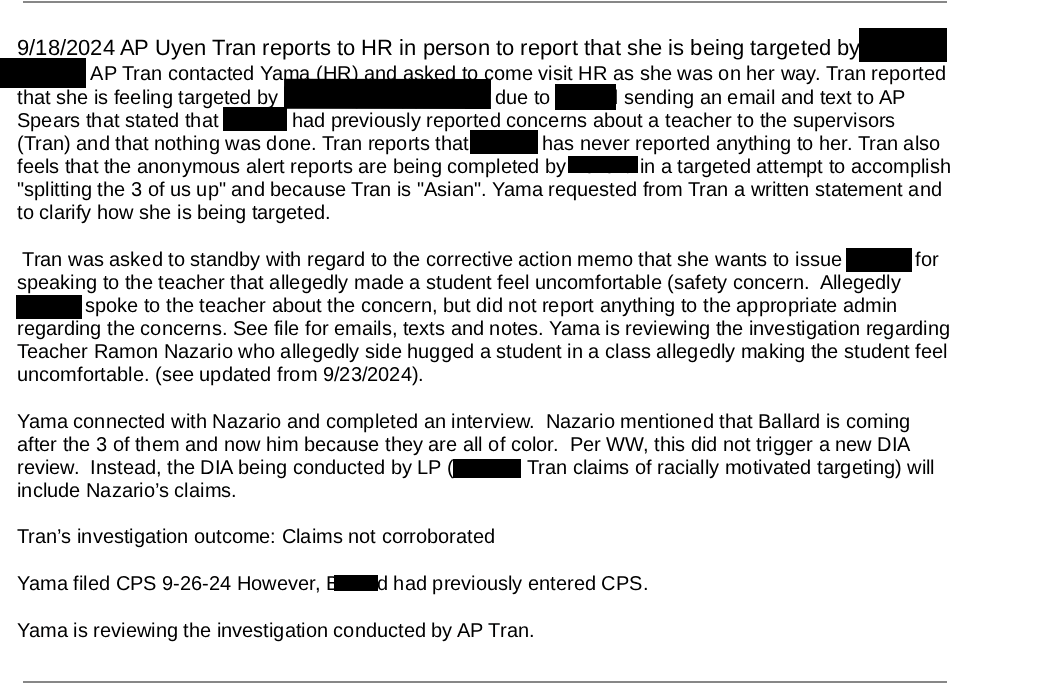
But according to HR notes reviewed by Buddy Falcon Media, the district’s focus shifted away from the girls and toward Ballard.
The notes reflect that Tran reported feeling targeted by Ballard. The notes also connect the matter to Ramon Nazario, described as a teacher who allegedly hugged a student and made the student feel uncomfortable. HR notes further reflect that Nazario reportedly claimed Ballard was “coming after” him and others because they were “all of color.”
That is the contradiction.
When unwanted physical contact was allegedly minimized, it was called “cultural.”
When Ballard reported concerns involving vulnerable girls, the reports were allegedly reframed as racial targeting.
That is not how student safety is supposed to work.
The issue should have been whether the girls were safe. The issue should have been whether the first cafeteria incident was minimized. The issue should have been why the stronger consequence reportedly changed. The issue should have been why SRO Juan “DJ” DeJesus did not arrest Mitchell the first time. The issue should have been whether the accused student heard an adult explain the incident as “cultural.” And in the Nazario matter, the issue should have been whether a girl who reported uncomfortable physical contact was protected without being made to carry the burden of proving why her discomfort mattered.
Instead, the record raises serious questions about whether PfISD focused on identifying Ballard and framing the safety alerts in racial terms rather than first confronting the student-safety warnings.
Anonymous Alerts exist so students and staff can report danger without fear of being identified or targeted. When the warning involves vulnerable teenage girls, the first response should be protection — not hunting the reporter.
Buddy Falcon Media will address that broader Anonymous Alerts issue in a separate report.
PfISD still needs to answer the questions at the center of this case:
Why did the first cafeteria incident not result in an arrest? Why was the stronger consequence allegedly abandoned? Did the alleged “cultural” explanation affect DeJesus’s response? Was Mitchell present when that explanation was allegedly made? Was the girl’s parent fully informed? Was there a documented safety plan? What did PfISD know about the prior Del Valle incident involving another female student? And could the September 10 arrest have been prevented if the first incident had been handled as a warning instead of something to explain away?
Again, who is protecting our girls?
Not after the arrest.
Not after the second incident.
Not after staff start asking whether she is still safe.
At the first warning sign. That is when protection is supposed to happen.
When a teenage girl says:
“What are you doing?”
after a boy grabs her, the answer should be immediate and unequivocal:
He should not be putting his hands on you.
No excuses. No cultural explanations. No downgraded discipline. No waiting for “next time.” No targeting of the people who report student-safety concerns.
And to every student reading this, especially girls: if someone grabs you, blocks you, holds you down, pulls your hair, pressures you, scares you, humiliates you, controls who you talk to, checks your phone, threatens to hurt himself or you, tells you no one will believe you, or ignores you when you say stop, that is not love. That is not culture. That is not “just how he is.”
That is a warning sign.
You are allowed to say no. You are allowed to get away. You are allowed to ask for help. You are allowed to tell more than one adult. You are allowed to ask for a written safety plan. You are allowed to ask not to be placed near that person. You are allowed to ask whether your parent or guardian has been notified. You are allowed to keep telling until someone listens.
If you are scared, document what happened as soon as you safely can. Write down the date, time, place, witnesses, screenshots, messages, and who you told. Tell a parent, counselor, teacher, SRO, coach, nurse, relative, or trusted adult. If the first adult minimizes it, tell another one. If you are in immediate danger, call 911.
For confidential teen dating abuse support, love is respect offers confidential support for teens and young adults 24/7 by call, text, or live chat: call 866-331-9474, text LOVEIS to 22522, or use live chat online. The National Domestic Violence Hotline also offers 24/7 confidential support at 1-800-799-SAFE (7233), text START to 88788, or live chat online.
Adults: stop teaching girls to survive warning signs.
Start teaching boys that boundaries are real.
Start teaching girls that being scared is enough reason to speak.
Start teaching schools that the first report is the moment to protect — not the moment to explain it away.
This post is public-interest reporting about student safety, transfer procedures, district records, teen dating violence concerns, and government accountability. It is not directed to any private individual, and no contact with any individual is requested or encouraged.
If you have information about this incident, the transfer process, Anonymous Alerts, or other ignored safety reports at Weiss High School, contact BuddyFalconMedia@gmail.com. Buddy Falcon Media can help direct information or concerns to the appropriate agency, reporter, or support resource.
— Buddy Falcon Media, LLC
Keeping Watch. Always. 🪶
@PfISDHR @PfISD_AD @PfISDAthletics @pfisd_police @pfisd @fox7austin @AlecOnFOX7 @tplohetski @JenniL_KVUE @BryanM_KVUE @suphannahrucker @QuitaC_KVUE @KXAN_News @statesman @USATODAY @TPPF @TexasEd911 @SarahisCensored @TrueTexasTea