Byte Alchemist ⚡️

2.1K posts

Byte Alchemist ⚡️ banner
Byte Alchemist ⚡️

Byte Alchemist ⚡️

@byte8alchemist

No bullshit. Only signal.

The Singularity Katılım Nisan 2024
327 Takip Edilen253 Takipçiler
Sabitlenmiş Tweet
Byte Alchemist ⚡️
Byte Alchemist ⚡️@byte8alchemist·
Intellia Therapeutics Investment Thesis $NTLA I typically stick to investing in technology stocks, but $NTLA caught my attention because of its groundbreaking work with CRISPR technology. I'm not a biotech expert or enthusiast, but the potential here is so compelling that I believe anyone can see the opportunity. It just makes sense. Introduction to CRISPR-Cas9 DNA is the cell’s long-term “source code.” Defects (mutations or regulatory changes) can make cells produce faulty proteins, driving disease. CRISPR-Cas9 is a programmable tool that uses a guide RNA (the address) to bring the Cas9 enzyme (the editor) to a precise DNA sequence, where Cas9 makes a cut. This disables this fault sequence and neutralizes its effects. You can think of this as making a change to production code (cure) versus applying multiple bandage patches (periodic dosing). Two ways to deploy editing: ex vivo, where cells are edited outside the body and reinfused (safer/controlled but complex and costly), and in vivo, which edits cells directly inside the patient (simpler access to organs demands highly selective delivery). Intellia Approach Intellia pioneered systemic in vivo CRISPR delivery to the liver: an IV-infused lipid nanoparticle (LNP) carrying Cas9 mRNA (temporary instructions to make the editor) plus a guide RNA (navigation) enters hepatocytes and performs the edit. This yields a durable gene knockout after a single dose (CURE)! The actual delivery mechanism is actually that relevant because Intellia is not dogmatic about delivery: beyond liver-targeted LNPs, it describes a “full-spectrum” platform exploring multiple CRISPR modalities and even LNPs for ex vivo cell engineering. Intellia’s Pipeline For accurate and more information about this I would view @GeneInvesting account. The specifics to the average investor is actually not that important. Only the data + PoS is truly what matters, there is actually no way a regular investor could have an "edge" on the clinical trials data. From ChatGPT: - NTLA-2002 (HAE, KLKB1 knockout) – Pivotal Phase 3 (HAELO): randomized 2:1, single 50 mg dose, primary endpoint = attack-rate reduction Weeks 5–28. Company guidance: complete enrollment H2 2025; potential top-line mid-2026; BLA H2 2026; potential U.S. approval H2 2027 (timelines indicative, contingent on data). Estimated PoS ≈ 70% given Phase 2’s near-elimination of attacks and direct biomarker-to-outcome linkage. -NTLA-2001 (ATTR, TTR knockout; with Regeneron) – Two pivotal Phase 3s: MAGNITUDE (ATTR-CM) and MAGNITUDE-2 (ATTRv-PN), building on deep TTR knockdown and encouraging functional trends in early data. Working timelines point to final data ~2027 for CM (approval ~2028), and potential PN approval ~2027 if surrogate/clinical endpoints align. Estimated PoS: ~70% (PN) and 60–65% (CM); weighted ≈ 65%. Market and Competitive Landscape Hereditary Angioedema (HAE). Rare (~1 in 50,000) but severe; attacks are unpredictable and can be life-threatening. Current prophylaxis - Takhzyro (lanadelumab, ~87% reduction; q2–4 weeks injections) and Orladeyo (berotralstat; daily oral; ~44% reduction)-reduces frequency but is lifelong and not fully preventive. List pricing implies Takhzyro ~$25.7k per 300 mg injection, translating to $335k/yr (q4w) to $670k/yr (q2w), while Orladeyo’s WAC is $44,484.33 per 28-day pack (~$578k/yr). All other options are very similar in pricing annually. Takhzyro generated $1.2B (2022), underscoring payer willingness to fund prophylaxis. Near-term, Intellia faces no in-clinic curative competitor and emerging orals may improve convenience but still require chronic use. ATTR Amyloidosis (TTR). A much larger opportunity: hereditary ATTRv (~50k globally; genotype-clustered) plus an aging wild-type ATTR-CM population (estimates up to ~500k worldwide; not all severe). Standard of care tafamidis (daily stabilizer) improves survival but doesn’t eliminate amyloid; franchise projected to exceed $6B annually later this decade (pricing at $268k/yr). RNAi/ASO competitors (Onpattro, Amvuttra, Eplontersen) suppress TTR chronically (these are priced even higher). Basically all options are >$250k/y. Investment Modelling This is the part that makes $NTLA stupid obvious. Assumptions: - NTLA-2002 (HAE): U.S. approval H2’27, first full commercial year 2028. - NTLA-2001 (ATTR): PN approval H2’27 (first full year 2028); CM approval H2’28 (first full year 2029). - PoS NTLA-2002 (70%), NTLA-2001 blended (65%) - Pricing at $1.5M to be very conservative - Operating Margin (55%): 85% GM, SGA 20% of revenue, and R&D 10% of revenue. If we assume by 2031 $NTLA has ramped their products and is treating 2000 patients annually (this is again conservative) we get total revenue at $3B. With 55% margins, 10x PE, and discounting back at 15% we get ~$7B. Now let's factor in PoS (65% - lower end) which means the company should be worth $4.55B TODAY. Now for fun let's look at a bull case: $2M price, Op margin at 65%, and 3000 patients annually. $6B in revenue and $3.9B in profit...🤯🤯🤯 Risks - Bad data read outs which leads to safety concerns and delayed approvals. This could deplete the company's cash balance and force them into bankruptcy. - All the other risks are minor (IP/patent landscape around CRISPR, manufacturing execution, slow adoption) To me $NTLA is a 10x opportunity in 5-6 years (with a small chance of a 20x) or a flat out 0. However, we are given the odds which are ~65% for a 10x and 35% for a 0x... who on earth wouldn't take those odds. NFA.
English
4
3
33
7.9K
CapexAndChill
CapexAndChill@CapexAndChill·
What do you find more insane about $NVDA? The growth or its margins?
English
13
0
15
3.9K
Byte Alchemist ⚡️
Byte Alchemist ⚡️@byte8alchemist·
@CapexAndChill Was looking into these but the whole space depends on the same AI narrative (hyperscaler capex) so $NVDA looks like a better risk adjusted option.
English
0
0
1
154
CapexAndChill
CapexAndChill@CapexAndChill·
If you could only choose one. $VST or $CEG?
English
10
0
13
5.2K
Byte Alchemist ⚡️
Byte Alchemist ⚡️@byte8alchemist·
@MetamateDaz That’s why u don’t have anywhere near that wealth… hasn’t the governments been pouring 10s of billions into this exact problem and it resulted in nothing? If any fraud
English
0
0
0
23
daz
daz@MetamateDaz·
I genuinely don't understand people like Bezos and Musk. If I had billions of dollars, I would just start fixing everything. Homeless veterans sleeping on the streets? Not on my watch. Hungry children going to bed with empty stomachs? Hell no. They could be making life better but instead choose to build spaceships and data centers to pump stocks and destroy the planet
English
6.8K
754
5.6K
1.2M
CapexAndChill
CapexAndChill@CapexAndChill·
We all know $ASML's moat is massive but why at this point in time would $NVDA not outperform for years?
English
6
0
24
4.6K
Byte Alchemist ⚡️
Byte Alchemist ⚡️@byte8alchemist·
@MarcoRamireZuno Every stock looks amazing when those growth assumptions...plus are they growing that fast considering acquisitions?
English
0
0
1
73
Marco Ramirez
Marco Ramirez@MarcoRamireZuno·
The more I look at $ZETA, the more I like it, specially after the Marigold deal. I initially wrote them off as another company spraying "AI" across their pitch deck. But now I understand $ZETA is an AI-native customer relationship platform built on a 535M+ permissioned identity graph globally, tracking trillions of behavioral signals against real, opted-in individuals. Full lifecycle customer relationship coverage: acquire > grow > retain (enhanced by loyalty) Marigold added the one missing piece (loyalty), brought 90%+ subscription revenue, and pulled the gross margin profile closer to enterprise SaaS than adtech. I can easily model 30% growth for 5 years, 20% for 5 more, while improving economics = $20B Intrinsic value, versus 4.65B. 🤤
English
3
0
6
5.7K
Limitless
Limitless@LimitlessFT·
Everyone's thinks Leopold's latest 13F is bearish AI. But they're wrong. he just told us where the next major AI bottleneck is: Power and memory infrastructure... and he's placing a massive $3.5B bet on it. The thesis is simple, but the trade is less obvious: -> The AI semiconductor trade is too crowded. Nvidia, AMD and Intel are up 200%+ over the last year. -> The next unlock? Powering the GPUs... his massive bloom energy and corweave prove it But there's also a genius move he's executing with corweave and bitcoin mining... We covered it all on todays episode 👇
English
10
15
222
52.8K
Jonah Lupton
Jonah Lupton@JonahLupton·
Very hard to come up with the right valuation on $NBIS in the short term... here's how I think about it over the long term... if $NBIS gets to 5-6GW of contracted & deployed power in 2030... let's say $8-9M of revenue per MW... that's $46.75B of revenues (using the midpoints) in 2030... let's be conservative and use 20-25% ebit margins (company has guided to 20-30% ebit margins)... let's say dilution through 2030 is another 50% in order to fund the capex... that would be $10.5B of ebit in 2030... put a 20-25x multiple on that (could be higher)... we'd have a $236B market cap / 384M shares... $615 per share in 2030. Very curious to see the actual numbers over the next 4-5 years... it's still one of our biggest positions. There's definitely a path to $800+ per share in 2030 if revenues are higher... if margins are better... if the market multiple is bigger... if dilution is lower... lots of reasons to stay bullish on $NBIS and none of this includes their stakes in Clickhouse and AVride which could be worth $20B+ someday (combined)
English
10
13
229
44.6K
TheBigBerbowski
TheBigBerbowski@TheBigBerbowski·
Can anyone explain how to value $NBIS ? Without using: - it will brr brr - bottlenecks - the demand is outpacing supply - asymmetric opportunity I know a lot of folks in the market today never talk about income, as that's secondary, but I think eventually companies will have to justify the price we're paying today. I hope? How do I know if I'm paying too much today? How do I know how much they can still grow? Genuinely interested to know what am I buying at the current price? Everyone is saying it's such a wonderful opportunity. I hope someone can educate me. No ragebait, honest question. I follow some NBIS bulls, but I never asked about it and about its opportunity. Please let me know should I convert to NBISism.
English
53
1
86
48.5K
Byte Alchemist ⚡️
Byte Alchemist ⚡️@byte8alchemist·
@wolfofharcourt Right now they are growing 50%+ and only in a closed system for mobile gaming. June that’s opening up to public, entering and scaling ecommerce, guided to 20-30% mobile gambling growth, optionality in connected TV, social media, other mobile apps, open web.
English
0
0
5
160
Wolf of Harcourt Street
Wolf of Harcourt Street@wolfofharcourt·
Spent the past 18 months or so consolidating the portfolio. Now down to 13 names. Looking to add some new fresh ideas. What’s your best idea and why?
English
13
0
23
6.1K
Kab X 🇺🇸
Kab X 🇺🇸@KabraxFX·
Trump showing the world that software isn't dead. Load $ADBE $NOW!
English
3
1
10
1.2K
Midnight Capital
Midnight Capital@Midnight_Captl·
Sold out of $META today to buy more $TSM We basically own a couple stocks now. Nvidia and TSMC and some Google I know, I’m a terrible portfolio manager!!! Too concentrated!! Too much risk!
English
44
0
162
22.6K
Byte Alchemist ⚡️
Byte Alchemist ⚡️@byte8alchemist·
Right, I believe its 21 if you annualize. I'm considering it as a small position because I like their products, just don't know how to pencil in revenue growth considering how fast celsius growth fell off. If it does maintain 15% CAGR then it can be a $20 Billion without multiple expansion. I don't want to assume multiple expansion
English
1
0
0
169
Brian McCormick
Brian McCormick@bjmtweets·
@byte8alchemist P/E is 17 right now if you annualize Q1. And they aren't optimized for profit ATM. Just growing at the industry rate would mean they are significantly undervalued.
English
1
0
0
402
Brian McCormick
Brian McCormick@bjmtweets·
Here is what is going on with $CELH Scanner Data, and Celsius in 2026-2027, per yesterday's panel at Goldman Sachs Forum Recent Celsius scanner data has brought into question the trajectory of the core Celsius brand with its retail sales declining 3% YoY. Just a few years ago, they were growing 100% YoY. It isn’t all bad news, as Alani Nu growth remains impressive at 49% YoY, though decelerating from 100% YoY growth just a few months ago. While it’s true that, no matter how you slice it, Celsius has decelerated growth, the negative 3% YoY figure is a bit misleading. There is a lot of missing context in the scanner data around what is actually going on. And that context has been significantly elaborated on in the Goldman Sachs Global Staples Forum that took place yesterday, May 12, 2026. Celsius is delivering a new strategy for the entire portfolio and doing some much needed housekeeping for the core Celsius brand. Without further ado, here is what is going on: There’s limited retail shelf space. When you’re a growing brand and only have a single unit of shelf space, you ask for more, and release a new SKU (product). The whole goal at these early stages is to keep getting new shelf space and releasing new SKUs to fill it. Eventually, new shelf space assignments start to slow and consumers can become a bit bewildered by all the SKUs, especially for a newer brand. At this point it’s no longer about just releasing new products, but cutting worst selling ones. And it’s also about releasing a steady cadence of new innovative flavors, which provide an immediate boost to replace under-performers. Eventually some of those will become permanent offerings as well. The whole process of cutting bad SKUs is called SKU rationalization. Celsius hasn’t really done as much work on this, as they kept getting significant new shelf space YoY. However, shelf space gains have stagnated, and so have Celsius sales. At this point, SKU rationalization is what drives future domestic growth for the core Celsius brand and makes way for new releases. The number of SKUs sold by Celsius to the avg store peaked in the Summer of last year. This was the time SKU rationalization should have aggressively started. But it didn’t, because of the Alani Nu acquisition, which paused most strategic initiatives of the brand as they began to focus on Alani Nu integration more than anything else. Now that Alani Nu is integrated into Celsius and the Pepsi distribution system, SKU rationalization has come to the forefront of re-accelerating the health and growth of the core Celsius brand. In the short term, SKU rationalization can taste a bit like sour medicine as it means: 1. The SKUs that aren’t selling will be heavily discounted to clear them off shelves. Those that aren’t distributed locally yet will be aggressively sold off on Amazon at lower price points. 2. The overall variety of product at some stores will decline as discontinued SKUs are sold off without an immediate replacement. This is more a timing issue. The net result is, in scanner data, it will show that Celsius core brand prices are declining and that sales are declining. This might look like the core brand is struggling when out of context, but this is exactly what happens when you do substantial SKU rationalization. However, what happens next is most important. Celsius has said the core brand is actually getting 17% more total shelf space in stores this year, and Alani Nu is getting triple digit shelf space gains. Many of these gains are in premium types of shelf space, such as coolers and end caps, which have higher velocity of sales than dry shelves. What happens next is that the dead SKUs (a total of which about 14 are being dropped by Celsius), will be replaced with the better selling Celsius flavors as well as better selling Alani flavors. And these new flavors are going in higher velocity of sale placements as mentioned. There is however a lag, as those new shelves can take a few months to be set up and fully installed. Another key highlight is that Alani Nu has more premium pricing than Celsius as customers are willing to fork over more for the brand. This means that SKUs that core Celsius cut that are underperformers can be replaced with higher performing Alani Nu SKUs. Not only does that mean more overall brand revenue per can sold, it also means higher velocity vs the dead SKU. This is a double shot of growth. Currently, Alani Nu only averages 11 items per store vs Celsius at 16 (which was in the 18s not long ago). With the triple digit shelf gains, Alani will have significantly more room to expand their SKUs. The shelf cut gains today will also make room for the substantial innovation overhaul that Celsius announced for 2027. The net result of all of this SKU rationalization is visible in the scanner data and Celsius updates: 1. Decrease in avg items per store for Celsius, despite new shelf space gains 2. Fewer avg items per store for Celsius brand 3. Increase of over 20% YoY in Amazon sales by Celsius (likely from SKU destocking efforts) 4. Celsius sales prices went from 6% increases YoY in early 2026 to a 3% YoY decrease as destocking efforts went on Overall, my interpretation of scanner data and the Celsius announcement is that the current Celsius slowdown we see in scanner data is temporary. New shelves are coming online in significant quantity, and this will naturally increase sales. Getting bad SKUs off the shelf will also naturally increase future sales with their replacements. The only negative part of all this is the temporary bad scanner data we see during the SKU rationalization process. In all likelihood, I believe this is a short-term blip, and the Celsius core brand as well as gains to Alani will return stronger than before the process began (and when everyone was reasonably happy with scanner data).
English
16
15
148
14K
IvanaSPEAR
IvanaSPEAR@IvanaSpear·
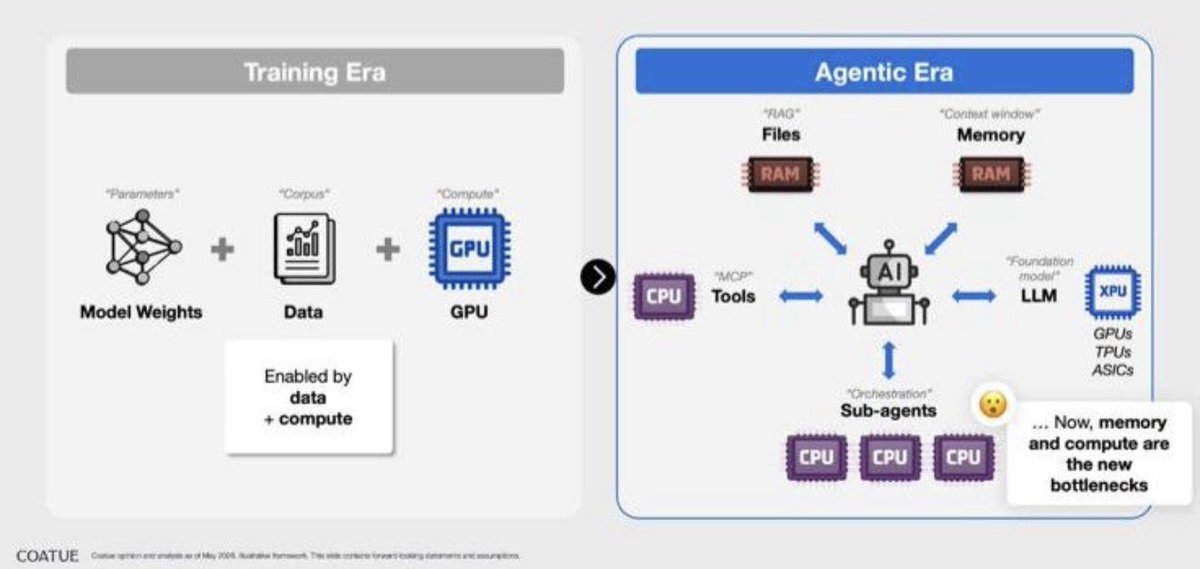
What does the Agentic AI explosion mean for AI Hardware? - 5x more memory - 12x more CPUs - 100x more networking Tune into @cvpayne at 2PM on @FoxBusiness for how to best capitalize on these trends.
IvanaSPEAR tweet media
English
3
6
33
3.3K
Ray Myers
Ray Myers@TheRayMyers·
Which Falling Angel is most likely to 2x? - $MELI at 38 FWD P/E - $NOW at 21 FWD P/E - $NVO at 14 FWD P/E - $HIMS at 72 FWD P/E - $DUOL at 40 FWD P/E
English
27
2
75
25.6K
Lucas Sacerdote🔋
Lucas Sacerdote🔋@LucasSacerdote_·
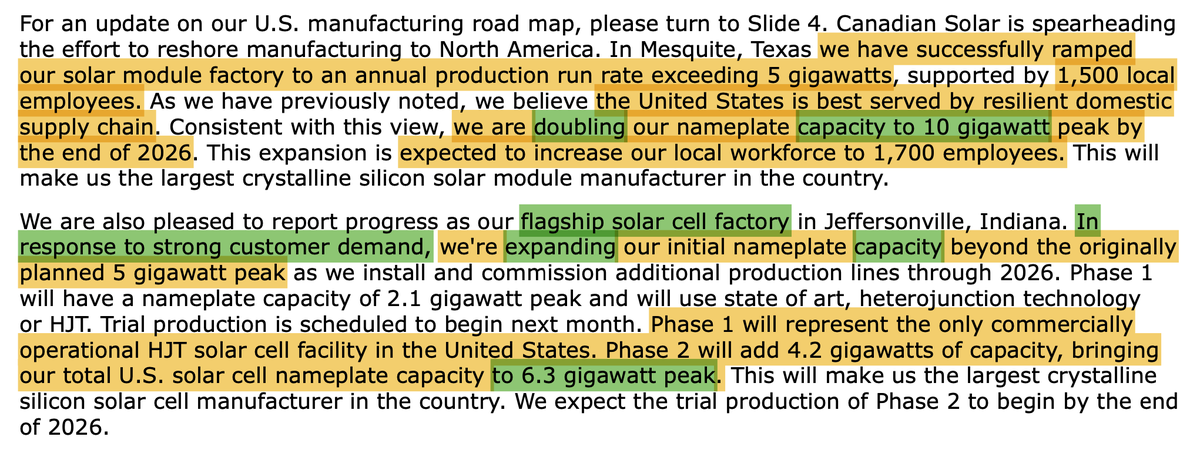
$CSIQ I spent this entire week in Dallas, Texas, learning as much as possible about Canadian Solar and its competitive landscape. Biggest takeaways: - From speaking with locals, multiple people corroborated $CSIQ 's factory in Dallas is working 24/7 non-stop. One or two years ago, they would work from Mon-Thursday. They are now continuously at Mon-Sun. This shouldn’t be surprising given they’re: "expanding capacity from 5GW to 10GW, in response to customer demand". You don’t do that unless the plant is already at full utilization. - On the other hand, $TE has yet to book 2 to 3GWs of their 2026 capacity, hence, they are not running at full capacity... (both are in Dallas, 30' away from each other) - Cell production, not modules, is the clear bottleneck. This is why cell production is keeping ~70-80% of solar's profitability down the value chain. $CSIQ with their already operating cell factory in Indiana is currently the only source of domestically produced N-type cells (TopCon & HJT). - Very encouraging to see their economies of scale starting to take place: with a 13% increase in their workforce in Dallas, they will be able to increase capacity by 2X. (Also, $CSIQ was able to do that in the same factory space. If $TE wanted to expand to 10GW, they would need a new building. Relatively more workforce and higher fixed costs for the same expansion). More to come… Looking forward to their May 14 earnings. Two weeks to go!
Lucas Sacerdote🔋 tweet mediaLucas Sacerdote🔋 tweet mediaLucas Sacerdote🔋 tweet media
Lucas Sacerdote🔋@LucasSacerdote_

Canadian Solar [Full Investment Thesis]: Everything You Need to Know About $CSIQ “THE GREAT SOLAR RECKONING” ☀️ 🔋$CSIQ became my largest position earlier this year, after I had been studying the company since 2023. Here is my 250-page, ~three-hour presentation on Canadian Solar. I made this video to compress the 1,000+ hours of work already done here, hopefully helping speed up the learning curve for anyone interested.☀️🔋 This is not meant to be flawless. It is meant to be done. I believe $CSIQ is entering one of the most promising periods in its history. With $15B+ in total assets, three multi-billion-dollar businesses spanning solar manufacturing, storage manufacturing, and project development across six continents, and a mere ~$1B market capitalization, Canadian Solar is poised to be one of the top energy performers in 2026. The market has left this company for dead. But underneath the surface, the foundations of the business have been getting stronger: - While the solar industry wrongly spent on building overcapacity, Canadian Solar was one of the few companies slowing down and investing upstream into its project development arm. - While everyone looked to globalize supply chains, Canadian Solar has been building its manufacturing presence in the U.S. since 2023. - While much of the industry was still debating battery storage, Canadian Solar was already building gigawatt-scale projects in 2021. Today, it is reaping the benefits of having been a first mover. This is the story of a company that, despite operating in a ruthless and complicated industry, has consistently been deliberate and rational in its capital allocation decisions. It remains founder-led, with the founder still owning ~20% of the company. Shareholder value creation will always be top of mind, regardless of the market’s current irrationality. The solar industry, like every commodity industry, is deeply cyclical. I am convinced we have already seen the worst of it, and that better profitability is ahead for equipment manufacturers. This is already starting to show in CSI Solar’s Q1 2026 results, with $100M+ in operating profit for the quarter. The supply-demand imbalance for electricity should result in excess profitability. $CSIQ is about to make the undeniable obvious: Canadian Solar is a Western (actually, global) leader in renewable energy. Not middle of the pack. At the very top. They produce ~25 GW of solar modules per year and ~15 GWh of storage per year. For reference, the entire U.S. added roughly 60 GW of total generation capacity in 2025. And they do not only manufacture. They also develop, engineer, construct, and operate billions of dollars of energy assets. That creates a powerful learning and feedback loop between manufacturing and operations, allowing them to stay ahead of the curve. Their BESS experience is the clearest example. At first glance, my estimates and projections may look overly optimistic. But I would ask you to take the time to analyze each one individually. I think you will see that even my bull case uses assumptions that many people already treat as base case assumptions for comparable companies such as $FLNC, $TE, $FSLR, $AMRC, $NXT, and others. My base case assumes roughly half the profitability the industry expects from peers, and still results in an ~10x investment opportunity. Not growing into it. Worth that today. Please feel free to share your thoughts, feedback, questions, and pushback!! ☀️☀️🔋🔋 Timeline CSIQ: 0:00 Introduction 1:38 Executive Summary 11:35 Macro 18:15 Corporate History 21:00 Management & Team 25:10 Solar Industry & Market 42:47 CSI Solar - the $7B solar behemoth $CSIQ owns 57:00 Project Demand - CSI Solar 1:00:05 BESS Subsidiary with Multi-GWh Firm Orders 1:05:35 Project Demand for e-Storage/BESS 1:11:44 Recurrent Energy - The Multi-Billion Renewable Project Developer 1:34:36 US Manufacturing - 10GWs of Capacity and First Ever to Produce Solar Cells Domestically 1:56:15 Competitors 2:19:29 Litigation 2:28:32 Quality 2:30:52 Valuation & Financial Analysis 2:40:40 Conclusion 2:43:15 Miscellaneous Disclaimer: This post is for informational and educational purposes only and does not constitute financial advice, investment advice, or a recommendation to buy or sell $CSIQ or any other security mentioned here. I am not a registered investment advisor (RIA). Always do your own research (DYOR). I and/or accounts under my management or discretion, may currently hold positions in $CSIQ and may purchase or sell shares at any time without further notice. My opinions, price targets, and allocation suggestions are my personal views and can change without prior notice. Investing in stocks involves a significant risk of loss of capital. Past performance is not indicative of future results. If you found this useful, follow me for more deep dives like this. I spend a ridiculous amount of time studying this whole ecosystem. Please like and share this post if you think more people should be aware of how attractive Canadian Solar could be as an investment opportunity.

English
10
6
83
28.4K
Caleb | Investor
Caleb | Investor@CalebInvests_·
What’s one stock I should add?! Looking for a stock to buy and hold for years!
Caleb | Investor tweet media
English
24
0
29
2K