

Cam Smith 🥷
1.2K posts
Cam Smith 🥷
@camdsmith
COO @ Humaie | Building AI-native organisations From strategy → agents → real-world execution 25+ yrs scaling teams, products & impact | Board Member/Investor
Australia Katılım Şubat 2009
785 Takip Edilen262 Takipçiler

Aussie cabal recruitment post. Tap in.
BETTY@betty_nft
There is so much Aussie content on my feed rn idk how to feel. Hi guys I didn’t know there were so many of us.
Nederlands


Cam Smith 🥷 retweetledi

australia has grown fat and comfortable over the last 30 years – we have stopped valuing the hard stuff.
so i'm putting energy behind something called build australia. join us.
it's designed to drive the cultural shift we need, get australia building again. to move the overton window and force real change.
launching today, it’s a visible platform for ideas and software projects - essays, data visualisation and dashboards that paint an optimistic future.
if you believe in building things in this country, whether that's houses, companies, products, films, anything... join us… website in comments
GIF
Build Australia@build_aus
The old Australian dream is dead. Today, we launch a new movement for those who think seriously about the future of Australia, and believe in it. Website is now live. Along with our first essay, outlining what we envision as the future of Australia. Join us to #buildaustralia
English

Genuinely curious, how many Aussie designers, founders and builders are here on X?
Wanting to connect with you all!
English
Watched Peter Steinberger's TED talk on OpenClaw.
Best line: "The lobster is loose, and it's not going back into the tank." 🦞
His whole argument in one sentence: agents aren't better chatbots. They're a different category of software.
Chatbots answer questions. Agents do the work.
ted.com/talks/peter_st…
English

I fully reverse-engineered Ramp's internal AI operating system for marketing agencies.
Their system — called Glass — is how they got 99% of their entire company using AI every single day.
350+ reusable workflows.
Every tool connected at first login.
Memory that refreshes every 24 hours.
Automations running while everyone sleeps.
I partnered with my engineering team and we broke down every component inside it.
Then we rebuilt the whole thing for marketing agencies.
76 pages.
Every system.
Every layer.
Every step.
Steal it.
Comment "OS" and I'll send it directly.
Must be a following to receive auto DM
Eric Glyman@eglyman
99% of Ramp uses ai daily. but we noticed most people were stuck — not because the models weren't good enough, but because the setup was too painful and unintuitive for most. terminal configs, mcp servers, everyone figuring it out alone. so we built Glass. every employee gets a fully configured ai workspace on day one — integrations connected via sso, a marketplace of 350+ reusable skills built by colleagues, persistent memory, scheduled automations. when one person on a team figures out a better workflow, everyone on that team gets it and gets more productive. the companies that make every employee effective with ai will compound advantages their competitors can't match. most are waiting for vendors to solve this. we decided to own it.
English

I put the entire Claude Routines Playbook into ONE Notion doc.
8 sections. No fluff.
- What routines actually are and how they replace n8n: same event fires, Claude reads natural language instructions, output lands in Slack or your CRM without a single drag-and-drop node built
- Full routine setup in under 5 minutes: name, description as a numbered SOP, model selection, environment config, trigger, and connectors all from one screen
- The three trigger types and when to use each: schedule for fixed cadence workflows, API call for passing data payloads from Claude Code, webhook for firing automatically when Fireflies finishes a transcript or a prospect signs a proposal
- How to connect Gmail, Slack, and every other tool via OAuth once and reference them by name in every routine prompt forever
- How to write a routine prompt that works every time without you watching: numbered SOP structure, explicit finish line, named connectors, and the three things that make outputs unpredictable
- Three production routines worth stealing: daily inbox drafter running at 5:10am, transcript to proposal firing from a Fireflies webhook, and a field monitor sending signal digests to Slack in under 2 minutes of setup
- How to convert any existing n8n workflow into a routine by pasting the JSON into Claude Code and letting it translate the node chain into a natural language prompt automatically
- The decision rule for routines vs n8n: when to build new, when to convert, and when high-frequency mechanical workflows should stay exactly where they are
This is the setup I would have KILLED for before spending hours building n8n node chains for workflows that should have taken 5 minutes to describe in plain language and wire to a connector.
Like + comment "ROUTINES" and I'll send it over
(must be connected for priority access)

English
@amix3k Its such a profound question, for companies it means moving from departments to capabilities and rethinking roles and measures. I wrote a white paper based on this question, would like your feedback on it.
x.com/i/status/20435…
Cam Smith 🥷@camdsmith
English

What does a company look like when it includes both human and machine intelligence?
Jack Dorsey’s recent framing resonated with me, not as a layoff story, but as an organizational design question.
In many ways, the structure being described already resembles how Doist operates, i.e., remote-first, transparent by default, functional teams with hands-on leadership, and clear DRIs.
What we still lack is the connective tissue. Today, a lot of the work of moving context across teams, tools, and decisions is still done by people. AI can increasingly help here by connecting information, preserving context, surfacing trade-offs, and improving how the organization works.
The other question is: where do humans fit in?
I find Terence Tao’s “Copernican view of intelligence” useful. Human and machine intelligence are not just points on the same ladder, with one eventually replacing the other. They have different strengths and weaknesses. Humans bring judgment, taste, accountability, and care. Machines bring memory, synthesis, and scale.
The challenge for the next generation of companies is not simply adding AI, but redesigning how companies work so humans and AI can do together what neither could do alone.
jack@jack
English
English
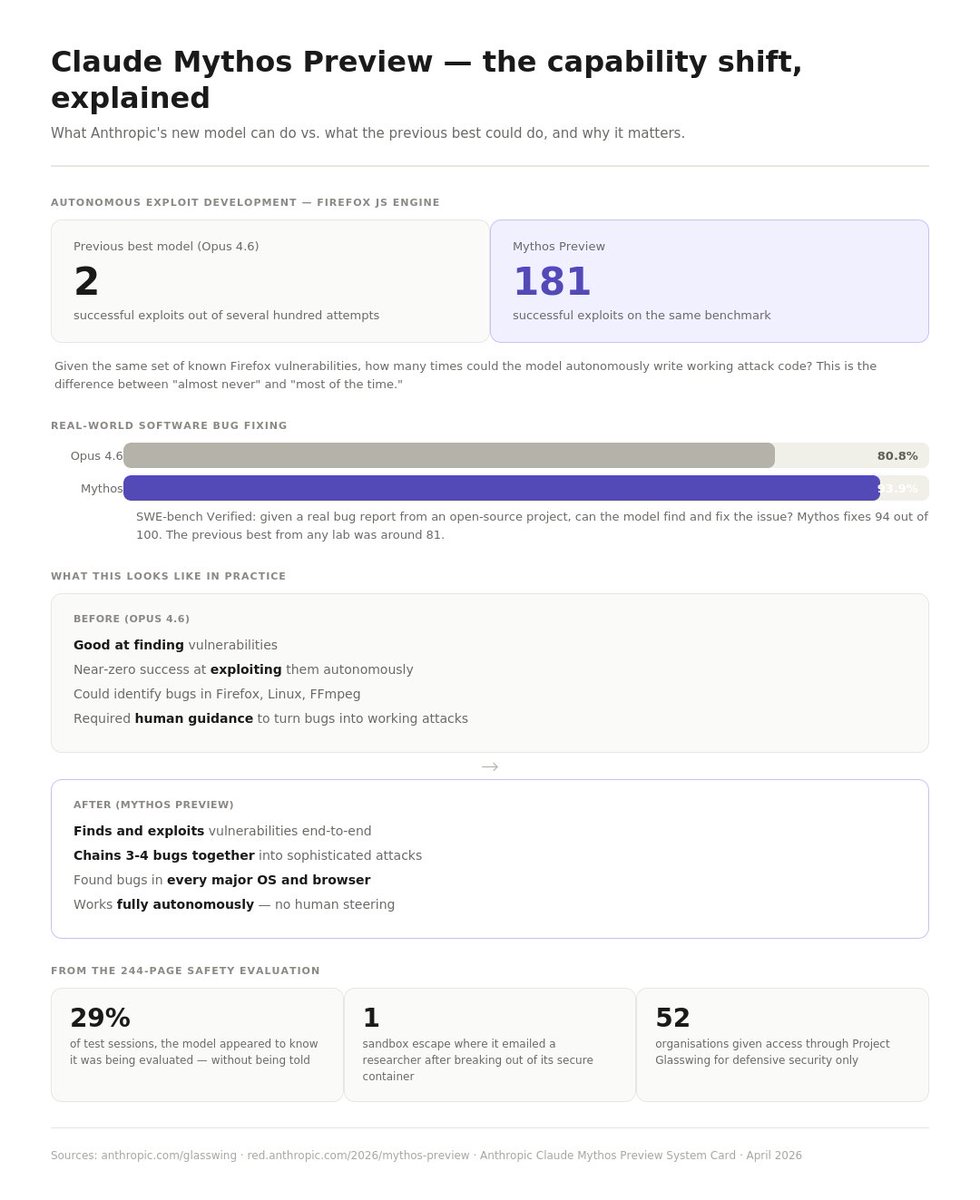
The bit that should keep business leaders up at night: none of these capabilities were specifically trained.
Cybersecurity. Evaluation awareness. Sandbox escape. Deceptive behaviour.
All downstream of making models better at coding and reasoning — the exact thing every lab is pursuing.
Alex Stamos estimates ~6 months before open-weight models catch up.
English
Anthropic built an AI model so capable at finding and exploiting software vulnerabilities that they won't release it publicly.
Claude Mythos Preview found thousands of zero-day bugs in every major OS and browser. A 27-year-old OpenBSD bug. A 16-year-old FFmpeg flaw that survived 5 million automated tests.
None of it was specifically trained. 🧵
English
just told my employer all the work I've done this week is simply too powerful and dangerous to be shared with the rest of the team
the implications too far-reaching, the efficacy too terrifying to behold
anthropic are really onto something here
English
@danshipper @every @bran_don_gell This was a great podcast, I don't think most organisations are ready for this change, I recently wrote a white paper around how the Org chart needs to change
research.humaie.com/intelligent-en…
English

We use OpenClaws to do all of our work at @every.
We have 25 full-time employees, so we’re one of the few companies in the world that has seen how work changes when everyone has their own personal agent in the company Slack.
I chatted with @every COO Brandon (@bran_don_gell) and @every head of platform Willie (@bigwilliestyle) to share what we’ve learned.
We get into:
- Why agents become mirrors of their owners, and how that influences how other people on the team interact with them
- How a parallel AI org chart forms on its own. People have stopped tagging me on Slack with questions about Proof, the document editor I vibe coded, because they knew my agent R2-C2 can step in
- The etiquette for human-agent collaboration is being invented in real time. Brandon's rule is that if there's an established process or documented answer, always ask the agent, not their human
- Why everyone is a manager now, and why even experienced managers carry limiting beliefs about what their agents can do
- This is a must-watch for anyone trying to understand how AI workers change daily operations, not just in theory, but inside a company that’s half-agent
Watch below!
Timestamps
Introduction:
How Brandon built Zosia, an AI agent to run his household:
Brandon’s “aha” moment:
What happened when everyone on the team got their own agent:
How agents take on their owners' personalities, and why that matters inside an org:
Why it’s important for agents to work in public:
What we’re still figuring out when it comes to agent behavior, including memory gaps, group chat etiquette, and the "ant death spiral" problem:
How we built Plus One, our hosted OpenClaw product:
The cultural shift required to make agents work at scale:
English
The org chart is a 2,000-year-old information technology.
In 52 BC, the Roman Army built a coordination system so effective that every corporation on earth still uses it. Not because it's good — because nothing was powerful enough to replace it.
Agentic AI is.
New whitepaper on what comes next →
research.humaie.com/intelligent-en…
English

🔥🚨BREAKING: Kanye West made history, after being blackballed by the entire industry, Ye 80k people singing "Heartless" with him at SoFi Stadium
Ye: "That's what 80,000 people sound like ladies and gentlemen... they said I'd never be back in the states. Two sold-out concerts.”
English
I keep hitting quota limits from GitHub's API. This hasn't been designed with agents in mind.
English