Radiation Janitor
36.2K posts

Radiation Janitor
@carter_ae
https://t.co/WDptBDBXqU
Michigan, USA Katılım Eylül 2012
3.8K Takip Edilen598 Takipçiler
Radiation Janitor retweetledi

@ripplebrain @devintoshea Who looked at scissors and thought they were too heavy
English
Radiation Janitor retweetledi

america u must convince ur gen z that organizing and infiltrating bourgeois institutions is a roguelike
Ichigo Niggasake@SomaKazima2
I hope this trend keeps going 😭😭😭
English
Radiation Janitor retweetledi

@hayleyglyphs Ahmadinejad has been pushing this line for years. And he's a huge U Michigan sports fan so he's gotta be pretty stoked rn
English

really enjoying the conspiracy theory that Iran destroying all those US installations has resulted in massive rains restoring the fertile crescent
Borzou Daragahi 🖊🗒@borzou
Mesopotamia returns to its status as a paradise following unprecedented rains
English
Radiation Janitor retweetledi

In 1980, two years before Feynman's famous Caltech lecture on Quantum Computing, a 43-year-old Soviet mathematician named Yuri Manin published a slim 128-page popular-science book called Вычислимое и невычислимое — Computable and Noncomputable — through the Moscow publishing house Sov. Radio. Manin was not a computer scientist. He was already one of the great algebraic geometers of his generation: a Lenin Prize laureate (1967), professor of algebra at Moscow State University, principal researcher at the Steklov Mathematical Institute, the mathematician behind the Gauss–Manin connection and the Mordell conjecture for function fields. He had been forbidden from foreign travel since 1968. The book was written in Russian, never officially translated for nearly thirty years, and its argument about quantum computation took up barely three pages of the introduction...
en.wikipedia.org/wiki/Yuri_Manin
What's striking about Manin's framing — and what got almost entirely lost when the Western quantum computing canon formed around Benioff, Feynman, and Deutsch — is the direction of the argument.
Feynman's 1982 case for quantum computers was pragmatic and engineering-flavored: classical machines can't efficiently simulate quantum systems, therefore we should build quantum machines that can.
Manin came at it from the opposite end. He looked at molecular biology — at protein synthesis on messenger RNA, at the absurd information density and energetic efficiency with which living cells perform what looks structurally like Turing-machine computation — and concluded that nature had already solved the problem. Classical physics, he argued, simply cannot account for what biology does. The mathematical theory of quantum automata must already be implicit in the substrate of life. Engineering quantum computers wasn't the goal; it was the obvious downstream consequence of taking biology's existence-proof seriously.
That places Manin in a different intellectual lineage than the one quantum computing eventually inherited. He was downstream of Schrödinger's What Is Life? (1944) and the broader Soviet tradition of treating life as a physical system whose laws had not yet been written — Vernadsky, Lyapunov, the cybernetics revival under Berg and Glushkov.
The West built quantum computing as an engineering discipline of qubits-as-fabricated-systems, and pushed biology off into a separate and often-dismissed sub-field called "quantum biology."
Forty-five years later, with the work emerging on microtubules, tryptophan networks, ordered water, and coherent processes in neural lattices, the field is, in a real sense, finally catching up to its own actual origin.
The translation below is from pages 13–15 of the introduction.
On the inefficiency of computing devices
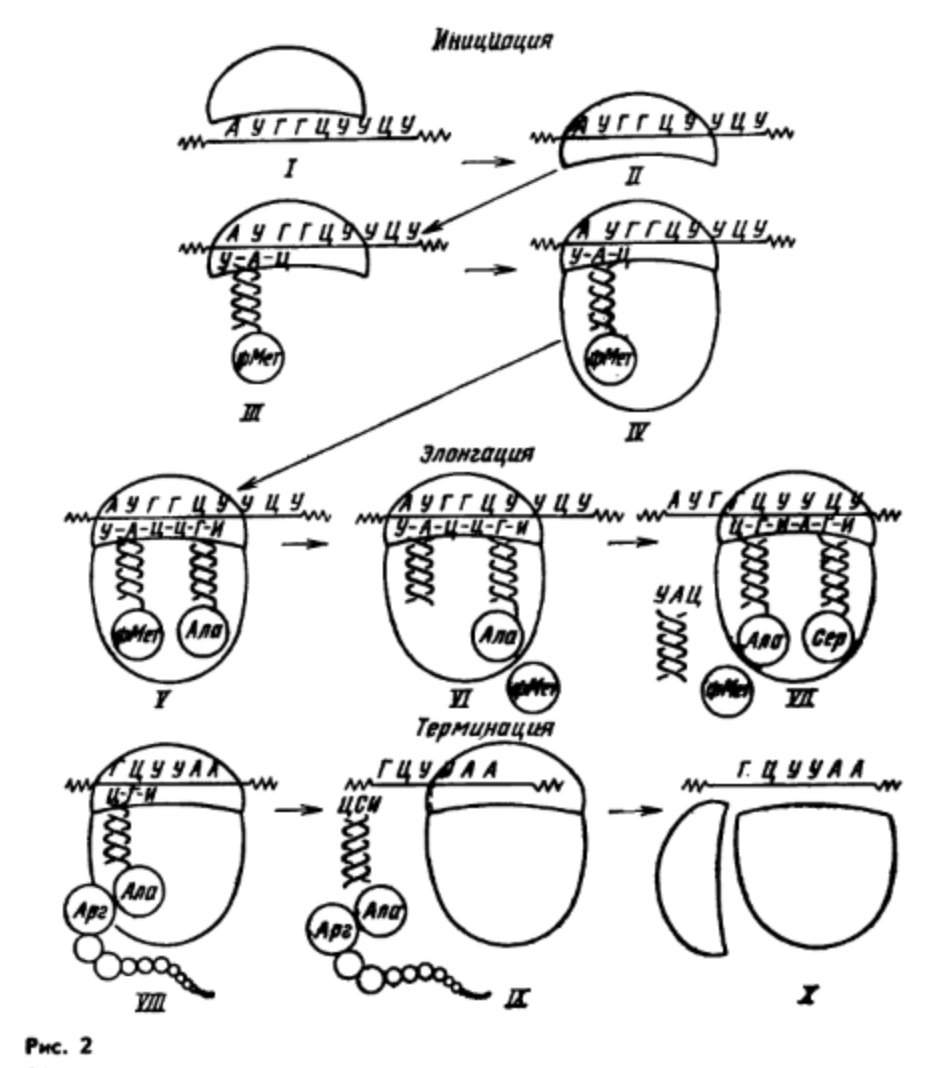
Molecular biology provides examples of the behavior of natural (not human-engineered) systems which we are forced to describe in terms close to those accepted in the theory of discrete automata. The figure below depicts the scheme of protein synthesis on messenger RNA: it closely resembles the depiction of a Turing machine copying information from one tape to another.
Classical continuous systems governed by differential equations can imitate discrete automata only when their phase space has an exceptionally complex structure — an abundance of stability regions separated by low energy barriers. Loading a program carves out a sophisticated system of passages through these barriers, predetermining the motion of the phase trajectory through this labyrinth. As a physical system, the computing device must be highly unstable, since an error of a single character in the program generally leads to an entirely different trajectory. Yet the computational process itself must be exceptionally stable — that is, spontaneous errors (transitions of the trajectory across a barrier that should remain closed, as a result of fluctuations) must have very low probability. It is well known that these requirements — combined with slowness of operation and the exponential growth of dissipated energy as complexity increases — erected the barrier that halted the development of mechanical computers.
[Citing Poplavsky's 1975 paper on thermodynamic models of information processes:] A genuinely instructive calculation can be found there: the quantum-mechanical description of the methane molecule by the lattice method requires computation at 10⁴² points. If we assume only 10 elementary operations are performed at each point, and suppose all computations are carried out at ultra-low temperature, then even so the calculation of the methane molecule would require expending energy roughly equal to that produced on Earth over a century.
On quantum automata
It is possible that for a better understanding of such phenomena a mathematical theory of quantum automata is lacking. The mathematical model of such objects must exhibit highly unusual properties compared with deterministic processes. The reason is that the capacity of the quantum state space is dramatically greater: where in the classical case there are N discrete states, in quantum theory — which permits their superposition — the state space lies in Cᴺ. When classical systems are combined, their state-counts N₁ and N₂ simply multiply; in the quantum case one obtains C^(N₁·N₂).
These rough estimates show that systems exhibiting quantum behavior are potentially far more complex than their classical counterparts. For example, since the system has no unique decomposition into parts, the state of a quantum automaton may be regarded in many different ways as states of entirely different virtual classical automata.
In carrying out such a program, the first difficulty will be finding the right balance between mathematical and physical principles. The quantum automaton must be abstract: its mathematical model should use only the most general quantum principles, without prejudging physical implementations. Then the model of evolution is a unitary rotation in finite-dimensional Hilbert space, and the virtual decomposition into subsystems corresponds to the tensor-product decomposition of that space. Somewhere in this picture the place of interactions — traditionally described by Hermitian operators and probabilities — must still be found.
Notes on this translation:
The C in "Cᴺ" is the field of complex numbers; Cᴺ is N-dimensional complex Hilbert space. C^(N₁·N₂) reflects the tensor product H₁ ⊗ H₂ — the structure that gives quantum systems their entanglement-driven computational advantage.
The Poplavsky reference is to R.P. Poplavsky, "Thermodynamical models of information processing," Uspekhi Fizicheskikh Nauk 115:3 (1975), 465–501.

Radiation Janitor retweetledi

It’s my birthday and I’m launching a Kickstarter to fund my indie anime! Will you support us? 🥰❤️#indieanimation #anime #daising
English
Radiation Janitor retweetledi

“The fewest acres of wheat planted since record keeping began”
GIF
Bloomberg@business
Wheat surged to the highest in nearly two years bloomberg.com/news/articles/…
English
Radiation Janitor retweetledi

@shaylanichelle_ They have mandatory range days each month.
The range is mostly open to them whenever they want.
They have free access to ammo and weapons.
Most couldn't shoot a row of elephants.
English
Radiation Janitor retweetledi

i have this idea for an #Alien movie where it starts as a police procedural where the CSI cops are trying to find out why President Disney-Yutani trashed their own penthouse/research lab with an orbital strike, moves on to unexplained abductions and the threat of total outbreak..


English

@CarlZha America would rather outsource their own defense capabilities than train shipyard workers and pay them a living wage.
English

US Military-Industrial-Complex gives up on hollowed out US industrial sector, outsource warship building to Japan and Korea
OSINTdefender@sentdefender
The Pentagon is considering outsourcing warship design and building to Korea and Japan with a proposed $1.85 billion feasibility study into the project within the proposed budget for 2027, with the study to look at the feasibility of adopting or co-producing advanced hulls such as Japan’s Mogami-class and Korea’s Daegu-class frigates to supplement the U.S. Navy, according to USNI News.
English
Radiation Janitor retweetledi

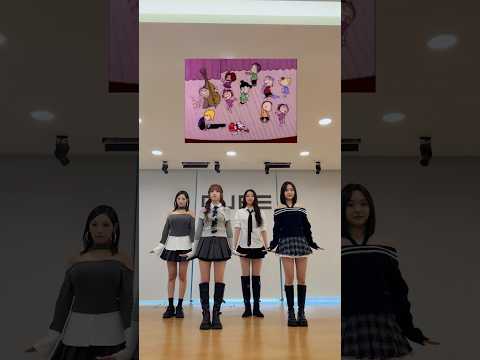
Wait Charlie Brown had hoes? I don't know what to believe anymore youtube.com/shorts/EA1PUnr…

YouTube
English
Radiation Janitor retweetledi

I aim at having a threesome with Alexandra Daddario and Ana de Armas
Kalshi@Kalshi
JUST IN: SpaceX aims at $7.5 trillion valuation, a million-person Mars colony and space data centers

English