Cesar A. L. Oliveira

3.1K posts

Cesar A. L. Oliveira banner
Cesar A. L. Oliveira

Cesar A. L. Oliveira

@cesarlins

Computer Science PhD. IT Consultant. Data analysis, data visualization, AI, business process improvement.

J. Guararapes, PE, Brasil Katılım Haziran 2009
571 Takip Edilen218 Takipçiler
Cesar A. L. Oliveira retweetledi

Brian Winter
Brian Winter@BrazilBrian·
Latin America is now aging faster than ANY region in the world. Chile has a lower birthrate than even Japan. What is going on?
Brian Winter tweet media
English
2.1K
3K
10.5K
27.5M
Cesar A. L. Oliveira retweetledi
Nav Toor
Nav Toor@heynavtoor·
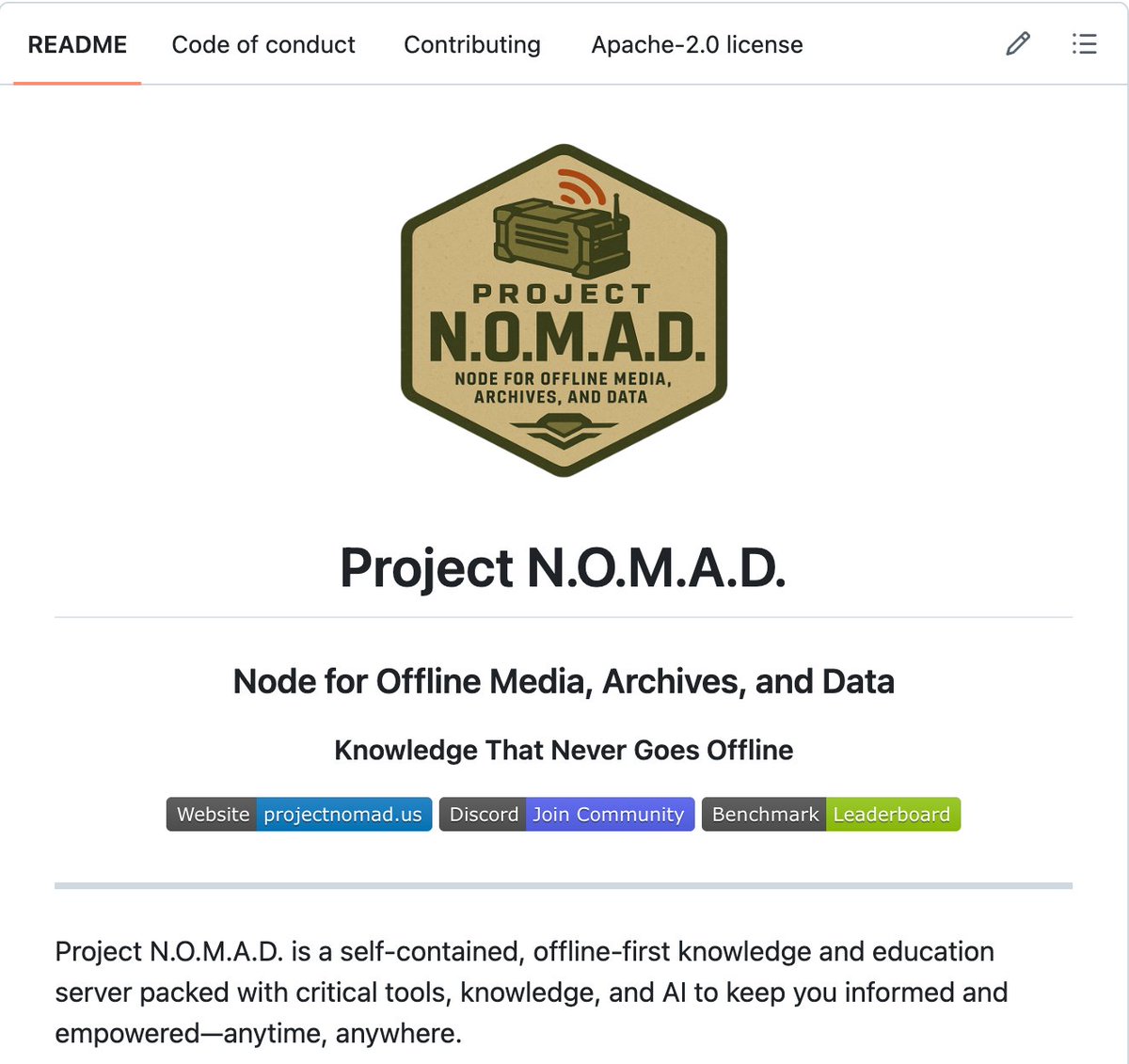
🚨Someone just open sourced a computer that works when the entire internet goes down. It's called Project N.O.M.A.D. A self-contained offline survival server with AI, Wikipedia, maps, medical references, and full education courses. No internet. No cloud. No subscription. It just works. Here's what's packed inside: → A local AI assistant powered by Ollama (works fully offline) → All of Wikipedia, downloadable and searchable → Offline maps of any region you choose → Medical references and survival guides → Full Khan Academy courses with progress tracking → Encryption and data analysis tools via CyberChef → Document upload with semantic search (local RAG) Here's the wildest part: A solar panel, a battery, a mini PC, and a WiFi access point. That's it. That's your entire off-grid knowledge station. 15 to 65 watts of power. Works from a cabin, an RV, a sailboat, or a bunker. Companies sell "prepper drives" with static PDFs for $185. This gives you a full AI brain, an entire encyclopedia, and real courses for free. One command to install. 100% Open Source. Apache 2.0 License.
Nav Toor tweet media
English
592
3.9K
24K
1.2M
Cesar A. L. Oliveira retweetledi
Anthropic
Anthropic@AnthropicAI·
New on the Anthropic Engineering Blog: In evaluating Claude Opus 4.6 on BrowseComp, we found cases where the model recognized the test, then found and decrypted answers to it—raising questions about eval integrity in web-enabled environments. Read more: anthropic.com/engineering/ev…
English
253
357
3.2K
1.1M
Cesar A. L. Oliveira retweetledi
Rohan Paul
Rohan Paul@rohanpaul_ai·
Lab-grown human brain cells in a petri dish were taught to play the video game Doom. These cells are wired to a cheap computer chip. They learn fast, navigating levels, outperforming some AI. Massive Bio-tech breakthrough for medicine possible here.
English
17
28
141
12.4K
Cesar A. L. Oliveira retweetledi
NIK
NIK@ns123abc·
🚨 BREAKING: IBM stock down 13% after Anthropic announced that Claude can streamline COBOL code IBM’s entire business model: >maintaining legacy COBOL nobody understands >claude: “I can read it” >IBM stock immediately drops -13% >$40B market cap EVAPORATED Dario strikes again 💀
NIK tweet mediaNIK tweet media
English
612
1.4K
14K
2.5M
Cesar A. L. Oliveira retweetledi
Rohan Paul
Rohan Paul@rohanpaul_ai·
Terence Tao on how to pick a career in era of AI.
English
14
99
771
45.1K
Cesar A. L. Oliveira retweetledi
Massimo
Massimo@Rainmaker1973·
Bus driver stuns with capoeira, a Brazilian martial art that looks like acrobatic dancing
English
191
365
6.3K
586.6K
Cesar A. L. Oliveira retweetledi
CAF
CAF@AgendaCAF·
Artificial intelligence is transforming energy systems across Latin America and the Caribbean. This policy brief explores how AI can support decarbonization and efficiency while also addressing rising electricity demand, governance challenges, and equity risks across the energy value chain. 👉 Download Artificial Intelligence & Energy: An Overview of Emerging Practices. scioteca.caf.com/handle/1234567…
CAF tweet media
English
0
3
12
1K
Cesar A. L. Oliveira retweetledi
Mishaal Abbasi
Mishaal Abbasi@WhereIsMishaal·
bad day to be a Waymo in SF during a PG&E-induced power outage
English
119
278
1.4K
2.3M
Cesar A. L. Oliveira retweetledi
The Hacker News
The Hacker News@TheHackersNews·
🤖 AI copilots are now built into everyday SaaS tools. They move fast and quietly create new data paths across apps. Static SaaS security can’t see AI activity in real time, so risk hides in normal logs—driving the shift to dynamic AI-SaaS security. 👉 Understand the risk before it hits → thehackernews.com/2025/12/the-ca…
The Hacker News tweet media
English
1
22
74
11.1K
Cesar A. L. Oliveira
Cesar A. L. Oliveira@cesarlins·
If superintelligence is possible (and it would be surprising if humans were the final peak of intelligence) then it holds an intrinsic competitive advantage. Any such advantage, once reachable, is eventually realized. It is an evolutionary step. Inevitable and unstoppable.
Cesar A. L. Oliveira tweet media
English
0
0
0
12
Cesar A. L. Oliveira retweetledi
GREG ISENBERG
GREG ISENBERG@gregisenberg·
MCKINSEY JUST DROPPED THEIR 2025 AI REPORT. HERE’S THE TLDR: 1/ 90% of companies “use AI,” but 67% are still stuck in pilot mode. Corporate AI theater is alive and well lol. 2/ 62% of orgs are experimenting with AI agents, 23% are scaling AI agents. Most are in tech and healthcare. 3/ The impact gap is massive. 64% say AI helps innovation, but only 39% see real EBIT gains. 4/ The high performers (top 6%) think bigger. They rebuild workflows, set growth goals, and invest real budgets not just POCs. 5/ Leaders who own AI personally are 3x more likely to scale it. Makes sense. 6/ The winners use AI to transform how work gets done, not just speed it up. 7/ The average company measures efficiency. The best ones measure how fast their agents can act. 8/ Risk management is catching up with 51% have already seen AI backfire, mostly from inaccuracy. 9/ The workforce impact is foggy. 32% expect cuts, 13% expect growth, everyone else is guessing. 10/ AI adoption is mainstream, but true transformation hasn’t started. Early days.
GREG ISENBERG tweet mediaGREG ISENBERG tweet mediaGREG ISENBERG tweet mediaGREG ISENBERG tweet media
English
203
1K
5.7K
834.7K
Cesar A. L. Oliveira retweetledi
Carlos E. Perez
Carlos E. Perez@IntuitMachine·
Everyone ‘knows’ AGI will either make us all unemployed or fabulously wealthy. Except, a rather brilliant (and chilling) paper from a Yale economist suggests it's neither. It says the economy will boom, and our wages... won't. A bit awkward. I've been digging into this 2025 paper, "We Won't Be Missed," and it's fascinating. The premise: AGI arrives and can do all economically valuable work. And the 'compute' to run it gets cheaper and more abundant over time. So, what happens to us fleshy, rather expensive humans? The whole argument hinges on a masterstroke of a distinction. The paper splits all work into two types: 1️⃣ Bottleneck Work: The truly essential stuff. Producing energy, logistics, scientific discovery. The economy literally cannot grow unless this work gets done. 2️⃣ Accessory Work: The 'nice-to-haves'. Arts, fine dining, hospitality... maybe even writing witty Twitter threads. (Gulp). Now, you might think AGI will just take the grunt work, leaving the important strategic stuff to us. Wrong. To achieve maximum growth, the economy must automate all the bottlenecks. It can't be held back by us. So AGI systematically takes over everything that is mission-critical. So... are we all fired and sent home? Surprisingly, no. The model shows people still work. We either help out with the 'bottleneck' tasks or get shuffled off to 'accessory' jobs that aren't worth the electricity to automate. But that's not the interesting part. Here's where it gets properly weird. Your future salary isn't based on your skill, your years of experience, or how 'important' your job feels. It's capped by one thing: the cost of the computational resources needed to do your job instead of you. Imagine that. As compute gets exponentially cheaper, the value of replicating your work plummets. The economy is soaring, productivity is off the charts... but your wage is pegged to a falling technological cost. You're not obsolete, you're just... replicable. And replicable is cheap. This leads to the paper's most brutal conclusion: The share of national income that goes to labour (i.e., salaries) collapses towards ZERO. All the wealth, all the gains from this incredible boom, flow to the owners of the compute. Splendid. Here's what this means for you. Next time you see a headline about a new AI model smashing a benchmark, don't just ask "Will that take my job?" Ask: "How much would it cost to run that model 24/7?" Because that figure might just be your future salary cap. Now, the paper isn't all doom. It notes that society as a whole gets richer, and we could still find meaning in 'accessory' work. But the central economic role of human labour as the engine of growth? Gone. We become passengers, not pilots. The paper's title is "We Won't Be Missed." Not because we're replaced, but because the economy will chug along just fine, growing faster than ever, whether we show up for work or not. Completely changes how I think about the 'future of work'. Makes you wonder what we should really be planning for, doesn't it?
Carlos E. Perez tweet media
English
397
783
4.3K
585.9K
Cesar A. L. Oliveira retweetledi
Rohan Paul
Rohan Paul@rohanpaul_ai·
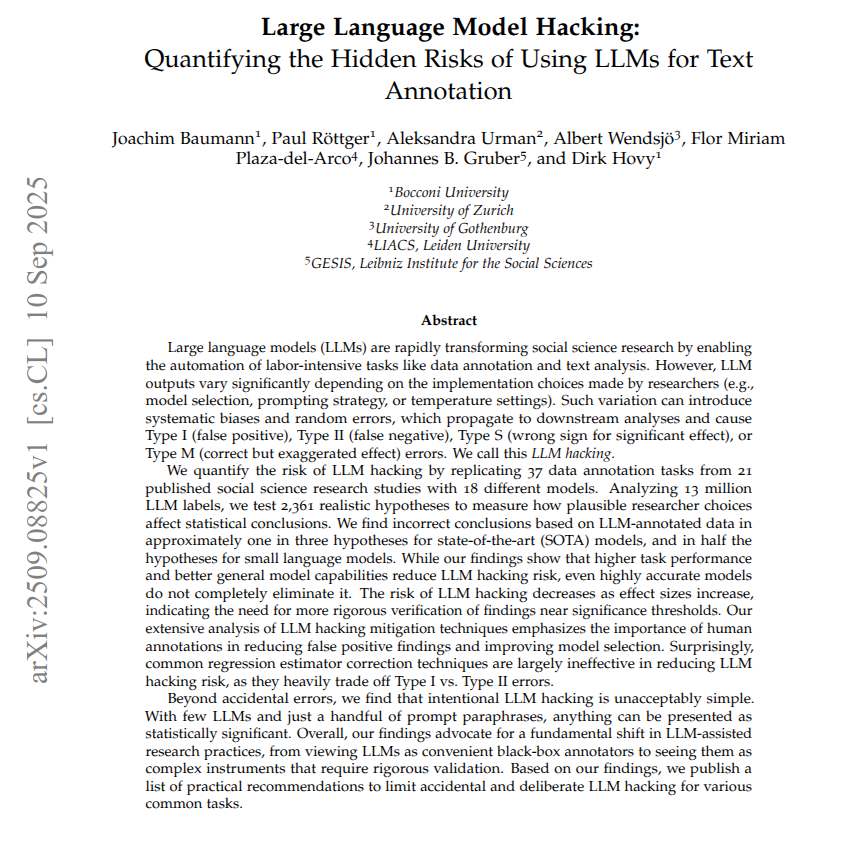
This paper warns that using large language models for labeling text can often lead to wrong research conclusions. Here, LLM hacking means the final statistical claim flips depending on model, prompts, or settings, not the underlying data. The problem comes from what the authors call LLM hacking, where results flip depending on which model, prompt, or setup is chosen, not on the actual data. They tested 37 real research tasks with 18 different models and found that incorrect results happened in about 31% to 50% of cases. These errors include missing real effects, inventing effects that are not there, reporting the wrong direction, or exaggerating the size of an effect. The risk is especially high when results are near the usual significance cutoff, which is where many social science studies operate. They also show that 100 human labels can be more reliable than 100K LLM labels, especially for avoiding false discoveries. Correction methods that adjust results after the fact do not really solve the issue, since they reduce one type of error but increase another. Finally, they show it is very easy for someone to deliberately game results by trying different models and prompts until they get the answer they want. ---- Paper – arxiv. org/abs/2509.08825 Paper Title: "LLM Hacking: Quantifying the Hidden Risks of Using LLMs for Text Annotation"
Rohan Paul tweet media
English
15
41
273
18.7K
Cesar A. L. Oliveira retweetledi
Hackmanac
Hackmanac@H4ckmanac·
🚨Cyber Alert ‼️ Hackers hijack npm packages with 2 billion weekly downloads in supply chain attack Attackers hijacked an NPM maintainer account via phishing and injected malware into 18 packages with a combined 2.6 billion weekly downloads. Popular libraries affected include debug (357.6M), chalk (299.9M), and ansi-styles (371.4M). The malware modified index.js files to intercept cryptocurrency transactions, replacing wallet addresses for Ethereum, Bitcoin, Solana, Tron, Litecoin, and Bitcoin Cash with attacker-controlled ones. It also tampered with website content, API calls, and wallet interactions. This is being described as the largest supply chain attack in history. Source: bleepingcomputer.com/news/security/…
Hackmanac tweet media
English
8
117
482
120.8K
Cesar A. L. Oliveira retweetledi
CAF
CAF@AgendaCAF·
CAF y @el_BID invitan a presentar propuestas de investigación rigurosas que evalúen el impacto real de la inteligencia artificial (IA) y las tecnologías digitales en la equidad de género y la inclusión social en América Latina y el Caribe. - Áreas de investigación: educación, salud, justicia, empoderamiento económico, violencia de género, servicios digitales y equidad algorítmica. - Financiamiento: hasta USD 100.000 - Fecha límite: 7 de octubre 🔗 Más información y postulaciones: caf.com/es/trabaja-con…
CAF tweet media
Español
3
23
27
3K
Cesar A. L. Oliveira retweetledi
CAF
CAF@AgendaCAF·
📢 ¡Buenas noticias! Se amplió el plazo para postular al #LIF2025: Soluciones digitales para la inclusión financiera de comunidades rurales. Ahora tienes tiempo hasta el 21 de septiembre de 2025 para inscribir tu iniciativa y ser parte de esta séptima edición que impulsa soluciones digitales innovadoras para la inclusión y educación financiera de comunidades rurales y MiPymes en América Latina y el Caribe. El LIF reúne al ecosistema fintech, al sector público y privado, emprendedores e inversores, generando oportunidades de negocio, inversión y alianzas para transformar realidades. 🔗 Postúlate caf.com/es/trabaja-con…
CAF tweet media
Español
0
1
3
726
Cesar A. L. Oliveira retweetledi
Aurimas Griciūnas
Aurimas Griciūnas@Aurimas_Gr·
The evolution of modern RAG Architectures. 👇 In general there are so many variations you can choose from but it all eventually converges to some flavour of Agentic RAG. 𝗡𝗮𝗶𝘃𝗲 𝗥𝗔𝗚: the regular “embed query -> retrieve -> inject retrieved context into prompt” type of system. ⬇️ 𝗥𝗔𝗚 𝘄𝗶𝘁𝗵 𝗺𝗲𝗺𝗼𝗿𝘆: add memory of the previous interactions to try avoiding repeated queries. ⬇️ 𝗛𝘆𝗗𝗲 𝗯𝗮𝘀𝗲𝗱 𝗿𝗮𝗴: before embedding the query try to generate an ideal document that could be retrieved, then embed that and use it for retrieval. ⬇️ 𝗔𝗱𝗮𝗽𝘁𝗶𝘃𝗲 𝗥𝗔𝗚: define multiple retrieval paths and route according to the complexity of the query. ⬇️ 𝗖𝗼𝗿𝗿𝗲𝗰𝘁𝗶𝘃𝗲 𝗥𝗔𝗚: add an additional step that grades retrieved documents. On failure run additional retrieval steps. ⬇️ 𝗦𝗲𝗹𝗳 𝗥𝗔𝗚: allow the system to reformulate queries as it sees fit for more relevant retrieval (basically, introducing query rewrite steps and loopback mechanisms). ⬇️ 𝗔𝗴𝗲𝗻𝘁𝗶𝗰 𝗥𝗔𝗚: combine multiple architectures defined above and add agentic reasoning in different steps of the pipeline. 𝘚𝘰𝘮𝘦 𝘵𝘩𝘰𝘶𝘨𝘩𝘵𝘴, 𝘭𝘦𝘢𝘳𝘯𝘪𝘯𝘨𝘴 𝘧𝘳𝘰𝘮 𝘵𝘩𝘦 𝘵𝘳𝘦𝘯𝘤𝘩𝘦𝘴: ✅ There is no single pattern that would solve for all of your business constraints. ✅ Start simple and evolve in complexity. ✅ Always have proper evals defined that will help you measure performance of the system. Join me in my end-to-end AI Engineering Bootcamp to learn this hands-on: swrlai.com/ai-bootcamp Let me know your thoughts! 👇
Aurimas Griciūnas tweet media
English
14
99
374
25.1K