Charlie Brewer

10.6K posts

Charlie Brewer banner
Charlie Brewer

Charlie Brewer

@charbrew

AI Transformation Leader | Certified MindStudio AI Agent Developer | Director of Product Design | Product Manager | AdTech CreatorTech Streaming PropTech EdTech

SF Bay Area Katılım Şubat 2009
2.5K Takip Edilen856 Takipçiler
Charlie Brewer
Charlie Brewer@charbrew·
@bernhardsson @parkerhendo Thank you! This needs to be shouted in the face of every tech leader who bangs on about mass job destruction and extinction of all white collar careers. This is feeding a generational backlash. We need to move the conversation to growth, benefits, expansion, evolution.
English
0
0
0
6
𝕾𝖎𝖗 𝕮𝖍𝖗𝖎𝖘
everytime people ask me how to get rich, i tell them; the reverse psychology. the truth you were taught in school or media, they are all lie. black is white & white is black. six rules of wealth you MUST know; 1. say no to the paycheck, paycheck makes you poor cos they make you a slave mindset. if you must accept a paycheck, build and develop yourself from there, then leave, you must. 2. do not make money, make business. money does not make business for you, but business makes money for you. 3. the best business you will build in bad times, in recession, in bear market cos you can hire and buy for cheap because your competition is weak, because you have silence to focus. 4. if your government is ruining your country, leave your country and build your business where you are more free. 5. normal people hate taxes, but you have to love taxes. only if you understand the system, you can escape the system. know your enemy, love your enemy, kill your enemy. 6. normal people fear the risk, they fear uncertainty, they fear decline. subconsciously, their fear of risk shows their fear of death but only with risk, you can get rich. buena suerte 👍
English
18
83
414
14.6K
Ole Lehmann
Ole Lehmann@itsolelehmann·
JUST IN: The public hates AI. And it's starting to get really ugly. Just in the last 60 days: University of Arizona students booed former Google CEO Eric Schmidt off the commencement stage when he tried to give them AI advice. UCF and Middle Tennessee State got similar reactions to other AI-themed graduation speakers. On the streets, Waymo robotaxis are getting attacked again in San Francisco. Crowds routinely surround the vehicles, smash the windows, and set them on fire to protest displacing Uber and taxi jobs. NYC parents and students packed a marathon school board meeting and demanded the city halt the rollout of AI in public schools. Parents are showing up to these fights now, with their kids in tow. Communities across the country are fighting new AI data center construction at zoning meetings. Residents are blocking permit approvals over power consumption, water usage, noise, and the sheer footprint these buildings put on the land. Some local governments have already passed bans on new construction. And a small slice of the anger has already turned violent at the very top. Last month, a 20-year-old threw a molotov cocktail at Sam Altman's house. He was arrested an hour later trying to smash his way into OpenAI's headquarters with a chair. 2 days after that, someone fired a gun near Altman's property. And last week, the Atlantic ran a piece called "The AI Backlash Could Get Very Ugly." Well, it's here. And it's not something we can ignore. I'm still an AI optimist. I genuinely believe it's going to bring abundance that most people can't picture yet. But the reality is humans don't deal well with change, especially when it feels like a threat to their livelihood. While many of us in AI land are amazed by the latest breakthroughs and love the productivity improvements in our lives... It's important to realize we are EXTREMELY disconnected from the general public. Most people's impressions of AI are still GPT 4. And I'd estimate 97% genuinely haven't seen a single concrete improvement in their daily life from any of this. They've been told for 2 years that their job is next while their grocery bill keeps going up. That's not a position people accept with grace lol Most of this comes down to speed IMO This is the biggest, fastest technological shift in human history. Adoption at this speed has never been easy for any technology, even the ones that ended up changing the world for the better. People need time to rebuild their mental models of what work is, what creativity is, and what they're worth to an employer. So now we're stuck in this situation where the lines keep diverging. AI capability is going up. Public acceptance is going down. And the gap between them gets wider every day. IMO the fix is bringing tangible AI value actually showing up in people's daily experience of life. Stuff like: > Cost-of-living relief > New jobs created by AI for the people it displaces > UBI once the displacement gets serious enough Because when AI actually shows up in someone's life in a real way, the temperature shifts. Think of the Uber driver who got automated out of his job when she discovers she can get her kid a free AI tutor that actually helps with math. AI stops being the thing that took her job and starts being the thing helping her kid. That's how you out-deliver the fear. And that kind of shift,multiplied across millions of people and use cases, is what closes the gap. I also think AI leaders also need to meet people with more empathy and stronger communication. These are humans with real fears about their kids, their mortgages, their sense of who they are when they're not at work And what happens if they suddenly have to compete against a model that costs $20 a month. The good news is I think this gap will close over time. Every major technological shift has gone through a phase like this. The internet, smartphones, even electricity. The pattern always repeats: once people start feeling the benefit in their own lives, the resistance to change fades. And if you're pro-AI... Our job is to keep shipping things and communicating the things that AI actually helps people with. And to stay patient while the rest of the world catches up.
English
40
12
62
16.1K
Charlie Brewer
Charlie Brewer@charbrew·
@poetengineer__ Hemingway’s advice to use strong, specific verbs and to limit the use of adverbs and adjectives.
English
0
0
0
14
Kat ⊷ the Poet Engineer
Kat ⊷ the Poet Engineer@poetengineer__·
what's one single thing/advice/practice that made you write significantly better as an adult?
English
71
6
254
62.9K
Zeb Evans
Zeb Evans@DJ_CURFEW·
@shaolin_flow We're able to do about 40x the research we did in the past, the goal is certainly hearing the customer more than was possible before. We do have people managing the systems and reviewing to ensure it's accurate.
English
24
1
72
129.8K
Zeb Evans
Zeb Evans@DJ_CURFEW·
Today we reduced headcount by 22%. The business is the strongest it's ever been. So I think it's important to be direct about what I'm seeing and why. First, I made this decision and I own it. I did it because the way to operate at the highest level of productivity is changing, and to win the future, ClickUp needs to change with it. Second, this wasn't about cutting costs. Most savings from this change will flow directly back into the people who stay. We'll be introducing million-dollar salary bands. If you create outsized impact using AI, you'll be paid outside of traditional bands. Most importantly, I have the deepest gratitude for those affected. We're doing this from a position of strength specifically so we can take care of people properly. Everyone affected receives a package aimed at honoring their contributions and easing the transition. I only see two options: wait for this to play out gradually in the market or be honest about what I'm seeing and act proactively. THE 100X ORGANIZATION The primary change is that we're restructuring around what I call 100x org. The goal is 100x output. The roles required to build at the highest level are fundamentally different than they were a year ago. Incremental improvements to existing systems won't get us there. We need new ones. That means creating enough disruption to rebuild rather than iterate on what's already broken. The common narrative is that AI makes everyone more productive. It doesn't. Many of the workflows of today, if left unchanged, create bottlenecks in AI systems. These roles will evolve. But waiting for that to happen naturally means falling behind now. The 100x org is actually heavily dependent on people - infinitely more than today. This is only possible with 10x people that have embraced and adopted new ways of working. THE BUILDERS, AGENT MANAGERS, AND FRONT-LINERS — THE BUILDERS: 10X ENGINEERS I don't think most companies have internalized what's actually happening with AI in engineering. The common narrative is that AI makes all engineers more productive. That may be true in isolation, but at an organization level - that is the farthest thing from reality. Here's what we've validated recently at ClickUp: the great engineers, the ones who can orchestrate, architect, and review, are becoming 100x engineers. They're not writing code. They're directing agents that write code. The skill is judgment. AI makes the best engineers wildly more productive, and everyone else using AI slows these engineers down. Think about it - the bottlenecks are (1) orchestration - telling AI what to do, and (2) reviewing - what AI did. Everything is leapfrogged and no longer needed. So who do you want orchestrating and reviewing code? And how do you want your best engineers to spend their time? If your best engineers are spending time reviewing other people's code, then this is inherently an inefficient bottleneck. These engineers can review their agent's code much faster than reviewing human code. The new world is about enabling your 10x engineers to become 100x. The wrong strategy is to push every engineer to use infinite tokens. Companies doing this are celebrating 500% more pull requests. But customer outcomes don't match the volume of code being generated. I call this the great reckoning of AI coding, and every company will face this soon if not already. More code is just another bottleneck to the best engineers, and ultimately to your company's impact as well. — THE BUILDERS: 10X PRODUCT MANAGERS Product management and design roles are merging. Designers that have customer focus, become more like product managers. And product managers that have intuition for UX become more like designers. The bottleneck of user research is gone. It takes us just one mention of an agent to kickoff research and analyze results. The bottleneck of product <> design iteration is also gone. The product builder iterates on their own, along with agents and skills that ensure alignment with quality and strategy. Also controversial today - I believe that the wrong strategy is to have your PMs shipping code - that just introduces another bottleneck that the best engineers will waste their time on. To be clear, PMs should be coding but they should do this in a playground to iterate, validate, and scope. That code should not go to production. Everything outside of managing systems, orchestrating AI, and reviewing output becomes a bottleneck. That's why the other roles that are critical along with these are the systems managers (to reduce bottlenecks) along with a bottleneck you can't replace - customer meeting time. — THE SYSTEM MANAGERS Ironically, the people that automate their jobs with AI will always have a job. They become owners of the AI systems - agent managers. We have many examples of these people at ClickUp. The underlying systems in which we operate are absolutely critical to get right. I think most companies are delusional to think they can iterate on existing systems and compete in this new world. You must create enough disruption so that old systems are deprecated entirely. If there's any definition for 'AI native' that's what it is. — THE FRONT-LINERS In a world that will become saturated with AI communication, the human touch will matter more than anything to customers. This is a bottleneck that you shouldn't replace - even when agents are high enough quality to do video meetings. One-on-one meeting time with customers is something that shouldn't be automated. The systems around the meetings should be - so that front-liners spend nearly 100% of their time with customers. REWARDING 100X IMPACT In a world where companies are able to do so much more with less, where does that excess money go? In our case, much of the savings in this new operating model will flow directly back to those that enabled it. We must reward people that create productivity accordingly. This aligns incentives on both sides. Plus, in a world where your best people create 100x impact, you can't afford to lose them. You should aim to retain these employees for decades. The context they have and their ability to efficiently orchestrate and review will be nearly impossible to replace. Compensation bands of today should be thrown out the door. We're introducing $1 million cash/year salary bands with a path available to nearly everyone in the company if they produce 100x impact by creating or managing AI systems. THE FUTURE Nearly every company will make changes like these. The ones that do it proactively will define what comes next. The future is not fewer people. It's different work, new roles, and better rewards for those who embrace it. We're already seeing entirely new roles emerge, like Agent Managers, that didn't exist a year ago. ClickUp is positioning to lead this shift, not just internally, but for our customers too. I've never been more certain about where we're headed.
English
1.6K
1.1K
12.4K
8.9M
JaimeOrtega
JaimeOrtega@JaimeOrtega·
@DJ_CURFEW “The bottleneck of user research is gone. It takes us just one mention of an agent to kickoff research and analyze results.” ???????????
English
1
0
0
48
Charlie Brewer
Charlie Brewer@charbrew·
Silicon Valley’s tone deaf leaders have created a huge problem for the AI industry. Classic example of “Too clever by half is stupid by whole”. Gleefully, even mockingly, proclaiming the creative destruction AI will wreak on jobs and the economy generates nothing but fear and anger. The backlash is just getting started. There are many tens of millions of white collar workers and young people in this country. Silicon Valley tells them their *means of survival* will soon be eliminated. They form the biggest voting constituency in this country, informed, motivated, and angry. This will become the preeminent political issue.
Ed Zitron@edzitron

this hasn't been true since 2008, AI is just the first time that executives doing commencement speeches have stopped saying "work hard and you'll get rewarded" and changed to "this software that I don't really understand will take your job, but don't worry, I'm rich!"

English
0
0
2
60
Charlie Brewer
Charlie Brewer@charbrew·
Why did the model providers choose this route instead of strategic partnerships with PWC/Accenture/McKinsey/Bain/etc.? I get the $iren $ong of an owned and operated, vertically integrated AI solution. But it’s a different business from LLMs. And you’re making enemies of the firms that should be your allies in the AI transformation.
English
0
0
0
163
Chamath Palihapitiya
If you are running a consulting business and you are deploying Anthropic or OpenAI directly into your organization (I’m looking at you PwC and Accenture) you are letting the fox into the hen house. OpenAI and Anthropic are openly funding and starting competitors to you while also using your usage to drive more success for them. This is not a failure on their part but a failure on your part. Consulting businesses that understand this are adopting a control plane that allows them to arbitrate where tokens go and who generates tokens for them. Controlling the tokens is controlling the spice (Dune). This was a key pillar of 8090’s global partnership with EY and they key feature of our Software Factory. We control token generation and can direct them to any model provider. We are close to another global partnership and will announce it soon. These organizations refuse to accept the disruption standing still or, even worse, by adopting and accelerating the companies who want to disrupt them.
Milk Road AI@MilkRoadAI

Chamath just delivered the clearest diagnosis of what is happening to enterprise software and the OpenAI Deployment Company is the most damning piece of evidence he could have picked. "The low end of the market is basically finished. There is no safe space." 90% of public SaaS stocks are down 30-80% from their 52 week highs, the median software stock is now negative over the last 3-6 months. Goldman Sachs reported that software forward P/E multiples fell from 35x to 20x, the lowest absolute level since 2014 and the smallest premium to the S&P 500 since 2010. The low end died first and fastest, because AI replaced it most directly. The small business tools, the lightweight project managers, the single function SaaS products that charged $49 a month per seat, those are being replaced by AI agents that do the same work as a workflow, not a product. You do not buy an AI powered tool, you describe what you need and it builds it and the seat based model that created the SaaS industry simply does not apply to that transaction. But Chamath's more interesting argument is about the high end and the tell he points to is perfect. OpenAI just raised $4 billion from 19 investors including TPG, Brookfield, Bain, and McKinsey to launch a consulting company and guaranteed those investors a 17.5% annual return to do it. On $4 billion in committed capital, that is roughly $700 million per year in guaranteed payouts, owed by a company that is projected to lose $14 billion in 2026. The goal of this venture is to compete directly with Deloitte, PwC, Ernst & Young, Andersen, and Cognizant. Think about what that structure reveals. OpenAI lost half of its enterprise LLM API market share from 50% to 25% between late 2023 and mid-2025, with Anthropic now leading at 32%. Its response was not to build a better model but rather to raise $4 billion, offer guaranteed PE-tier returns and hire embedded engineers to physically sit inside client organizations and make AI actually work in production. The reason, as Chamath identified, is that the high end of the market is not easy. "It's not like boop boop boop, put in a prompt and beep bap boop, it all works," he said and the data confirms exactly that. 88% of organizations running AI agents reported a security incident in the past year, 42% of C-suite executives say AI adoption is creating internal organizational conflict. The average enterprise AI consulting implementation costs $228,000 in year one versus $77,000 for platform-based approaches and most still stall before reaching production. Anthropic immediately matched OpenAI with a competing $1.5 billion consulting venture backed by Blackstone, Goldman Sachs, and Hellman & Friedman bringing the combined spend by the two leading AI labs on human powered enterprise deployment to $5.5 billion in a single month Chamath's read is that the high end, the large enterprise platforms like Salesforce with proprietary data flywheels, Palantir with its FDE model already proven at scale, Oracle with vertical specific data moats will survive and consolidate. The mid-market point solutions, the single function tools, the lightweight enterprise apps without defensible data assets, those are on the conveyor belt. The AI industry is not just disrupting the companies that use software but rather disrupting the companies that sell it.


English
303
398
4.3K
2.1M
Charlie Brewer
Charlie Brewer@charbrew·
@clairevo @trq212 Quick question: How much are the HTML-ers also taking about applying “Semantic Web” principles? (Apologies: Have not watched the vid yet.)
English
1
0
0
129
claire vo 🖤
claire vo 🖤@clairevo·
Soooo @trq212 has straight up changed my life with these 5 words: "HTML is the new markdown." It's so obvious in hindsight: while .md is simple to write and agents can read it well, it's a total slog to eyeball as a human. In this special ep recorded live at Code with Claude, Thariq walks me through how he: - uses HTML artifacts as interactive specs - builds throwaway micro-UIs - maintains a living design system in HTML - prompts Claude with "whatever is needed" to give it room to actually think He also tells us what comes after the SWE + PM role 👀 As always, a huge TY to our amazing sponsors: 🔀 @celigoinc - Intelligent automation built for AI: celigo.com/howIAI 🪪 @withpersona - trusted identity verification for any use case: withpersona.com/lp/howiai Watch now on YT: youtube.com/watch?v=Qrpm7E…
YouTube video
YouTube
English
42
21
427
192.5K
Aakash Gupta
Aakash Gupta@aakashgupta·
Pizza Hut corporate spent seven years killing the exact thing this guy is bringing back. And his stores are now some of the busiest in the entire chain. Tim Sparks, President of Daland Corporation, is converting 80 Pizza Hut locations to the original 1980s format. Red cups. Salad bars. Stained glass lamps. Pac-Man machines. Vinyl booths. His first job was as a Pizza Hut dishwasher. The Classics are massively outperforming standard Pizza Huts. Customers drive two to three hours to eat there. A single Facebook post about one Classic location in Pennsylvania got 7,500 shares and broke onto TikTok overnight. Meanwhile, corporate is doing the exact opposite. 250 store closures planned for first half of 2026. "Red Roof" dine-in franchises no longer offered to new operators. Yum Brands is considering selling the entire chain. No obvious buyer. The decline numbers are brutal. Pizza Hut held 25% of U.S. pizza market share in 1995. Today: under 14%. In 2019, half of traditional stores were still dine-in, but 90% of revenue came from off-premises orders. Corporate saw the mismatch and decided to eliminate the dine-in format entirely. Convert everything to delivery boxes. Compete with Domino's on logistics. The problem with that strategy: Domino's is a technology company that happens to sell pizza. Their competitive advantage is order tracking, delivery optimization, and franchise efficiency. When Pizza Hut stripped out the booths, the salad bar, the lamps, and the experience, they became a worse Domino's. A typical Pizza Hut location now generates 20% less revenue than the average across the other four major pizza chains. Their biggest franchisee went bankrupt in 2020 and closed 300 stores. Total sales haven't grown since 2004. Twenty-two years of stagnation. And a former dishwasher is adding salad bars and Pac-Man machines, and people are driving across state lines. The Friday night with your family in a vinyl booth under a stained glass lamp while the kids played arcade games and loaded up plates at the salad bar. That was always what Pizza Hut was selling. Corporate optimized it off the balance sheet. One franchisee who grew up inside the original version understood what the spreadsheet couldn't measure.
Matt Braynard@MattBraynard

We're so back. An entrepreneur is restoring Pizza Huts to their former glory.

English
299
1.7K
12K
1.5M
DepressedBergman
DepressedBergman@DannyDrinksWine·
While filming this crucial scene in "No Way Out" (1987), Kevin Costner had disagreement with the director on staging of the scene & how Gene Hackman's character reacts to Costner's character. Costner was pissed when things didn't go as he had hoped. When the director asked what Gene Hackman should do, Costner replied, "Gene can do whatever he wants, it's up to Gene what he wants to do." After the shoot for the day ended, Gene Hackman met Costner in the parking lot & asked if he could talk to him. Costner feared that Hackman was going to say, "if you ever do that to another f**ing director in front of me again, I'll ki!! you." Instead Hackman said, "I watched you today and I have been through a divorce and for three years, I've been doing a lot of shitty movies and I've been trying to pay for this divorce. I kind of didn't feel about acting the way I felt for a long time. I watched you today & [I remembered] I used to feel like that. I was really happy to see you do that." He then drove off. Costner considers this conversation with Gene Hackman an important moment in his life. ["Kevin Costner on Working with Gene Hackman | Conversations at the SAG-AFTRA Foundation", 2025]
English
66
221
4.2K
809.6K
Luke Pierce
Luke Pierce@lukepierceops·
If I was starting an AI agency from zero today in May 2026, I'd build it completely differently than I did in 2022. Here's the exact 5 moves: 1. Stop selling n8n workflows. Anyone with Claude Code and a weekend can ship what used to be a $5k project. The build is commodity now. 2. Sell the audit or bake it into your process at the beginning. Depends on how the sales process goes and where the company is at. $3K-$5K paid audit that produces a real document showing every workflow, every bottleneck, every opportunity ranked by ROI. The audit is the product. The build is the follow-on. 3. Target $5M-$50M companies. Below that nobody has the budget. Above that you're competing with the Big 4. The middle is wide open. 4. Pick one industry and become unreasonably specific to it. Marketing agencies, PE firms, e-comm $5M+. You CAN expand out later on. 5. Get your first client one of three ways. Warm network (text everyone you know who runs a business). Upwork (still the fastest paid path in 2026, nobody wants to admit it). Or cold outreach and dream 100. If you're doing cold, it's not 20 messages. It's thousands, tens of thousands. The agencies that ship that volume are eating. Everyone else is wondering why their pipeline is empty (they don't want to admit they simply just aren't trying). The agencies still selling 2024 offers in 2026 are getting wrecked. The ones who shifted to audit-first are charging more than ever.
English
23
3
178
17.1K
Jacob Klug
Jacob Klug@Jacobsklug·
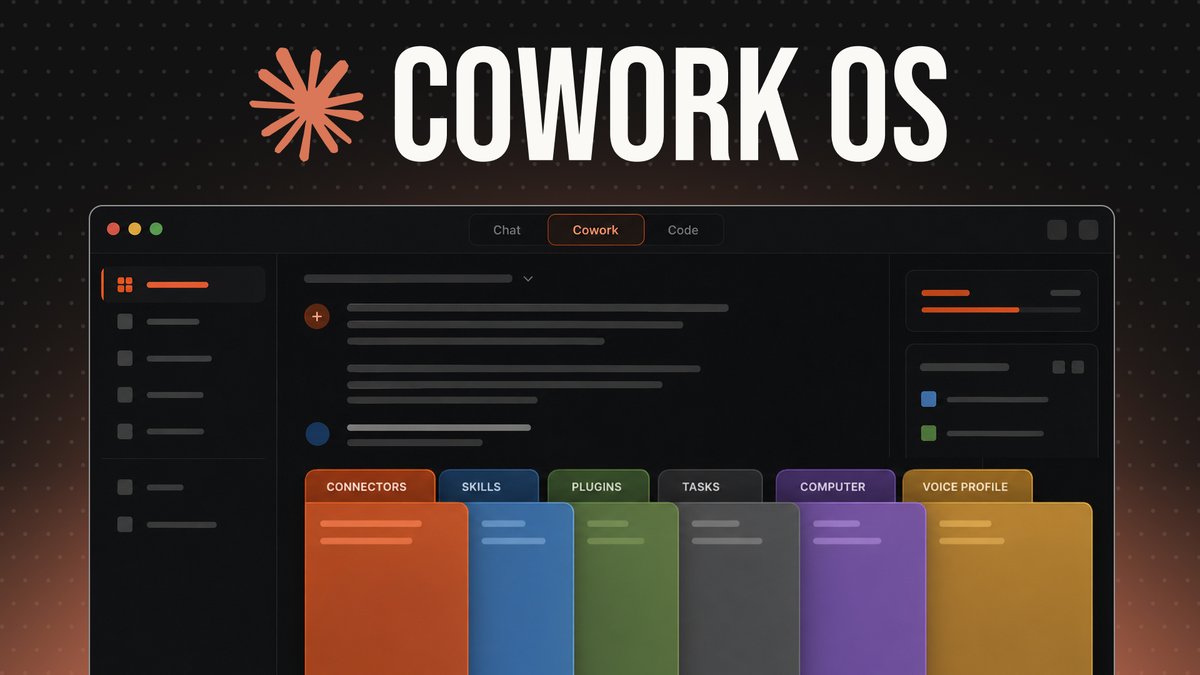
I built a Claude Cowork OS that replaces OpenClaw and runs on autopilot. Manages my business & personal life tasks. I created the whole playbook so you can re-build it tonight. What's inside: • The exact foundation prompt • 3 level orchestration map • Memory template for global context • Routing table for file management • Starter workstations (finance, content, community, habits) • Project file structure • Single prompt that builds the entire folder tree Follow + Comment 'OS' and follow. I'll DM it to you.
Jacob Klug tweet media
English
890
63
681
66.1K
Charlie Brewer
Charlie Brewer@charbrew·
@TommiPedruzzi I got your workshop invitation, thanks. Is there another batch of files or email I should look for?
English
0
0
0
5
Tommi Pedruzzi
Tommi Pedruzzi@TommiPedruzzi·
99% of "how to make money online" video online is trash. Because every video makes it look like you need an audience, a brand, a camera, and two years of patience before seeing a dollar. Here's what I do instead. Oh, and if you want my full AI publishing system — niche research, AI prompts, and the exact workflow I use to publish one book a month... Like this post, follow me and comment "YES". I'll DM it to you. Every week I open Amazon and look at what people are already searching for and buying. • Money anxiety. • Sleep problems. • Career transitions. • Relationship issues. Real problems and real searches. I pick a topic. Build a 70 to 150 page book around it using AI an publish it. If it sells, I scale it with ads. If it doesn't, I move to the next idea the following week. Just asystem and a portfolio that grows every month. - ChatGPT builds the outline. - Claude writes the chapters. - Ideogram designs the cover. - Amazon distributes it to 310 million buyers. I do about 1 hour a day. One book earning $600/month is a gym membership, a phone bill, and a dinner out, paid. Six books is a mortgage payment. Twelve books is $7,000/month before a single ad runs. If you want the full system: 1. How I find topics people are already paying to read 2. The AI workflow to go from idea to published in under 30 days 3. How I test and scale what works, drop what doesn't Like this post, follow me and comment "YES". I'll DM you everything at no cost. All 3. Or the DM doesn't go out.
English
238
17
273
17.8K
John Park
John Park@itsAsgherAli·
This feels illegal… seriously. A FREE Claude Design system that turns ideas into clean, pro-level designs instantly. →No skills →No tweaking →Works everywhere Figma, Canva, websites… all covered. One setup. 100% AI-powered. Worth $399. FREE 48h. Type " SEND " Follow
John Park tweet media
English
118
26
79
5.2K
Charlie Brewer
Charlie Brewer@charbrew·
@garrytan So great that you share this…thank you. And you’re right about the AI mindset shift: We become systems makers. We won’t do the work ourselves.
English
0
0
0
31
Garry Tan
Garry Tan@garrytan·
The thesis is simple: the future belongs to individuals who build compounding AI systems, not to individuals who use corporate-owned centralized AI tools. I'm trying to build these in open source so you can have them for free. That's what GBrain is.
Garry Tan@garrytan

x.com/i/article/2052…

English
145
321
3.3K
459.5K
Charlie Brewer
Charlie Brewer@charbrew·
What caused this overstaffing to be so big and to go on for so long? The fiduciary duties and stock performance incentives on executives and boards were always there. Any 50%-75% downsizing over the past 30+ years was only the rare (and criminal) collapse, like Enron. Was it because size meant power…for the company, ? I’m stumped as to why AI would change anything if the inflated staffing levels were always there. The “shareholder revolution” of the 1980s would have made permanent downsizing its centerpiece at that time, but it didn’t. Light, one-time trims compared to what would have been needed in the face of companies that were 4x too large in personnel. I’m not saying you’re wrong, and I accept your numbers. I’m just left with disturbing questions. What was the incentive to ignore gross overstaffing? Who was incented to look the other way? Does this level of corporate overstaffing constitute fraud & breach of duty & conspiracy? (“Just got another 250 ‘mission-critical’ positions to fill, Joe. That puts me in the Tier 1 category for compensation discussions. Winning! *wink wink*) Should shareholders sue for the earnings that were diverted into salaries?
English
1
0
1
144
Charlie Brewer
Charlie Brewer@charbrew·
What a post! So many great insights. Thank you! Biggest Idea: WIDER. This single word captures the new spirit of the AI age. Well done. I hope this gets picked up and repeated. Another meme bomb: No ceilings. SaaS came for your IT & software budgets. Amazon & Bezos came for your margin. Both scarcity-based. Both run by and for operators. But AI is coming for your ceilings. For the first time since electricity, we have an abundance-generating technology. Entirely new concepts in business and life. Visionaries will be in the driver’s seat.
English
0
0
1
63
Dustin
Dustin@r0ck3t23·
Jensen Huang just killed every AI replacement narrative on contact. NVIDIA’s engineers use AI to write most of their code. The company is hiring more engineers than ever. Huang: “AI basically does most of our coding. And yet, we’re hiring more engineers than ever, we have more challenges than ever, we have bigger dreams than ever, our ambitions are greater than ever.” AI didn’t shrink NVIDIA’s workforce. It exposed how much ambition was trapped behind human bandwidth. The printing press didn’t produce fewer writers. The internet didn’t produce fewer publishers. No tool in history has permanently reduced demand for human effort. Because humans don’t use tools to do less. They use them to want more. Ambition is elastic. It expands to fill whatever capacity becomes available. Always has. Always will. Every economist forecasting mass displacement is measuring the wrong variable. They count the jobs that disappear. They never count the ambitions that take their place. Huang isn’t running a leaner company. He’s running a wider one. That gap will define who survives the next decade. Companies using AI to cut headcount will be destroyed by companies using AI to attempt what was never possible before. The machines aren’t coming for your job. They’re coming for your ceiling. Most people won’t know which one hit them.
English
41
41
134
12K