Chinmay Nivargi

819 posts

Chinmay Nivargi

Chinmay Nivargi

@chinmayn

Building AI agents at Intuit. Previously led evals for Rufus at Amazon. ex AWS and Applied Materials. PhD @Stanford, @IITB .


San Francisco Bay Area Katılım Kasım 2008
1.7K Takip Edilen379 Takipçiler
Chinmay Nivargi
Chinmay Nivargi@chinmayn·
Find myself preferring Opus 4.6 over 4.7 for PM artifacts. 4.7 feels like a smarter ChatGPT o1 or o3 - very smart, but not really readable. Anyone else have the same experience?
English
1
0
1
56
Chinmay Nivargi
Chinmay Nivargi@chinmayn·
Of course I had to try to create the Mt. Rushmore of tech companies discussed by @benthompson and @gruber. Nano Banana and ChatGPT were quite good - and Grok and Meta AI came nowhere close. Same prompt for each. Guess which is which.
Chinmay Nivargi tweet mediaChinmay Nivargi tweet mediaChinmay Nivargi tweet mediaChinmay Nivargi tweet media
English
0
0
1
77
Chinmay Nivargi
Chinmay Nivargi@chinmayn·
@andrewchen A coworker has agency not only to break a goal down into steps to achieve them, but also to set them in the first place. Agents are getting good at memory and integration, but not yet on true agency. Agents working together, challenging each other are paths to RL our way there...
English
0
0
0
16
andrew chen
andrew chen@andrewchen·
ai is shifting from “chatbot UX” to “coworker UX.” it’s not just about having smartest model, they’ll have the best handoff between human judgment and autonomous execution I think this is what we see in explosive hype around openclaw. What's magical about it is that it can be proactive, it can self-improve, it can link into your accounts so that it’s triggered. These are the things you need to be a coworker, chief of staff, colleague, etc rather than just something that is a smarter google search. What people underestimate is that the interface paradigm itself is changing: - Chatbots assume every task begins with a prompt - Coworkers don’t wait for prompts They watch the environment, notice patterns, and surface things before you ask. The best AI systems will feel less like “ask me anything” and more like “I’m already working on it.” that requires three things that chatbot systems historically lack: memory, agency, and integration. Memory so the system understands your projects and preferences over long running periods of time. agency so it can break goals into steps and execute them. integration so it can touch real systems, like email, docs, repos, finances, calendars, APIs. Once those exist together, the model stops being a tool and becomes a participant in the workflow. we are sooooo close to having all this, but not yet... the claws show a glimmer of the future. So the question is, which agentic systems will know what you’re trying to do? Which ones can take partial direction and move the ball forward? Which ones learn your style and anticipate the next step? Feels like we're almost there, and likely to figure this out in 2026. am very very pumped this is about to happen.
English
86
25
311
31.5K
Chinmay Nivargi
Chinmay Nivargi@chinmayn·
@lennysan @amankhan and @talraviv have reinvented the technical tutorial here - and Cursor seems to be a perfect substrate for it. This is way more approachable in the age of coding agents, and improves upon Jupyter notebooks. Although, maybe we are trading off some comprehension for personalization and vibes!
Lenny Rachitsky@lennysan

Texts from friends this morning: - "I won't be surprised if this goes viral because it's the most approachable content I've seen yet for people to get started with AI." - "I finally have a place to point people to when they ask me 'How do I get started with AI?'" - "By far the most useful how-to I’ve seen yet for people to get started with Cursor." Most AI content is designed to induce FOMO and make you feel behind, not to actually teach you anything. Today's post is the opposite. @talraviv and @amankhan spent 100+ hours building an interactive experience that teaches you the most essential AI concepts—from inside @cursor_ai itself. I’ve never seen anything like this before and I’m excited to bring it to you. If you've ever nodded along when someone says "context engineering" or "RAG" in a meeting—while hoping no one asks you to use them in a sentence—this post is for you. Don't miss this one: lennysnewsletter.com/p/how-to-build…

English
0
0
2
65
Chinmay Nivargi
Chinmay Nivargi@chinmayn·
A retcon that fixes everything! You’re welcome.
Chinmay Nivargi tweet media
English
1
1
1
50
Trung Phan
Trung Phan@TrungTPhan·
@RampCapitalLLC last few years stopped by third week of jan, need to finish the spreadsheet this year!
English
4
0
62
3.5K
Trung Phan
Trung Phan@TrungTPhan·
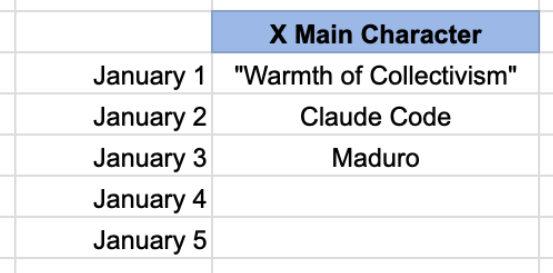
started the X Main Character tracker for 2026
Trung Phan tweet media
English
112
239
7.7K
203K
Chinmay Nivargi
Chinmay Nivargi@chinmayn·
@devangbaheti @patrickc @stripe I didn’t read it as loans rejected for business that accepted them. It is loans not offered at all, which may not have as much of an impact on affinity and volumes.
English
0
0
0
42
Patrick Collison
Patrick Collison@patrickc·
I'm very excited that we now have results from an almost two-year randomized controlled trial that we ran across thousands of businesses on Stripe: those that accepted a loan from @Stripe Capital grew annual revenue around 27% faster. (Two years isn't that long in the scheme of things, but it is when you're waiting for the results of an experiment you're interested in.) We had two kinds of controls: businesses to whom we offered loans but didn't accept them, and a holdout group of businesses to whom we randomly did not offer loans but which were otherwise identical to those to which we did. As such, we feel confident in the causal nature of this conclusion. While this might not sound like news ("capital increases growth"), I think the finding is a good reminder that many businesses are still quite capital-starved (this effect is on top of all of the other sources of capital that businesses have access to), and it is consistent with what we hear directly from businesses in surveys. Beyond Stripe, inefficient capital allocation at economy-wide scale is likely a major bottleneck to growth around the world. We have an ambitious roadmap planned and we're very much looking forward to expanding worldwide access to growth capital.
English
78
112
1.4K
228.4K
Chinmay Nivargi retweetledi
Carl Vellotti 🥞
Carl Vellotti 🥞@carlvellotti·
Every PM should be using Claude Code. So I built a HUGE course for you to learn Claude Code... IN Claude Code! 🔹 Complete guide 🔹 Make PRDs, analyze data, create decks Soon, I'll sell it for $149. For the next 24h: FREE! Follow + RT + comment "CC" & I'll DM it.
English
2.2K
1.5K
2.4K
460.9K
Lulu Cheng Meservey
Lulu Cheng Meservey@lulumeservey·
Everyone working at a startup should read A Message to Garcia
English
42
16
390
88.3K
Chinmay Nivargi
Chinmay Nivargi@chinmayn·
@ValerieTetu A/B testing will still continue to answer the question - On average, did the dynamically adapted, personalized feature lead to better conversion / engagement / revenue? And by how much?
English
0
0
1
48
Valerie Tetu
Valerie Tetu@ValerieTetu·
I question the future utility of A/B testing for products and websites. Why would we optimise for the "best average for all" in a world in which interfaces, content, and features can dynamically adapt to each individual user?
English
6
0
20
3K
Chinmay Nivargi
Chinmay Nivargi@chinmayn·
@ankrgyl IMO Evals ≠ Experiments. They serve different layers. Pre-launch evals = input metrics → ensure the AI feature itself is robust. Experimentation = output metrics → measure actual customer impact. Evals test the model in isolation; A/B tests test the whole system in the wild.
English
2
0
3
1.2K
Ankur Goyal
Ankur Goyal@ankrgyl·
This is the exact opposite conclusion to draw from the acquisition. AI enables you to build much more dynamic products that evolve faster (and even automatically). The foundation underlying that is good evals. A/B tests are officially the way of the past.
ben hylak@benhylak

wow, openai just bought @statsig evals are dead. a/b tests are the future of building AI products.


English
11
3
174
63.4K
Chinmay Nivargi
Chinmay Nivargi@chinmayn·
@sariazout For me the key is to actively inject a lot of my own thoughts in the prompts and followups vs. giving into the vibes. It still may be a distraction - but I find that LLMs help me get over the hump of creating the mental space and focus to sit with my own thoughts.
English
0
0
1
119
sari azout
sari azout@sariazout·
I’ve been spending 4+ hrs a day talking to LLMs and I love it, it feels fun. But I’ve been having this feeling lately that it may just be another distraction and maybe if I just sat with my own thoughts longer, I’d get somewhere better AND faster. Not sure. Curious if others feel this too.
English
39
1
159
12.2K
Jesse Pujji
Jesse Pujji@jspujji·
The fastest way to waste a decade is to optimize for goals you never chose. Every week, I meet operators smashing revenue targets yet privately admitting they have no personal North Star. That mis-alignment bleeds into hiring, roadmap…even family time. My fix is a one-page Dream Future State prompt. 15 mins with it drags your ACTUAL ambitions into daylight. Comment “🚀” and I’ll DM it.
English
26
2
19
7K