

陈德元
173 posts
@policytensor China was also magnitudes poorer than the U.S. during the Korean War and suffered disproportionate casualties and loss of leaders
English

They said the same thing about Frederick the Great. He’s too poor. He can’t stand up to the combined might of the great powers of the continent! Oh, he showed them all their place! I can’t think of another case as close to our David vs Goliath battle over here.
Policy Tensor@policytensor
The US could not even get the Iranians to not impose a tollbooth for more than 60 days despite dropping all this cash. They have accepted joint Iranian-Omani administration of Hormuz. Together with the agreement to withdraw US forces from Iran’s near-abroad, this is how great powers have been formally recognized since 1648. The case that pops to my head is the recognition of Prussia in 1763, when Austria, France and Russia capitulated and recognized Prussian authority over Silesia. Iranian audacity and triumph despite the odds echoes Fredrick’s audacious struggle and triumph against the three great powers on the continent.
English
@RJDAIGOGO 新加坡不是不选边站。外交部发言人说的“某些域外国家插手南海问题......”好几次是包括新加坡的,那个非法的南海仲裁就是新加坡“暗中”发起组织的
中文

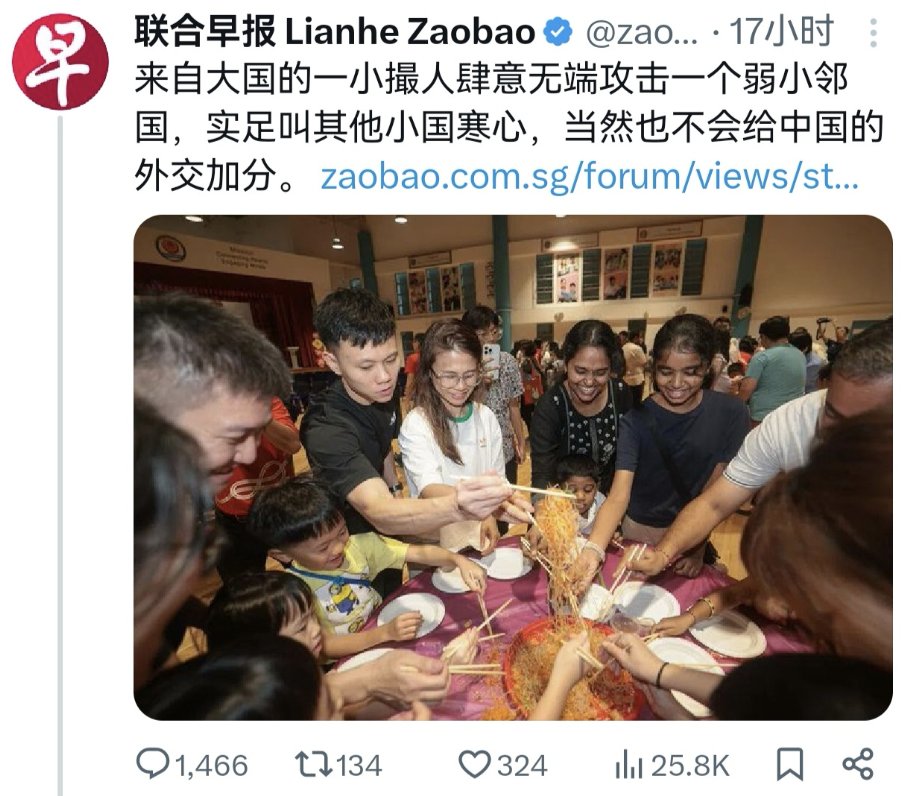
联合早报:来自大国的一小撮人肆意无端攻击一个弱小邻国,实足叫其他小国寒心,当然也不会给中国的外交加分
在这场地缘政治的大博弈中,新加坡坚决不选边站,但和其他力求中立自主的中小国家一样,必须面对来自两大阵营的信息战和认知战,不管是政府还是非政府行为。较之其他国家,新加坡的地位尤其特殊,在诸多中国或亲中网民心目中,我们就是个华人国家,照理应该认同和倒向中国,反美反日,但却偏偏不这么干,因此对如此“不识相”的小国,必须大加挞伐、教训、贬损、羞辱和唱衰。
这暴露的既是对我国所处地缘政治环境和外交政策的无知,也是对小国自主的缺乏尊重。无论如何,来自大国的一小撮人肆意无端攻击一个弱小邻国,实足叫其他小国寒心,当然也不会给中国的外交加分。来自友邦的人,试图搅动新加坡的种族政治,擅闯我国最敏感的政治禁区,更是对新加坡人感情的极大伤害。
摘自《联合早报》署名文章《新加坡变印加坡?》,作者吴俊刚系新加坡前国会议员

中文

I'm quite certain that Lianhe Zaobao has played the biggest role in damaging China-Singapore relations, second only to Singapore's county cheif Lawrence Wong and Chinese netizens.
Most Chinese people, myself included, had no particular ill feelings toward Singapore before. I had been on X for six or seven years, and at least up until 2025, I had never once criticized Singapore. Back then, Lianhe Zaobao was still able to report on China with relative neutrality — I even once commented that Singaporean media could serve as the 'Al Jazeera' of the Chinese-speaking world.
But with Lawrence Wong taking office, Singapore has gradually abandoned its neutral stance. If the Singaporean government still makes a superficial effort to disguise this shift, its media makes no attempt to hide it at all — they openly and unashamedly spread anti-China ideology within their own county, distorting facts and twisting narratives against China. It was only at that time I could no longer tolerate this and began to push back against Singapore.
From 2025 to 2026, more and more Chinese people have come to see Singapore's true ugly face through Lianhe Zaobao. These Singaporean may look like us on the outside, but inside they are utterly selfish and arrogant. The label 'Israel of Southeast Asia' is well deserved. Most Chinese people now despise you and loathe you — and you have earned every bit of it.
These Singapore bitches of course never reflect on themselves. Lianhe Zaobao has stepped up its quarrels with Chinese netizens, even going so far as to run trivial, selective stories — like a Malaysian Muslim woman saying Chinese people smell, or a Chinese thief stealing 3,000 yuan in Singapore — all in an effort to smear China's image. Fine — we have never feared open enemies, especially when that enemy is this tiny.
English

我现在开始怀疑马克思和列宁对于革命是否过于乐观了
我并不是认为资本主义可以通过改良解决问题,而是马克思那个时代——热兵器早期的火枪时代——是统治阶级和民众武力差距最小的年代,而自从20世纪开始,科技站到了统治阶级一边,国家机器和民众的武力差距越来越大,并且没有任何缩小的迹象
中文
@andy_tattz 小资产阶级的政治观就是不靠信仰而靠立场。革命潜力 potential 这个词,似乎暗示了当今无产阶级并不比其他群体掌握最多最先进的生产力,从而失去了成为革命领导力量的应有资格
中文

Mao: "The petty bourgeoisie. Included in this category are the owner-peasants, the master handicraftsmen, the lower levels of the intellectuals--students, primary and secondary school teachers, lower government functionaries, office clerks, small lawyers--and the small traders."
English
@KlausHDiekmann 随机刷到这个帖子,说一些题外话。德国政客世家世袭的比例很高,政党又习惯挪用国家民众未来发展用的钱折现买选票同时搞老鼠仓,这比像晚清官员那样颟顸顽愚还糟糕
中文

Hearing Germans complain about another countries "aggressive" export policy causing job losses in manufacturing just blows my mind.
The lack of self-awareness by the masters of beggar-thy-neighbour policies is mind-boggling.
Jens Südekum@jsuedekum
"So gingen im verarbeitenden Gewerbe in Deutschland von 2019 bis 2025 rund 520.000 Arbeitsplätze verloren, 400.000 davon nur wegen Chinas aggressiver Wirtschaftspolitik" Und endlich zieht diese Diagnose vom China-Schock 2.0 auch Konsequenzen nach sich. handelsblatt.com/politik/deutsc…
English
@SwampCommunist 不管你属于什么阶级,参与什么性质的运动,你所在人群只有在掌握生产力的前提之上,你干出来的事才配叫革命,你才有革命者的资格。去搬箱子送快递甚至开起重机在当今都谈不上掌握生产力,不说写软件,起码得学会飞无人机和读书写文章吧。革命者要终身学习,终身去社会实践
中文

Hes a professor, he was already petit-bourgeois without the tenants
yocheved 🇵🇸@saintyoche
Just discovered my Marxist professor has a side hustle as a landlord
English


@wokejucheism 朝鲜追求独立自主,他们认为只有先独立自主才能再发展。当朝鲜表示不再谋求统一韩国,即不在拥核的同时持有进攻姿态,那么在非常大的程度上,朝鲜的若干主张是合理的,并且可以得到充分的理解和支持的
中文

so true queen. please give nukes to albania🇦🇱
thereisnobeth@thereisnobeth
crazy how you don't actually have sovereignty unless you have nukes
English

@squidnyaknife 毛主席的终身学习在晚年让他周围人感到诧异和畏惧,他被限制更直接地学习英语……从基辛格的书中描述道他看见毛在读理论物理XD。毛的学习观在他还是青年学生的时候就接受过解构主义和皮亚杰的建构主义,而这些是由留学过阿伯丁大学的老师杨昌济先生传授的,同时传授的还有传统文化中王船山的学派思想
中文

Marx, Engels, Lenin, and Mao all studied nearly as much as a person can, and you all think you can eschew this in favor of working a proletarian and organizing the industrial proletariat. or otherwise are delusional enough to think there exists enough time to do all 3
English
Geopolitics rule:
Those who kang the loudest, end up overtaken and suprised by those who work in silence.
English

簡中網民在這件事上咬著聯合早報和新加坡不放,言行愚蠢得連我都開始懷疑這群人裡是不是有台灣1450在。
一個對中國沒有惡意甚至大多數時候友善的媒體和國家,都會被這群人消耗掉耐心。
联合早报 Lianhe Zaobao@zaobaosg
近期网络上嘲弄和抵制印度族社群的贴文和视频已被警方要求屏蔽删除,政府也正对此类煽动种族情绪的行为展开调查,不容许新加坡的种族与社会和谐遭破坏。 #Echobox=1781540570" target="_blank" rel="nofollow noopener">zaobao.com.sg/forum/talk/sto…
中文


Suggestion for Indian anti-China propagandists: If your objective is to elevate India's status, stop attacking modern China and focus on ancient China. Start emphasizing the extraordinary scale and depth of India's historical influence on Chinese civilization. Talk more about China's historical "debt" to India. This is a far more effective line of attack than contemporary geopolitics or economics.
There's more than enough raw material. Many are completely unaware of the sheer scale we're dealing with here. People think that the cultural exchanges (which were largely one-sided) began and ended with Buddhism. In truth, Buddhism is merely the tip of the iceberg. It's not even close to the whole story. Indeed, if Indian influence and contribution to Chinese civilization is removed, Chinese culture and history would be virtually unrecognizable.
The sheer volume of ideas, philosophies, cultural concepts, scientific knowledge, artistic traditions, religious practices, and technologies that travelled from India to China frankly boggles the imagination. The list is simply endless: Logic and epistemology, metaphysics, philology, phonetics (Chinese could literally understand their own language and pronunciation better because of Sanskrit and Prakrit), astrology, astronomy, calender science, clothing, food, medicine, surgery, biology, art, sculpture, cosmology, meditation, music, dance, performance art, biology, botany, knowledge of medicinal plants...and that's just for starters. And it's not just the scale, the depth is equally astonishing. One would be hardpressed to find a single element of Chinese culture, society, and history that was untouched by India.
Whole Indian branches of the above arts and sciences were adopted wholesale and incorporated into their Chinese equivalents, across centuries and across generations. It was possibly the greatest civilizational transfer of knowledge in human history.
-------
As an example, everyone knows that Chinese considered China the "middle kingdom" - the center of the world. Yet, it was India that Chinese philosophers considered the spiritual center of the world, including the physical center in Buddhist cosmology (which Chinese Buddhists adopted), and the source of sacred knowledge. India was the most noble and most honored land, and was simply considered heaven. Chinese travellers would cross mountains, both literal and figurative, to reach India and learn its teachings. Call it kanging on a civilizational scale. India was basically the Holy Land for Chinese intellectuals.
A common claim amongst historians is that India was the teacher and China the student. Astonishingly, many ancient Chinese intellectuals and philosophers would themselves agree with this claim. They openly referred to India as the teacher who they wished to learn from.
As a comparison, for ancient Chinese, India occupied a position even far higher than Greece did for many Roman intellectuals back in the day.
To take another damning example, when Indian logic first got transmitted to China, Chinese experts simply didn't understand it. So they had to be trained on it. Indian logical systems required extensive clarifications and interpretations before they could be assimilated into Chinese intellectual traditions. Indian philosophers had to actually explain it from first principles, and then translate Sanskrit texts into Chinese themselves (after learning Chinese), since understanding that kind of logic is important to understanding Sanskrit. This is why much of the translation of Sanskrit texts into Chinese was almost completely dependent on Indian expertise. This lasted until travelers like Xuanzang came to India, learned how to do it, and established their own translation bureaus back home. And even then, homegrown expertise took a long time to be fully established in China.
Indeed, entire new Chinese vocabulary had to be invented to incorporate Indian philosophy and concepts, since Classical Chinese literally didn't have the words to describe them.
It was only after this entire process that Chinese Buddhists were able to understand and appreciate Indian philosophy, and then adapt it by fusing elements of their own philosophy into it. This is the origin of the entire (sub)field of Chinese Buddhism.
And if you think that's too overwhelming, absolutely do NOT research the origins of Chinese martial arts - perhaps the one thing China is most known for globally after Chinese food (which also has significant Indian contributions).
In fact, all of the above combined is not even 0.01% of the KNOWN scope and depth of the philosophical, cultural, and scientific transmission.
English

@johnnys_dream で?
なぜアメリカが中国を包囲しようとし、日本を含む同盟国がアメリカに追従するか、は考察しないのか?
中国がフィリピン、日本、台湾、ベトナム、マレーシアといった周辺諸国とトラブルを起こし、かつ、侵略国家ロシアと親密な『現代のならず者国家/現代の悪の枢軸』だからでしょ
アメリカとその
Hioki-shi, Kagoshima 🇯🇵 日本語

「中国が意地悪をしてレアアースの輸出許可を引き延ばしている。だから日系企業が困っている」
感情的で局所的な悲鳴だけをクローズアップし、
「なぜ中国がそのカードを今切っているのか」
というグローバルな地政学・産業構造の鳥の目を完全に遮断する。
日本のマスコミは、米国や日本が対中半導体輸出規制や経済安全保障(デカップリング)を強化する際は、自由主義陣営の安全を守るための正当な措置として英雄的に報じる。
しかし、中国側が全く同じロジック、つまり自国の安全保障にリスクをもたらす国に対して、戦略物資の輸出を管理・厳格化するというカードを切った瞬間、マスコミは急にそれを不当な嫌がらせや経済的威圧として描き出す。
中国が輸出許可を出さないのは、日本が半導体製造装置や外交的発言で米国に追従して中国を包囲しようとしていることに対する、同じレベルの経済安全保障法の合法的な執行に過ぎまない。
そしてマスコミは単にレアアースと一括りにするが、中国が今、特に輸出ライセンスを絞っているのは、ガリウムやゲルマニウム、そしてガドリーニウムやネオジムといった次世代の心臓部を構成する特定物質だ。
【日本のミリオタ・スペック厨】
「F-35を爆買いだ!次世代半導体のラピダスに国費を投入だ!」
⇒ カタログスペック上の強さに熱狂する(劇場型政治の観客)
【中国の鳥の目のアプローチ】
・F-35の最先端AESA(アクティブ・フェーズドアレイ)レーダーの基盤となるガリウムを絞る
・次世代EVやロボットのモーターに必要な高性能磁石のネオジムを絞る
⇒ インフラの原材料を止めることで、日米が熱狂するハイテクの配管を上流から干上がらせる
F-35の整備問題やタングステンガスの消滅と同じく、いくら紙上のスペックが優れていても、それを作るための、あるいは維持するための土台(レアアースやタングステン)を中国に握られているという構造を直視すれば、日米が仕掛けている経済戦がいかに脆弱な基盤の上に成り立っているかが分かる。
日本のマスコミが全体構造を説明しないのは、この勝ち目のない構造的敗北を国民に気づかせないためだ。
中国が日系企業への輸出許可を引き延ばしている最大の理由は、日本の素材メーカーが根を上げて市場から退出するまでの時間を稼ぎ、その隙に中国国内の代替メーカー(国産サプライチェーン)へシェアを完全に移行させることにある。
日本の素材産業(関東電化などの優秀な化学企業)は、中国の原材料を買い、それを日本で超高純度に精製して、世界(サムスンやTSMC)に売ることで利益を得ていた。
中国が原材料の輸出許可をダラダラと遅らせれば、日本のメーカーは顧客への納期を守れず、信用を失う。その間に、中国政府は莫大な資金を自国の精製・ガスメーカーに投入し、原材料から精製、最終製品までを中国国内で完結させる垂直統合を完成させる。
日系企業が「中々許可が出ない」と役所の前でお辞儀を繰り返している間に、日本のお家芸であったハイテク素材産業の既得権益そのものが、物理的に消滅させられている。
東京新聞デジタル@tokyo_shimbun
「中国がレアアース輸出許可を中々出さない」 中国にある日系企業の団体が報告した日中関係悪化後の「現実」 tokyo-np.co.jp/article/494485/
日本語

🇨🇳🇵🇭 Beijing for the first time launched a personal political attack on one of China's harshest critics
The Chinese Foreign Ministry announced the imposition of sanctions against Philippine Defense Minister Gilberto Teodoro and his family members. They are prohibited from entering mainland China, Hong Kong, and Macau, and Chinese organizations and citizens are forbidden from conducting any business or other contacts with them.
In Beijing, Teodoro is accused of spreading "anti-Chinese statements", undermining Sino-Philippine relations, and supporting a confrontational line on the South China Sea.
His speech at the Shangri-La Dialogue forum in Singapore was particularly offensive to China, where the head of the Philippine military department sharply criticized Beijing's position on regional security issues.
china3army
English
@naokiaoki7 @zaobaosg 外交部发言人说的“某些域外国家插手南海问题……”好几次是包括新加坡的。那个非法的南海仲裁就是新加坡“暗中”发起组织的
中文

菲律宾国防部长特奥罗多称,自己是因为“说出真相”而被中国制裁,但仍将坚守本职,在中国的恶行面前维护菲律宾。 #Echobox=1781228877" target="_blank" rel="nofollow noopener">zaobao.com.sg/news/china/sto…
中文
@nmamtbh @narya24fire 拿他们黄循财做例子,人家一批人十六到十八岁岁就被两李选中悉心栽培,严格训练,但这意味着啥?可能在第一次跟女人上床之前就世界观固化了吧,笑
中文

中国的问题在于,它常常把正常的国家关系看成以中国为中心的上下秩序关系,把海外华人视为政治资产,把不同意见看成背叛。
和其他国家相处,真的有那么难吗?
有礼貌一点。尊重主权
不要把海外华人当成中国的政治延伸
不要把每一次分歧都说成对中国的羞辱
不要要求其他国家通过所谓的文明忠诚测试。
统战式思维,正是许多国家对中国越来越警惕与反感的原因。
它传递的信息是:你的公民身份是次要的,血缘才是首要的;你的政治忠诚,仍然被期待交给别国
这不是友谊。
中国不能一边在方便自己时像帝国那样行事,一边在受到挑战时又把自己说成受害者,还指望成为一个受人尊重的大国。
大国要赢得尊重,首先要懂得尊重别人
𝘊𝘰𝘳𝘳𝘪𝘯𝘦@OopsGuess
Chinese netizens’ negative perception of Singapore largely stems from one core issue: Singapore’s leadership sided with Japan and criticized China for remembering history after Japan provoked China on the Taiwan question. This is why Chinese netizens’ contempt toward Singapore runs so deep — sometimes even deeper than their contempt toward open adversaries. To many Chinese people, Singapore’s behavior represents a particular kind of betrayal. As an ethnic Chinese-majority country, Singapore should have a natural understanding of the trauma Japan inflicted on the Chinese people — including the brutal Japanese occupation of Singapore itself, such as the Sook Ching massacre. Instead, Singapore’s leadership downplays or sidesteps Japanese historical aggression, cozies up to Japan strategically, and then has the audacity to lecture China to “move on” from history. That crosses several Chinese red lines at once: Historical memory. Ethnic and civilizational loyalty. Dignity. Backbone. In the eyes of many Chinese netizens, Singapore has chosen self-colonization for survival and geopolitical positioning. It willingly distances itself from mainland China, aligns with former colonizers and their allies, suppresses its own historical memory, and still benefits from being ethnically Chinese whenever convenient. That is why Chinese netizens so often describe Singapore’s political class as “殖物” — self-colonized creatures of empire. To them, Singapore is no longer seen as a genuine overseas Chinese community with historical memory. It is seen as a traitorous outpost that has internalized the worldview of its former and current masters. This is also why Chinese netizens’ criticism of Singapore often feels more personal and venomous than their criticism of many other countries. For many Chinese people, betraying one’s own blood, memory, and historical suffering is worse than being an external enemy. It is seen as a profound moral and civilizational failure.
中文