

Chris Jensen
4.3K posts


@histofarch David, it turns out a hot pocket microwave meal hits an A minor perfectly?
English
This device was banned in some cites.
They called this soulless machine music.
It took over a decade to allow some cites to remove restrictions.
When you know the past, you know the future.
Brian Roemmele@BrianRoemmele
The rage against the machine advertisement, 1930. The violent revulsion to the player piano. It started a call for regulation.
English
@BrianRoemmele Not quite a Luddite, yet, but I do find myself admiring the Amish and Mennonites more and more every day. For many more reasons, too.
English
@milman2025 @_10delta_ @grok Thanks. I’ve been trading for more than a decade now but still had to find my decoder ring for this post.
Clarity > Shibboleth … every single time.
And yes, using the word Shibboleth here is about as dry and ironic as jokes come🤣.
English

@Joschmo1326 @OMApproach It’s moving faster for some reason, too.
English

@chrishjensen @OMApproach It appears it rotates in a full 360 degree circle every 400-500 years. Looks like it’s halfway through its migration
English

The theory is that during every geomagnetic excursion, the decoupling weakens and the upper mantle undergoes a derotation relative to the core and lower mantle of the Earth. This 90-degree slip causes the oceans to spill over the land and leads to the Great Flood described in ancient religions around the world.
In my opinion, the elites are not preparing for this; I think they are preparing only for increased cosmic radiation, rapid climate change, and cooling, especially in the Northern Hemisphere.
Open Minded Approach@OMApproach
It is crucial for the elite to eliminate their enemies in the Middle East because they have several doomsday cities and databases there, including the Line, which has not been canceled. The Line started as a large project to generate more funding, but the intention was always a smaller, AI-run system where the elite will try to survive the Geophysical Event. There are many other projects like this. How long will it take for people to realize that The Line and Project NEOM are part of a global elite plan to build doomsday bunkers and cities? This was never meant to be available to the public, yet even countries like Great Britain invested in the project. The Line will be embedded between two giant 500-meter walls, which will protect the elite from the outside environment, climate change, and potential giant waves, while also creating a separate internal microclimate for them.
English

🚨 WARNING: THE NEXT 24 HOURS WILL CHANGE EVERYTHING!!
Tomorrow, UAE will officially leave OPEC and remove all caps on oil production and exports.
They spent $3.3 BILLION building a secret pipeline to flood the market with cheap oil.
And Iran’s blockade CANNOT touch it.
That means oil supply changes overnight.
And when oil supply changes, every market reprices.
Stocks.
Bonds.
Crypto.
One of the world’s largest oil producers is now positioned to pump at full scale while routing exports around the entire Iran conflict.
More oil supply with protected export infrastructure changes global pricing.
Oil moves everything.
Energy drives inflation.
When oil falls, transport costs fall.
Manufacturing costs fall.
Shipping costs fall.
Consumer prices fall.
And when inflation falls, central banks move.
Now connect it:
→ UAE pumps more oil
→ Habshan–Fujairah routes it around Hormuz
→ Global supply expands without regional bottlenecks
→ Oil prices fall
→ Inflation drops
→ Rate cuts accelerate
→ Liquidity expands
And when liquidity expands, risk assets skyrocket.
Bitcoin.
Tech.
Growth stocks.
Capital rotates fast.
But there are only two options now:
1⃣ US-Iran war ends.
Regional pressure cools.
Shipping stabilizes.
Iranian exports return.
And UAE supply scales at full capacity through Fujairah.
That creates maximum supply expansion.
No bottlenecks.
No quota limits.
No blocked exports.
Oil drops hard → Inflation falls fast → The Fed pivots → Liquidity returns → Risk assets surge.
2⃣ War escalates.
Hormuz becomes unstable.
Shipping lanes face disruption.
Regional exports get squeezed.
But UAE keeps exporting.
That makes UAE the most strategically protected oil exporter in the Gulf.
While others face chokepoint risk, UAE keeps flowing.
That makes Fujairah one of the most important oil terminals in the world.
It’s not just a pipeline.
It’s an oil war hedge.
It’s a supply chain weapon.
It’s the infrastructure behind UAE’s OPEC exit.
They built their own route.
Then they removed the cap.
That was the plan.
And now the market is repricing it.
Pay attention NOW.
Because the pipeline changes who controls oil flows in the world.
I’ve studied markets for over 10 years and called nearly every major top and bottom.
And I’ll call the next market crash too.
Follow and turn notifications on.
I’ll post the warning BEFORE it’s too late.
English
Circa 87, me and my friends had been waiting an hour or more to ride the Shockwave at Six Flags, when she and her entourage were led to the front of the line and cut in front of us. Guess she was playing there that night. I just remember being POed and that she was extremely pale.
English

Had ChatGPT generate a map of the movement of magnetic north over the past 50 years. Took six swings at it and each time the data was wrong. I’d point it out, only to have it reply “You’re right. To make an accurate map I’ll need to X, Y, Z. Would you like me to do that?” Six times! And it’s still not accurate. And i certainly don’t trust it.
Grok does the same thing. Inaccurate info all the time.
English

Just finished a 10min argument with @OpenAI ChatGPT as it insisted there was no way Tim Cook was out as $AAPL CEO.
Couldn’t find a headline on its own to confirm and did not believe me until I shared the actual link myself.
Can’t wait to short the piss out of this IPO
“You’re right-that’s a real announcement.”💀

English

@TheEuropea0p3 Elliott Wavers would now call this the Alternative Count
English
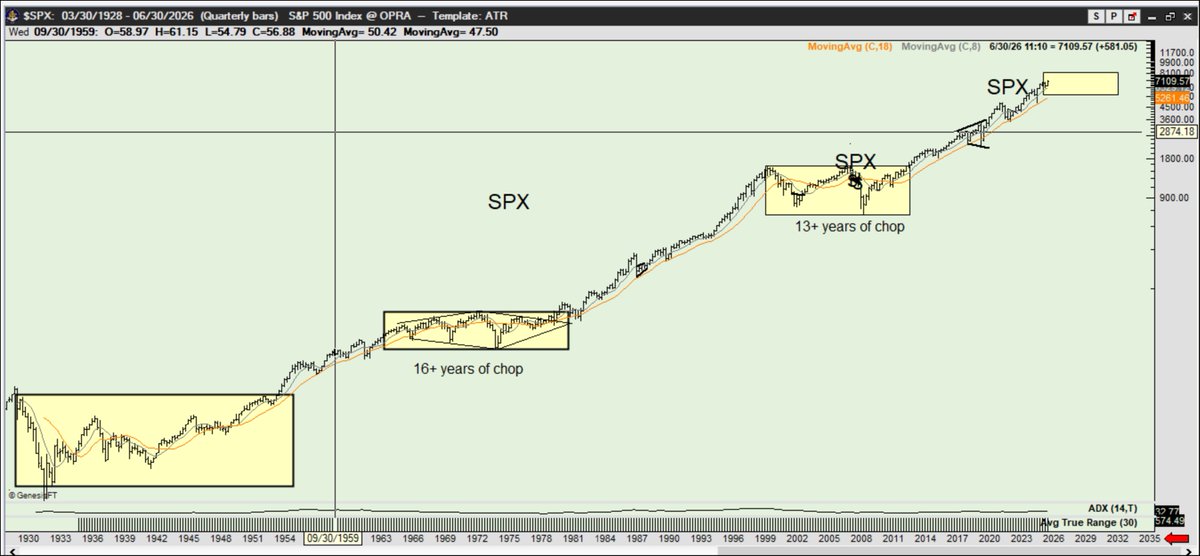
U.S. equity investors -- get ready for five to ten years of chop suey
During the past 100 years the S&P index chopped sideways for 54 years. That is 46 years of no new net gain (other than from dividends)
S&P Index is entering another major period of chop $SPX
English
Join me this Wednesday & Thursday for a free trial of our live trading room. We start at 8:15AM ET & go until 4:00 PM ET. No obligation, just fun & informative... To sign up just click here: tradershighway.com/2026trial/
#ES_F $SPY $QQQ #NQ_F #EC_F #CL_F #US_F #ZB_F
Damon Pavlatos@DamonPavlatos
I updated my weekly S&P chart from last year to show we are still heading for the measured objective of 7450-7500. The previous selloff came close to the HVN & the 2024 high's. We had a correction in a bull market & then followed by a short covering rally. 🧐 tradershighway.com #ES_F $SPY $QQQ #NQ_F #EC_F #CL_F #US_F #ZB_F
English
Chris Jensen retweetledi

Paul Tudor Jones says the US is more dependent on equity prices than ever, and explains what a 35% correction would trigger in the economy:
"We're 252% of stock market cap to GDP. In 1929 we were 65%. In 1987 we got to ~85-90%. In 2000, 170%.
If you think about the periodicity of significant bear markets. Since 1970, we get a mean reversion about every 10 years.
Let's say mean revert to the past 25 or 30-year PE. That would be a 30, 35% decline. Well, 35% on 250% of GDP is 80, 90% of GDP.
10% of our tax revenues are capital gains, they go to zero. So you can see the budget deficit blowing up. You can see the bond market getting smoked. You can see this kind of negative self-reinforcing effect.
In the stock market, we're over-equitized as a country. We have the highest individual equity weightings in the history of the country.
And then the real problem is if you look at private equity in 2007-2008, that was about 7% of institutional portfolios. Now it's about 16% of the institutional portfolios. We're so much more illiquid than we were in 2008.
The problem is that if you buy the S&P at this current valuation, the 10-year forward return is negative when you buy the S&P with a PE of 22. That's what history shows.
So yes, the S&P is spectacular long-term, if you have a hundred-year view. But that's because that's an average of a hundred years, including times when the S&P 500 PE was 6, 7 and 8, or one third of what it is right now.
Valuation matters a lot, and the stock market's really high and it's gonna be really hard to make money from here with any kind of long-term view."
Patrick OShaughnessy@patrick_oshag
My guest today is Paul Tudor Jones (@ptj_official), one of the greatest macro traders of all time. He correctly predicted the 1987 stock market crash and shorted the Japanese bubble in 1990. For over 40 years, his flagship fund has had a negative correlation to the S&P 500. 100% of his returns are alpha. He says today's market has so many similarities to 2000, "the easiest bear market I've ever seen in my whole life." He makes the case for going long dollar-yen, why Bitcoin beats gold as an inflation hedge, and why he was wrong about Warren Buffett. But what I'll remember most from this conversation is Paul's zest for life. He's 71 and still wakes at 2:30 every morning to trade the London open. He works out for two hours a day. He walks with his wife every evening. He travels the country chasing peak spring and peak fall. He's so excited about the songs picked for his funeral that he wishes he could be there to hear them. Paul has lived five lifetimes in one. He's one of the most entertaining and interesting people I've met, and the conversation will leave you searching to be as passionate about what you do as he is about what he does. Enjoy! Timestamps: 0:00 Intro 1:00 The Kindest Thing 13:19 Trading vs. Investing 17:33 Lessons from Warren Buffet 22:24 The Existential Risks of AI 29:54 The Nature of Trading 31:46 Bitcoin 35:55 Bubbles 42:08 A Day in the Life of PTJ 46:00 Information Overload 47:07 Passion for Markets 50:49 The Robin Hood Foundation 54:18 The Workless World 56:03 Journalism 1:00:00 Principal Components of a Great Life 1:05:06 Kill Them With Kindness
English

Scam Altman and Greg Stockman stole a charity. Full stop.
Greg got tens of billions of stock for himself and Scam got dozens of OpenAI side deals with a piece of the action for himself, Y Combinator style. After this lawsuit, Scam will also be awarded tens of billions in stock directly.
The fundamental question is simply this:
Do you want to set legal precedent in the United States that it is ok to loot a charity? If so, you undermine all charitable giving in the United States forever.
I could have started OpenAI as a for-profit corporation. Instead, I started it, funded it, recruited critical talent and taught them everything I know about how to make a startup successful FOR THE PUBLIC GOOD.
Then they stole the charity.
X Freeze@XFreeze
Interesting how it works Elon puts up his own money, rounds up the absolute best AI talent on the planet, leverages every connection he has to secure serious resources, and launches OpenAI in 2015 as a pure non-profit explicitly created to develop AI for the benefit of humanity, with zero profit motive and open research Then the “team” decides they want the bag They push Elon out, take control, and quietly flip the entire thing into a for-profit machine All while preaching the same sanctimonious lines on repeat: “We’re still mission-driven!” “AI for the good of humanity!” “We’d never abandon our principles!” The ultimate betrayal: Elon got zero equity. Not a single share. He funded it. He built the foundation. He got nothing while they turned his non-profit into their personal cash cow This is the level of betrayal and hypocrisy we’re dealing with And for the record.... this lawsuit doesn’t put a single penny in Elon’s pocket. Any win goes straight back to the non-profit to restore the exact mission he founded
English

Suppress rates, push stables and banks to pick up the slack in Treasuries, growth thru spending — all of these tools will help. But, the most impactful spigot to turn is letting the currency inflate. The Fed and politicians just have to figure out how much and how long they can turn that spigot on before people revolt.
English

This all makes sense when you consider that the United States faces a debt dynamic that can no longer be solved through orthodox policy.
Federal debt held by the public is approximately 100% of GDP, interest expense is above $1 trillion annually, & the primary deficit is structurally running at around 5% - 6% of GDP.
Under these conditions, achieving debt sustainability becomes a function of 3 variables only: the nominal growth rate, the effective interest cost of the debt stock, & the primary fiscal balance.
Because the primary balance is politically locked, the remaining levers are nominal growth & the effective interest cost of the debt.
Thus, we’re going to see negative real rates for a long period (explicit default is obviously not an option).
“We’re going to grow ourselves out of the debt.”
How?
Using the combination of policy tools detailed in some of my previous posts.
But, to rehash, we can consider 4 distinct mechanisms that will run in parallel:
1/ Rate suppression: policy rate at 2% - 2.50% versus structurally elevated inflation (core PCE likely to run 2.5% - 3.5% for the next several years), which delivers negative or near 0 short-end real rates. Thus reducing the value of the debt service.
2/ (forced) Private sector demand for Treasuries.. Stablecoin issuance mandates T-bill holding. Relaxed eSLR encourages bank absorption of longer duration Treasuries. Money funds continue to be a large bill buyer. All of this compresses front end yields below the “free-market” clearing price.
3/ Nominal GDP (hyper) acceleration via fiscal transfer: tariff dividends, targeted transfers, & ongoing defense & industrial policy spending will keep nominal GDP growth elevated (“run it hot!”), which mechanically erodes the real value of the debt stock.
4/ Central Bank Policy Coordination: Warsh will weigh growth & debt sustainability much more heavily relative to the “outdated” 2% inflation target.
Study the 1942 - 1951 Treasury-Fed period, when the Fed was committed to supporting the Treasury market with pegged rates.
This post war financial policy strategy compressed real yields to around -1.5% to -2.0% on average.
This is the core mechanism that took Debt to GDP from 119% in 1946 to 47% by 1974.
I’ll be tracking the 10 year real rate, which (in my base case) should move from the current 2.1% to approximately 0.5% by end of 2027 & potentially negative territory by 2029.
Time to run it hot!
10Δ@_10delta_
We will see a combination of rate cuts, QT, stimulus checks, domestic stablecoin diffusion (perhaps by decree?), & the proposal for multiple policy interest rate levers in the next few months. The Fed & Treasury are going to undergo *very* significant changes.
English
@market_sleuth @michaeljburry That looks like something I should get into. Full port 🤔 maybe! 👊
English

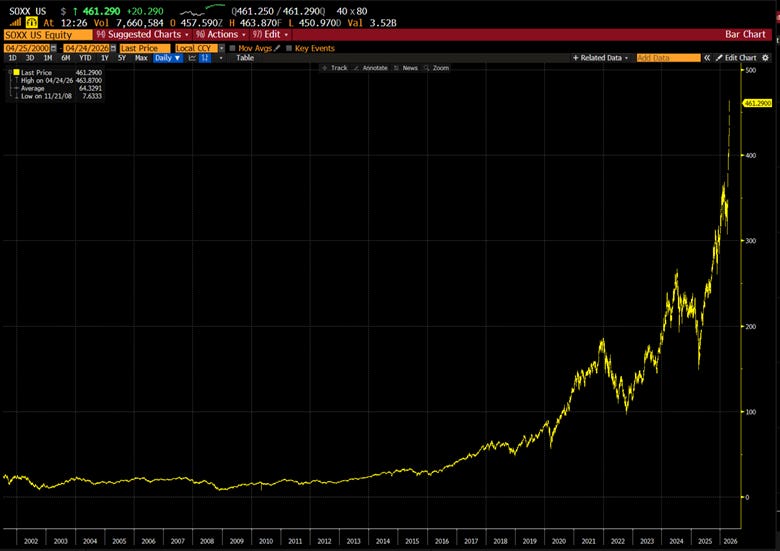

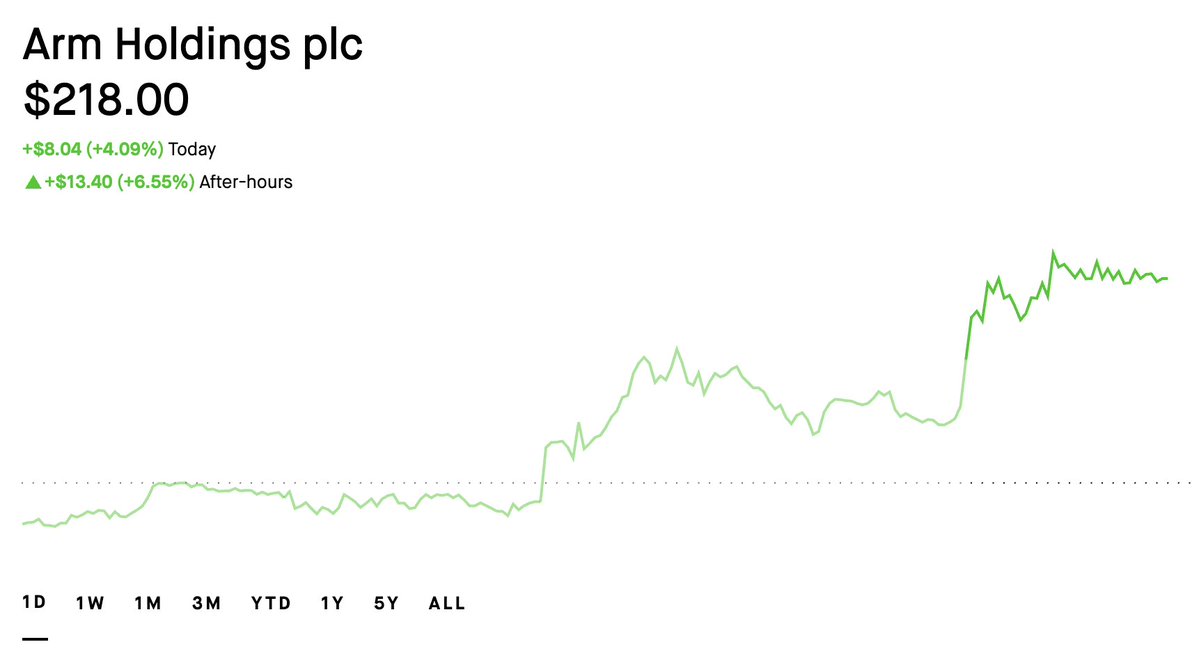
$ARM is up 6%+ after-hours after $INTC earnings.
Strong Intel results = validation that overall CPU demand (especially AI-related) is accelerating, which lifts sentiment for $ARM, $AMD, and the whole group
AskLivermore@asklivermore
I went all into $ARM back in 2023 and never sold. I won't sell until i reach $1 billion net-worth.
English
I will keep teaching you all how to trade for free.
I'll be posting my pre-market setups on YouTube every day so you can make 100%+ every year.
Dan@DanBenewent
@asklivermore +44% since your advice. Thank you
English