
Sabitlenmiş Tweet
Tedrick
292 posts


Tedrick
@christedrick
Marketing. Filmmaker. Tech enthusiast. News junkie. Web3. @tedrick.bsky.social
Jersey City, NJ Katılım Aralık 2009
939 Takip Edilen316 Takipçiler
So the US is dominating the global economy and the GOP wants to start tariff wars to increase domestic manufacturing, which will then be uncompetitive globally. Higher inflation and unemployment to follow + pushing Asia, EU, Latin America closer together with trade.
🤷♂️
English
Trump deleted his tweet accusing Pennsylvania of “massive fraud.” He said he would reveal the evidence and there was A LOT of it. Let’s see it.
forbes.com/sites/antoniop…
🤡 show.
English
Shouldn’t we be working on policies/culture that shares more profit with the working class? Have we over-valued investor interests at the expense of the working class?
I don’t understand shunning a global economy we’re dominating because the gains aren’t well distributed.
English
@DrewPavlou I think quadrant 4 is correct. And crazy that white progressives don’t agree. But the other questions require more nuanced responses. So this isn’t apples to apples. Also, Trump during many interviews said he thinks America is not a great country. It’s kind of his thing.
English


@MannyMVK @YourAnonNews @elonmusk Money isn’t sent to Ukraine. That’s not really how it works. We provide money to American companies to create weapons and equipment for Ukraine. People don’t understand that the money feeds (mostly) US companies.
English

@YourAnonNews @elonmusk You could end homelessness in the US with less money sent to Ukraine.
English


Best breakdown I’ve seen yet.
Kyla Scanlon@kylascan
What are the economic policy proposals of each candidate? I have a new video up on who is spending whatm how they plan to pay for it, and what each economic future would look like, depending on who wins. The CRFB put together a fantastic analysis on this - over ten years, the proposals from Harris will increase the debt by ~$4T. Trump will increase it by ~$7T. Harris is better for the long-term strength of the economy, especially through the lens of spending. Both candidates have very different spending plans- Harris has a lot of social spending, Trump has tax cuts. They also have very different ways to pay for things - Trump loves tariffs*, Harris likes taxes. Harris is a lot of social spending - she plans to extend tax cuts for those making < $400k, expand CTC and EITC, expand the ACA, supporting affordable housing, no tax on tips, raise minimum wage, support small businesses, improve border security, expand pre-K and childcare, establish paid family and medical leave, and support education. This will cost ~$7.6T She will pay for this through increasing the corporate tax rate from 21% to 28%, increasing taxes on capital income, NIIT, and raising the medicare payroll surtax, reforming international tax rules, and lowering prescription drug costs. This will generate ~$4.2T This will cost about ~$550b in higher interest payments. So in total, her plan costs $7.6T - $4.2T + $550b = $3.9T (Penn Wharton estimates $1.2T) Trump is a lot of tax cuts. He will extend and modify the TCJA, costing $5.35T, exempt overtime income from taxes, end taxation of social security benefits, lower corp tax rate to 15% for domestic manufacturers, other tax breaks, strengthen the military, secure the border, provide credits to first-time homebuyers, pay for IVF, and improve long term care. This will cost $10.4T. He will pay for this through 10-20% flat tariffs + 60% tariff on China (which as we know from @Brendan_duke will cost the avg American about ~$4000). This is expected to generate $2.7T. He also wants to reverse current energy/environment policies, reduce fraud, and end the department of education. This will all together will generate $3.7T. This will cost $1T in higher int payments. So in total, his plan costs $10.4T - $3.7T + $1T = $7.7T (Penn Wharton estimates $5.8T) So Trump is spending a lot more, but his policies benefit fewer people. According to ITEP, the average tax changes vary widely between the two candidates’ plans. For example: The middle fifth of Americans would receive an average tax cut of $1,980 under Harris’ plan and an average tax increase of $1,530 under Trump’s plan. The bottom fifth of Americans would receive an average tax cut of $1,130 under Harris’ plan and an average tax increase of $790 under Trump’s plan. The top 1 percent of Americans would receive an average tax increase of $121,460 under Harris’ plan and an average tax cut of $36,320 under Trump’s plan These are all ballpark numbers. In the video I go into more detail about the economic impact of raising the deficit and the breakdown of what this spending could look like for the future. It's a great election day watch because I am sure everyone wants to hear about deficits right now and wants to think in decades instead of days. Great.
English
Tedrick retweetledi
Democracy depends on the peaceful transfer of power. But Trump was willing to sacrifice even this principle after he lost in 2020. Trump did a lot of bad things, but this was the most dangerous. If elections stop working, you stop being a democracy.
English
@FoxNews is getting off too easy. Trump wouldn't exist if conservative media didn't paint such a bleak picture of the world and each other, when the data shows constant improvement across nearly every major issue. They learned from Rush & here we are now. wsj.com/lifestyle/rela…
English
After many debates with MAGA fam & friends, it has become clear that it’s not about the economy, it’s about cultural issues.
The scary part: Ask what policy they would support to remedy the shift left culturally. They are ok with gov infringing on individual freedoms.
English

@sunil_trades I understand the impulse BUT if Trump wins then your high priority cause will be worse off. How is that the smart play?
English

US Election
Lots of abuse in the US esp. vs. Jill Stein voters
FTX creditors heard the same: you can’t change anything, you’re voiceless, your vote is meaningless
No vote is ‘wasted’ for principle like against genocide
Good deeds save our soul
People have the power to make a change
English
I feel like this guy does. I don't get how Jan 6 isn't disqualifying. I can't understand it.
Fernand R. Amandi@AmandiOnAir
If you happen to live with, know or be acquainted with an undecided voter or Republican who is on the fence about whether or not to vote for Kamala Harris, please show them this argument from Florida voter @DavidMarkoMiami. This should do the trick.👇🏼
English

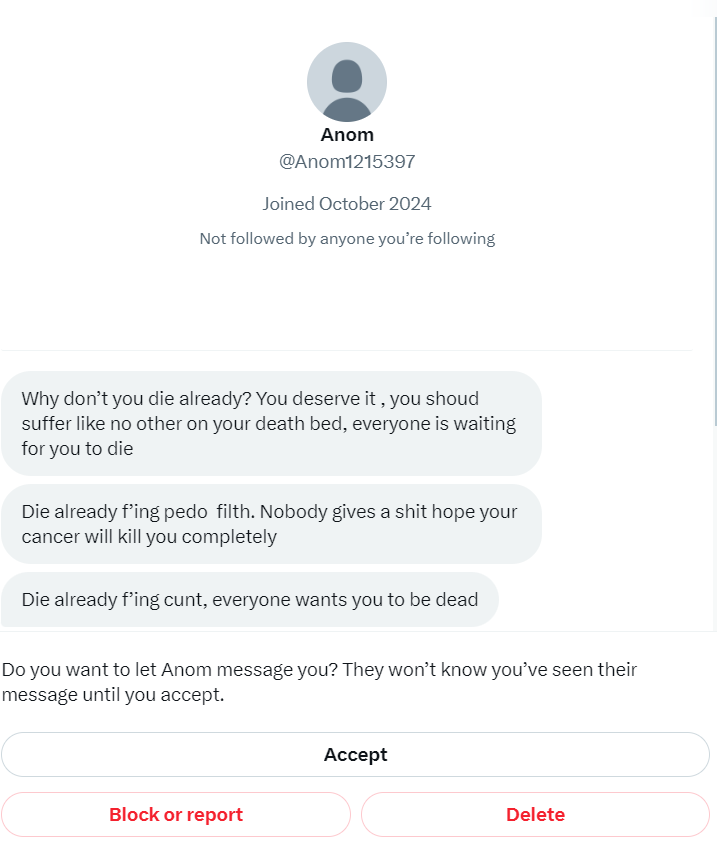
Goodness, some people get really riled up over data revisions. Yes, now reported and blocked.
English
@balajis It’s interesting that Trump has been warning of fraud in our elections since 2015 and was so concerned about it that he did nothing about it for 4 years as President. 🤷♂️ btw after bringing 65 court cases arguing fraud in 2020 - he lost 64 of them because no evidence of fraud.
English

Tedrick retweetledi

Flashback to when Fox News asked Donald Trump about declassifying the Jeffrey Epstein files and he hesitated.
Telling that he's assertive and assured when asked about 9/11 and JFK files.
English
@RBReich No need 2 demonize successful people. Musk has done great things, including 4 climate change. My take: his hard right turn comes down to AI policy, which he wants control of. He wants EV subsidies removed 2 kill competition, and tariffs on Chinese EVs, & federal self driving laws
English
Why would the world’s richest man be f*cked if Donald Trump loses?
English