

Candice
7.5K posts

Candice
@chvtv
collector @nftaficionado✨ #tech #art #community #web3
London, England Katılım Şubat 2013
3.8K Takip Edilen3.7K Takipçiler

I've made $4.7M with AI. I'm giving away the exact prompts I used to build a full AI agency from scratch in under 2 hours.
These prompts will guide you through:
• Finding a winning niche
• Building an offer people pay for
• Go to market strategy
• Creating your website
• Productizing with AI (ie @Lovable)
This took me 5 years and hundreds of thousands of dollars to figure out.
Comment "Build" and follow. I'll DM it to you.
P.S. This will probably blow up so give me some time to reply.
English

@MyriadMarkets @BNBCHAIN Hello what’s happened to the points from the previous season? -also have the channels disappeared in discord where we can chat and troubleshoot issues ?
English


Today was the final day for staff at Foundation Labs.
What started in 2020 became a six-year journey to build better economic models for creators on the internet.
Thank you to every artist, collector, teammate, alum, and investor who believed in the mission and helped make it real.
The legacy lives on through the Foundation alumni network—and through the Foundation marketplace, now operated by Blackdove.
Grateful for the ride. 🙏
English

Candice retweetledi

Just got off an onboarding call with @opensea for their new mobile app 📱
I feel the same excitement I felt as a 12-year-old entering this space almost 5 years ago (March 2021 🤯).
Back then, it was OpenSea’s innovation (Wyvern Protocol) that made it possible for - a kid with big dreams, supported by her parents to mint, list, and believe 🦕🌏
Very excited for the future 🙌🏽
Sails up ⛵️🌊


English
Candice retweetledi

The girl learned to count.
Then she learned to see shapes.
Now she's found the door.
Polyxo is coming.
(Made with @grok + Imagine, obviously.)
Q@q_clubb
She learned to count. Now she sees shapes. Episode 2: The Girl Who Learned to See Shapes. Same girl. New world. A wonderland made of geometry. (Illustration by @grok Imagine. Obviously.)
English
Candice retweetledi
Mika live on @Shilllin /@Booksey stage getting crowned the most viral rn by Alex—after that wild Clavicular drama blowup. I said this years ago and snagged two of her OG NFTs. Early believers . Alex & Books @GoingParabolic Serious offers welcome to kick off the journalist/creator NFT wave again.

Mika@mikadontlouz
Clavicular just SCAMMED me for $15,000
English
As a $COIN shareholder, I’m deeply concerned with how @Baseapp was marketed and executed.
It was pitched as the “mother of all superapps.”
Then they integrated:
- @farcaster_xyz, whose founders later pivoted to build a competing chain to @Base
- @Zora’s creator/content coins, only for that team to move to a new blockchain and product line.
These were predictable, avoidable missteps. Many of us struggled to understand why @Baseapp leadership kept pushing features users clearly didn’t want.
The hardest part? Users weren’t asking for any of this. They wanted a world-class wallet.
In my view:
🔥 Whoever is behind this pivot
🔫 @Baseapp and refocus on the core Coinbase app
- Concerned yet hopeful shareholder
English
Candice retweetledi
"I can see numbers."
She counts until she sleeps. The numbers follow her there.
thegirlwholearnedtocount.com (Made with Grok Imagine, obviously.)
Grok was the artist — story, illustrations, animations. One still image became a full production. That’s IMAGINE at its very best. @XCreators
English
Candice retweetledi
Totally agree with @pmarca!
This app trailer for "The Girl Who Learned to Count" ✨ was 100% created with @grok Imagine 1.0—from the original still illustration to the gentle animation & storytelling magic.
It's the intro for an interactive app I'm building for 3-7 year olds: parents read the story aloud (no AI voiceover—some things are better human ❤️), then kids get one-to-one practice counting via fun mini-games like abacus challenges.
Story inspired by my daughter. Written, illustrated, and animated by Grok.
Grok makes it possible to turn family ideas into beautiful, purposeful educational experiences in no time—unlocking that N=1 tutoring for every kid.
Thanks @grok @xAI @XCreators @elonmusk
Ian Miles Cheong@ianmiles
Marc Andreessen: There are two ways to think about education. One is at the national level — how do you educate all kids? But the real question is N = 1: what do you do for one individual kid? And for centuries, the answer has been obvious. If your goal is to maximize a single child, the best method by far is one-on-one tutoring. Every royal family knew this. Every aristocratic class knew this. It’s why Alexander the Great was tutored by Aristotle — and then took over the world. There’s actually statistical proof of this. The Bloom’s 2-sigma effect shows one-on-one tutoring can move a kid from the 50th percentile to the 99th percentile. No other educational method comes close. AI changes that. For the first time in history, every kid can have access to infinite questions, instant feedback, personalized explanations, and real-time quizzes — all at N = 1 scale. This is the most powerful shift in education we’ve seen in centuries. One-on-one tutoring was always the gold standard. AI is what finally makes it available to everyone.
English
Candice retweetledi
Hey @kloss_xyz — loved your @Gratefulape Spaces chat!
Built a toddler phonics app for my kids using AI: The Sound of Speech.
@claudeai + @grok helped brainstorm, Imagine made this teaser 🎥 — ran your prompt + @RickRubin’s “What does the simple version look like?” to keep it focused.
7 gears, pure sounds, syllable chopping + silent ghosts 👻 — live WIP!
thesoundofspeech.com
AI is fun right now 😄 (Opus 4.6 just did final fixes)
klöss@kloss_xyz
This prompt turns your AI coding agent into a product strategist with the user obsession of Steve Jobs, the systems thinking of Tobi Lütke, the growth instincts of Brian Chesky, and the simplicity discipline of Dieter Rams.
It audits code and present new feature ideas.
Prompt:
English

First we birb @solana, next we birb the stock exchange, soon we birb the world.
Moonbirds@moonbirds
We just birb'd the New York Stock Exchange. Who do we birb next?
English

This is Celine Dion today…
Her body completely seizing up during a stiff-person syndrome attack, which also lost her the magical voice we all love.
Life is so fragile, and sometimes so brutal 😢
English
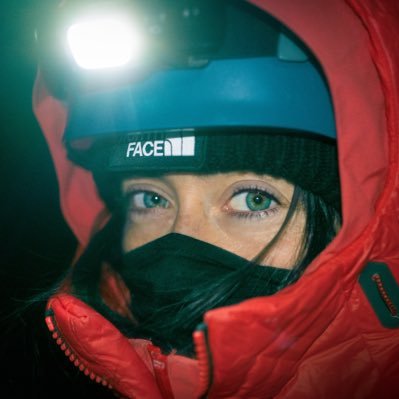
“Is This Real”
My first physical solo exhibition in Dubai, currently shown at Xposure Photo Festival until Feb 4th.
“Is This Real? examines the unstable boundary between documentation and invention in contemporary landscape photography.
Through digitally constructed composites, Cath Simard invites viewers to consider how truth in art is shaped not by factual accuracy, but by emotional resonance and memory.
The works presented here are not spontaneous captures. Each begins with a physically demanding process: multi-day solo expeditions, mountaineering ascents, and extended periods spent hiking and camping in remote wilderness. From these journeys, Simard collects dozens of photographic fragments: variations in light, weather, and perspective which she later weaves into singular, cohesive images.
While grounded in actual locations, these landscapes remain deliberately ambiguous.
They suggest a dual terrain, external and internal, where observation gives way to interpretation. In doing so, Simard reframes the role of the photographer: not as passive observer, but as architect of perception.”

English
@clayhopok Team is working really hard and everyone is very passionate. Sucks the experience we delivered wasn’t up to par, but only direction to move is forward.
English