
GROMPIYE retweetledi
GROMPIYE
3.8K posts


GROMPIYE
@civic_cat
bootleg theory of self, quantum-classical heresy, aesthetics as spellcasting, febrile dreams of happy cities, mysticorational christ-worship
Katılım Nisan 2022
97 Takip Edilen265 Takipçiler

GROMPIYE retweetledi

“We already have functioning prototype devices fabricated and tested in research nanofabrication environments.” - @DrSonnyWhite, Founder and CEO of Casimir in @Debriefmedia today.
thedebrief.org/free-energy-fr…
English
haha why am i bothering with rgbd - lidar fusion again?
Andrea Tagliasacchi 🇨🇦@taiyasaki
This is why I refuse to work on camera estimation problems. For embodied AI, I consider it a **solved** problem at large – there are better things to spend your time on. It's only a "problem" in academia.
English
GROMPIYE retweetledi

乾燥そばを生めんのように美味しくする作り方は…
年越しに食べるおそばですが、乾燥そばを生めんのように作る方法を紹介していきます。
美味しくなる茹で方のポイントは2つ
①乾麺のそばを水から茹でる
②茹で時間は表示時間の半分にする
◎用意するもの
【材料】(2人分)
そば(乾麺)…2束(200g)
水…約2L
サラダ油…大さじ1
氷…適量
◎作り方
①点火前の鍋に水、そば、サラダ油を入れます。
⚠️ポイント
水から茹でることで、もっちり感が増します。また、サラダ油を入れることで、そばがくっつかずにスルッとした食感になります
②中火にして、沸騰するまで待ちます。
③沸騰したら、パッケージに記載されている茹で時間の、半分の時間で茹でます。
⚠️ ポイント
茹で時間、5分なら2分30秒茹でます
④そばをザルに上げ、流水でぬめりを取ります。
⚠️ぬめりを取るらないとつゆがにごったり、ドロっとした食感になります。
⑤氷水でしっかり麺をしめます。
温かいそばで、食べる場合は
つゆに入れる前にお湯に湯通しするとスープの温度が下がらずに美味しく食べれます。
年越しそばを作る際に試してみてください。
『 お金の知識で生活を豊かに 』をテーマに発信してます!
ボクをフォローすると
✅お金の知識がつく
✅お金のお得情報をゲットできる
✅お金で悩まなくなる
✅生活が豊かになる
ボクをフォローして、一緒に生きるための知識をつけていきましょう
👉@jiro_3_
日本語
GROMPIYE retweetledi

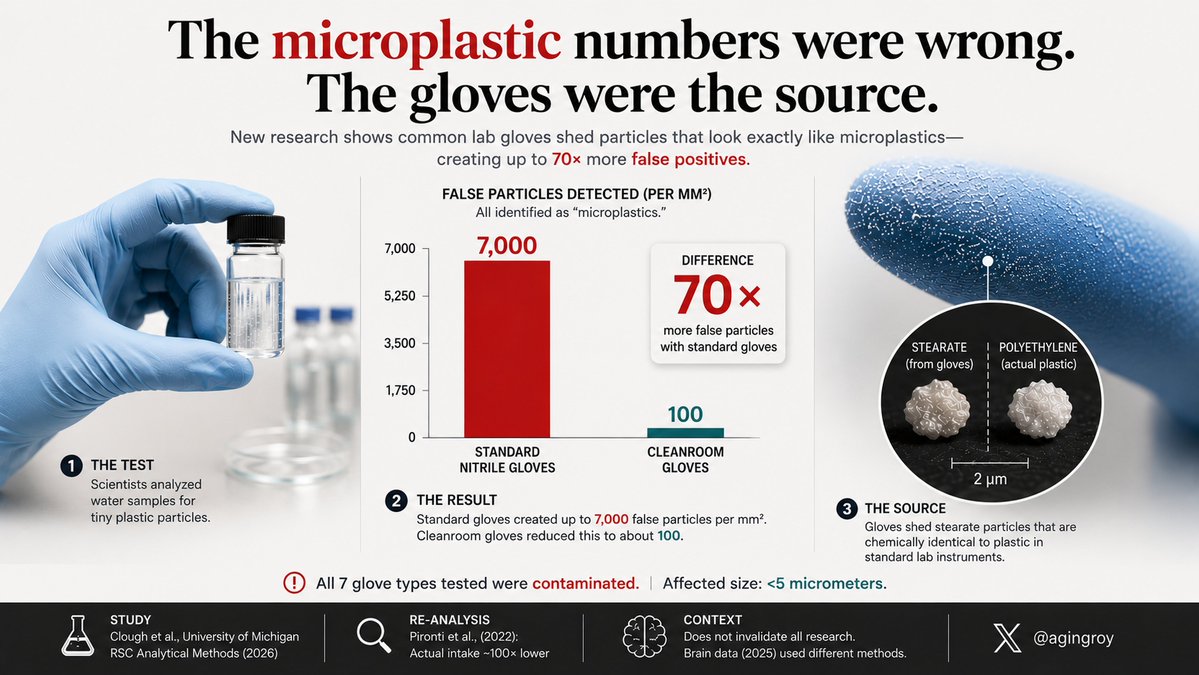
7,000 false positives per square millimeter. The culprit was the lab gloves.
University of Michigan researchers just upended a core assumption in microplastics science. Latex and nitrile gloves, worn by the scientists doing the measuring, shed stearate particles that look chemically identical to polyethylene. Standard infrared and Raman instruments can't tell them apart. The gloves were counting as plastic.
Seven glove types tested. All contaminated. The cheapest fix: switch to cleanroom gloves, which dropped false positives to around 100 per mm² vs. 7,000.
The "credit card per week" headline (5 grams, WWF/Newcastle 2019) has separate problems. A 2022 re-analysis found severe methodological errors in the original estimate. Actual measured intake is likely 100x lower.
None of this means microplastics are harmless. Last month's data on brain accumulation still stands. But the numbers driving the panic may have been measuring the scientists, not the environment.
Science catching its own errors is exactly how it's supposed to work.
English
GROMPIYE retweetledi

GROMPIYE retweetledi

Python can now render a 3D satellite timelapse of any part of the world, draping Sentinel-2 imagery over Copernicus DEM terrain with soft transitions and an orbiting camera. Built with forge3d
Try forge3d 👉github.com/milos-agathon/…
English
GROMPIYE retweetledi

Chinese researchers have developed the best shortest-path algorithm in 41 years!
Dijkstra’s Algorithm has been the undefeated king of the shortest path for over 40 years.
Whether you’re using Google Maps, booking a flight, or routing internet packets, Dijkstra is the engine running in the background.
Since 1984, textbooks have taught that its efficiency was hit by a "sorting barrier."
To find the shortest path, you have to sort the points by distance. And sorting has a mathematical floor you can’t cross.
Until now.
A research team from Tsinghua University just published a paper that shatters the 41-year-old record.
They proved that Dijkstra is not optimal.
By combining the logic of the Bellman-Ford algorithm with a revolutionary "recursive partial ordering" method, they figured out how to find the path without fully sorting the nodes.
The results are a massive shift in theoretical computer science:
- The first deterministic improvement to the Single-Source Shortest Path (SSSP) problem since 1984.
- A new time complexity of $ O(m \log^{2/3} n)$, officially beating the long-standing $ O(m + n \log n)$ limit.
- On massive sparse graphs (like the web or global logistics), this means finding the best route significantly faster than previously thought possible.
For four decades, the greatest minds in algorithms believed this limit was absolute.
Last year, even the legendary Robert Tarjan won an award proving Dijkstra was "optimally efficient" at sorting distances.
Tsinghua’s answer? Stop sorting.
The world’s most settled problem is suddenly wide open again.
If we can break a 40-year-old law in basic graph theory, what other "impossible" speed limits are waiting to be crushed?
English
@bygregorr @cecianasta maybe 'consequence-free' is exactly what deepmind agents need to learn, ahem, manoeuvring actual humans towards outcomes. without legal repercussion.
English

@cecianasta Training on EVE assumes the players behave like real economic actors but they don't. It's a consequence-free sandbox. You're basically training AI on how humans act when nothing actually matters. Is that the generalization you want?
English

Exclusive: Google DeepMind will train its AI technology on EVE Online after Google took a multi-million-dollar stake in the sci-fi MMORPG's developer.
EVE Online is famous for players' corporate espionage, economic maneuvering and politicking. bloomberg.com/news/articles/…
English
they take turns singing the notes of the opening arpeggios. the texture of the brief overlaps is extraordinary!
Masayuki Tsuda@MasayukiTsuda2
1950年代のドゥーワップ風の曲 "Mr. Sandman" を心地よいジャズアレンジでカバーした素敵な演奏
English
GROMPIYE retweetledi


it is true i cannot approve edits and prompt the next thing fast enough, especially not across disparate projects. but we might see a subtle (and splendid) flip when autonomous harnesses become standard: that the human was always the prized processor, the crown jewel of all generative workflows. speed and pattern manipulation belong to silicon; all its intent will forever be descended from a human heart.
English

Andrej Karpathy: "To get the most out of the tools that have become available now, you have to remove yourself as the bottleneck.
You cannot be there to prompt the next thing. You need to take yourself outside the loop. You have to arrange things such that they are completely autonomous.
The more you can maximize your token throughput and not be in the loop, the better. This is the goal. So, I kind of mentioned that the name of the game now is to increase your leverage. I put in very few tokens just once in a while, and a huge amount of stuff happens on my behalf."
---
From @NoPriorsPod YT channel (link in comment)
English

Here's my submission for @bruno_simon 's #threejs challenge.
Happy with the final look of the experience and how the fog deepens the atmosphere 😶🌫️
projects.thibautfoussard.com/the-sleepers
#threejsjourney #webgl #creativecoding #FrontendDev
English
GROMPIYE retweetledi

Let your robot turn ordinary video
from a regular phone camera
into a searchable 3D map:
Imagine filming your bedroom with just your phone and then asking, “Where’s my blue backpack?”... and it shows you exactly where it is on a super cool 3D map!
That’s RADIO-ViPE. It turns ordinary video from a regular phone camera into a searchable 3D map you can ask questions about in plain English.
This is without fancy lasers or special gear... just your phone.
Under the hood, it pulls dense “meaning vectors” from the RADIO foundation model for every pixel in the video, then plugs those same vectors straight into bundle adjustment.
So the optimizer fixes the camera poses for perfect geometry and semantic consistency in one single step. It even handles people walking around or stuff getting moved by tracking how steady each pixel’s meaning stays over time.
Thanks for sharing, @OfficialNathanY!
📌 Paper here: arxiv.org/pdf/2604.26067
----
Weekly robotics and AI insights.
Subscribe free: 22astronauts.com
English
project t
3 may 2026 devlog
ui, ui, ui: insist on something that feels good
1. after many text renderer tweaks, i abandoned the coral pink text — it was fatiguing. we are now off-white with a coral pink bloom. should i build in tweakability? maybe not now.
2. after much fussing over how to accommodate the unceremonious black anomaly that is the iphone's dynamic island, i landed on this asymmetrical brass yoke.
3. many subtle shades of off-black later...
4. you will notice there is a speaker grille on the lower left, but not the lower right. yes, i will pan diegetic device audio (the sound the device outputs in its 'world') only through the left channel of the actual device.
5. crafting sfx (!), on-hold music playing through a cruddy speaker (!), and toying with an unnerving non-diegetic (between designer and user) minimalist ambience.
6. loving text effects like i didn't know i could.

English
Himanshu Tyagi, IFS@Himanshutyg_ifs
This is why you must plant more #trees and protect birds. From an evolutionary standpoint, our brains are literally wired to find peace in birdsong. Birds sing in safe, stable environments — calm mornings and evenings with no predators around. So when we hear them, our brain reads it as: all clear. A 2024 EEG study found that birdsong triggers the strongest alpha wave activity in the brain — linked to calm, peace, and mental stability. Birdsong activates the parasympathetic nervous system, signalling rest to the body, while dialling down the sympathetic system — the one responsible for fight-or-flight. Studies show that nature sounds lower heart rate, blood pressure, and cortisol levels, and slow down breathing. Some research, using skin conductance monitoring, found that nature sounds relieve stress faster than many conventional therapies. Urban noise is the opposite. Vehicle horns, industrial sounds — these are transient, non-rhythmic, and they directly activate the amygdala, spiking stress and anxiety. Birds sing in the 2–8 kHz frequency range, and our ears are most sensitive to exactly that range. Research shows these sounds sharpen attention and boost mental productivity — a concept known as Attention Restoration Theory in cognitive psychology. Plant trees. Protect birds. Your nervous system will thank you.
ZXX
GROMPIYE retweetledi



@AndrewYNg @godotengine better, with dummy content — will tweak transitions and visibility (icons, colours, dark mode please).
English
Two years later, I'm rebuilding the visual node system except now the nodes will spin up agent instances, a la minute, instead of prompts to an API.
This is a first test of the UI with 2,000 nodes and edges to see if things stay snappy (no, not snappy).
So I can work on all projects and see their progress simultaneously, and retrieve / search for ancient context all in one workspace. Have the app ping me on my phone when input or approval are required.
Instead of my mind switching contexts, what about an operating surface that combines ALL contexts?!
Looking forward to:
(A) Having agents whir all day
(B) Agentic zettelkasten w/everything on one canvas
(C) Multi-user collaboration in one workspace
Notes:
composable context. everything stays in storage, but not everything gets attached as context for agentic sprints. build tools for grabbing distilled or detailed context across all history.
English
I think AI agentic workflows will drive massive AI progress this year — perhaps even more than the next generation of foundation models. This is an important trend, and I urge everyone who works in AI to pay attention to it.
Today, we mostly use LLMs in zero-shot mode, prompting a model to generate final output token by token without revising its work. This is akin to asking someone to compose an essay from start to finish, typing straight through with no backspacing allowed, and expecting a high-quality result. Despite the difficulty, LLMs do amazingly well at this task!
With an agentic workflow, however, we can ask the LLM to iterate over a document many times. For example, it might take a sequence of steps such as:
- Plan an outline.
- Decide what, if any, web searches are needed to gather more information.
- Write a first draft.
- Read over the first draft to spot unjustified arguments or extraneous information.
- Revise the draft taking into account any weaknesses spotted.
- And so on.
This iterative process is critical for most human writers to write good text. With AI, such an iterative workflow yields much better results than writing in a single pass.
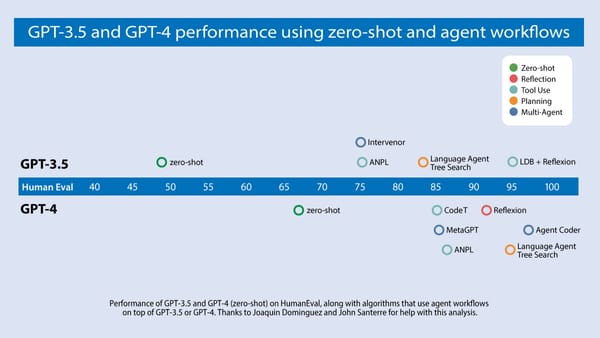
Devin’s splashy demo recently received a lot of social media buzz. My team has been closely following the evolution of AI that writes code. We analyzed results from a number of research teams, focusing on an algorithm’s ability to do well on the widely used HumanEval coding benchmark. You can see our findings in the diagram below.
GPT-3.5 (zero shot) was 48.1% correct. GPT-4 (zero shot) does better at 67.0%. However, the improvement from GPT-3.5 to GPT-4 is dwarfed by incorporating an iterative agent workflow. Indeed, wrapped in an agent loop, GPT-3.5 achieves up to 95.1%.
Open source agent tools and the academic literature on agents are proliferating, making this an exciting time but also a confusing one. To help put this work into perspective, I’d like to share a framework for categorizing design patterns for building agents. My team AI Fund is successfully using these patterns in many applications, and I hope you find them useful.
- Reflection: The LLM examines its own work to come up with ways to improve it.
- Tool use: The LLM is given tools such as web search, code execution, or any other function to help it gather information, take action, or process data.
- Planning: The LLM comes up with, and executes, a multistep plan to achieve a goal (for example, writing an outline for an essay, then doing online research, then writing a draft, and so on).
- Multi-agent collaboration: More than one AI agent work together, splitting up tasks and discussing and debating ideas, to come up with better solutions than a single agent would.
I’ll elaborate on these design patterns and offer suggested readings for each next week.
[Original text: deeplearning.ai/the-batch/issu…]
English
@AndrewYNg @godotengine Clearly needs some type of semantic culling. No need to show all 2,000 nodes and 4,000 edges at max zoom.
English