Avi Roy

7.6K posts

Avi Roy banner
Avi Roy

Avi Roy

@agingroy

Biomed Scientist in #longevity. Mentor & Investor in Health startups. Past CTO @BioVivaScience ,Researcher @CASMIORG ,Lead @oxfordscisoc @NewsInLongevity ,BGRF

Oxford, England Katılım Mayıs 2008
2.7K Takip Edilen7.3K Takipçiler
Sabitlenmiş Tweet
Avi Roy
Avi Roy@agingroy·
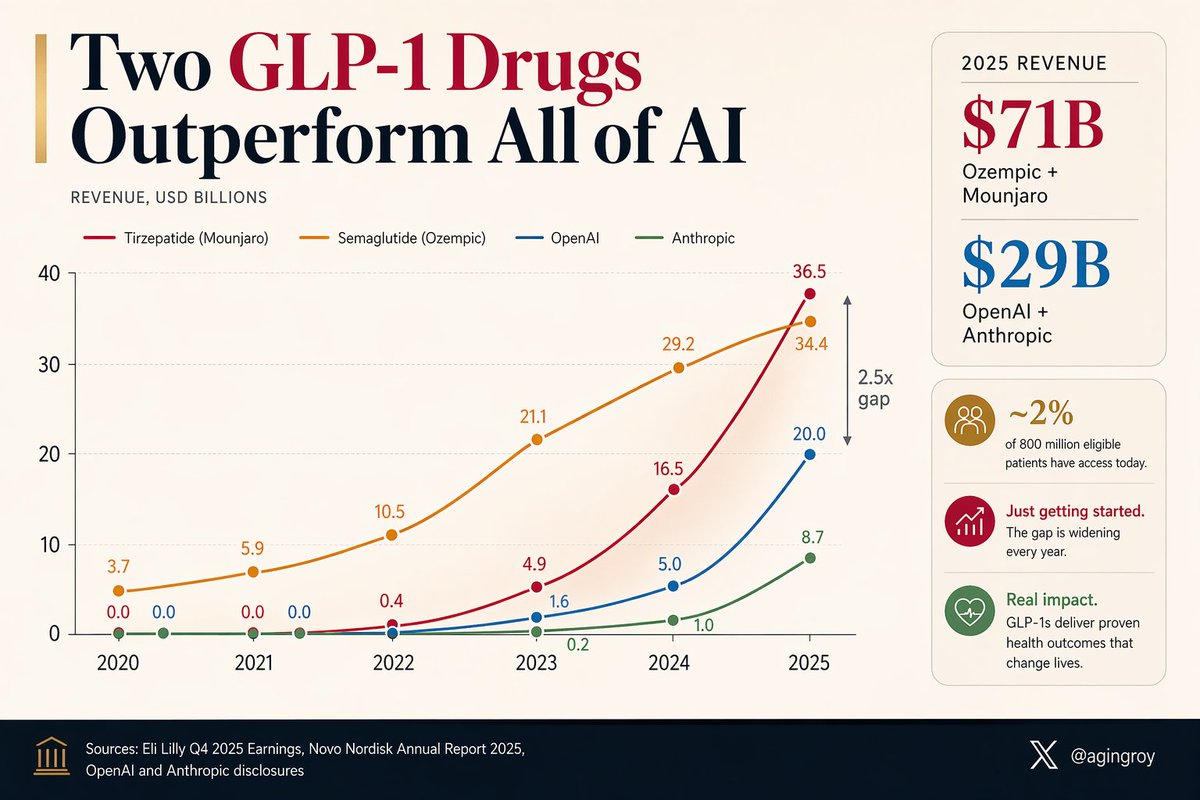
A weekly jab in the belly is generating more revenue than the entire AI industry. Ozempic + Mounjaro: $71B in 2025. OpenAI + Anthropic: $29B. And they've barely started. ~2% of the 800 million eligible patients can currently access them. h/t @DrSamuelBHume
Avi Roy tweet media
English
52
179
1.1K
522.5K
Avi Roy
Avi Roy@agingroy·
Source: Our World in Data, "Life expectancy at different ages" ourworldindata.org/grapher/life-e… Data: Riley (2005), Zijdeman et al. (2015), Human Mortality Database (2025), UN WPP (2024) US data shown, but the pattern holds across wealthy nations.
English
0
0
2
49
Avi Roy
Avi Roy@agingroy·
In 1880, a newborn in the US could expect to live to 39. Today, 78. Most people think that's just because fewer babies died. It's not. A 45-year-old back then could expect to reach 68. Now it's 82. A 65-year-old? Gained nearly a decade. Even 80-year-olds live 3 years longer. We didn't fix one thing at the start of life. We got better at keeping people alive at every stage of it. That's a huge win for all. @OurWorldInData
Avi Roy tweet media
English
1
0
6
115
Avi Roy
Avi Roy@agingroy·
Within the Mandsager data, no ceiling. HRs keep dropping from high to elite with no attenuation. But elite is only the top 2.5%, so CIs widen fast and there's basically no clean data above ~18 METs. So it keeps scaling as far as we can measure, and we can't really see past that yet.
English
0
0
0
123
Silvia N Cickovska
Silvia N Cickovska@SilviaNilssonC·
@agingroy @ClevelandClinic Does the benefit keep scaling even beyond ‘elite’ on the table (e.g. >16 METs for young guys)? Or does it top out somewhere we haven’t measured yet?
English
1
0
0
179
Avi Roy
Avi Roy@agingroy·
A treadmill test predicts your odds of being alive in 8 years better than diabetes, smoking, or end-stage renal disease. 122,007 patients. @ClevelandClinic followed for 8.4 years. Patients with elite cardiorespiratory fitness had 5x lower mortality than those with low fitness. The benefit kept rising at the very top of the curve. No ceiling. The “fit but not too fit” advice your cardiologist gave you isn’t supported by the data.
Avi Roy tweet media
English
6
6
50
5.6K
Avi Roy
Avi Roy@agingroy·
Mechanism's right. Worth separating two curves though: 'fit but not too fit' was always about AFib and CAC in masters endurance athletes, not all-cause mortality. Mandsager's looking at mortality, where the Fick variables (stroke volume, a-vO2 diff, mitochondrial density) keep paying dividends with no obvious biological reason to plateau.
English
1
0
0
176
MedUniDoc
MedUniDoc@MedUniDoc·
the no ceiling finding is the part that should make every cardiologist reconsider the "fit but not too fit" advice. mechanistically it makes sense: VO2max reflects mitochondrial density, cardiac output efficiency, and the ability to clear lactate under load. there's no obvious biological reason those adaptations would become harmful at the top end. the data keeps confirming that, and yet the advice persists.
English
1
0
0
234
Avi Roy
Avi Roy@agingroy·
Half of it, sure. VO2max is ~50% heritable (HERITAGE), but the other half is trainable, with 10-30% gains typical and up to 40% in low-fit folks. And Mandsager's 122K Cleveland Clinic cohort wasn't genetically selected, so the dose-response across quintiles isn't just heritage shining through.
English
1
0
0
32
Jamie Timmons
Jamie Timmons@metapredict·
Genetics in action.
Avi Roy@agingroy

A treadmill test predicts your odds of being alive in 8 years better than diabetes, smoking, or end-stage renal disease. 122,007 patients. @ClevelandClinic followed for 8.4 years. Patients with elite cardiorespiratory fitness had 5x lower mortality than those with low fitness. The benefit kept rising at the very top of the curve. No ceiling. The “fit but not too fit” advice your cardiologist gave you isn’t supported by the data.

English
1
0
3
178
Avi Roy
Avi Roy@agingroy·
Source: Zhang et al. (2025), Cell Reports Medicine: doi.org/10.1016/j.xcrm… Key findings: - Zeaxanthin enhances CD8+ T cell cytotoxicity via TCR signaling - Augments anti-PD1 checkpoint inhibitor efficacy in vivo - Tested in B16F10 melanoma and MC38 colon carcinoma (mouse) - Human TCR-engineered T cells also showed enhanced killing in vitro - Mechanism: promotes T cell receptor stimulation on CD8+ surface - No human cancer outcome data yet Zeaxanthin dietary sources (@USDA): Corn, egg yolks, orange peppers, kiwifruit, leafy greens
Avi Roy tweet media
English
0
0
4
157
Avi Roy
Avi Roy@agingroy·
A $5 supplement made immune-based cancer drugs work significantly better in mice. Zeaxanthin is the yellow pigment in corn, egg yolks, and orange peppers. @UofC researchers found it made CD8+ T cells better at killing tumors. Those are the body’s cancer-killing immune cells. Anti-PD-1 drugs work by taking the brakes off them. Tested in melanoma and colon cancer models. Both responded. In mouse melanoma and colon cancer models, zeaxanthin strengthened the response to anti-PD-1. In lab tests, human-engineered T cells also killed cancer cells more effectively when zeaxanthin was on board. The mechanism was stronger T-cell receptor signaling. In plain English, the T cell seemed better able to recognize the cancer cell and fire. This is mice and cells, not patients. Don’t add it to cancer treatment on your own. But a cheap eye-health supplement with a mapped immune pathway is worth watching.
Avi Roy tweet media
English
1
1
25
1K
Avi Roy
Avi Roy@agingroy·
Good point and a real concern in any retrospective ICI cohort. Calendar-time confounding is exactly why this needs RCT confirmation. That said, a 17-month OS gap is hard to explain by treatment-era drift alone, even granting that ICI regimens have improved substantially. Worth seeing if the authors did era matching in the supplement.
English
1
0
0
100
Avi Roy
Avi Roy@agingroy·
Yeah, big area. Moderna/Merck's mRNA-4157 + Keytruda cut melanoma recurrence ~44% vs Keytruda alone in Phase 2b (KEYNOTE-942, NEJM 2023). BioNTech has similar programs in melanoma and colorectal. These are personalized to each tumor's mutations, different from the COVID vaccine effect in my post above.
English
0
0
7
309
Avi Roy
Avi Roy@agingroy·
Your COVID mRNA vaccine may have accidentally helped fight cancer. MD Anderson studied 884 lung cancer patients on immunotherapy. 180 of them got a COVID mRNA vaccine within 100 days of starting treatment. Results (AACR 2026): - Vaccinated group: 37.3 months median survival - Unvaccinated group: 20.6 months - Nearly doubled. The mechanism: mRNA acts like a siren for your immune system. It floods the body with type 1 interferon and upregulates PD-L1, the exact protein that checkpoint drugs target. The vaccine didn't fight COVID here. It supercharged the cancer treatment. This wasn't planned. It was discovered by accident in retrospective data. But 884 patients is not a small number.
Avi Roy tweet media
English
182
681
1.8K
132.4K
Avi Roy
Avi Roy@agingroy·
Worth flagging that this cohort was ICI patients (pembro/nivo), not osimertinib. EGFR+ NSCLC usually goes to osi first-line and tends to respond poorly to ICI, so they're often excluded from these trials. The Type I IFN + CD8 priming story here is an ICI-augmentation mechanism. Whether mRNA would do anything useful alongside a TKI is a separate question, and I haven't seen data on it.
English
1
0
5
748
Mother of Swans
Mother of Swans@motherofswans·
What if a COVID mRNA vaccine given concurrently with osimertinib plus a checkpoint inhibitor could overcome the historic failure of immunotherapy in EGFR-mutant disease? The interferon surge makes the tumor visible, osimertinib suppresses the driver, and the checkpoint inhibitor blocks the PD-L1 escape hatch simultaneously. ????
English
2
0
4
1.5K
Avi Roy
Avi Roy@agingroy·
Honestly, the paper doesn't say. It's retrospective, 704 of 884 patients were unvaccinated during the COVID era, likely a mix of hesitancy and oncologists telling immunosuppressed patients to wait. The bigger issue is healthy vaccinee bias. If frailer patients skipped the shot, the vaccinated arm starts healthier and lives longer regardless of immune effect. That's why the RCT matters.
English
0
0
5
561
MTM 14
MTM 14@mtm14·
@agingroy What was the reason such a large percentage of the cohort did not get the vaccine? Too sick to take it perhaps?
English
1
0
6
983
Avi Roy
Avi Roy@agingroy·
Yeah, can't rule that out. Retrospective design can't separate mRNA immune priming from "fewer COVID setbacks let ICI work better." The COVID-deaths gap is a limitation the data can't resolve. Doesn't kill the signal (37.3 vs 20.6 mo OS is large), but needs a prospective trial before anyone calls it causal.
English
1
0
5
386
revival.care
revival.care@RevivalCare·
@agingroy Were number of Covid infections controlled for? How was the effect of the vaccine isolated from a probable self-selection effect of cautious and health conscious individuals being more likely to be vaccinated?
English
1
0
4
664
Avi Roy
Avi Roy@agingroy·
Fair gap. It's retrospective, and if some unvaccinated deaths were COVID rather than cancer, that inflates the control arm's mortality and widens the gap artificially. Real limitation. My guess is it narrows the delta but doesn't erase it. A prospective trial would isolate the two effects.
English
2
0
0
137
Avi Roy
Avi Roy@agingroy·
@DonEford You're right that 37.3 vs 20.6 months is median OS, so survival time. But the same dataset also reported the 3-year landmark: vaccinated patients were 2x more likely to still be alive. Both effects show up together, time and rate.
English
0
2
20
562
Don Ford - The People's Strategist -
This data means they lived twice as long, not that twice as many survived. The thing is, this is not even the best data for this; there are a few examples of spontaneous recovery of external cancers, but they did not have the same effect on the same cancer in internal organs. Technically, your lungs are considered outside your body and share mechanisms with the immune system for your skin. So, this is something with only the lung and skin cancer, and it won't help with metastasized cancer of the same type in internal organs. Which is actually super interesting because we can learn a lot about the immune system from this. It also strengthens the argument for interferon-based treatments.
English
2
3
16
1.1K
Avi Roy
Avi Roy@agingroy·
All 884 patients already had advanced lung cancer before getting the vaccine. The shot came after diagnosis, during checkpoint immunotherapy. Whether mRNA causes cancer is a separate question the study didn't ask, but in people already fighting it, vaccinated patients lived longer.
English
2
0
10
387
cbarrick
cbarrick@c_barrick·
Let me help you -- what you mean is: Your COVID mRNA vaccine may have accidentally given you cancer. Your welcome...
English
3
1
52
656
Avi Roy
Avi Roy@agingroy·
@carl_jurassic "May have" is doing real work because it's retrospective, not an RCT. But 37.3 vs 20.6 months across 884 patients in Nature isn't nothing. The hedge is honest, the effect size isn't subtle.
English
2
0
6
278
Jurassic Carl 🦖🐭
Jurassic Carl 🦖🐭@carl_jurassic·
@agingroy “may have” is doing some heavy lifting here, bruv. Like, Olympic powerlifting level shit.
English
2
0
36
777
Avi Roy
Avi Roy@agingroy·
The endpoint was overall survival, not cancer-specific. That counts every death from any cause, including cardiac. Vaccinated patients still had 37.3 vs 20.6 months median OS. If cardiac deaths were skewing the vaccinated arm, they're already in that number and the gap would be smaller, not larger.
English
4
1
13
560
Avi Roy
Avi Roy@agingroy·
That colorectal trend has been rising since the early 1990s, 25 years before any mRNA vaccine existed. SEER formally excludes 2020 from trend analyses because COVID gutted cancer surveillance that year. The chart has no vaccine exposure variable. It can't test causation. Diet, obesity, and gut microbiome disruption are the peer-reviewed drivers.
English
12
0
30
1.1K