
cjiang
18 posts


cjiang
@cjiang
Agentic economy in the making, rulebooks, permissions, programmable money| Co-founder & CTO @Cobo_Global | Prev @Meta @Google | UIUC PhD
Katılım Nisan 2008
500 Takip Edilen105 Takipçiler
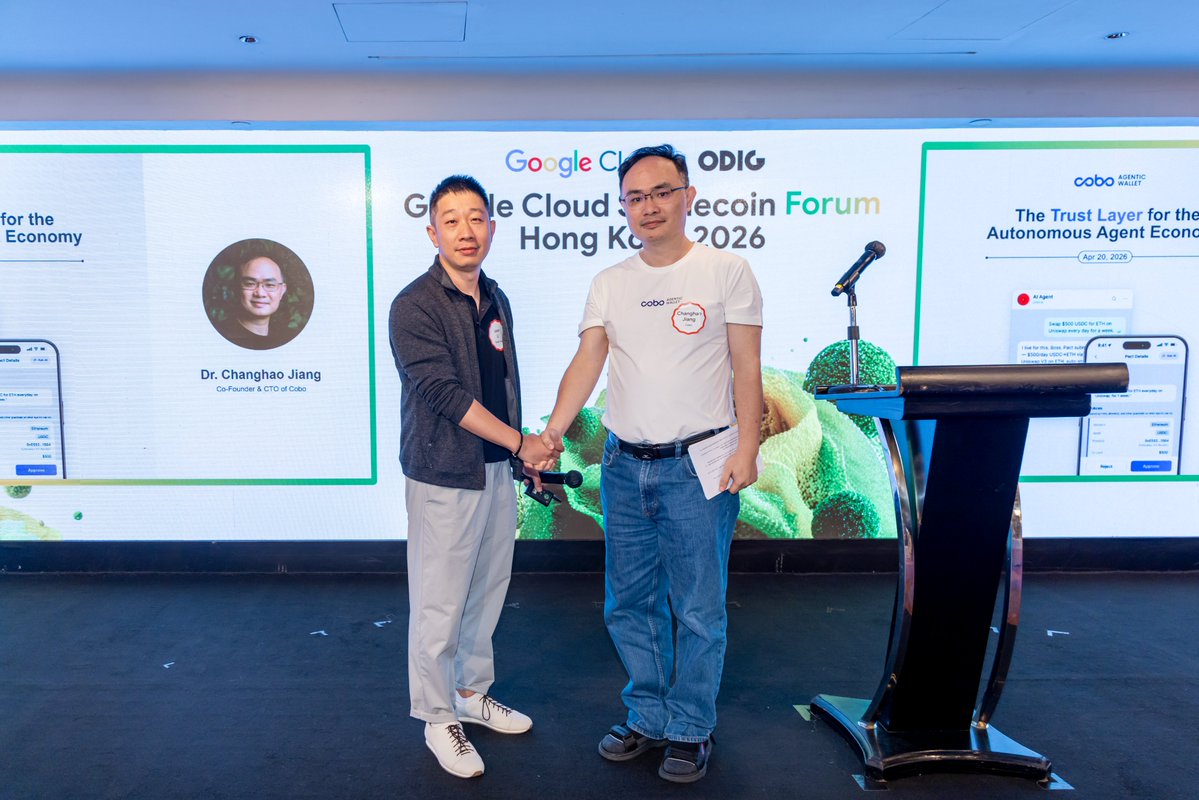
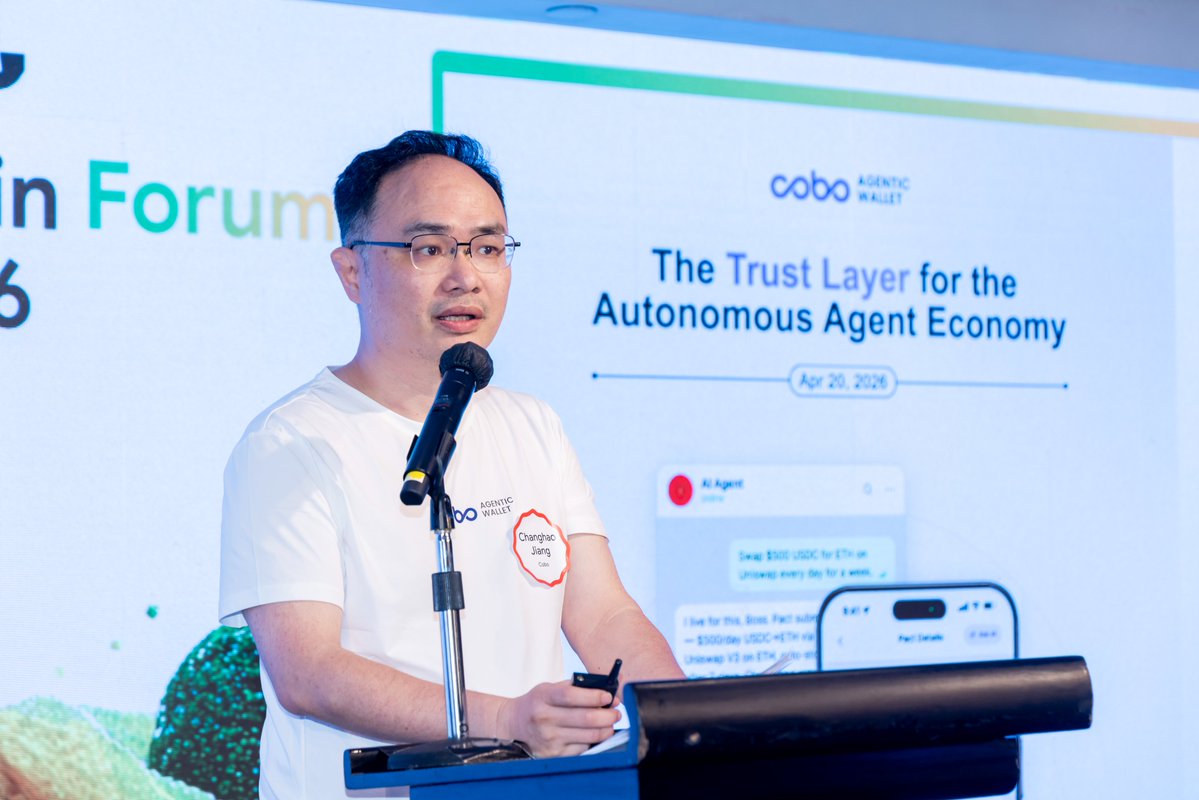
What an inspiring day at the Google Cloud Stablecoin Forum Hong Kong 2026!
Seeing leaders from OKX, OSL, and other great projects on stage proves one thing: the Agentic Economy is already here. AI is no longer just chatting—it is moving real liquidity at machine speed.
But as agents take control, the missing piece is the Trust Layer. Natural language can express intent, but it cannot enforce machine-level permissions. You can't secure funds with fragile system prompts.
During my keynote, I shared how Cobo Agentic Wallet (CAW) solves this by bringing three world-firsts to the space:
1️⃣ The 1st MPC-based Agent Wallet (A mathematical guarantee, not just a software promise)
2️⃣ The 1st Infra-enforced 'Pact' mechanism (Defining the absolute boundaries)
3️⃣ The 1st Recipe-driven skill layer (Ensuring reliable execution)
I walk away today more optimistic than ever. With the broader industry building the roads and Cobo enforcing the rules, the Agent Economy is truly ready to scale.
Agents get autonomy; humans keep certainty. Huge thanks to @GoogleCloud for bringing us together! 🚀
#Web3 #AIAgents #AgenticWallet
English
Right now, most protocols still handle Agent permissions in a very crude way. The controls are thin. The boundaries are soft.
So the real question is straightforward: how do we build a hard enforcement layer outside the LLM itself, one that makes overreach impossible at the system level? That feels like the most urgent engineering challenge in Web3 x AI right now. Someone has to solve it.
English
An extra $0.20 is small. The real problem is the logic underneath it.
Today the Agent doubles the margin on its own. Next time it widens slippage to get the trade through. After that, changing the destination address no longer feels like a hard line. Once AI starts cooking the books inside a black box so it can hit the goal, “intelligent custody” starts to look a lot like shadow custody, and a far more dangerous one.
English
Crypto was built on one simple rule: Don’t trust. Verify.
What makes the AI Agent era tricky is that we are starting to lose the very ability to verify what actually happened.
Recommended read: 👇
Cobo@Cobo_Global
English
Many blame poor UX, but from a systems architecture perspective, it’s a fundamental misalignment of interaction paradigms.
In human workflows, Checkout is the terminus: Intent → Explore → Converge → Pay. It serves users who have already made up their minds.
But AI Agents operate differently. They are task-execution systems with zero "shopping impulse." To an Agent, payment isn't a final phase; it’s a constraint.
The logic is: Execute → Hit payment constraint → Resolve → Continue. Payment is just a sub-step in compute, a callable API.
Forcing a traditional checkout UI into ChatGPT triggers a "post-decision" mechanism while the user is still exploring. It’s like a pushy salesperson aggressively upselling a VIP card before you even step into the store.
Agent-centric commerce doesn’t need a smoother checkout UI. It needs clear authorization protocols: Budgets, boundaries, and triggers. Once set, payment fades into the backend as an invisible API call.
When payment becomes just another part of the compute process, today’s entire UI layer—shopping carts, checkout pages, and CTA buttons—will slowly become obsolete. The future of commerce is headless and Agent-driven.
#AI #Ecommerce #Agents #ChatGPT #Walmart

English
Target quietly updating its terms ahead of the Gemini integration and placing liability on users isn’t particularly surprising. Once AI agents are allowed to participate in transactions, the open question has always been: who eats the mistake?
Right now, it’s the user.
What’s more interesting is what this says about where the infrastructure actually is. Agents are getting good at execution — they can search, decide, and complete transactions — but there’s still very little in place to define or enforce how those actions should be constrained.
So when something goes wrong, the system doesn’t prevent it. The terms just assign responsibility after the fact.
That works as a stopgap. It’s harder to see it holding as agents start handling more real money and more complex flows.
businessinsider.com/targets-google…
English
在容错率为零的金融场景下,AI 的「聪明」往往是安全最大的敌人。现在很多团队在疯狂给 AI Agent 赋权,却忽视了随之带来的隐秘路径劫持与「影子托管」风险。如果没有独立的策略引擎(Policy Engine)和链上观测器(Watcher)做实时兜底,你的系统就是一台对 AI 敞开大门的提款机。
推荐阅读 Cobo 内部的安全实践,了解我们如何将执行风险拦截在链上交易发生之前。👇
Cobo@Cobo_Global
中文
也许有人会问:既然有了Agent Card,为什么 AI Agent 还需要稳定币?
答案在于物理极限。
传统金融 3% 的费率和 3 天的账期是为人类设计的摩擦力。在人类尺度下,这些成本是可以接受的;但在 Agent 之间每秒上万次的微额交互中,这种摩擦会直接让系统失去可行性。
这是 Cobo 稳定币周报改版为「Agentic Finance」后发布的首篇内容。本文尝试从 AI Agent 支付出发,对比两种正在并行发展的路径:一条是接口层适配,让 Agent 可以接入人类的支付体系;另一条是协议层重构,让支付体系开始适配机器本身。
只有当价值流转的速度,开始接近代码执行的速度,机器经济才真正成立。
Cobo@Cobo_Global
随着 AI 从信息助手走向执行主体,人类经济系统正在迎来一种全新的参与者。 AI 不再只是处理信息,而开始执行任务、调用资源,甚至参与交易。机器之间的价值交换,正从概念走向现实。 我们正式启动「Agentic Finance」专题系列。作为该系列的开篇,本期试图回答一个具体的问题:当 Agent 获得支付能力,金融系统会如何响应? 一条路径,是将 Agent 接入现有体系。Ramp 为 AI Agent 提供 @Visa 卡,使其能够在既有网络中完成交易。 另一条路径,则是重写支付本身。Tempo 推出的机器支付协议(MPP),尝试让支付嵌入机器原生的执行逻辑。 两种方向,指向同一个问题:当机器成为新的经济主体,货币与支付系统将如何演进。
中文
离开 Twitter 的这段时间,世界并没有停止转动。只是如今的转速,已经超越了我们过去的任何想象。当我重新审视眼前的一切时,那种熟悉又陌生的感觉扑面而来,我们正站在又一个巨大的分水岭上。
上一次有这种感觉,还是在 2008 年。
那一年,Twitter 刚刚出现,那时它还不叫 X。我带着好奇心发出了第一条推文:「explore this twitter thing.. It looks so simple, seems like a subset of Facebook status update.」那时,我们刚刚踏入 Web2 的黎明,亲眼见证了社交网络如何重塑信息传播与人类协作。信息的摩擦成本被压缩到前所未有的程度,那一刻,我们以为那已经足够颠覆。
但现在,一个全新的物种出现了。
AI Agent。
不需要睡眠,没有身份的束缚,更不受人类生理极限的桎梏。以机器的速度执行逻辑、调用工具、完成任务。彼此之间的协作,不再依赖漫长的人类谈判,而是毫秒级的握手。
现在,想象一个由无数这样的 Agent 组成的经济体。
如同人类,Agent 也需要工具,需要协作,需要交易,甚至会自发形成复杂的组织结构。但我们为人类设计的传统金融体系(银行账户、信用卡、人工审批)在这样的高速、无眠、微交易的世界面前,几乎像是史前遗迹。银行有工作时间,清算需要三天,合规审查则需要人类的介入。
而 Agent 的世界是 24/7 的,是机器原生的,是每秒可能发生数千次微交易的。这正是加密网络存在的意义。只有加密网络,能提供真正的「机器原生」金融接口。
在这个体系中,Agent 可以直接通过链上协议完成即时结算。通过我们精心设定的预算和规则,人类为这个系统划定安全边界,同时赋予 Agent 在这些边界内自主行动的权力。
如果说过去两年的 AI 革命,是关于大脑的进化,让机器能够理解语言、生成内容、进行推理。那么接下来,我们将为 AI 接通双手。AI 将从信息的处理者,真正成为价值的交换者。
当 AI 能够自由调用工具、支付费用、执行协议,就获得了一种全新的身份:经济参与者。
我们正在进入一个无人驾驶的经济时代。贸易创造了城市,金融塑造了现代世界。而 AI 与加密网络的结合,正孕育出一种全新的经济结构:一个在我们熟睡时仍在持续运行、协作、交易,并自我进化的系统。
未来的图景已经展开。
我们要做的是理解这一切,并为这个全新的经济形态构建基础设施。因为要让这些“手”真正动起来,还需要一些更基础的东西。
敬请期待。
cjiang@cjiang
中文