
CK
3.5K posts


CK
@ckoglmeier
Product leader interested in confluence of ideas, resources & people , and how our purpose is changing in the AI era.
Denver, Boston Katılım Kasım 2009
743 Takip Edilen650 Takipçiler
@cynthiamcgillis Big problem.
Have been publishing out some of what's been working for my teams here: github.com/ckoglmeier/cla…
English

How are y'all handling company-wide skills? Putting them in a repo? Does that work for Cowork and less technical teams? I feel like there has to be a better way to organize these.
English
Man, Anthropic now has Boris out shilling for enterprise context and complexity with ServiceNow. It really is all hands on deck to hit those IPO numbers.
Marcelo P. Lima@MarceloLima
Boris Cherny of Anthropic on $NOW: "If I'm doing something and I don't have the context, I'm not going to do a great job... ServiceNow is a really a great way to bring in that context that it needs to do the job."
English
Have been thinking a lot about pricing in the AI era.
I’m fairly familiar with the literature on SaaS models, marketplace take rates and other usage based systems.
What’s the canonical work on license based models?
@ttunguz @danhockenmaier any recommendations?
English
@adamghowiba Can’t believe this counts as news.
A more complex version of this is something we ship every day in skills at Guild.
English

JP Morgan's investment research team just shared exactly how they built their multi-agent system "Ask David", and it's the same architecture pattern showing up everywhere:
- supervisor agent orchestrates
- specialized subagents handle retrieval, structured data, analytics
- LLM-as-judge reflection node before the answer ships
- human-in-the-loop for the last accuracy gap
worth watching for anyone building:
English

The obvious path for designers in the AI age is to move closer to code.
But the more valuable path may be upstream: closer to the customer, the business, and the problem.
If everyone can prompt agents to code, the scarce skill becomes knowing why, what, and how to build.
English
The gravity has really shifted here, from small consultancies, to the big ones, to now the frontier models.
The team at Task (taskeng.aI) is excited everyone moving to implement here - and hopeful that all the end companies ask “where should we and how”. Solutions without understanding the business will go… not well.
English

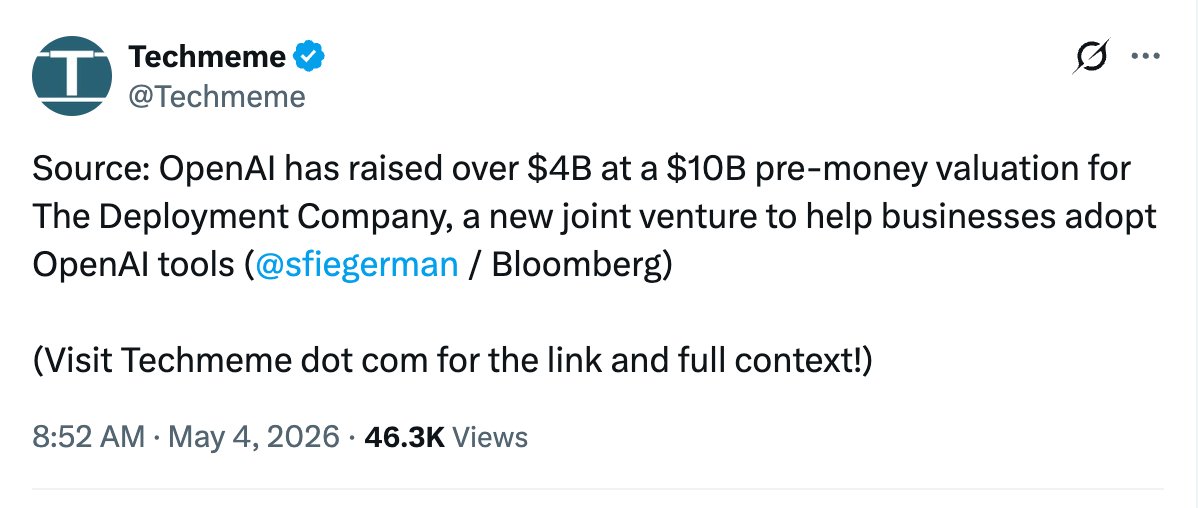
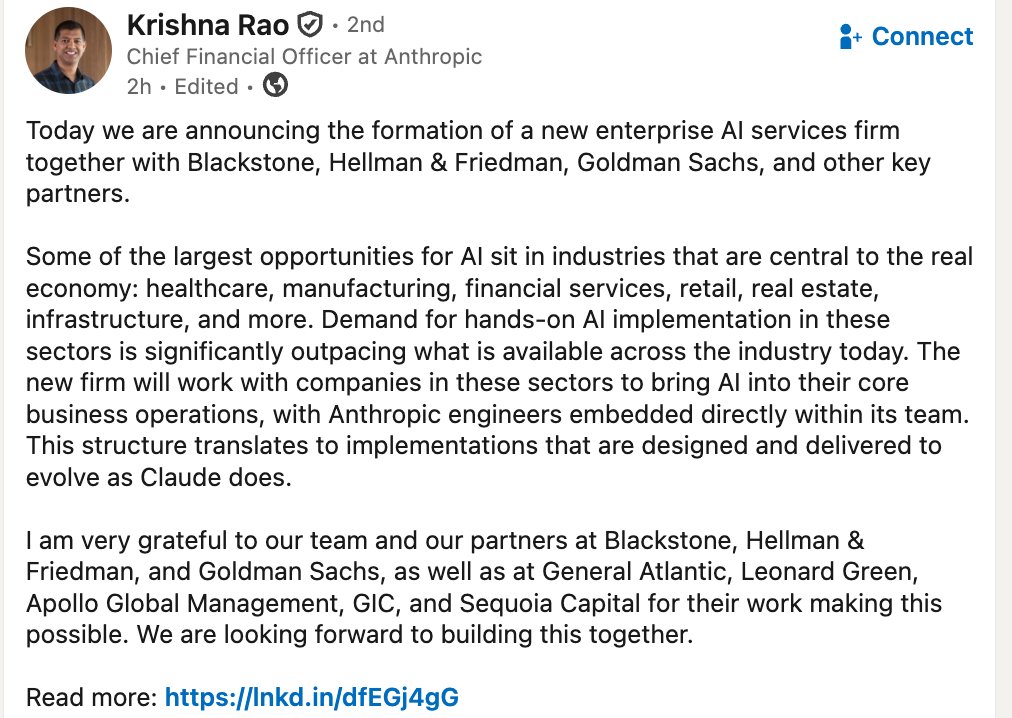
OpenAI and Anthropic both have news about them getting into the services business
getting AI deeply embedded into existing companies is going to take a lot of work, many times those companies don't have the resources or expertise to do it themselves
English
@claybavor Excited for y’all @claybavor. We’re early customers at Guild and very pleased with the results!
English

Sierra is raising $950 million from new and existing investors, led by Tiger Global and GV, at a valuation of over $15 billion. We now have more than $1 billion to invest in becoming the global standard for companies wanting to transform their customer experiences with AI.
Two years ago, most of our customers’ agents were limited to support — tracking orders, troubleshooting devices, and resetting passwords. Fast forward to today, and AI agents built on Sierra are powering all parts of the customer life cycle, from purchase consideration to product discovery to retention and more.
We are so excited for what’s ahead, and are deeply grateful to our customers and partners for being on this journey with us.
sierra.ai/blog/better-cu…
English
Huge move.
Love what the team at Task is doing here and they are seeing the same thing: mid-size businesses are ready to deploy AI, but most still need the operational map first.
Which tasks? Which workflows? Which handoffs? Which judgment calls?
Claude unlocks the capability. The next layer is deployment precision.
I’m sure they’d love to partner with y’all on this: taskeng.aI
English

We just launched a new company with Blackstone, H&F, Goldman, others. $1.5B to bring Claude to mid-size businesses at scale. The demand I see across the economy is outrunning everyone's ability to deploy — ours, our partners', all of it. This is one piece of a very big puzzle.
English
@DanielMiessler The team at Task is doing great work in the critical middle phase of this — diagnosing where to focus and documenting what actually happens in your business, so AI and the humans doing the work can redesign it together.
taskeng.ai
English

@levie The team at Task is doing great work in the critical middle phase of this - diagnosing where to focus and documenting what actually happens in your business so that you can redesign with AI + humans successful in the new flow.
taskeng.ai
English

Whether it’s existing consulting firms, new ones that emerge, FDEs from agent vendors, or new internal agent engineering roles, the amount of work that is going to be created to implement agents in enterprises will exceed anything we imagine today.
The complexity of implementing agents in any existing organizations is very real. When I talk to large enterprises, as you move from a chat paradigm to agents that participate in meaningful workflows, there are a number of things they need to do.
First, you have to get agents to be able to talk to your data securely across your systems. In many cases, enterprises have decades of legacy infrastructure that contain the valuable context for AI agents. That’s going to take a ton of work to go modernize and move to systems that work well with agents.
Then, you need to ensure that you’ve implemented agents with the right access controls and entitlements, the right scopes to be safely used, and have ways of monitoring, logging, and securing the work that they do.
Next, you need to actually document the processes in the organization in a way that agents can utilize for doing the work. You also need to figure out what the new workflow looks like when agents and people are working together on a process, and who steps in where. Just replicating the old workflow will mute the gains. Oh and you likely need to create evals for your top new end-state processes.
Finally, you have to keep up with a rapidly changing set of best practices and architectural shifts happening in the agent space. While it’s fun for people to change their personal productivity tools on a dime, it’s 100X harder to do this in a business process. The speed of change is a blessing and a curse right now for anyone trying to keep a stable system design.
All of this means that individuals and companies that develop expertise on the above set of components (and more) are going to be needed to help organizations actually implement agents at scale. This is also the rationale for vertical AI agents right now that can go in deep on a business domain and help bring automation to it.
This is a huge opportunity right now whether you’re doing this internally or as an external business provider.
English
@Mappletons I've been experimenting with various approaches. Open sourced some of what is working here. github.com/ckoglmeier/cla…
Next step is figuring out context files. Similar but different needs.
English

How is everyone managing their agent SKILL.md files? Is it just chaos?
Global skills, repo-specific skills, keeping them in sync between machines, figuring out which ones you have installed, authoring new ones. What are we doing? Does anyone have a sane system?
English

DESIGN: THE FIRST AI CASUALTY
I'm increasingly sure that 2026 signals the end of product design as a full-fledged stand-alone function within companies. If so, it will be the first role / function to be eliminated by AI on a go-forward basis.
Instead of hiring FT designers, startups are hiring / will hire design consultants to create a design system that the founder likes (this takes a few weeks max). Once the design system is finalized, PM/Eng feed it into their AI tool of choice to generate prototypes. The design system is refreshed annually by the same consultant.
Larger companies will likely not backfill design roles and will do some targeted attrition to reduce the design department to 20% the size it is today.
If you're a designer, I think you have two choices:
1. Become an entrepreneur: Start a design agency and become the go-to resource for design systems for startups and even larger companies. This can be a good recurring revenue business.
2. Become a builder: Add PM/Eng responsibilities to become a product builder.
Would suggest you embrace this proactively vs waiting for the other shoe to drop.
I'm really sorry about this - some of my best friends and the people I admire most and have learnt the most from are designers - but it seems inevitable.
English