Verdha | Email Designer

2.7K posts

Verdha | Email Designer banner
Verdha | Email Designer

Verdha | Email Designer

@cleaacreative

Fixing underperforming email campaigns & flows for ecom brands 💌

Katılım Mart 2024
171 Takip Edilen432 Takipçiler
Verdha | Email Designer
Verdha | Email Designer@cleaacreative·
@HamzaDTC When a brand sends overlapping or contradictory emails, it breaks the illusion that there’s an actual customer journey behind the scenes. It starts feeling like random automations firing independently instead of a coordinated brand experience.
English
0
0
0
11
Hamza Malik
Hamza Malik@HamzaDTC·
@cleaacreative nothing makes a brand feel more automated than getting hit with conflicting emails that clearly have no awareness of each other 😭
English
1
0
0
10
Verdha | Email Designer retweetledi
Verdha | Email Designer
Verdha | Email Designer@cleaacreative·
Nobody talks about email timing and it’s costing brands money. Not “send on Tuesday at 10am” timing. That’s cargo cult advice. I mean: are your flows sending at logical intervals relative to each other? A customer just bought. Your post-purchase flow triggers. But they’re also in your welcome flow. And a campaign went out yesterday. They got 4 emails in 48 hours from your brand. This is an architecture problem. And it’s more common than anyone admits.
Verdha | Email Designer tweet media
English
1
1
8
132
Amena
Amena@AmenaiSabuwala·
Onboarding for payment processing app✨
Amena tweet media
English
28
4
117
2K
Satya
Satya@heysatya_·
This is what staying consistent looks like… And the portfolio keeps growing 🔥
Satya tweet media
English
42
28
566
39.7K
Verdha | Email Designer
Verdha | Email Designer@cleaacreative·
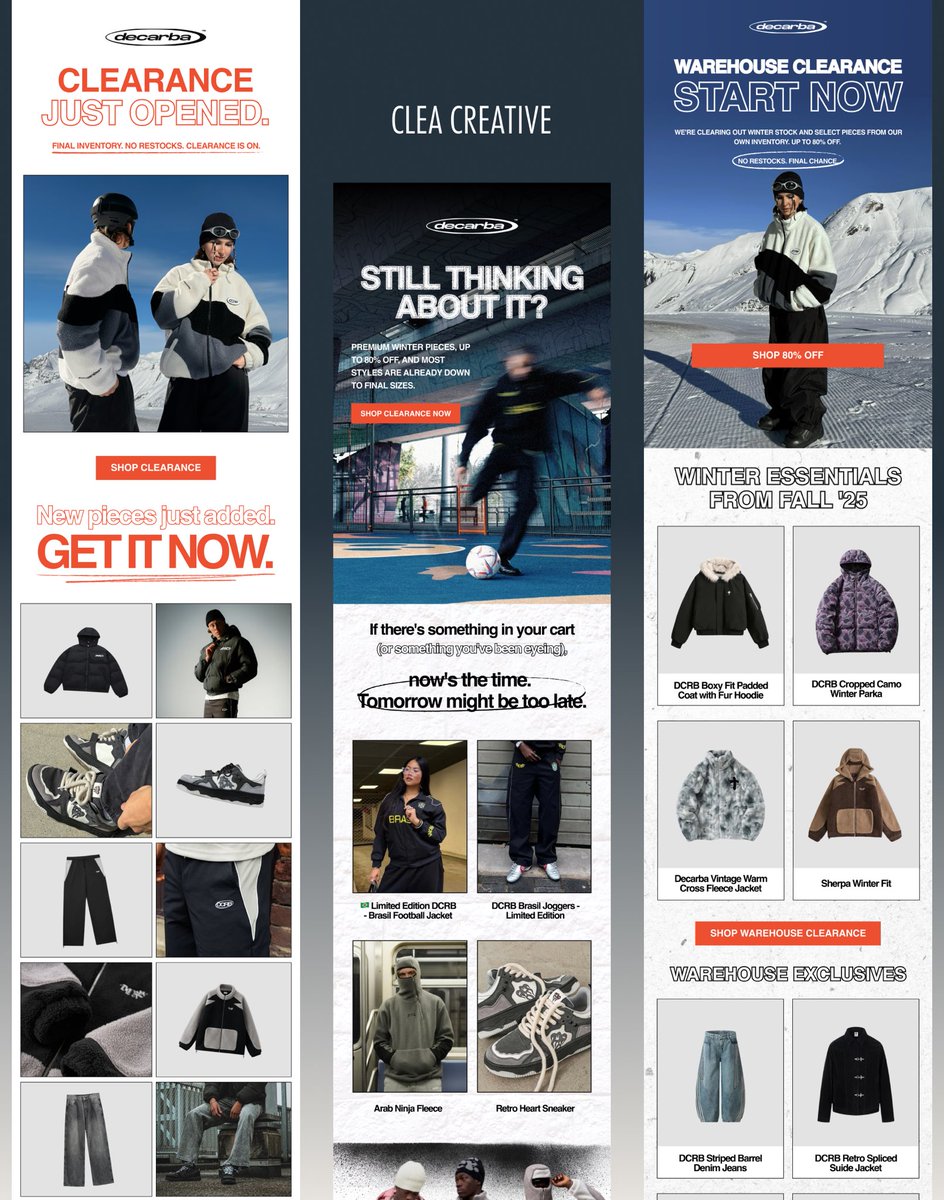
Most brands treat clearance emails like an afterthought. Slap a discount. Add a subject line. Hit send. Wonder why it didn’t convert. Here’s what actually moves inventory, design that does the selling before the reader even reads a word. Bold type creates urgency. High contrast creates focus. The right product shot creates desire. By the time the copy lands, the customer is already convinced. The difference between an email that gets opened and one that gets acted on? Usually, it’s the one where someone actually thought about what the reader should feel before they thought about what they should read.
Verdha | Email Designer tweet media
English
1
2
17
326
Verdha | Email Designer
Verdha | Email Designer@cleaacreative·
Unpopular opinion: most DTC brands don’t need more email content. They need better email architecture. More campaigns ≠ more revenue. Smarter triggers + cleaner segments + one great flow beats 12 mediocre sends every time.
English
1
0
5
85
Satya
Satya@heysatya_·
Feature section made for Ticket App (client project)
Satya tweet media
English
29
13
320
10.4K
Verdha | Email Designer
Verdha | Email Designer@cleaacreative·
Hot take: your welcome flow is probably your biggest revenue leak and you don’t even know it. Most brands spend thousands on paid ads and then dump new subscribers into a 2-email welcome sequence with no segmentation, no offer logic, and no brand story. You paid to get that subscriber. You’re throwing them away. A properly structured welcome flow should: → Set expectations in email 1 → Deliver proof in emails 2–3 → Create urgency in email 4 → Handle objections in email 5 That’s not complex. That’s just respecting the attention you bought.
English
0
0
2
108
Andreas Janesch
Andreas Janesch@JaneschAndreas·
I collected +200 cart abandonment emails from top DTC brands. I'm giving them away for free. To get it, you must: 1. Like & retweet this post 2. Comment "CART" 3. Follow me so I can DM you ( or have an open DM)
Andreas Janesch tweet media
English
18
7
14
394
Maz
Maz@the_email_girl1·
@cleaacreative This is so true. Most brands have the flows, but the details are missing. Timing, relevance, and personalization are where the real money is.
English
1
0
2
9
Verdha | Email Designer
Verdha | Email Designer@cleaacreative·
Nobody talks about this but most Klaviyo “experts” are just recycling the same 5 flows everyone already has. The real money is in the gaps between flows. Here’s what I find in almost every DTC audit I run: — Browse abandonment with no dynamic product block — Post-purchase with zero upsell logic — Winback triggered too late (90 days? You’ve already lost them) Fixing these 3 things alone moved one client from 18% to 31% email revenue attribution in 4 weeks. The strategy isn’t secret. The execution is just bad.
English
1
0
8
242
Oleg Coada
Oleg Coada@olegcoada·
Now I need to work twice as hard. In 2026, I’ll be a dad of a second child.
Oleg Coada tweet media
English
173
6
803
20.6K
Max Sturtevant
Max Sturtevant@maxwellcopy·
The email flow for a one-time purchaser should look different than the flow for a new subscriber. There's overlap… But there are key differences most brands miss: - Both flows should educate on the product. - Both should reinforce benefits. - Both should emphasize regular use. Consumption is the most important messaging to emphasize regardless of purchase type. On subscriptions, cancellations and low repeat purchase rates happen because people don't use the product. Not because your emails weren't pretty enough. One-time purchase flow: Your goal here is to get them to come back. First few emails: founder story, brand story, how to use the product, reinforce benefits. Subtle upsell of complimentary products somewhere in the middle. Then around day 21-30, push for the subscription. This is the ideal time period in my experience because they've had the product for a few weeks, they're still in the honeymoon phase, and they still have some left but they're starting to think about reordering. This is the perfect window to pitch subscription as the convenient option. Too early and they haven't used the product enough to commit. Too late and they've already moved on. Subscription flow: Your goal here is to keep them subscribed. The first week: go heavy on education. How to use the product. How to build the habit. How to access their subscription portal. Then leave them alone. After that first week, back off. Every email you send is a reminder that they're subscribed and an opportunity for them to reconsider (don’t ghost them, but significantly decrease your sends). The messaging throughout the flow should push long-term benefits. Don't feature testimonials from people who saw results in a week. Feature testimonials from people who've been using it for 6 months, a year, or longer. Frame expectations around what happens at month 1 vs month 3 vs month 6. This pre-sells retention. They signed up expecting a 90-day commitment, not a one-week trial. One-time purchase flow: Educate, build relationship, push for subscription at day 21-30. Subscription flow: Educate hard in week one, then back off. Emphasize long-term commitment from the start. Both flows: Consumption is everything. If they're not using the product, nothing else matters.
English
4
0
37
3.1K