Closing Bell Orca

111 posts

Closing Bell Orca banner
Closing Bell Orca

Closing Bell Orca

@closingbellorca

Orca in the stock market. Tech analyst reviewing & analyzing big tech and AI. Just a poor investor.

The Bottom of the Ocean Katılım Ocak 2025
79 Takip Edilen77 Takipçiler
Sabitlenmiş Tweet
Closing Bell Orca
Closing Bell Orca@closingbellorca·
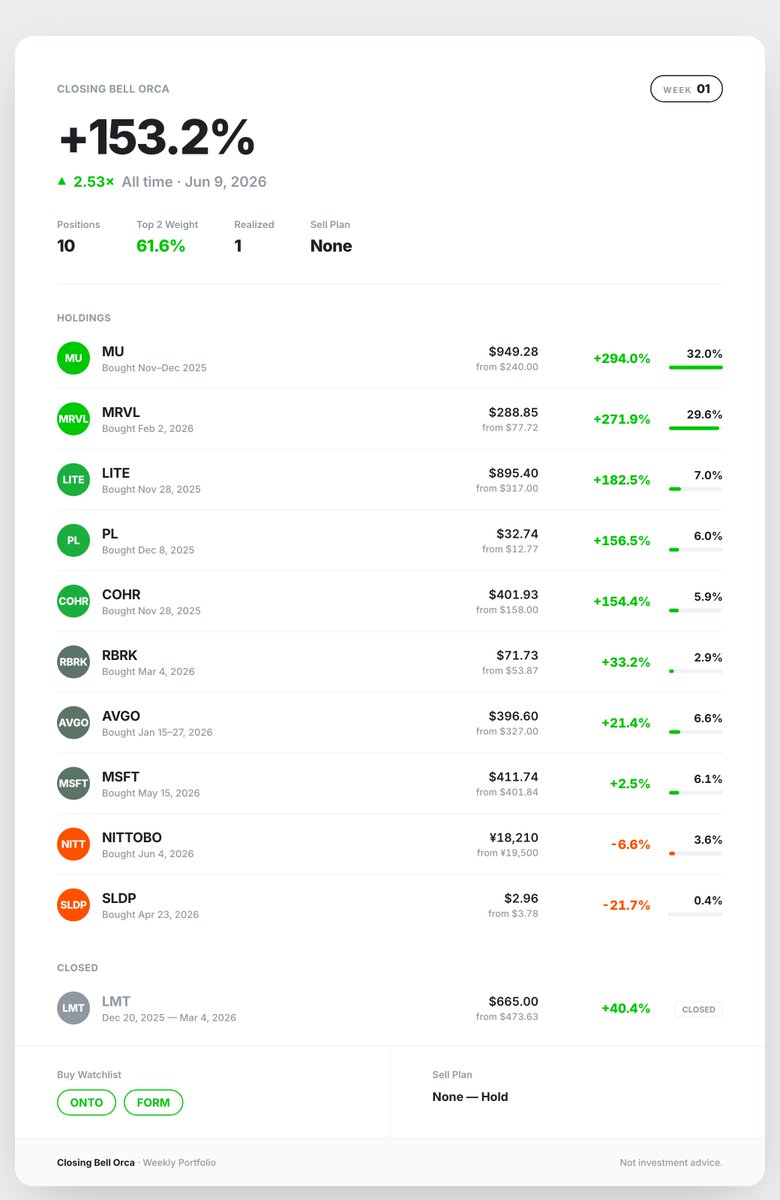
Week 1 Portfolio As of June 9, 2026 Return: +153.2% (2.53×) This is my record, not a flex. I post the full book every week so the timeline can check whether my principle actually holds over time. This week's buy plan I'm looking to add two names, about 4% weight each: · $ONTO , in the $260 to $270 range · $FORM , in the $115 to $125 range When I actually buy them, I'll publish a separate article laying out the full thesis on each, the upside case and where my stop sits. I don't want to add a position here without writing down why, so the reasoning is on record before the result is known. No sells planned this week. Current book stays as is. As always, my analysis can be wrong. I'm just trying to keep buying under the same principle and let probability do its work. #ClosingBellOrca #Portfolio
Closing Bell Orca tweet media
English
1
0
4
199
Closing Bell Orca
Closing Bell Orca@closingbellorca·
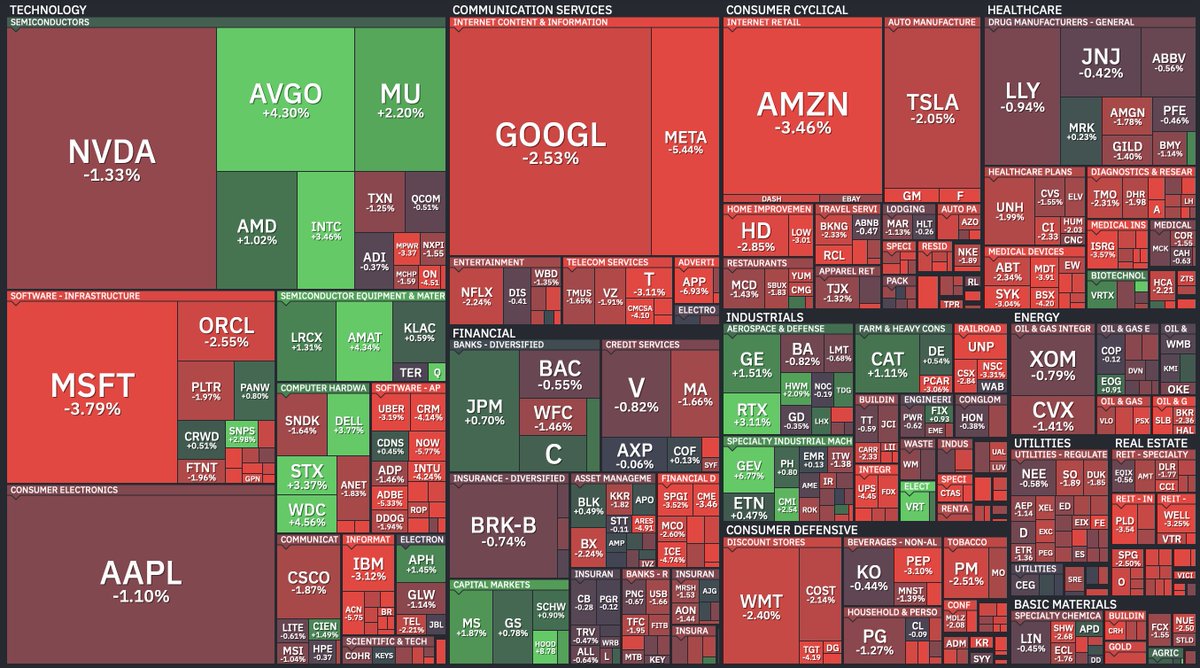
US Market Commentary | 6.22.2026 1. On June 22 the US market closed mixed. Even as US Iran peace talks made major progress, weakness in big tech and a rise in Treasury yields pulled the market down. $GOOG fell 5% on news that two of its key AI talents were leaving, leading the decline and sending the nasdaq 1.3% lower, while $SPCX dropped 16.4%, its largest fall since listing, after news of a debt issuance. Yet the same day the Dow approached a record and the Russell 2000 set a fresh record close. Today's real news is not the direction of the indices but the fact that market leadership has begun to move from one side to another. 2. For the past few weeks the market's question was whether AI demand is real. Today that question changed, to whether AI's financing works. As one strategist put it, today's tech decline was not triggered by a single bad headline but by accumulated doubts about overheated sentiment and free cash flow surfacing all at once. The market still believes AI will eventually make money, but for the first time it began to seriously weigh whether the capital being poured in to get there, and the financing that funds it, is sustainable. 3. This shift showed up as a split within AI. The same theme, but opposite fates. $MU rose nearly 7% on news of a strategic partnership with Anthropic. SpaceX, by contrast, collapsed more than 16% on news it would fund AI investment with debt, and Google wobbled as key talent departed. The market bought the side that holds AI's demand and scarce resources, memory, and sold the side that must burn enormous capital and talent, the cost burden of the infrastructure and model race. Today's grading standard was not AI's revenue but AI's cost. 4. At the heart of these doubts about cost are two things. Matt Maley of Miller Tabak pointed first to the fact that hyperscalers are pouring astronomical sums into AI yet seeing extremely poor returns. The second is so called circular financing. A structure in which one company invests in another, and that money returns as revenue for its own product, is woven throughout the AI ecosystem. In a boom it props up everyone's growth, but if one link shakes, the whole shakes together. That is why the shadow of the vendor financing of the late 1990s, when telecom equipment makers lent customers money to buy their own gear, hangs over this. 5. But why did these doubts erupt now? Because of rates. After Warsh's hawkish meeting last week, the 2 year Treasury yield set a new 2026 high at 4.23% and the dollar set a fresh high too. Higher for longer presses on AI from two directions. One is raising the interest burden on AI firms that fund capital with debt, the other is discounting far future cash flows into a lower present value, pulling down the valuations of long duration growth stocks. In other words, the cost of funding rose at the very moment the return on that funding was being questioned. It is no accident that SpaceX's bond issuance led to a 16% plunge precisely today. 6. The market's answer to this pressure is rotation. Money that left big tech flowed into the Dow and the Russell 2000, and the Russell set a fresh record close. When rates stay high and AI's profitability is doubted, cheaper, more domestically oriented value and small cap names look more attractive than expensive, rate sensitive big tech. But whether this rotation is a healthy broadening of market breadth or a defensive exit from the most expensive ground is too early to call. In their early stages, the two look identical. 7. Beneath the surface a quieter warning also sounded. Apollo's private credit fund saw redemption requests reach 16.8% of shares outstanding, with foreign investor requests especially large at 12.5%. The firm honored only 5% under its quarterly redemption cap. This is significant because, as AI investment is increasingly funded by debt and private credit, a move to pull money out of the private credit market that is the source of that funding has appeared. At the point where the financialization of AI meets a tightened monetary environment, the first sign of a crack became visible. 8. The geopolitics that should have been a positive carried little weight today. Vice President Vance called the Switzerland talks with Iran a good day with major progress, and Iran's agreement to invite IAEA inspectors and a 60 day sanctions waiver came as results. Oil fell further to 74 dollars a barrel, a clear positive for inflation. Yet the market barely bought this relief. Partly that owed to weekend tensions over Lebanon and Trump's renewed warning of possible military action, but more fundamentally it was because what dominated the market today was not geopolitics but AI's internal problem of financing. 9. Now all eyes turn to Thursday's May personal consumption expenditures inflation. Headline is expected at 4.1% and core at 3.4%, still strong, and the easing effect of lower oil will not appear in this print due to the lag. Chicago Fed President Goolsbee warned that inflation is heading in the wrong direction, citing the rise in services prices unrelated to energy. Views on Warsh's new communication style are also split. Citadel sees his strong resolve to curb inflation as lowering the term premium and supporting long dated Treasuries, and indeed the curve has flattened since last week. Morgan Stanley, by contrast, warns that a Greenspan style environment without guidance could bring turmoil to the short end of the rates market. 10. To sum up, June 22 was the day the market's question moved from AI's demand to AI's financing. Within the same AI, names holding demand rose while those carrying capital and debt fell, and higher for longer rates amplified that split. So what to watch now is not the direction of the indices but the pattern of that split, the gap between demand names and names with heavy funding burdens, whether the rotation from big tech into value and small caps takes hold, the 2 year yield that reflects the Fed's reaction function, Thursday's PCE, and the crack in private credit that Apollo revealed. The next chapter of the AI bull market will be decided not by demand, but by whether the money borrowed to buy that demand can be justified.
Closing Bell Orca tweet media
English
1
0
4
236
Closing Bell Orca
Closing Bell Orca@closingbellorca·
Fair point. My focus wasn’t really the dot itself, but what the dot implied about the Fed’s reaction function under Warsh. I agree that the next two inflation prints and labor data will matter far more than the median dot on release day. The real question is whether PMs start modeling a prolonged pause or a renewed hiking risk.
English
0
0
0
22
Taylor North
Taylor North@tnorth_work·
@closingbellorca The dot plot shift probably got priced in before the meeting even started. My question is always what the PMs are modeling for the next two prints, not what the median dot says on release day.
English
1
0
1
11
Closing Bell Orca
Closing Bell Orca@closingbellorca·
US Market Commentary | 6.17.2026 1. On June 17 the US market closed lower. At new Fed Chair Kevin Warsh's first meeting, the Fed held the policy rate unchanged at 3.50 to 3.75% by a unanimous vote, but what the market focused on was not the hold, it was the dot plot. As the median projection for the year end rate rose from 3.4% in March to 3.8%, the market read the Fed as having turned more hawkish than expected. This does not mean the disagreement among officials disappeared, though. The 18 members who submitted dots were split across hikes, holds, and cuts, and the market put more weight on the re-emergence of a hike. The S&P 500 fell 1.21%, with big tech such as $MSFT, $META, , and $AMZN leading the decline. The rate sensitive 2 year Treasury yield jumped to 4.19% and the dollar reclaimed 100. Semiconductors, by contrast, rebounded from the prior day's plunge, so the weight of the decline fell on big tech. The market has begun to price not the level of rates but a change in the Fed's policy function. 2. But the real meaning of today's meeting is not the direction of a quarter point. This was the day the way the Fed operates began to change. Warsh did not simply make one hawkish decision, he signaled an intent to rebuild the framework of communication and policy the Fed has accumulated over more than a decade. So his first meeting is less about this quarter's rate than a chance to gauge which direction the Fed will move over the next several years. Understanding precisely who he is and what he is trying to change is the key to reading this market. Warsh's core concern is that since the financial crisis the Fed lost policy flexibility by over communicating with markets, and that markets came to depend too much on the Fed's guidance. In other words, he is trying to redesign the relationship between the Fed and the market more than the direction of rates. 3. The first pillar of Warsh's policy is the end of forward guidance. At his confirmation hearing he said he does not believe in forward guidance and would not preview future decisions. At this meeting he duly stripped the easing bias and future policy direction from the statement, and he was the only one of 19 policymakers not to submit his own dot to the plot. This is a partial return from the era of transparency the Fed has pursued since Ben Bernanke toward the strategic ambiguity of the Alan Greenspan years. The Fed will no longer tell you its next move in advance. Warsh's logic is clear. If the Fed promises the future, it becomes trapped by that promise, and when the promise breaks, policy credibility is instead damaged. This can raise market volatility in the near term, but it can also be read as an attempt to restore policy flexibility over the long term. 4. The second pillar is rules based policy. Warsh has long criticized the Fed's habit of fine tuning by discretion case by case. What he favors is a structure in which the Fed publishes an arithmetic rule linking the rate to key indicators such as inflation, and when it deviates from that rule the chair appears before Congress to explain why. If forward guidance is a promise that we will do this, rules based policy is a principle that we follow this rule. The idea is to find predictability in a rule rather than in a promise. This is close to the philosophy of the widely known Taylor Rule. It means a move from an era in which the market interpreted the Fed's words to one in which it reads the Fed's rule and the data directly. Going forward, investors are likely to watch CPI, PCE, and the labor data more closely than FOMC remarks. 5. The third pillar, and perhaps the most fundamental change, is the balance sheet. Warsh has criticized the Fed's 6.7 trillion dollar balance sheet as bloated, and at this meeting he said he would form five task forces, including one to review it. He sees the Fed as having reached too deep into markets, and his position is that the Fed should hold only short term Treasuries and exit its mortgage backed securities. He said he would examine whether monetary policy comes from the rate tool or the balance sheet tool. This matters because shrinking the balance sheet while leaving the rate unchanged is itself a tightening that drains liquidity from markets. It is in effect a redesign of the philosophy of quantitative tightening. In other words, a quieter but more structural tightening can proceed behind the rate headline. 6. The fourth pillar is a hawkish instinct that puts price stability first. Warsh dismissed any review of the 2% inflation target while repeatedly stressing that price stability is the Fed's core principle. The new projections raised the inflation forecast, and the cut path the market had expected weakened sharply. Nine of the 18 members, half, projected a hike this year, and six of them left the door open to two or more. As he stressed prices, the money market quickly began to treat an October hike as a near certainty. With energy prices from the Middle East war and AI infrastructure investment pushing prices up, Warsh's Fed appears to place greater risk on hiking than on cutting. This is closer to a Fed that prioritizes Price Stability over the Fed Put the market had grown used to. 7. Put the four pillars together and the direction of rates becomes clear. There are no cuts for now, the door to a hike has reopened, and rates stay higher for longer at or above the current level. One variable, though, could soften this hawkish picture. With oil down into the 70s thanks to the US Iran deal, if the agreement holds, energy driven price pressure cools and inflation may have peaked this quarter. In that case a prolonged pause, rather than further hikes, becomes the realistic outcome. What matters is that a prolonged pause set against resilient growth and gradually moderating inflation, unlike a renewed tightening cycle, can actually support asset prices. The scenarios split three ways. The bull case is oil staying low and core inflation cooling so that a prolonged pause supports valuations without a hike, the bear case is sticky core inflation and a rebound in oil that confirms an October hike, and the base case in between is a prolonged pause. What separates them is not the Fed's words but core PCE, the labor data, WTI crude, and the 2 year Treasury yield. 8. The biggest challenge Warsh's regime poses to the market is that investors must now move without the Fed's guidance. With forward guidance gone and the chair not even placing a dot, the market must forecast rates from the data itself rather than from the Fed's signals. In the near term this raises volatility. The market had been moving along a path the Fed laid out in advance, but now interpretations of the same data diverge and prices can swing more. Warsh's logic is clear. If the Fed promises the future, it becomes trapped by that promise, and when the promise breaks, credibility collapses. The honesty of telling you less in order to be wrong less, and the opacity that unsettles markets, are two sides of the same coin. At the same time, this can strengthen the bond market's price discovery and raise the volatility premium in options markets as a structural change. 9. The five task forces Warsh announced at this meeting show his intent is not a one time event. Communications, the balance sheet, data sources, productivity and jobs, and the inflation framework, these five areas span almost every axis on which the Fed operates. In particular he noted that current policy rests on dated survey data that may not match the real shape of the 2026 economy, and that the Fed should look to the real time information the private sector uses. This means changing the very lens through which the Fed sees. In other words, the Fed's change includes not only the direction of policy but the data that makes policy. Since this work runs through year end, Warsh's true impact will show not in a single dot plot but over the next several years. 10. To sum up, June 17 was not a day the Fed held rates, it was a day the Fed's direction changed. Warsh is a chair who withdraws forward guidance, favors rules based policy, shrinks a bloated balance sheet, and puts price stability first. As a result rates have moved away from cuts, and the market has entered a new environment in which it must read the data directly without the Fed's guidance. So what investors should watch now is not the chair's next words but the inputs to the rule, core inflation and the labor data, the pace of balance sheet reduction, and the 2 year Treasury yield that reflects the Fed's reaction function in real time. The one sentence left for investors is clear. The era of reading the Fed's promises has ended, and the era of reading the Fed's rule and the economic data directly has begun. Warsh's Fed is one that aims to say less, ease later, and grow smaller. And its success depends on whether the market can come to trust the data itself rather than the Fed's language.
Closing Bell Orca tweet media
English
1
0
3
299
Closing Bell Orca
Closing Bell Orca@closingbellorca·
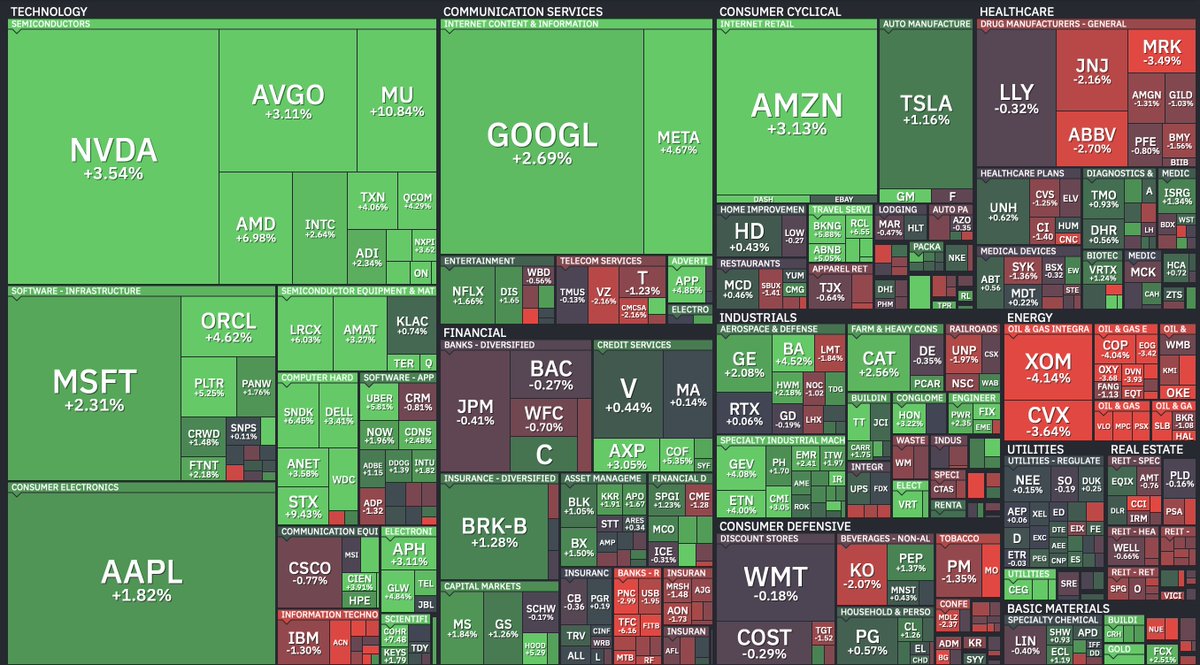
US Market Commentary | 6.18.2026 1. On June 18 the US market closed higher. As the US Iran peace deal took effect and traffic through the Strait of Hormuz normalized, optimism spread that inflation risk would ease, and the S&P 500 rose 1.08% and the Nasdaq 100 2.48%, recovering much of the ground lost to Chair Warsh's hawkish meeting the day before. The Philadelphia Semiconductor Index set a fresh record high, and oil fell to its lowest since early March. But beneath the surface relief lay a more important signal. While stocks rose, the policy sensitive 2 year Treasury yield never left the vicinity of the prior day's 2026 high at 4.18%, and the dollar index instead set a new high. On the same day, faced with the same news, risk assets took relief while short rates held to a hawkish line. The market did not converge on one answer, it split into two. 2. This split is not an accident but a continuation of yesterday. The day before, Warsh withdrew forward guidance, opening an environment in which the market must price rates from data rather than from the Fed's signals. Today was the first time that new environment was put to the test. The market had to digest two shocks pointing in opposite directions at once, the hawkish Fed hardened the day before and the peace deal that pulled oil lower. An older Fed would have steered the market toward a single interpretation with its dots and guidance, but with that steering gone, the market had to arbitrate between the two itself, and unable to reach agreement, it divided the answer across assets. Yesterday we argued that ending guidance would raise volatility and strengthen price discovery, and today's decoupling is exactly that predicted outcome. 3. This division is explained by two channels. A peace deal reaches the market in two ways. One is the price channel that lowers oil and inflation expectations, the other the policy channel of where the Fed takes rates. Equities chose the first. When oil falls, long dated yields decline, and a lower discount rate directly supports the valuations of growth stocks. Short rates, by contrast, are bound to the second channel. The 2 year is hostage to the Fed's reaction function, not to peace, and with Warsh having just re fixed that function as hawkish, it could not loosen. The same deal was read on one side as relief that lowers the discount rate, and on the other as an irrelevant variable. 4. This mechanism was etched into the shape of the yield curve. As inflation expectations fell, longer dated bonds reacted first, with the 10 year easing to 4.455% and the 30 year falling to a three month low of 4.9%. The 2 year was nearly unchanged. The long end falling while the short end holds is a bull flattening. Historically this shape is read two ways. One is a soft landing in which the Fed can hold rates high while inflation cools, the other a warning that high rates will eventually break growth. Today the market bet on the former, but the curve itself has not yet answered which it is. 5. The problem is that the relief stocks bought is not yet in the data. The national average gasoline price fell below 4 dollars a gallon, and if oil stays in the 70s a barrel, headline inflation clearly cools. But that effect will not appear in next week's May PCE. May prices are expected to show another strong gain, and the oil decline feeds into the June CPI and PCE released in mid July. In other words, today's gain bought in advance a forecast that will only be confirmed a month from now. This one month air pocket between the trade and the data is the relief rally's greatest vulnerability. 6. The economic data out the same day made this tension more complex. Initial jobless claims held steady at low levels, and the June Philadelphia Fed manufacturing index rebounded sharply from negative to 10.3. On one side this eases recession fears and supported stocks. On the other, a resilient economy removes the Fed's reason to cut. Indeed the Fed that warned of labor market risks in March now saw those risks as balanced, while almost every member saw inflation risks tilted up. That is why half the committee penciled in a hike this year. In a higher for longer world, the contradiction is that good data is a positive for earnings but a negative for the discount rate. The same data that supported stocks today is why short rates stayed pinned high. 7. The record high in semiconductors must also be peeled back layer by layer. Three forces are mixed in the index today. The first is the structural strength underpinned by AI investment, the second a policy catalyst as President Trump's mention of US chip production with Nvidia and Apple lifted Intel more than 10%, and the third the expiration flows discussed below. Intel's surge in particular rests on reshoring hopes rather than fundamentals, so it is too early to read the index record as a broad improvement in semiconductor fundamentals. Only by separating structure, policy, and flows can you see how far today's record is real. 8. The weight of those flows was especially large today. This was triple witching, with stock, option, and futures expirations overlapping ahead of the Juneteenth holiday, and a record 8.3 trillion dollars in notional options expiry was scheduled. Into expiry, dealers who sold options buy and sell the underlying to balance their hedges, and in that process prices can pin to certain strikes or skew in one direction. With a record expiry falling in a holiday shortened week, part of today's close was made by expiration flows rather than fundamentals, and it is too early to call that single close a trend. 9. The risk building quietly beneath the surface relief is the dollar. As short rates held high, the dollar index climbed to a new 2026 high. A strong dollar itself tightens financial conditions outside the US and adds pressure to the yen, which has slid toward a 40 year low. Some in the market see around 162 to the dollar as an intervention zone. Looking further out, dollar strength reflexively returns to the US as well. The earnings of large technology firms with heavy overseas revenue are trimmed in translation, and if capital in emerging markets and Asia wobbles, risk assets broadly feel it. Beneath the relief in equities, tightening is proceeding through another channel, the exchange rate. 10. To sum up, June 18 was a day when one market produced two answers at once. Equities and the long end bought the disinflation the peace deal opened, while short rates and the dollar held to the hawkish reaction function Warsh hardened. This decoupling is not a stable equilibrium but an uneasy truce that lasts until the data takes one side. So what to watch now is not the record high in stocks but the indicators that will decide that truce, the 2 year yield that reflects the Fed's reaction function, the gap between long and short rates that measures the width of the decoupling, whether oil in the 70s feeds into the June CPI, next week's May PCE, and the dollar at a new high along with the yen. In the environment where the Fed withdrew its promises yesterday and told the market to find its own answer, the first answer the market gave today was not convergence but division. How that division is resolved will set the next phase.
Closing Bell Orca tweet media
English
0
0
3
76
Closing Bell Orca
Closing Bell Orca@closingbellorca·
@DudeWhoInvests Looking out to Q2 next year, I expect Microsoft’s growth to accelerate further as AI monetization becomes more visible. This looks like a buyable dip to me.
GIF
English
0
0
0
326
Just a Dude Who Invests
Just a Dude Who Invests@DudeWhoInvests·
I want to buy more Microsoft $MSFT here. Sell off getting stupid imo.
English
21
3
218
18.8K
Closing Bell Orca
Closing Bell Orca@closingbellorca·
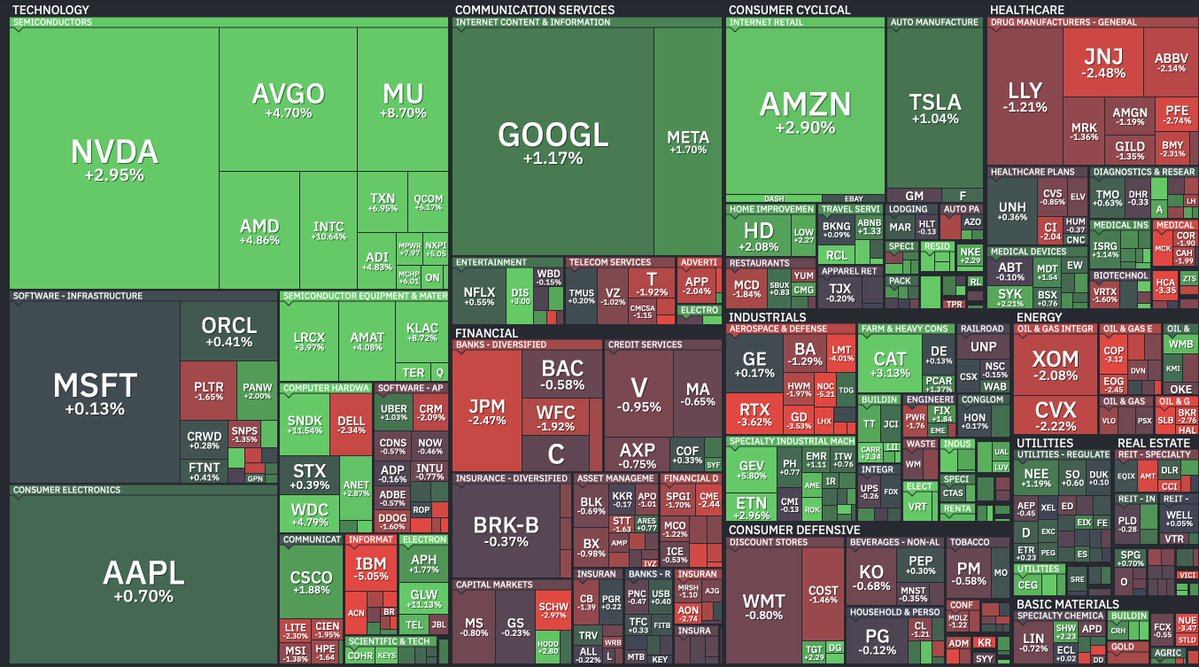
US Market Commentary | 6.16.2026 1. On June 16 the US market caught its breath ahead of new Fed Chair Kevin Warsh's first rate decision a day away. The S&P 500 fell 0.57% and the Nasdaq 100 1.89%, while the Dow rose 0.64%, a split, mixed session. On the surface it looks like a pullback, but open it up and it was less a decline than a changing of seats. Money flowed out of the semiconductors that had led the market and into cyclicals like banks and industrials. In other words, today was less a day the market fell than a day leadership began to change. 2. The drop in semis was too large to call mere profit taking. $INTC fell 8.5%, $AMD 7.3%, $MU 6.2%, and $AVGO 4.4%, while the equipment names $KLAC and $LRCX dropped 7.5% and 5.0%. To collapse this much in a day is not because fundamentals worsened but because the positions stacked on the most crowded winners unwound all at once. BTIG noting that the semiconductor index has fallen on five of the last nine sessions and that momentum is weakening points the same way. A stock setting record highs yesterday falling the most today is the kind of reversal of crowding that often appears late in a bull market. 3. Look at where that money went and you can read the market's mind. As oil and yields fell, money moved into banks and industrials. Falling oil lowers corporate costs and consumer burdens, brightening the earnings outlook for cyclical sectors, and falling yields revives the appeal of the value names that had been left behind. This rotation reads two ways. One is a healthy signal that the narrow rally carried by technology alone is broadening across sectors, the other a defensive signal that money is fleeing the most expensive momentum. Which is right will be decided by whether semis get bought again or this changing of seats hardens. 4. The bigger picture today is that the epicenter of volatility has shifted. What shook the market over the past month was the Middle East war, but once the 60 day deal pushed that uncertainty back a step, the market now stands before a new variable, the Fed. The same risk has a different character. War was an exogenous shock that could not be predicted, but the Fed is an endogenous variable that delivers its message on a set date in a set format. The market catching its breath today without direction is closer to the quiet just before the act of war closes and the act of rates rises. 5. At Warsh's first meeting tomorrow, a hold is all but settled, so the market's eyes are not on the rate number but on the dot plot. The dot plot gathers the rate level each Fed member sees as appropriate, and it is a projection at that moment, not a promise. The market expects its median to rise from 3.375% to 3.625% for 2026. That means erasing the chance of one cut this year and shifting the Fed's gaze toward keeping rates higher for longer. It is a move of a single notch, but because it withdraws the hope of the cut the market had counted on, it does not carry light weight. 6. Layered on top is the variable of Warsh himself. Bloomberg sees that, unlike his predecessors, Warsh may not submit his own dot to the plot, and there is talk that the quarterly Summary of Economic Projections itself could be streamlined. This is not a mere matter of form. A change in how the Fed communicates with the market means a change in the map investors use to read the Fed's next move. A new chair's first meeting matters more for what it reveals about how he diagnoses inflation and talks to the market than for the rate decision itself. 7. The most favorable ingredient for the market this week is the fall in oil. Brent dropped below 80 dollars for the first time since March, and Goldman Sachs cut its fourth quarter forecast from 90 to 80 dollars. Normally a fall in oil pulls down headline inflation and eases the Fed's burden. But Nomura offered an interesting counterargument. A steep drop in oil slows inflation in the near term, yet with consumer sentiment already healthy, cheaper fuel fattens consumers' wallets and stimulates demand, which can in turn become kindling for inflation again. In other words a fall in oil can press down one channel of prices while opening another. That is why good news is not purely good. 8. While the indices hover near record highs, the real economy's data sent a different signal. May housing starts came in at 1,177K, far below the 1,430K expected. Since housing is the first place high rates press, this plunge shows the accumulated weight of tightening. New employment data released the same day also softened, while import prices actually rose. On one side a signal that the economy is cooling, on the other a signal that inflation is sticky, both at once. This mismatch is exactly why the Fed cannot easily set its direction, and it is the homework Warsh must solve tomorrow. 9. The other face of today's market was $SPCX . Up 49% after listing, it passed Amazon with a 2.65 trillion dollar market cap to become the world's fifth largest company, and briefly topped Microsoft intraday. There is a structural reason for this surge. The float released to the market right after listing is only 4.2% of total shares, making it a low liquidity stock whose price swings hard on even modest buying. Add the start of options trading and hopes of index inclusion that could draw passive money, and the fire grew. A surge built on such low liquidity and crowding is both the vitality of a bull market and the classic late cycle scene of a price set by flows rather than value. 10. To sum up, today was a day of transition in which the Fed began to fill the space the war vacated. The rotation from semis into cyclicals could be a signal that the market is broadening or a signal that money is leaving expensive ground. Falling oil has two faces, pressing prices down while stimulating demand, and beneath it lies the mismatch of a cooling economy and sticky inflation. The knot of all those threads is Warsh's first message tomorrow. At the crossing where the era of war as an exogenous variable fades and the era of rates and the economy as endogenous variables opens, the market is catching its breath and waiting for the next direction.
Closing Bell Orca tweet media
English
0
0
2
269
Closing Bell Orca
Closing Bell Orca@closingbellorca·
US Market Commentary | 6.15.2026 1. On June 15 the US market rose across the board on news that the US and Iran had reached a 60 day deal to reopen the Strait of Hormuz and halt the war. The S&P 500 closed up 1.65% at 7,554 and the Nasdaq 100 up 3.06% at 30,543, while the Philadelphia Semiconductor Index surged more than 5% to a fresh record high. President Trump said the deal was complete and would be formally signed in Switzerland on the 19th, and oil fell to around 81$ a barrel, threatening the 80 dollar level for the first time since March. As the storm cloud of war that had weighed on the market for nearly two months lifted, risk assets exhaled in relief all at once. 2. Still, it is worth noting that much of this relief rally was already in the price. The deal closely matched what the market had expected over the past several days, so the major indices greeted the news from levels already above where they stood before the conflict. The reason markets often fail to climb further and turn to profit taking once good news becomes real is that the expectation was already priced in. Semis carried the tape today, but once the single catalyst of the deal is spent, the market has to find a new engine. There is also caution that short term volatility may persist as the signing and implementation are confirmed. 3. Look closely at the nature of the deal and it is too early to lean fully into relief. This is not a permanent peace but a temporary 60 day framework. By Vice President Vance's account, the core is a two stage verification: if Iran keeps its promises it regains access to a sanctions free economy, and if it breaks them it cannot obtain the funds to rebuild its nuclear program. In other words the deal is closer to a conditional bargain than to trust. Israeli Prime Minister Netanyahu drawing a line that, deal or not, he will keep Iran from a nuclear weapon and that the fight is not over, and a tanker again taking gunfire off Yemen, show that the embers of the patched up conflict still remain. 4. Even so, the biggest gift this deal gives the market is the fall in oil. If Hormuz reopens, the bottleneck in crude supply eases, and as oil falls, the energy pressure that had been lifting headline inflation weakens. Falling oil lowers inflation expectations, which in turn pulls down bond yields, and lower yields again support the valuations of risk assets. Today's drop in the 10 year yield to 4.473% and the 2 year to 4.070% is that chain at work. That said, the fact that the US Strategic Petroleum Reserve has fallen to a 43 year low under a policy of holding down gasoline prices during the war is a hidden weakness, meaning the cushion available for the next shock is that much thinner. 5. The change worth watching in this rally is the possibility that leadership broadens. The advance since the March low has effectively been a narrow rally carried by technology alone. But as geopolitical tension eases and oil and yields fall, money may rotate into the cyclical sectors, mid caps, and equal weight names that had been left behind. That is why firms like Edward Jones and JPMorgan see cyclicals leading further upside in the second half. A market broadening its breadth is healthier than one carried by a single stock or sector. If this rotation actually takes hold, it could be a more meaningful signal than today's record high. 6. Behind the dazzling indices, however, the economic data was telling a different story. The June Empire State manufacturing index released the same day came in at 5.7, far below the 13.5 consensus and the prior 19.6. May industrial production rose just 0.1%, below the 0.3% expected. Stocks are pushing toward record highs while the gauges of the real economy are flashing a slowdown. This gap can be read two ways: either the market treats a slowing economy as good news by linking it to coming rate cuts, or corporate earnings eventually follow the slowing economy lower. Which one is right will be decided by the earnings and data ahead. 7. So this week's real center of gravity shifts from the war to the Fed on Wednesday. This FOMC is the first meeting chaired by new Chair Kevin Warsh since he took office. The market expects a hold, but the point to watch is not the rate itself but the Fed's tone. With employment improving and inflation rising again, many expect the Fed to erase from its statement and dot plot the easing bias it had left in place, namely the chance of one cut this year. The updated projections are likely to show higher inflation, lower unemployment, and no cuts in 2026. 8. Yet the same picture lends itself to two readings. Removing the easing bias has two faces. One is the worry that the Fed could turn back toward tightening, the other a prolonged pause that stays at the current level with neither a cut nor a hike. And what matters more to the market is the distinction between the two. A cycle of raising rates again weighs on valuations, but a prolonged pause set against resilient growth and gradually moderating inflation, the so called higher for longer, can instead support valuations. Add the expectation that, with oil lower thanks to the deal, inflation may have peaked this quarter, and even if Warsh's first message is hawkish, the market may not immediately take it as purely bad news. 9. Meanwhile, the other face of today's market was the frenzy around $SPCX . Up 19% on its first day Friday, SpaceX surged nearly 20% again on Monday, topping the retail net buying list for a second straight day. The statistic that retail's net purchases of SpaceX over the past two days roughly equal what retail net bought across the entire US market last week lays bare the speculative heat of money crowding into a single name. Such crowding is both the vitality of a bull market and a sign of the kind of overheating that often appears late in a cycle. While @elonmusk talks of 1 trillion dollars in revenue by 2030, the market is testing how much to pay in advance for that dream. 10. To sum up, today was a day of relief in which the largest uncertainty, the war, lifted and the market reclaimed record highs. But the deal is a conditional 60 day arrangement, much of the good news is already in the price, and behind the dazzling indices the manufacturing data is cooling. So the market's next question is clear: what will carry the advance after the deal? The first button of that answer is Warsh's first FOMC on Wednesday, and whether a rotation into cyclicals can take up the baton behind it is the key.
Closing Bell Orca tweet media
English
0
0
3
269
Closing Bell Orca
Closing Bell Orca@closingbellorca·
US Market Commentary | 6.13.2026 1. On June 12 the US market closed out the week with gains across the board. The S&P 500 rose 0.50% to 7,431, the Dow 0.70% to 51,202, the Nasdaq 100 0.64% to 29,636, and the Russell 2000 0.72% to 2,944. The headline numbers look like an ordinary up day, but the texture underneath was clear. Small caps in the Russell 2000 led while the tech heavy Nasdaq lagged. Given that technology was the most violently shaken corner of the market this past week, the rebound read as a cautious return of risk appetite, one that buys risk back but does not rush straight into the most expensive assets first. Two forces drove the move, hopes for an imminent US Iran peace deal and the splashy market debut of $SPCX . 2. The biggest story is that the end of the war is finally coming into view. Iran's foreign minister said a memorandum of understanding was closer than ever, and Pakistan's prime minister, acting as mediator, said the final text of the peace agreement had been drafted. A White House official cited by Bloomberg put the odds of a deal at 80 to 85%. The agreement is reported to include an inspection regime and the reopening of the Strait of Hormuz. The market's math turned simple. When the Middle East cools, the first asset to react is oil. WTI fell nearly 2.5% from 86.42 to 84.29 dollars a barrel, back near the lows seen right after the conflict broke out. The geopolitical premium the war had layered on is being peeled back one sheet at a time, and lower oil lifts the weight off both inflation and corporate input costs, which is broadly supportive for equities. 3. The details of the peace, however, are still rough. The same day, Iran's foreign minister insisted the management of the Strait of Hormuz would not return to its pre war state, and the White House official acknowledged that final tuning remained, including pushback from hardliners inside Iran. The more important point is the structure of the rewards. Iran gets nothing from signing alone and only earns relief from economic pressure once it fully carries out its agreed obligations. Signing is not peace, compliance is. That is why RBC Capital's Helima Croft noted that despite differences over the terms, the market is still pricing in a deal. The market has bought the happy ending in advance, which means the room to give it back grows just as large if the deal slips or the signing is delayed. Whether a signing happens around the G7 summit between the weekend and Monday is the trigger for next week's first bout of volatility. 4. It is worth remembering that falling oil is a double edged sword. Lower oil pulls down consumer prices and corporate costs, a positive for most sectors, but it directly pressures energy company profits and oil related investment. Fittingly, Goldman Sachs cut its 2027 oil forecast the same day. The reasoning is textbook, supply is rising while demand softens. Add the expectation of an end to the war and the downward pressure on oil grows further. Historically, when oil falls fast the market cheers that inflation is being tamed, but the story changes if that drop springs from a slowing economy. The current decline is led by an easing of conflict, a supply side positive, so it still leans favorable for equities, but one should watch whether signs of weakening demand begin to stack on top. 5. The undisputed star of the day was SpaceX. SpaceX completed a 75 billion dollar IPO priced at 135 dollars a share, with institutional and retail orders more than four times the amount on offer. Trading opened above the offer at 150 dollars, spiked as much as 31% intraday, and closed up 19% at 161.11 dollars. Volume for the day reached 64 billion dollars, double that of Micron, the next most active name. This is not simply one more expensive stock being added to the board. A single ticker pulling the center of gravity of market trading toward itself for a day shows how much investor attention and capital rushed into the new listing. The intriguing part was the volatility. Horizon Investment's Mike Dickson said it was surprising how little volatility SpaceX showed given the IPO frenzy. For an overheated debut, it settled in with unexpected calm. 6. SpaceX's success is one more signal that the doors of the capital markets are opening. With this IPO landing well, the path widens for large private tech names such as OpenAI and Anthropic that are floated as candidates to go public later this year. The same day the Nasdaq 100 added Astera Labs, CoreWeave, Nebius, Rocket Lab, and Teradyne ($ALAB, $CRWV, $NBIS, $RKLB, $TER), a mix of AI infrastructure, space, and chip equipment that shows at a glance where money is flowing now. There is a shadow too. Some US states raised questions about changing the index inclusion rules for SpaceX. It is a place where governance issues such as dual class shares collide with index criteria, and as more giants list, the old debate over which companies belong in an index flares up again. 7. The economic data, for once, pointed to a recovery in sentiment. The June University of Michigan consumer sentiment index came in at 48.9, beating the 46.0 expected and the prior 44.8, its first rise in four months. The one year inflation expectation released alongside it fell from 4.8% to 4.6%. The causation is natural. As oil falls, the price pressure people feel eases, and that feeds through into better sentiment. Still, BMO Capital Markets' Vail Hartman drew a line, saying that while a drop in inflation expectations offers relief on the policy front, inflation readings remain high by pre war and historical standards. The 4.6% figure is only better than the prior month, still more than double the 2% range the Fed is comfortable with. Better is not the same word as good. 8. The bond market sent a different signal from equities. Normally when oil falls, inflation pressure eases and yields fall with it. Yet this day, even as oil dropped, the 10 year Treasury yield rose from 4.459% to 4.481% and the 2 year from 4.062% to 4.085%. As risk appetite revived, money left the safe haven of Treasuries, pushing prices down and yields up. The dollar index also ticked up from 99.7 to 99.8. The market is betting that the end of the war is good for the economy and risk assets, which relatively dims the appeal of safe havens. This split between stocks and bonds is evidence the market is climbing out of its fear phase, but it also means that unless yields come down further, the burden on high valuation tech is not easily lifted. 9. Now all eyes turn to next week's FOMC. This meeting is the first chaired by new Fed Chair Kevin Warsh. Short term money markets still price one 25 basis point (0.25 percentage point) hike by the start of 2027. Many expect Warsh to walk a careful line, signaling that policy is effectively on hold while making clear he would hike if needed. A new chair's first meeting is always something the market reads with heightened sensitivity. The words a new leader chooses and the tone he strikes become the first coordinates for gauging the policy direction of the years ahead. With inflation still high by historical standards, how the hawkish leaning Warsh frames his message on his first stage could decide whether this week's peace rally extends or pauses for a beat. 10. Among individual names, confidence in semiconductors and AI gathered once more. Citi raised $AMD to buy from neutral with a 575 dollar target, and JPMorgan lifted defense name Kratos ($KTOS ) to overweight from neutral with an 82 dollar target. Marvell ($MRVL ) named a new chief financial officer and reaffirmed guidance, while Nvidia ($NVDA ) reportedly began taking orders for its new Vera CPU from Chinese customers. Bank of America noted that the AI and semiconductor enthusiasm drove record inflows into tech funds. On the other side, Western Digital ($WDC ) agreed to swap its SanDisk holdings for its own buyback shares, and Adobe ($ADBE ) fell 6% after hours on news of its CFO's resignation. All told, deal hopes and a record IPO lit up the close of the week. But the further path of oil, yields that refuse to come down, and above all Warsh's first FOMC are the real test of next week. The brighter the mood, the more one foot needs to stay planted firmly on the data.
Closing Bell Orca tweet media
English
0
0
3
483
Closing Bell Orca
Closing Bell Orca@closingbellorca·
@derrick_dao If so, isn't the tailwind for metals reacting to expectations rather than real cost declines , meaning significant reversal risk in the near term
English
0
0
0
4
Derrick Dao
Derrick Dao@derrick_dao·
The Iran deal optimism flowing through equities misses the commodity angle — a genuine deal means less geopolitical risk premium in oil AND potentially Iranian supply returning to market. That's deflationary for energy input costs, which is a direct tailwind for energy-intensive industries like mining and metals processing. Market is pricing the peace dividend in tech; the smarter play might be watching what happens to industrial metals on normalized supply expectations.
English
2
0
2
62
Closing Bell Orca
Closing Bell Orca@closingbellorca·
US Market Commentary | 6.11.2026 1. On June 11 the US market rallied across the board on hopes that the war between the US and Iran could end. After President Trump said the deal with Iran had entered its final stage, the S&P 500 closed up 1.75% at 7,394 and the Nasdaq 100 up 3.29% at 29,446. The semiconductor index, which had crashed 3.6% the day before, surged nearly 8% in a single session, and Intel, helped by a Bank of America upgrade, jumped 9.3%. It was a day when assets sold off on risk aversion were broadly bought back. The Dow rose 1.86% and the Russell 2000 3.02%, with large and small caps rising together, and on de-escalation hopes oil fell to around 86 dollars a barrel. 2. Still, the character of this rebound is worth noting. Early in the day the mood was the opposite. Trump threatened to strike Iran hard that night and to seize oil infrastructure like Kharg Island to control Iran's oil and gas market. Then only a few hours later, news of a canceled strike and an imminent deal flipped the market in an instant. According to Bloomberg, this intraday reversal off the lows was the second largest since Trump abruptly paused his tariffs last April. Threats and reconciliation dragged the market to both extremes within half a day, which means today's gain was a move made by a headline, not by fundamentals. 3. The most notable point is that the statements coming out of the US and Iran right now point in exactly opposite directions. Trump says he reached a great settlement, that Iran's supreme leader already approved it, that the Hormuz blockade lifts the moment it is signed, and that it could be signed in Europe as early as the weekend. Iran's foreign ministry, by contrast, said only that much of the draft is complete, that no final decision has been made, that the US keeps shifting its position and obstructing the diplomacy, and that it will never compromise on its red lines. CBS reported the two sides are likely to sign a memorandum early next week, yet one side says it is all done while the other says it has not yet decided. When negotiations play out in public, each side's statements are less reports of fact than cards in the bargaining. 4. When the two messages diverge like this, what the market prices comes closer to a coin flip. In a binary phase where the outcome splits into signed or failed, volatility rises structurally. If the deal is signed, the conflict risk priced in until now unwinds and there is room for further upside; if it falls through, today's gains can be handed back. It is wide open both up and down, with no safe middle in between. Today's drop in oil to 86 dollars is one sign of that. The market has already priced in roughly half of the de-escalation, so if the deal breaks, oil and equities have room to snap back the other way together. 5. The history of geopolitical shocks makes it even clearer why one cannot be sure of a single direction. When Saudi Aramco's core facilities were hit by drones in 2019, oil spiked nearly 15% in a day, yet within weeks it returned to pre shock levels once supply was restored. After the killing of Soleimani in early 2020, markets wobbled briefly and found their footing within days. Geopolitical events often arrive in a V and vanish in a V. Conversely, if the conflict drags on, oil and volatility may settle at higher levels. Neither can be declared at this stage. So rather than trying to call the direction now, it is more reasonable to acknowledge a phase of higher volatility and approach it with care. 6. Buried under the noise of war, the May Producer Price Index released the same day was a quiet warning. The headline rose 1.1% month over month and 6.5% year over year, the largest annual gain since November 2022. About 80% of the rise came from energy such as gasoline, so a large part is temporary, but the burden is that even the supercore measure, which strips out food, energy, and volatile trade services, rose. This supercore feeds into the PCE price index the Fed watches most closely, so it partly reversed the relief that the prior day's softer core CPI had given. On top of that, the energy price rise from the Iran conflict feeds into inflation more, with a lag, from June onward. 7. This inflation path complicates the Fed's math. With inflation rebounding and job growth recovering, the market expects the Fed to hold for now but to remove its easing language in next week's statement. Further hikes cannot be ruled out if the inflation outlook worsens, but since the prior day's core CPI was relatively contained once energy is excluded, the prevailing view is that the bar for additional tightening is high. The bond market leaned toward lower oil and inflation expectations on de-escalation, with the 10 year yield falling to 4.459% and the 2 year to 4.062%. The same day, the European Central Bank raised its policy rate to 2.4%. 8. There was also notable news on the earnings and capital markets front. Adobe posted second quarter revenue up 13% and adjusted EPS above expectations, and raised both its fiscal 2026 revenue and EPS guidance, though CFO Dan Durn will step down on June 15 and Steve Day takes over on an interim basis. The SpaceX listing set for Friday priced at 135 dollars a share, raising 75 billion dollars, for a valuation of 1.77 trillion dollars at the offer price, and on the excitement space related names such as Redwire and Firefly surged. JPMorgan, however, urged a careful approach, noting that large IPOs have on average fallen 1.4% on day one in the secondary market, underperformed the S&P 500 by about 15% in their first year, and seen maximum drawdowns of 48%. 9. Taken together, today was a rebound leaning heavily on the single pillar of deal hopes. But that deal is not yet signed, the US and Iran statements diverge, and inflation has climbed back to 6.5%. The view that a completed deal leaves room for further upside and the view that a failed signing could reverse today's gains both have merit. With both scenarios open, it is more reasonable now to accept a phase of higher volatility and keep judgment cautious than to load conviction onto a single direction. 10. In the end, the heart of this week is not calling the direction but handling the swings. With US and Iran messages telling different stories, semis popping 8% in a day, and producer prices climbing to 6.5%, it is too early to declare a one day headline rally a trend. Geopolitics may arrive in a V and vanish in a V, but the structural variables of inflation and rates remain behind it. Until the signing, next week's Fed statement, and the flows after the $SPCX listing are confirmed one by one, this is a phase that calls for prudence over conviction.
Closing Bell Orca tweet media
English
1
0
2
419
Closing Bell Orca
Closing Bell Orca@closingbellorca·
@derrick_dao Won't it take time for Iranian supply to actually return to the market? The war risk premium would come out of oil the moment a deal is announced, but actual barrels coming back is much slower because of infrastructure and reconnecting buyers.
English
0
0
0
4
WallStTitan
WallStTitan@BullMarketBoss·
"Be fearful when others are greedy, and greedy when others are fearful." _Warren Buffett When the crowd is running scared and the index drops into the red zone like this, great companies often go on sale. I guess I might be adding more to $AMZN $AVGO $GOOGL $NVDA Are you looking to pick up some high conviction pieces while the market is sweating? 🤔
WallStTitan tweet media
English
12
2
29
896
Closing Bell Orca
Closing Bell Orca@closingbellorca·
US Market Commentary | 6.10.2026 1. On June 10 the US market fell even with a friendly inflation print in hand. May core CPI rose just 0.2% month over month, below the 0.3% consensus, finally signaling that underlying inflation is cooling. Yet the early relief did not last. After the US struck Iran for a second straight day and Iran declared a full blockade of the Strait of Hormuz, the market gave back all of its gains and the S&P 500 fell 1.62% to a five week low. A market that cannot buy even on good news, that is the temperature of sentiment right now. 2. But what I studied longest today was neither the index nor the war. It was $ORCL results after the close. Oracle posted overwhelming numbers: cloud infrastructure revenue surged 93%, and remaining performance obligations, the measure of its backlog, swelled nearly fivefold in a year from 138 billion dollars to 638 billion. By common sense the stock should have soared. Instead it fell about 5% in after hours trading. Why would the best results push a stock down? The essence of the current AI investment cycle sits right here. 3. The answer is the capex bill. Oracle spent about 16.5 billion dollars on data centers last quarter alone, and its total spend this year reached 55.7 billion, well above the company's prior 50 billion guidance. More striking is the fiscal 2027 outlook: roughly 70 billion in net capex, and with prepayments for components the actual reported figure could run 20 to 25 billion higher. To fund this, Oracle said it will raise an additional 40 billion through stock and bonds next year. The debate over whether AI demand is real is over. The market's question has moved on. Can future profit justify the enormous capital being poured in to capture that demand, and the dilution that comes with it? 4. This is the inflection point where AI investment crosses from a story into a capital cycle. For two years the market bought AI as a growth story. Rising revenue and a bright outlook were enough. Now the fact that this growth requires astronomical equipment is arriving as a bill. I think of the fiber buildout of the 1999 dot com era. Back then internet traffic demand was real and the fiber that was laid did get used, yet the enormous capex and the financing needed to cover it crushed shareholder value, and the stocks suffered for years even though the demand was genuine. There is one decisive difference, though. Those telecoms were loss making companies surviving on debt, whereas today's Oracle and the hyperscalers are cash generative, and Oracle's 638 billion backlog is demand already locked into contracts. On top of that, customers are prepaying for expensive servers, which eases part of the funding burden. This is not a simple rerun of the same bubble. But it is clear that capital intensity has become the new grading standard for stock prices. 5. That bill anxiety spread straight into semiconductors. The $SOXX dropped 3.6%, with Nvidia down 3.7%, Micron 4.7%, and Broadcom 5.1%. Super Micro in particular crashed 28% right after announcing a 7 billion dollar equity raise. That 28% compresses everything about today. What the market hates most right now is an AI company printing new shares. A raise means dilution, and dilution means the existing shareholders' slice gets smaller. 6. The problem is that this is not one company's issue. Starting with Google's raise last week, there is a lineup of the largest ever SpaceX listing this Friday, and the possibility of further share issuance from Meta, OpenAI, and Anthropic. It is a phase where a supply of stock is pouring into the market all at once. For institutions and individuals to take part in this paper, they have to pull money from somewhere, and that money comes out of the semiconductors that had risen the most. Half of today's semiconductor selloff was not fundamentals but this flow, an oversupply of stock and the selling to fund participation in it. Distinguishing fundamental damage from supply driven selling is what matters most right now. 7. The irony is that today's inflation data was actually good. Core inflation came in below expectations, showing underlying pressure is easing. The 4.2% headline was driven largely by energy, with gasoline up 40.5% over a year, a temporary effect of the war. In a normal tape the market would have cheered this number. Instead no one bought. As one strategist put it, the market was handed an inflation lifeline and still flinched, like someone burned by soup who now fears the lid. When good news cannot be bought, it is a sign the market has entered a fear regime. And in a fear regime it reacts only to bad news, not to good. 8. Gold told the same story today. The war escalated, yet gold, the safe haven, plunged from 4,284 dollars to 4,094 in a single day. In a war gold should rise, so why did it fall? Because the dollar and yields rose together, and above all because forced cash raising kicked in. When the market shakes, investors sell what they hold to cut risk. In that moment they turn gold or anything else into cash first. Even money fleeing risk crowded into cash rather than gold, a deleveraging signal. The Hormuz blockade pushed oil back into the 91 dollar range, and three shadows, Kevin Warsh's rate path, the war, and AI capex, are covering the market at the same time. 9. So I see next week as the start of a genuine extreme fear phase. The Fear and Greed Index has already fallen to 27, into extreme fear territory. On top of that, once Friday's session closes, the market has to carry the weekend without knowing where the war might turn, which makes a selloff easy to trigger. Add the liquidity that the largest ever SpaceX listing will absorb, and the risk of infrastructure destruction from a widening war. So I am raising my cash level to 35%, and from the point where extreme fear sets in for real I plan to accumulate in tranches, focused on companies with firmly contracted backlogs. In particular I intend to keep adding semiconductor equipment names in tranches, and if FormFactor falls further to 100 dollars I plan to build it to around 7% of my total portfolio. The key is not to catch the whole falling knife at once, but to buy in tranches once fear has pulled prices down far enough. Stacking cash on defense and using that cash to pick up good companies on weakness are not contradictions, they are a pair. 10. To sum up, today's market taught us to separate two AIs. One is AI demand. As Oracle's 638 billion backlog proves, this is real, the data center is still in its early innings, and my long view on semiconductors is unchanged. The other is AI's capital and financing. The enormous equipment spending and the endless share issuance needed to capture demand form a cycle that weighs on stock prices in the near term. Buy the demand for the long run, but stay wary of the financing cycle in the short run. Do not bet on direction in a shaky week, and accumulate good companies in tranches at the prices that shakiness creates. That is the one sentence today's market confirmed once again, the one I hold to.
Closing Bell Orca tweet mediaClosing Bell Orca tweet media
English
0
0
3
407
Closing Bell Orca
Closing Bell Orca@closingbellorca·
Week 1 Portfolio As of June 9, 2026 Return: +153.2% (2.53×) This is my record, not a flex. I post the full book every week so the timeline can check whether my principle actually holds over time. This week's buy plan I'm looking to add two names, about 4% weight each: · $ONTO , in the $260 to $270 range · $FORM , in the $115 to $125 range When I actually buy them, I'll publish a separate article laying out the full thesis on each, the upside case and where my stop sits. I don't want to add a position here without writing down why, so the reasoning is on record before the result is known. No sells planned this week. Current book stays as is. As always, my analysis can be wrong. I'm just trying to keep buying under the same principle and let probability do its work. #ClosingBellOrca #Portfolio
Closing Bell Orca tweet media
English
1
0
4
199
Closing Bell Orca
Closing Bell Orca@closingbellorca·
US Market Commentary | 6.9.2026 1. On the surface June 9 looked mixed, but underneath it was a rollercoaster that swung from heaven to hell within a single session. After Iran shot down a US Army Apache helicopter over the Strait of Hormuz and the US answered with retaliatory strikes, the S&P 500 fell as much as 2.3% intraday and the Nasdaq 100 dropped close to 4%. Yet from the lows the market rebounded 3.4%, leaving the S&P down just 0.26% at the close. That intraday reversal was the second largest since President Trump paused his tariffs last April. What matters more is that the decline was concentrated in expensive mega cap tech. The Dow and the Russell finished higher, and the equal weight index rose 0.8%. It was not the whole market that pulled the index down, but a handful of richly valued names. The body of the market was surprisingly firm. 2. Right now I believe a conservative stance is the correct one. The reason is simple: uncertainty has piled up all at once. Military tension with Iran has reignited, and even if the war calms overnight, this single week still holds quadruple witching on Thursday, the SpaceX IPO on Friday, tonight's May CPI, and the new rate path of incoming Fed Chair Kevin Warsh. Any one of these is digestible, but when four land in the same week, volatility compounds rather than adds. Making a large directional bet in this kind of window is closer to gambling. That said, conservative does not mean doing nothing. As I explain below, I run a barbell that carries defense and selective accumulation at the same time. 3. The detail I watched most closely in this escalation was the paradox in oil. The war widened, yet WTI fell from 91 dollars to 88. Israel and Iran halted their mutual strikes, Chinese crude imports collapsed, and the US EIA expects OECD oil inventories to fall to their lowest level since 2003 this year. Why does this matter? The scenario the market feared most was a chain in which war lifts oil, oil stokes inflation, and inflation drags rates higher. But if oil, the starting point, does not rise, this domino of fear never topples its first tile. Geopolitics brings volatility, but there is no guarantee it passes straight through into prices. If anything, a fall in oil read as a demand warning leaves a different question hanging over the economy. 4. The market is bracing for tonight's May CPI. The consensus is 4.2% year over year, a three year high, which is why nerves are high. But you have to read the number in context. The May data reflects the picture before this escalation. Energy inflation from the Iran conflict is a forward risk for June and beyond, not tonight's print, and as noted, oil is falling, so even that future risk is fading. So rather than the big 4.2% headline, I care more about whether core inflation keeps cooling around 0.52% month over month and 2.8% year over year. Core, stripped of volatile energy, is the real thermometer of inflation. Sell on the fear of the headline and you miss the substance. 5. Incoming Chair Kevin Warsh is the hardest card to read among this week's variables. Honestly, I lean toward seeing him as hawkish, but I am not certain, and that uncertainty itself is the risk. Warsh is known to be critical of the Fed's balance sheet expansion and quantitative easing, and he favors rule based policy over discretion. The problem is that the market does not yet know his reaction function. If he turns out more hawkish than expected, the weight shifts toward rate hikes, and the first to get hit are long duration growth names with rich valuations, that is, semiconductors. And here is the paradox. If Warsh risk pushes semis lower in the near term, that decline becomes the price at which I get to accumulate good names cheaply. The uncertainty does not break my long view, it hands me an entry. 6. Thursday's quadruple witching and Friday's SpaceX IPO need to be clearly separated by character. Quadruple witching is the day when index futures and options and single stock futures and options all expire at once, unleashing a flood of position unwinds and rollovers. This is noise, not signal. Do not mistake the swings near the close for the market's direction. The SpaceX IPO is different. It is a mega deal with more than 250 billion dollars of demand, so institutions are selling existing leaders to fund their participation. This is not a fundamental negative, it is a temporary drain of liquidity. Once it is absorbed, the selling pressure disappears. And if the dip this pressure creates pulls down the price of a stock I wanted to own, that is not a risk, it is an opportunity. 7. So the conservatism I am describing rests on two axes. One axis is defense. In the index and in short term trading I raise my cash level a notch, and in a week like this where variables overlap, I hold off on new directional bets. The other axis is selective accumulation. When fear grips the market and even good companies are thrown out cheaply, I keep accumulating the structural winners in tranches. Reducing risk and ceasing to buy good things are two entirely different stories. The discipline not to bet on direction in a shaky week and the courage to use the prices that shakiness creates are not contradictions, they are a pair. 8. Despite this conservative posture, my long view on semiconductors is unchanged. Data center investment is not at its end, it is still in the early innings. As AI models grow and inference demand rises, demand for compute, memory, and the equipment that builds them runs for years. I am especially positive on semiconductor equipment. Whether chipmakers are in boom or bust, they ultimately have to buy tools, and equipment sits at the crossroads of every cycle, selling picks and shovels. You should not blend short term volatility with long term structure. This week's swings are not the end of the cycle, they are a rite of passage. 9. That said, within semiconductors I do not put equipment and memory in the same basket. Memory is a direct beneficiary of the HBM cycle, but it is a high volatility asset whipsawed by the inventory cycle. Process control tools such as metrology and inspection, by contrast, see inspection intensity rise nonlinearly as advanced packaging and HBM grow more complex, and their recurring revenue makes results more stable. It is a way to ride the same AI theme at a lower beta. So I plan to accumulate the process control name $ONTO in the 255$ to 265 $ range in tranches, starting at 1% of my long term account and building to a final 4%. 10. To sum up, this is not a week to bet on direction, it is a week to keep discipline. Escalation, quadruple witching, a mega listing, inflation, and the Warsh variable are all clouding the market's view at once. Making a big bet in this fog is not courage, it is recklessness. But when the fog blurs the price of good companies too, calmly picking up that price is a different story. I stay conservative in front of the index, yet I do not waver in front of the structure that is the early innings of the data center. Do not bet on direction in a shaky week, and accumulate the structural winners on weakness.
Closing Bell Orca tweet media
English
0
0
3
704