โค้ชภูมิ เทรนเนอร์สุดน่ารัก

3.4K posts

โค้ชภูมิ เทรนเนอร์สุดน่ารัก banner
โค้ชภูมิ เทรนเนอร์สุดน่ารัก

โค้ชภูมิ เทรนเนอร์สุดน่ารัก

@coachphoomChula

รับเทรนออนไลน์ / ส่วนตัว / ตามบ้าน คอนโด / มียิมส่วนตัวที่ แพรกษา

ปัญฐิญา แพรกษา Katılım Mart 2020
43 Takip Edilen990 Takipçiler
Sabitlenmiş Tweet
โค้ชภูมิ เทรนเนอร์สุดน่ารัก
10 นาทีนี้ จะเปลี่ยนชีวิตคุณ คุณจะเลิกถามลดน้ำหนักต้องทำไง แค่คลิปนี้ผมก็เสียรายได้หลายหมื่นละ เพราะคือเคล็ดลับที่ใช้ทำงานจริง ... เหมือนขายตรงป่ะ แต่พูดจริงนะ ฟรีและดีกว่านี้ ไม่น่ามีละ จะลดน้ำหนักทำไง น้ำหนักไม่ลดทำไง ไปดู m.youtube.com/watch?feature=… #ลดน้ําหนักแบบไม่แดกยาโว้ยย
ไทย
1
31
47
0
โค้ชภูมิ เทรนเนอร์สุดน่ารัก retweetledi
Daniel Berglind, PhD
Daniel Berglind, PhD@DanielBerglind·
Cluster sets = more high-quality reps💪 Use a ~5RM load:
2 reps → rest 20s (~3 times) Short intra-set rests may help maintain force, velocity & technique while reducing acute fatigue vs traditional sets—supporting strength and hypertrophy training pmc.ncbi.nlm.nih.gov/articles/PMC11…
English
1
10
49
1.5K
โค้ชภูมิ เทรนเนอร์สุดน่ารัก retweetledi
Coach Wayland | Performance Expert | Craftsman
Stop underloading your hamstrings in the gym, the Romanian Deadlift (RDL) crushes sprint-level demands. New BJSM study (2026) used MRI + EMG + 3D motion capture + musculoskeletal modelling to measure actual muscle force & stretch in the hamstrings (BFlh, semimembranosus, semitendinosus) during common exercises vs. walking → jogging → running → max sprinting. Key findings: Bilateral RDL produced the highest peak force in biceps femoris long head (1.6 BW) and semimembranosus (1.9 BW) — significantly more than any other exercise or even max sprinting (p<0.001). It also created the greatest stretch. Unilateral hamstring bridge came close behind for high force + stretch. NHE (Nordic) and eccentric sliders: solid force (~0.9 BW in BFlh, similar to sprint) but much lower stretch. Hip thrust: lower force & stretch than walking — great for early rehab. "The RDL and unilateral hamstring bridge produced significantly greater peak stretch than any other task across all three hamstring muscles. The Nordic, often considered the eccentric gold standard, generated lower stretch demands than most other exercises. The eccentric slider was similarly modest." ryortho.com/2026/03/hamstr… Practical takeaway for coaches/athletes: RDL is a beast for building resilience against high-load, high-stretch scenarios (like late swing in sprinting). Use it in later rehab or prevention phases. Match exercise to running speed demands: low-stretch options early, progress to RDL for full specificity. Link: bjsm.bmj.com/content/60/6/4…
Coach Wayland | Performance Expert | Craftsman tweet media
English
7
19
107
32.8K
โค้ชภูมิ เทรนเนอร์สุดน่ารัก retweetledi
$ artô $
$ artô $@artcardio·
เจมส์จิ ออกกำลังกายหนัก หุ่นดีขนาดนี้ แต่ Chol 320 , LDL 280 mg/dl ปัจจุบันองค์ความรู้เพิ่มขึ้นเยอะมากๆว่าระดับไขมันในเลือดไม่ได้ขึ้นกับพฤติกรรมทั้งหมด แต่ส่วนหนึ่งถูกกำหนดโดยกรรมพันธ์ ✅Homozygous Familial Hypercholesterolemia พบได้น้อย กลุ่มนี้ไขมันจะสูงมากๆๆตั้งแต่เด็กๆเลย ✅แต่ Heterozygous Familial hupercholesterolemia ตัวเลขในอเมริกาประมาณกันว่าพบ 1 ใน 250 คน (ไม่น้อยเลย) และเป็นหนึ่งในสาเหตุสำคัญของภาวะไขมันในเลือดสูง ตัวเลข LDL ระดับนี้จะปรับพฤติกรรมเก่งแค่ไหนก็กดลงไปยาก การกินยาลดไขมันไม่ใช่เรื่องผิด แต่หากปล่อยให้สูงจนเริ่มเกิด plaque แล้ว อาจจะเกิดหัวใจวาย (acute MI) ตามมาได้ อีกอย่างเราสามารถกินยาไปด้วยและปรับพฤติกรรมไปด้วยก็ได้ การปรับพฤติกรรมยังเป็นสิ่งสำคัญแต่ไม่ใช่ทั้งหมดจะแก้ไขด้วยการปรับพฤติกรรมอย่างเดียว
ไทย
14
4.3K
2K
1.3M
โค้ชภูมิ เทรนเนอร์สุดน่ารัก retweetledi
Daniel Berglind, PhD
Daniel Berglind, PhD@DanielBerglind·
Harder doesn’t always mean better If balance, coordination becomes the limiting factor, the target muscle receive less local stimulus Keep compound lifts for strength and skill—but add stable exercises when the goal is to load a specific muscle hard frontiersin.org/journals/physi…
English
1
5
34
1.2K
โค้ชภูมิ เทรนเนอร์สุดน่ารัก retweetledi
Daniel Berglind, PhD
Daniel Berglind, PhD@DanielBerglind·
Longer rest between sets is not “lazy training.” For strength and hypertrophy, resting ~2–5 min often allows heavier loads, better performance, and more high-quality volume than rushing back after 30–60 s. More pump ≠ more muscle. pubmed.ncbi.nlm.nih.gov/27126459/
English
2
19
84
3.6K
โค้ชภูมิ เทรนเนอร์สุดน่ารัก retweetledi
Daniel Berglind, PhD
Daniel Berglind, PhD@DanielBerglind·
Higher training volume does not always mean more muscle or strength. 📚In trained men, increasing lower-body training volume by 30% or 60% over 8 weeks did not produce greater hypertrophy or strength gains than maintaining previous volume journals.physiology.org/doi/full/10.11…
English
4
17
55
2K
โค้ชภูมิ เทรนเนอร์สุดน่ารัก retweetledi
Daniel Berglind, PhD
Daniel Berglind, PhD@DanielBerglind·
Muscle fatigue is a temporary decline in force-producing capacity after repeated contractions. For hypertrophy, the goal is not to maximize fatigue, but to create mechanical tension with sufficient motor unit recruitment by training close to failure journals.physiology.org/doi/full/10.11…
English
3
16
67
3.6K
โค้ชภูมิ เทรนเนอร์สุดน่ารัก retweetledi
William A. Wallace, Ph.D.
William A. Wallace, Ph.D.@WilliamWallace·
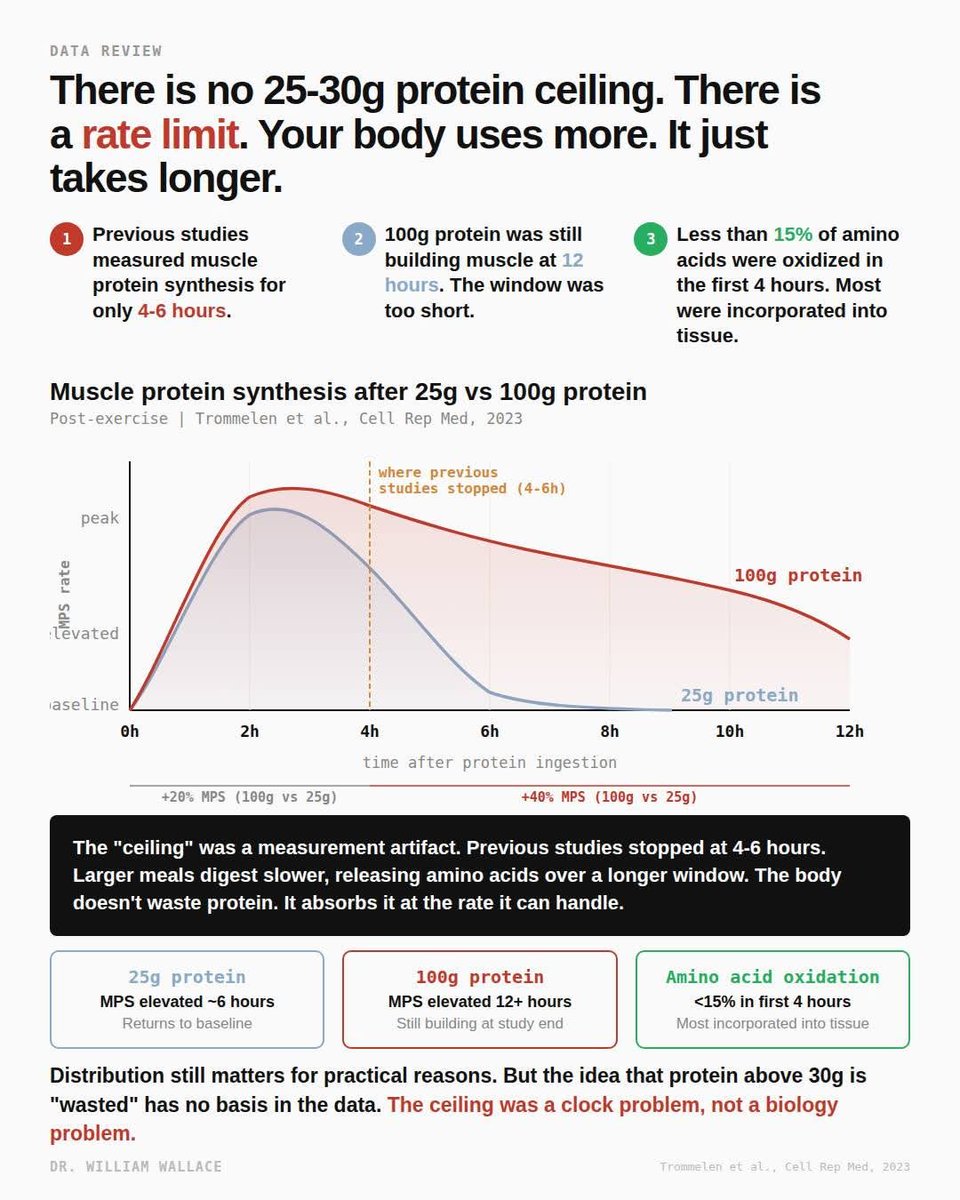
"Your body can only use 25-30g of protein per meal. Anything above that gets wasted." This claim has been repeated in fitness nutrition for over a decade, and it was built on studies that measured the right thing over the wrong timescale. Moore 2009 gave six young men 0, 5, 10, 20, or 40g of egg protein after leg-only resistance exercise and tracked muscle protein synthesis for four hours. MPS plateaued at 20g. Witard 2014 repeated a similar dose-response with whey protein after unilateral leg exercise in 48 resistance-trained men and found MPS rose 49% at 20g and 56% at 40g over four hours, with the authors concluding 20g was sufficient for maximal stimulation. Case closed, or so it seemed. The problem wasn't the dose. It was that a 4-hour window captures the peak response to 20g but only the opening chapter of what 40g is doing. Think of digestion as a funnel with a fixed flow rate. Pour a cup of water through it and it drains in minutes. Pour a gallon and it doesn't overflow. The funnel just drains at the same rate over a longer period. Protein behaves the same way. A smaller dose gets absorbed and used quickly. A larger dose digests over a longer window because the stomach slows gastric emptying and the intestine releases amino acids gradually. Muscle tissue keeps incorporating them wave after wave. The "ceiling" in those early studies wasn't a biological saturation point. It was what you see when you stop watching before the larger dose finishes working. Trommelen et al. (2023, Cell Reports Medicine) tested this directly. They randomized 36 recreationally active young men to 0g, 25g, or 100g of milk protein after a 60-minute whole-body resistance session and tracked muscle protein synthesis for twelve hours using a quadruple isotope tracer. In the first four hours, myofibrillar protein synthesis was only about 20% higher after 100g than after 25g. In the four-to-twelve-hour window, that gap widened to roughly 40%. That later window is where the bigger dose actually separates from the smaller one, and it's exactly where every prior dose-response study stopped measuring. The authors also reanalyzed the oxidation data from Moore and Witard and concluded that postprandial amino acid oxidation represents less than 15% of the increment in ingested protein. The paper states it plainly: "Protein ingestion has a negligible impact on whole-body protein breakdown rates or amino acid oxidation rates." Caveats belong in the read. This was young recreationally active men following a single bout of resistance exercise. Not trained athletes, not women, not older adults, not a longitudinal hypertrophy trial. A 2024 Witard commentary in the International Journal of Sport Nutrition and Exercise Metabolism flagged that the finding may not translate to resistance-trained young women with different anabolic kinetics. Practically: you don't need to portion exactly 25-30g of protein every three hours to avoid "wasting" it. Larger meals extend the anabolic window rather than capping it. Distribution across the day still matters for satiety, blood sugar, and hitting your daily target. But the rigid per-meal rule has weaker biology behind it than previously believed. Sources: pubmed.ncbi.nlm.nih.gov/19056590/ pubmed.ncbi.nlm.nih.gov/24257722/ pubmed.ncbi.nlm.nih.gov/27511985/ pubmed.ncbi.nlm.nih.gov/38118410/ pubmed.ncbi.nlm.nih.gov/38991545/
William A. Wallace, Ph.D. tweet media
English
27
214
985
337.5K
โค้ชภูมิ เทรนเนอร์สุดน่ารัก retweetledi
Daniel Berglind, PhD
Daniel Berglind, PhD@DanielBerglind·
A new 10-week study in resistance-trained adults found that both a high-protein 🥩 maintenance diet and a high-protein diet with a small ~250 kcal/day deficit increased fat-free mass, but the small deficit led to greater fat loss 🔥 link.springer.com/article/10.100…
English
0
16
67
43.2K
โค้ชภูมิ เทรนเนอร์สุดน่ารัก retweetledi
Daniel Tawfik
Daniel Tawfik@dantawfik·
A meta-analysis of exercise training studies has revealed something counterintuitive about aerobic adaptation. All training intensities—endurance, high-intensity intervals, and sprint work—increased mitochondrial content by roughly the same amount: 23–27%. But only one modality meaningfully expanded the capillary network surrounding muscle fibers. Endurance training produced 5–10% greater capillary density than high-intensity or sprint protocols. This matters because mitochondria and capillaries solve different problems. Mitochondria generate ATP. More mitochondrial content means greater capacity to produce energy aerobically. Capillaries deliver oxygen and substrates to those mitochondria—and clear metabolic byproducts. Without adequate capillarization, even high mitochondrial density can't sustain prolonged work. The divergence suggests that intensity and volume don't trigger the same vascular adaptations. Researchers analyzed data from nearly 6,000 participants across hundreds of studies, comparing how different training protocols influenced mitochondrial biogenesis, capillary growth, and VO₂ max. Sprint interval training was 2–3x more efficient per hour at boosting mitochondrial content—especially in untrained and moderately trained individuals. But endurance training consistently outperformed sprint and high-intensity protocols in expanding capillary-to-fiber ratios. Why? Because capillary growth appears to depend on sustained shear stress—the mechanical force exerted by blood flow against vessel walls during prolonged, moderate-intensity exercise. Brief, maximal efforts produce powerful metabolic signals for mitochondrial biogenesis (via AMPK and PGC-1α), but they don't sustain the shear stress long enough to trigger robust angiogenesis. This creates a functional trade-off. If the goal is to maximize mitochondrial content in minimal time, sprint interval training delivers disproportionate returns. If the goal is to build the vascular infrastructure that supports endurance performance and metabolic substrate exchange, continuous moderate-intensity work remains essential. The implication: neither modality is strictly superior. They're complementary. Sprint protocols excel at stimulating mitochondrial biogenesis. Endurance protocols excel at expanding the delivery system that makes those mitochondria functional during sustained efforts. VO₂ max improved by 9–12% across all training types, but the physiological pathways driving those gains differed. Baseline fitness was the strongest predictor of adaptation magnitude. Age, sex, and disease status had minimal influence—suggesting the cellular machinery governing both mitochondrial and vascular adaptations remains responsive across populations. This week's Research Review examines the evidence behind training-induced mitochondrial and capillary growth, and what these divergent adaptations mean for designing effective exercise protocols. gethealthspan.com/research/artic…
English
10
35
254
22.6K
โค้ชภูมิ เทรนเนอร์สุดน่ารัก retweetledi
Paul Hough
Paul Hough@the_hough·
A new study shows why team sport athletes should generally avoid bodybuilding training in season. Compared to low-volume strength training, hypertrophy training resulted in ⬆️ Higher muscle soreness ⬇️ Reduced performance (20 m sprint & agility) mdpi.com/2075-4663/14/4…
English
1
7
23
2.4K
โค้ชภูมิ เทรนเนอร์สุดน่ารัก retweetledi
Daniel Berglind, PhD
Daniel Berglind, PhD@DanielBerglind·
Muscle growth is partly driven by weekly volume, but how you distribute that volume may matter too. Spreading sets across 2–3 sessions/week can improve set quality, reduce fatigue, and likely make each set more effective pubmed.ncbi.nlm.nih.gov/27102172/
English
0
11
56
4.6K
โค้ชภูมิ เทรนเนอร์สุดน่ารัก retweetledi
Nick Krontiris
Nick Krontiris@nick_krontiris·
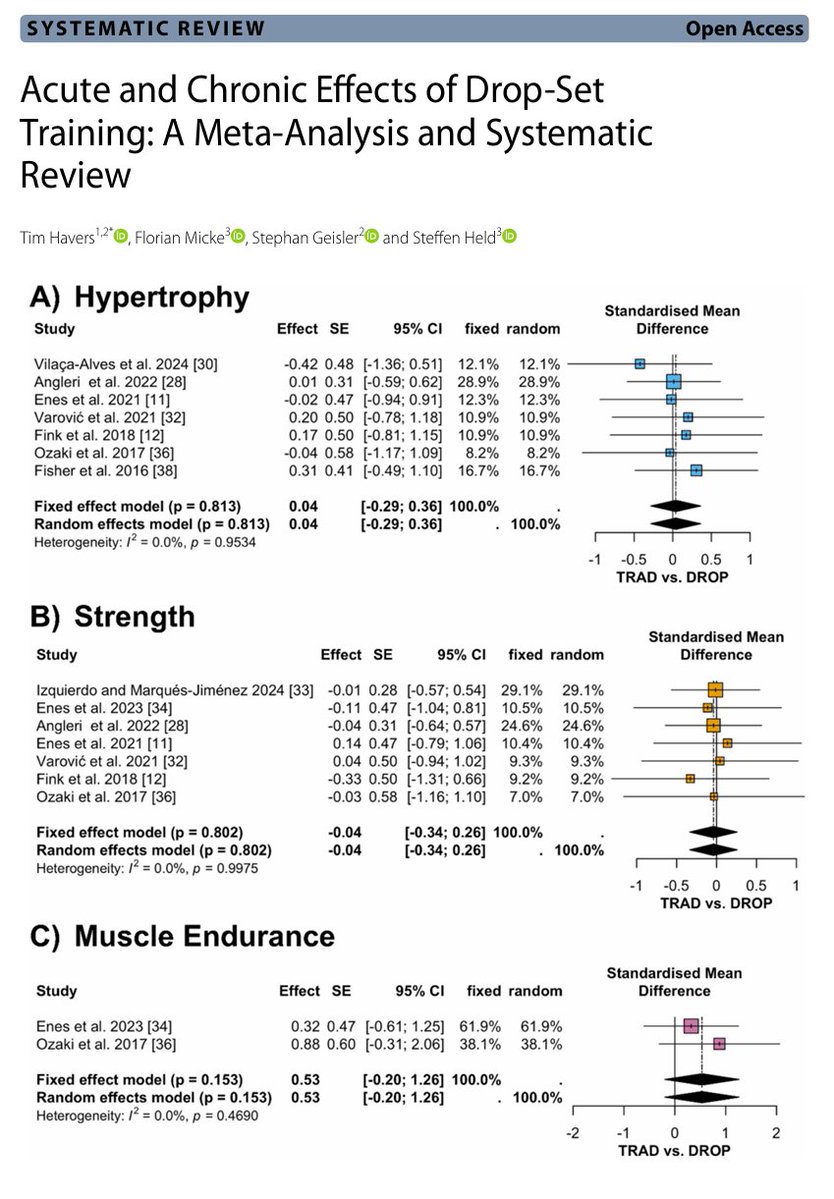
This meta-analysis finds that although drop-set training is an effective and time-efficient training method capable of eliciting similar hypertrophic and strength adaptations as traditional resistance training while requiring significantly less training time, it can elicit greater rating of perceived exertion and neuromuscular fatigue.
Nick Krontiris tweet media
English
3
6
28
3.4K
โค้ชภูมิ เทรนเนอร์สุดน่ารัก retweetledi
Daniel Berglind, PhD
Daniel Berglind, PhD@DanielBerglind·
🏋️Cluster sets can be a smart way to maintain rep quality when loads are moderate to heavy. ⏱️By inserting short intra-set rest periods, they help reduce declines in velocity and power compared with traditional continuous sets fisiologiadelejercicio.com/wp-content/upl…
English
0
7
28
1.3K
โค้ชภูมิ เทรนเนอร์สุดน่ารัก retweetledi
Daniel Berglind, PhD
Daniel Berglind, PhD@DanielBerglind·
Training hard while under-fueling is a bad deal. A new systematic review found that short-term low energy availability in athletes consistently lowered leptin and often shifted bone turnover toward reduced formation/increased resorption 🦴 onlinelibrary.wiley.com/doi/10.1111/sm…
English
0
15
61
3.3K
โค้ชภูมิ เทรนเนอร์สุดน่ารัก retweetledi
Jozo Grgic
Jozo Grgic@Jozo_Grgic·
Is muscle fiber growth load-specific? Our meta-regression exploring the effects of training load on type I and type II muscle fiber hypertrophy is now posted as a pre-print Comments are welcome @DorianVarovic sportrxiv.org/index.php/serv…
Jozo Grgic tweet media
English
2
17
85
5.6K
โค้ชภูมิ เทรนเนอร์สุดน่ารัก retweetledi
Daniel Berglind, PhD
Daniel Berglind, PhD@DanielBerglind·
Creatine may be more than a sports supplement: a 2026 technical paper proposes first adult adequate intakes based on turnover/synthesis data: ☑️400 mg/day for men ☑️240 mg/day for women Highest insufficiency risk may be in vegans, vegetarians, and older pubmed.ncbi.nlm.nih.gov/41689538/
English
1
10
48
2.7K
โค้ชภูมิ เทรนเนอร์สุดน่ารัก retweetledi
Daniel Berglind, PhD
Daniel Berglind, PhD@DanielBerglind·
🏋️Heavy squats before HIIT may not raise VO2peak, but in trained athletes they may increase time spent at very high intensity and extend total work duration—especially with cluster sets. 👉potentiate, don’t annihilate. Heavy first, but low fatigue onlinelibrary.wiley.com/doi/10.1002/ej…
English
0
10
48
2.2K