Alex Brandes ²

538 posts

Alex Brandes ² banner
Alex Brandes ²

Alex Brandes ²

@codebrandes

CTO @conste11ation | generating utility

Katılım Kasım 2015
160 Takip Edilen1.9K Takipçiler
Sabitlenmiş Tweet
Alex Brandes ²
Alex Brandes ²@codebrandes·
AI has crossed a threshold and knowledge work will never be the same. Last week we announced Gate AI, drop-in security and token savings for any agent. Here's why we built it: constellationnetwork.io/blog/why-we-bu…
English
20
41
110
68.7K
Allie K. Miller
Allie K. Miller@alliekmiller·
Enterprises are in full-on cost management mode. They’re going to look to places like AWS, Fireworks, and OpenRouter to manage their costs down, while also prioritizing visibility into team usage, easy to set limits, auto cost management with smaller or OS models, speed to enabling state of the art models, zero data retention and other enterprise-friendly policies, access management, ease of use, and tool connections and control. If I were an orchestrator, I would go loud with marketing right about… now.
English
25
6
55
9K
Alex Brandes ² retweetledi
Dean W. Ball
Dean W. Ball@deanwball·
Some observations on Kimi: 1. It's a very good model! I don't think its performance can be explained away by distillation or anything like that. In agentic coding sessions, it seems pretty much on par with the best public models of Q1 2026. In my fairly limited use, it also seemed very token hungry. It's not obvious to me that this model is actually that cheap to run. 2. I am personally surprised the Chinese state continues to allow the open sourcing of models this good, given potential risks. To be clear, I *myself* might be fine with models presenting this level of marginal risk being open weight, but I am surprised that China is fine with it. I suspect the reason they are is 75% explained by strategic blindness/lack of AGI-pilledness (the CCP is very Yann Lecun-y in its views of AI). The other 25% or so is their lack of compute for customer inference (making China's open-weight strategy an unintended byproduct of US export controls) and the normal Chinese strategy of aggressive exports. For the companies, as opposed to the government, the decision to open source is partially ideological and partially because they are behind, and they know that very few people would pay for sub-frontier models from China. 3. Open-weight models are inherently decelerationist, and I'm continually surprised to see the so-called "accelerationists" so excited about open-weight models. I suspect the reason they are is that they know open-weight models are effectively ungovernable, and they simply like the overall cloak of ungovernability open-weight models create over the whole of AI. It's not a bad strategy; it reminds me of James Scott's recounting of the hill people in "the art of not being governed." Still, in the end, open-weight models deter further AI capex. 4. One probable outcome of an open-weight-model-dominant world is full AI communism, which is precisely what China proposes: rather than a market product, AI is a "public good" which will ultimately be provided by the state as a kind of "digital public infrastructure." This future strikes me as a dystopian hellscape, but I've never met an open-weight models advocate who doesn't ultimately concede this is where things end. You'd be surprised how many 'accelerationists' lobbied me, while I was in government, to support an eleven or twelve-figure federally funded data center so that startups could train models at a subsidy and then give them away for free. There was no other way for AI to progress, they said. Perhaps this is the logical end state of things. Nonetheless, I find myself surprised to see supposed accelerationists excited about such an outcome. I think many of them just don't know what they're doing. Many accelerationists do not view the creation and serving of frontier models as a legitimate business. 5. I would guess that the Trump Administration will at some point realize that their best strategy here would be to create large amounts of regulatory risk around the use of open-weight Chinese models. You don't need to "ban open source" (one of the dumber motifs of AI policy discussion). You just need to direct every agency to issue soft law that creates FUD. "A Federal Reserve Advisory Bulletin found that there may be backdoors in Chinese AI models." It needn't be that well justified. You just create enough regulatory risk that every regulated enterprise backs off. You probably don't want to create so much regulatory risk that you scare off the hyperscalers from serving Chinese models; this will just drive startups to sketchier providers. There's a happy middle ground here. I'd assume they will do some version of this. 6. It's probably true that open-weight models of this capability make the world a bit more dangerous, but not so much more that you'll really notice. At some point the models will be capable enough that you will notice. "A nonliving, invisible, dangerous, and infinitely self-replicating agent escaped from a Chinese lab," you say? Color me shocked.
English
2.1K
909
7.5K
10.9M
Alex Brandes ² retweetledi
Dagnum²
Dagnum²@Dagnum_PI·
I put 48 million tokens through Claude in the last hour. You hit your limit before lunch. This is my own Gate AI dashboard, past week: 358.97M tokens across Claude, GPT-5.5, and Grok. 7,109 messages. Total spend: $57.23. One gateway, every model in one place, prompts compressed before they hit the meter, every call screened and fingerprinted on-chain. Running out of tokens is a single-provider problem. Bookmark this for the day your model cuts you off. And reply with your monthly AI bill: if it's over $57, I'll tell you what's eating it.
Dagnum² tweet media
English
8
11
44
4.6K
ollama
ollama@ollama·
Open models are already being used in the enterprise. Over 85% of the Fortune 500 companies already use Ollama to fulfill specific tasks. @jmorgan Why open models and Ollama? Ownership. Open models are yours to keep, customize, and optimize. Affordable. Run it the way you like, in your own environment. Private. Your data belongs to you.
English
32
56
442
40K
Kevin
Kevin@kevincodex·
new motivational qoute unlocked: "but if there’s one thing i’ve learned from the last decade of building in this space, it’s that when things feel the worst, the best thing to do is just put your head down and build." will keep building much respect sir!
jesse.base.eth@jessepollak

lots of conversations about base over the last week. wanted to share my candid take after a week of listening and a lot of reflection over the last 6 months. first off - in case it’s not obvious, the first quarter of 2026 was a punch in the face. I spent 2024 and 2025 making a two pronged bet to bring base to the world: (1) builders would unlock the next wave of crypto adoption; (2) adoption would be driven by new onchain-native social experiences - creators, content, messaging. imo we made the right bet on builders, but obviously the wrong bet on social. builders did drive the next wave of crypto adoption - prediction markets, perpetuals, stablecoins - but social was not at the center of it. in fact, the entire social side of the market that many of us had been building towards - farcaster, zora, miniapps, and yes, creator coins - disintegrated completely. I was wrong - whether it was timing wrong (is $ansem a creator coin?) or fully wrong, only time will tell, but regardless, i was definitively wrong. the collateral damage was pretty bad! and this year has been an exercise in eating shit. we realized how our focus on social had meant that base had fallen behind in key areas that were now increasingly critical - we had perps (shoutout avantis!) and prediction markets (shoutout limitless!), but both were well behind scaled competitors. and we had a lot of room to improve in unlocking base as a platform for tokenization and payments that really worked for enterprises. people lost confidence, and CT spectators reminded me weekly of all of my mistakes as often as they could. it felt bad man, still feels bad. but if there’s one thing i’ve learned from the last decade of building in this space, it’s that when things feel the worst, the best thing to do is just put your head down and build. so that’s what i’m doing. I refocused my time and attention back to the chain away from the app, started writing code again, shipped a bunch of stuff (azul, beryl, b20, privacy, ledgers) and questioned a bunch of my assumptions: does crypto need social to grow? does base need an app? can base be bigger than coinbase? I thought for a long time that social was the only thing that could drive the sort of viral growth to get crypto to a billion people. unsurprisingly, I now believe that’s wrong. It’s clear that better money is more than enough - we are seeing this live with stablecoins, predictions, perpetuals, tokenization and i only expect it to accelerate. I am now focused on bringing a billion people onchain just by making global finance actually work. on the app, my focus is on building base into the blockchain for global finance. to that end, i’ve handed the base app back to the coinbase mothership, where my now good friend @cobie will be taking it from here to make it the best damn app for onchain you’ve ever seen, including expanding beyond the base ecosystem in ways that tbh i won’t love as the leader of base. it’s incredibly hard to grow a decentralized network inside of a big public corporation. and i feel like much of the discourse on CT over the last week is downstream of this. the following things can be true: (1) base (and i) love memes and (2) brian probably won’t ever bullpost memes on the tl (this activity is illegal once you’re over 40 years of age). it’s weird and we’re working through it as we continue to decentralize base, which has been our commitment from the beginning. we’re going to build base into the blockchain for global finance and do everything we can to be the place that the world’s money settles over the next century. we will surely have formidable competitors (welcome robinhood and stripe!) and people may abandon our cause, but we welcome the competition and believe it’s our duty to win the respect and commitment of those who rally to our banner.  in 2026, this concretely means three things: winning trading, payments, and agents. [continued in the reply]

English
7
8
81
3.2K
Alex Brandes ²
Alex Brandes ²@codebrandes·
@thdxr Love your posts and apologies for shilling but this is exactly what we’re working on @_GateAI
English
0
1
5
122
dax
dax@thdxr·
prompt injection risk is so annoying man we could do so much cool automation if this wasn't a problem
English
117
18
1.9K
146.2K
Alex Brandes ²
Alex Brandes ²@codebrandes·
@alexocheema While I 100% support local AI and am excited to see what Apple releases next - I have to say, this is some weird fear mongering.
English
0
0
0
76
Alex Cheema
Alex Cheema@alexocheema·
If you don’t have at least 1TB VRAM and a VPN to torrent model weights from China, you are asleep at the wheel, and ignoring the uncomfortable truth that open weight models may be banned this year. Losing access to frontier models will be depressing and make a lot of people feel helpless - a few will have access to 100x productivity, and you will be stuck. Personally I cannot imagine doing work without frontier-level models right now. Think of the narrative: Chinese model (GLM-6?) with Fable capabilities, no guardrails. It’s plausible. Everyone is underpricing the chance that open models get banned. What are you going to do if it happens?
English
136
44
707
131.1K
Alex Brandes ²
Alex Brandes ²@codebrandes·
A new American lab has entered the open-weight AI race with Inky, a nearly 1T parameter multimodal model. It doesn’t appear to be quite frontier-level on benchmarks yet, but it’s great to see another serious entrant pushing open models forward. I’m excited to try this one out on @_GateAI soon!
Thinking Machines@thinkymachines

Today, we are introducing Inkling. Inkling reasons efficiently across text, image, and audio modalities. We are making the full weights available. thinkingmachines.ai/news/introduci… Available today for fine-tuning on Tinker. Play with it in the Inkling Playground. 🧵

English
1
0
15
704
Alex Brandes ² retweetledi
Gate AI
Gate AI@_GateAI·
A new Gate blog is out from @berg_dave42 Deploying AI everywhere makes work faster, not better - real efficiency comes from a single layer under every AI client that lets you secure it, see what it costs, and prove what it did.
Dave Berg²@berg_dave42

Automation, efficiency, and transparency are three different things. Speed without a shared way to see, secure, and prove what your AI is doing isn't efficiency. It's the wrong outcome at scale. On what closes the gap across every AI client you run: constellationgate.ai/blog/faster-is…

English
0
12
43
3.8K
Alex Brandes ² retweetledi
Gate AI
Gate AI@_GateAI·
Everyone gets Pro now. New sign-ups start with a 14-day Pro trial, and every existing free account has been upgraded to a Pro trial automatically. Nothing to do on your end. Go build something.
English
7
25
87
3.9K
Dagnum²
Dagnum²@Dagnum_PI·
@BenJorgensen Actually crazy you can use Crypto to pay for AI usage
English
2
1
9
257
Dagnum²
Dagnum²@Dagnum_PI·
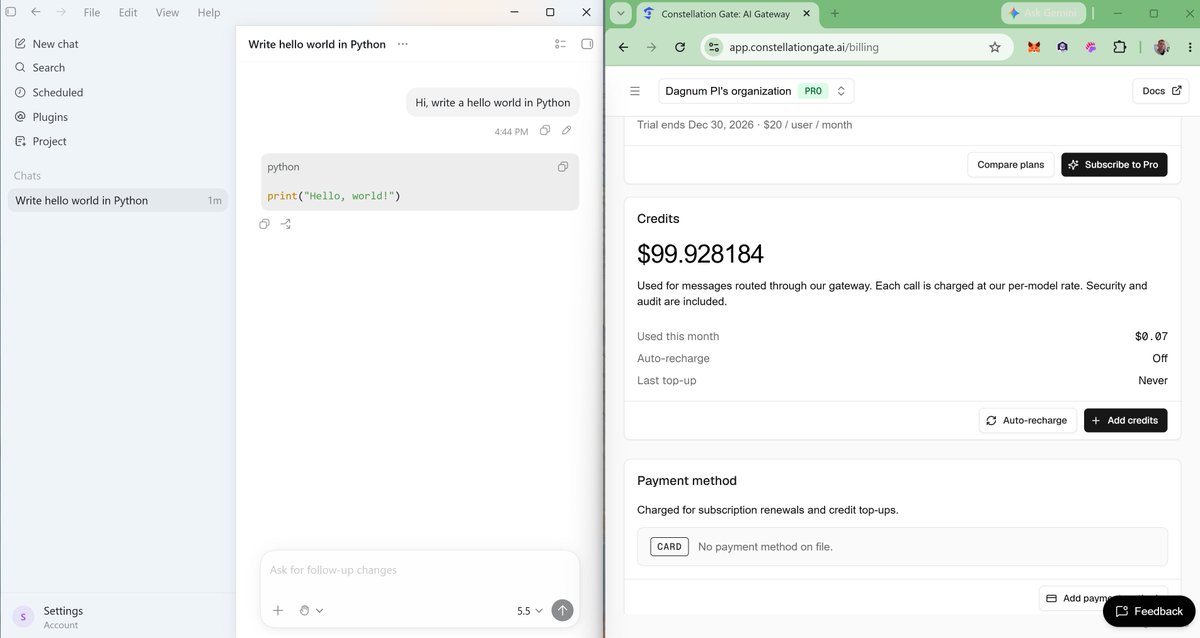
Used $DAG to pay for Gate credits. Zero fees on the checkout. Ran my first real prompt in OpenAI Codex through it right after. $0.07 used. The rails handled screening and spend compression in the background without me touching anything. Pick your models. Own your rails. This is what it looks like when you're actually using it instead of just reading the post. $DAG $AIAI
Dagnum² tweet media
English
8
16
96
3.3K
Jun Song
Jun Song@jun_song·
The new engine for MLX is in its final stages of development. Just ran GLM-5.2 on a single MacBook (116GB) hitting 41.8 tok/s with a 256k context window. Quality loss is only around ~4%, which puts it right at the 3-4bit quality level. The tech behind this uses a newly introduced layered architecture. When I first started, I was getting 10 tok/s with Kimi-K2.6 (128GB, 1024 context). Now it is fully at production level. Been grinding on this for months. Feels great to see it finally coming out soon.
Jun Song tweet media
English
103
64
942
61.7K