
jer
1.3K posts

jer
@coffeewithjer
5x Red Dot Design Award Winner, 3x USA Coffee Judge.
Hong Kong Katılım Kasım 2013
620 Takip Edilen1K Takipçiler

Built a wheelchair cupholder in minutes on @CadX_Studio
Tube diameter. Snap fit. Clamp geometry. All parametric. All manufacturing-ready.
This is what AI CAD actually looks like

English

@sdamico @ImpulseLabs NPS is the right metric to obsess over for consumer hardware
English

Wild: our NPS @ImpulseLabs with customers over the last ~12mo is at 85. (survey had a 25% response rate)
Still at zero remorse returns.
English
Very much needed
Y Combinator@ycombinator
Hardware Supply Chain @dessaigne In Shenzhen, a team can go from design to a new physical part in a day. In the US, that same loop often takes weeks, and that gap compounds. The overall stack for rapid hardware iteration still doesn't exist in America, and we want to fund the startups building it.
English
jer retweetledi

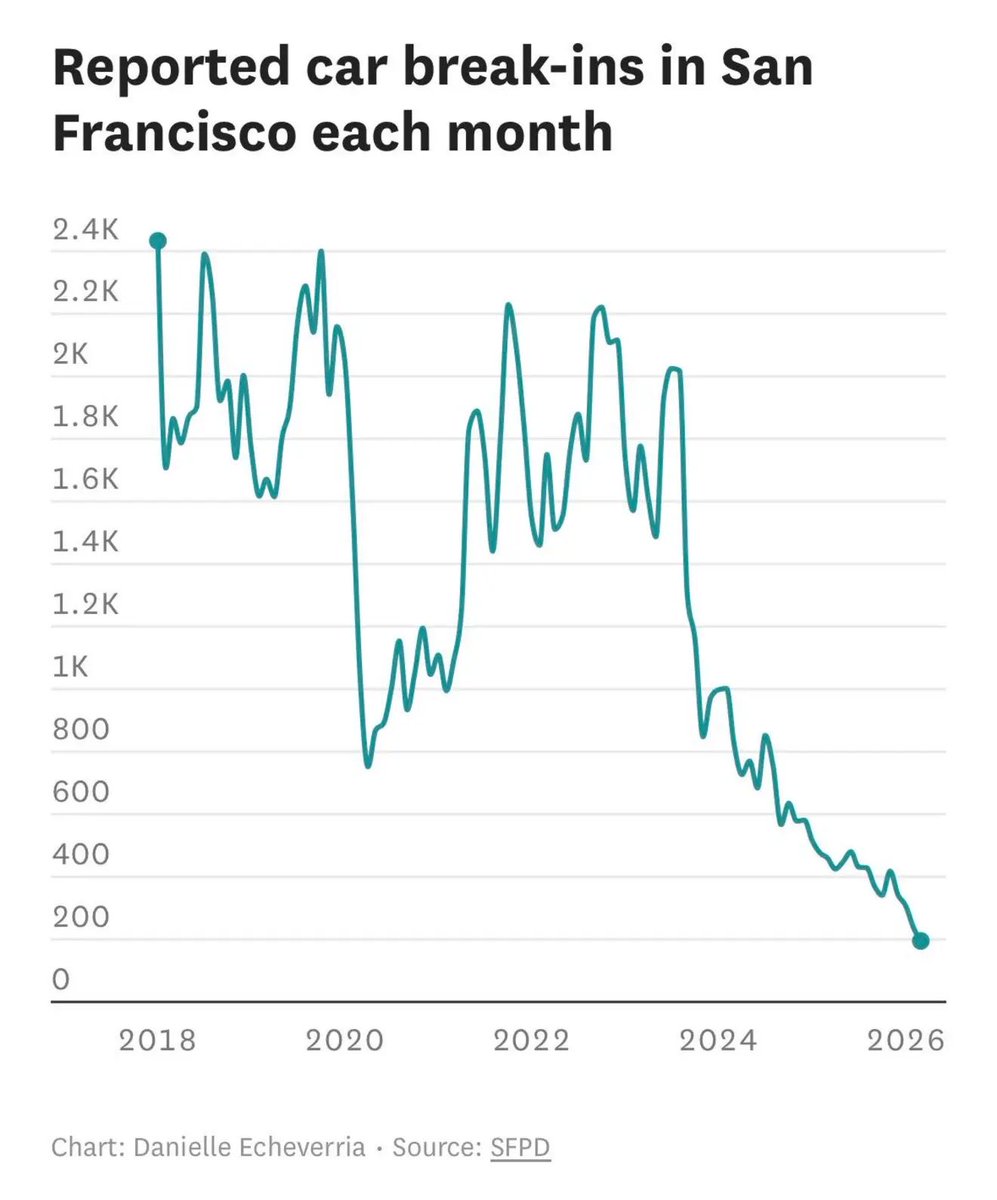
San Francisco is now a model for how to fight crime.
A few years ago it averaged 86 car break-ins per day. Today: 15.
SF did two things:
1. Got a DA that prosecutes criminals: Following the successful recall of Chesa Boudin, DA Brooke Jenkins started prosecuting prolific offenders and said so loudly. Crime dropped every year since she took office.
2. Put tech to use: In 2024, SF activated 400 license plate readers and deployed 80 drones citywide. This tech feeds officers live intelligence on suspects in motion. Drones alone have assisted in 1,000+ arrests since then. The technology lets authorities solve crimes as they happen rather than depend on much more intensive, legally perilous post hoc investigations (which ironically are often more intrusive than using tech).
The results:
- Car break-ins down 85%
- Robbery down 30%
- Burglary down 33%.
- Homicides hit their lowest level since 1954.
Plate readers, drones, a prosecutor who prosecutes. That's the whole formula!
Austin has the opposite approach. License plate cameras are effectively banned. Jail bookings are down despite repeat offenders victimizing innocent people regularly. Bond violations went from 37 in 2020 to 250 last year.
SF proved crime is a choice. Austin, so far, keeps making a different one.

English
In case you’re wondering why I chose to buy property in San Francisco
scott budman@scottbudman
#New: Bay Area rents (median 1BR): San Francisco: $3,790* Palo Alto: $3,610** Mtn View: $3,380 Sunnyvale: $3,130 Santa Clara: $3,040 Redwood City: $2,930 San Jose: $2,660 Berkeley: $2,270 Oakland: $2,000 *Up 18.5% in one year **Up 14.6% in one year Source: @Zumper
English

Anyone in SF want to learn kitesurfing?
A group of friends is booking lessons to get on the water this season 🌬️

English


@coffeewithjer True! Although I’ve been listening to the new Die Spitz album like it’s my job lately.
English
It feels like people don’t listen to proper albums anymore and just let Spotify shuffle for them instead…
There’s a certain joy to immersing yourself in a proper album, start to finish.
here are my top 5 albums
1. OK Computer, Radiohead
2. Kind Of Blue, Miles Davis
3. I Got Next, KRS One
4. Dark Side of the Moon, Pink Floyd
5. Unplugged, Eric Clapton
English
@paulcjh_ @josancamon19 Hell yeah! This is what we need!!!!! Nice work
English

I've been hard at work the past few months in SF working on some buy buttons. Today I'm launching my plug-and-play product line that lets you build a robot real fast.
Right now to make a robot you have to stitch together a bunch of different PCBs with jumper cables and wait weeks for blackbox actuators to arrive from China. You spend lots of time debugging why your CAN bus isn’t working, why every actuator performs differently, and meanwhile your wires keep coming loose.
So, I'm making the following:
- RB1: A robot main board powered by an Nvidia Jetson. This handles power distribution, compute, and a bunch more.
- WM1: 2-channel wireless radio for sending video/data making the RB1 remotely controllable over USB-C.
- M1: A pancake BLDC motor machined in-house.
- ACB3: An FOC control board with matching connectors to the RB1. (big brother to ACB v2.0)
- A1/A1m: A planetary/cycloidal actuator powered by the ACB3. (this is on the site in a couple weeks)
Everything is on sale for this week, and shipping begins this spring! As a big thank you to the supporters of ACB v2.0 (and thanks for patience in shipping delays) you can buy the ACB3 for 50% off.
If you like this kind of thing and want to join please DM me, I'm working solo right now and need good folks to join!
Y Combinator@ycombinator
HLabs (@hlabs_) is making plug-and-play electronics and actuators for robots domestically in the USA. These products abstract away all of the complexity in designing and controlling a robot's electronics. Congrats on the launch, @paulcjh_! ycombinator.com/launches/PfW-h…
English


i can't believe nobody caught this.
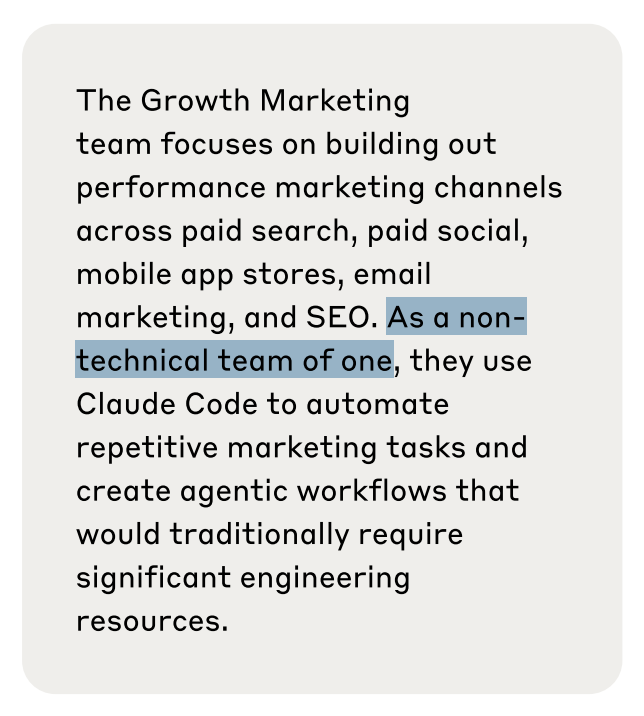
Anthropic's entire growth marketing team was just ONE PERSON
(for 10 months, confirmed)
a single non-technical person ran paid search, paid social, app stores, email marketing, and SEO for the $380B company behind claude
here's exactly how one human is doing the job of a full marketing team:
it starts with a CSV.
1. he exports all his existing ads from his ad platforms along with their performance metrics (click-through rates, conversions, spend, etc)
2. feeds the whole file into claude code
3. and tells it to find what's underperforming.
claude analyzes the data, flags the weak ads, and generates new copy variations on the spot
this is where he gets clever:
he then splits the work into 2 specialized sub-agents:
1. one that only writes headlines (capped at 30 characters)
2. and one that only writes descriptions (capped at 90 characters).
each agent is tuned to its specific constraint so the quality is way higher than cramming both into a single prompt
so now he's got hundreds of fresh headlines and descriptions.
but that's just the text.
he still needs the actual visual ad creative, the images and banners that go on facebook, google, etc.
so he built a figma plugin that:
1. takes all those new headlines and descriptions
2. finds the ad templates in his figma files
3. and automatically swaps the copy into each one.
up to 100 ready-to-publish ad variations generated at half a second per batch.
what used to take hours of duplicating frames and copy-pasting text by hand
so now the ads are live.
the next question is which ones are actually working.
for that he built an MCP server (basically a custom integration that lets claude talk directly to external tools) connected to the meta ads API.
so he can ask claude things like:
• "which ads had the best conversion rate this week"
• or "where am i wasting spend"
and get real answers from live campaign data without ever opening the meta ads dashboard
and the part that ties it all together and closes the loop:
he set up a memory system that logs every hypothesis and experiment result across ad iterations.
so when he goes back to step one and generates the next batch of variations...
claude automatically pulls in what worked and what didn't from all previous rounds.
the system literally gets smarter every cycle.
that kind of systematic experimentation across hundreds of ads would normally need a dedicated analytics person just to track
the numbers from the doc:
ad creation went from 2 hours to 15 minutes. 10x more creative output.
and he's now testing more variations across more channels than most full marketing teams
a $380 billion company.
and their entire growth marketing operation (not GTM) = just one person and claude code lol
truly unbelievable
English

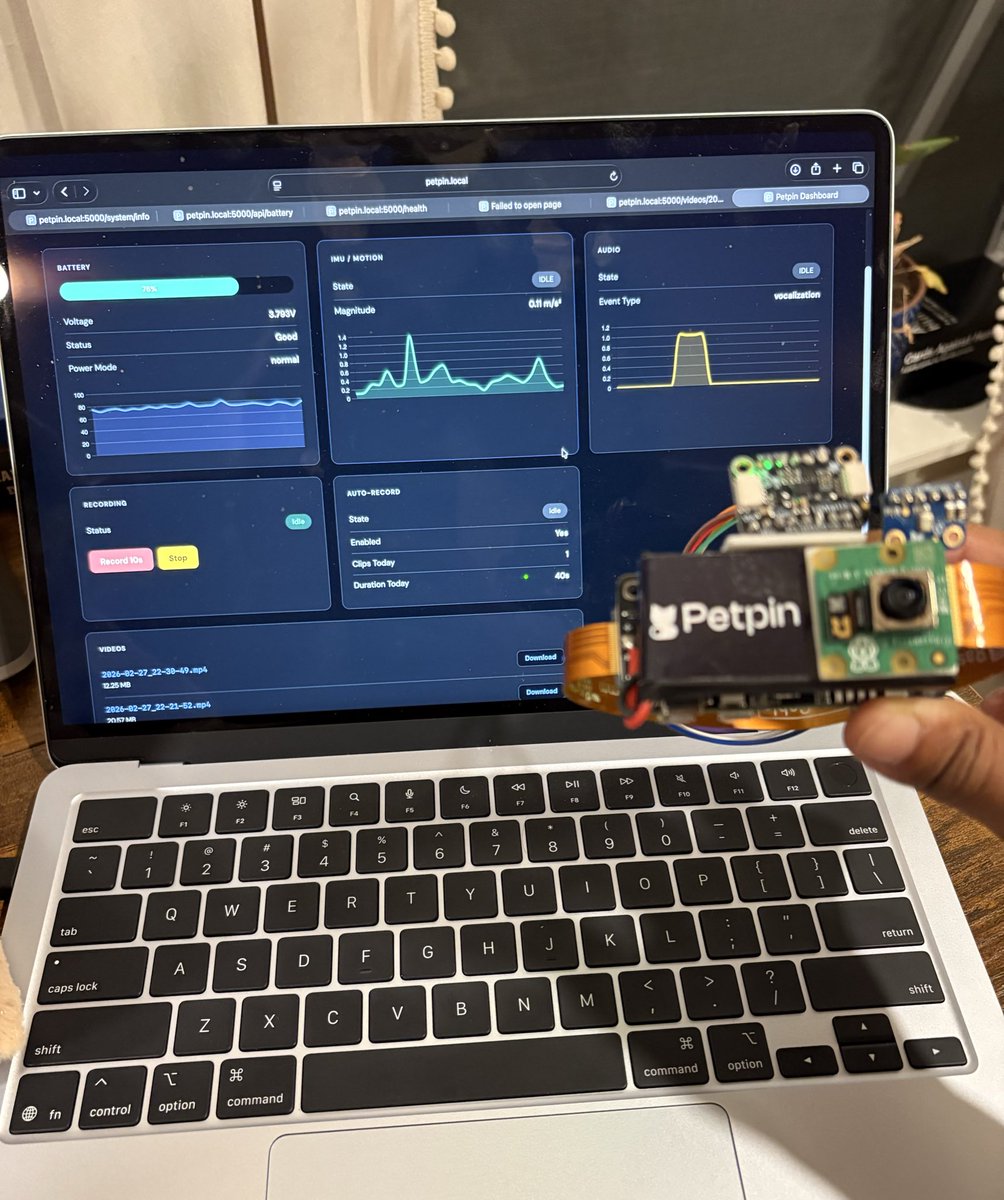
Friday night breakthrough.
Petpin V0 just ran ~3 hours on a 1200mAh battery under active triggers (motion + audio + camera events) and we’re still sitting at ~78%.
Projected full day battery life in this form factor.
Power optimization is the product.
English