
Arjun Krishnan

1.1K posts

Arjun Krishnan banner
Arjun Krishnan

Arjun Krishnan

@compbiologist

ML & data-driven discovery; Complex traits & diseases; Data reuse & open science. Associate Professor | Group leader @KrishnanLab | @compbiologist everywhere

CU Anschutz Med Campus Katılım Mayıs 2008
280 Takip Edilen1.2K Takipçiler
Arjun Krishnan retweetledi
Kelly Sullivan
Kelly Sullivan@kellydsullivan·
Excited to share this work. A huge effort from many team members, led by former @CUHMGGP PhD student and current @CrnicInstitute Post-doc, Dr. Lauren Dunn! Altered hepatic metabolism in Down syndrome: Cell Reports cell.com/cell-reports/f…
English
1
1
1
73
Arjun Krishnan retweetledi
Kelly Sullivan
Kelly Sullivan@kellydsullivan·
The call for poster abstracts for the 6th International Conference of the Trisomy 21 Research Society is now open! Conference registration for the conference, to be held June 17-20 2026 in Denver, CO, USA, is open as well. t21rs2026.com/call-for-poste…
English
0
1
0
53
Michael Baym
Michael Baym@baym·
I will never understand why statisticians say “Type I error” and Type II error” when false positive and false negative are the same number of syllables and self-defining
Joachim Schork@JoachimSchork

Understanding Type I and Type II errors is the secret to unlocking the full potential of your statistical analysis. These errors are pivotal in hypothesis testing, where Type I errors represent false positives (incorrectly rejecting a true null hypothesis) and Type II errors represent false negatives (failing to reject a false null hypothesis). Handling these errors effectively can greatly improve the accuracy and credibility of your analyses. By meticulously managing these errors, you can ensure your statistical conclusions are both reliable and valid, ultimately leading to more trustworthy and impactful research findings. Cons of Mismanaging Type I and Type II Errors: ❌ Misleading Results: High rates of Type I errors can result in false claims of significance, leading to incorrect conclusions. ❌ Missed Discoveries: Excessive Type II errors can cause important findings to be overlooked, as genuine effects are dismissed as insignificant. ❌ Reduced Trust: Frequent errors undermine the credibility of your analysis, leading to mistrust in your results and decisions. Pros of Effectively Managing Type I and Type II Errors: ✔️ Minimized False Positives: By carefully setting thresholds, you can reduce the number of false positives, ensuring that positive results are genuinely significant. ✔️ Accurate Conclusions: Proper management of Type I and Type II errors helps draw more accurate conclusions from data, enhancing the overall validity of your study. ✔️ Improved Decision-Making: With fewer errors, the decisions based on your data will be more reliable and informed. To manage Type I and Type II errors effectively in practice: 🔹 R: Use the p.adjust function from the stats package to control for multiple comparisons and reduce Type I error rates. 🔹 Python: Utilize the statsmodels library, specifically the multipletests method, to adjust p-values and maintain control over error rates. The visualization originates from a wikipedia image (link: en.wikipedia.org/wiki/Type_I_an…) and shows the results of negative samples (left curve) overlapping with positive samples (right curve). Adjusting the cutoff value (vertical bar) helps balance false positives (FP) and false negatives (FN), impacting the rates of true positives (TP) and true negatives (TN). To explain this topic in further detail, I collaborated with Micha Gengenbach to create a comprehensive tutorial: statisticsglobe.com/type-i-and-typ… Eager to advance your skills in statistics and R programming? My online course, "Statistical Methods in R," might be ideal for you. More details are available at this link: statisticsglobe.com/online-course-… #statisticians #DataScience #DataAnalytics #RStudio #RStats #database

English
108
270
6.1K
436.8K
Arjun Krishnan
Arjun Krishnan@compbiologist·
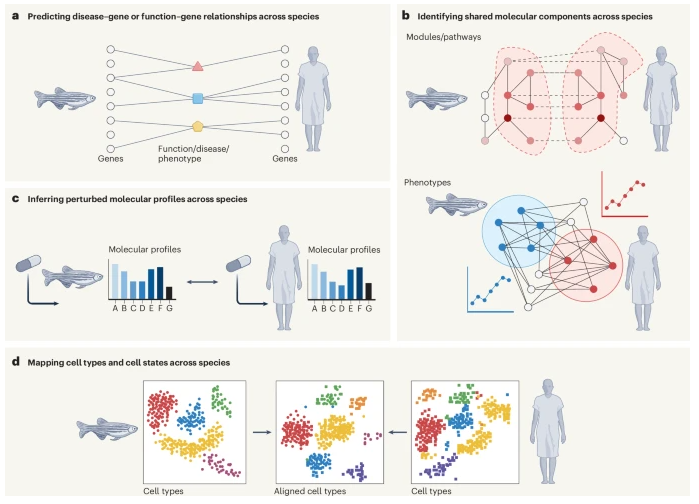
#ASHG24 Interested in comparing & transferring data & knowledge across species for translational biomedicine? This review is for you! We take a deep dive into methods & highlight gaps/challenges. Details on implementation, data, & benchmarks: github.com/krishnanlab/cr…
Arjun Krishnan@compbiologist

Preprint 🚨 A review state-of-the-art computational strategies for cross-species knowledge transfer in biomedicine 💻👩‍🦰🐭🐟🪰🪱🧬🫁⚕️ Led by an excellent team at @KrishnanLab: @yhbioinfo, @ChrisAMancuso, & @kaylainbio in collab w/ @FishEvoDevoGeno 🧵 arxiv.org/abs/2408.08503

English
0
2
6
1.2K
Arjun Krishnan
Arjun Krishnan@compbiologist·
#ASHG2024 #ASHG24 If you’re interested in effectively reusing public omics data and/or passionate about data discovery, data reuse, metadata, etc., do ping me!
Biology+AI Daily@BiologyAIDaily

Annotating Publicly-Available Samples and Studies Using Interpretable Modeling of Unstructured Metadata 1. This study introduces txt2onto 2.0, an improved NLP and ML-based tool that automates the annotation of unstructured biomedical metadata, linking samples and studies to controlled disease and tissue vocabularies without manual intervention . 2. By using a TF-IDF-based feature extraction approach instead of averaging word embeddings, txt2onto 2.0 offers more interpretable results, allowing it to accurately identify key predictive terms within sample and study metadata . 3. The model outperforms its predecessor in both tissue and disease annotation tasks, excelling particularly in scenarios with limited training data, thus making it ideal for infrequent or rare biomedical terms . 4. A notable strength of txt2onto 2.0 is its ability to work across different biomedical text sources (e.g., GEO, PRIDE, ClinicalTrials), providing consistent annotations by capturing meaningful semantic relationships even with unseen terms . 5. The interpretability of txt2onto 2.0 is highlighted through word clouds of predictive terms, where it captures domain-specific keywords without requiring explicit mentions of target terms, showcasing its robustness and potential to adapt to new datasets . 6. This tool’s transparent prediction process and scalability support its application across various data repositories, advancing the FAIR data principles (Findable, Accessible, Interoperable, Reusable) in biomedical research . @compbiologist 💻Code: github.com/krishnanlab/tx… 📜Paper: doi.org/10.1101/2024.0… #BiomedicalNLP #DataAnnotation #MachineLearning #FAIRdata #ComputationalBiology

English
0
4
6
2.1K
Arjun Krishnan retweetledi
Anthony Gitter
Anthony Gitter@anthonygitter·
Our preprint 'Chemical Language Model Linker: blending text and molecules with modular adapters' is now out on arXiv, led by @Dengyifan1012. ChemLML is a method for text-based conditional molecule generation that uses pretrained text models like SciBERT, Galactica, or T5. 1/
Anthony Gitter tweet media
English
2
14
88
9.1K
Arjun Krishnan retweetledi
CU Department of Biomedical Informatics (DBMI)
Today, @compbiologist, PhD, joined us for Bytes to Bedside. To celebrate #NPAW2024, he led a workshop offering valuable tips for planning a successful postdoc that emphasized the importance of not putting your life on hold, learning new skills, and following through on projects.
CU Department of Biomedical Informatics (DBMI) tweet mediaCU Department of Biomedical Informatics (DBMI) tweet mediaCU Department of Biomedical Informatics (DBMI) tweet mediaCU Department of Biomedical Informatics (DBMI) tweet media
English
0
1
6
605
Arjun Krishnan retweetledi
Vidhya Rangaraju, PhD
Vidhya Rangaraju, PhD@RangarajuVidhya·
🙏Thank you, SfN (@SfNtweets). I am humbled and honored to receive this award, which has recognized many excellent scientists in recent years. Special thanks to my postdoc mentor, Erin (@erin_schuman), for the nomination.@MPFNeuro @maxplanckpress
Society for Neuroscience (SfN)@SfNtweets

SfN is proud to announce the recipients of the 2024 Promotion of Women in Neuroscience awards, who will be honored at #SfN24. Through mentorship, professional development and outstanding careers, these seven researchers have made significant contributions to the advancement and inclusion of women along the length of the research pipeline paving the way for a more inclusive and impactful field of neuroscience. Learn more about the recipients and their remarkable contributions to #neuroscience. 🔗 bit.ly/3TA00s2 The Bernice Grafstein Award for Outstanding Accomplishments in Mentoring is supported by Bernice Grafstein, PhD. #NeuroTwitter #AcademicTwitter #SciTwitter

English
9
11
70
7.4K
Arjun Krishnan retweetledi
CU Anschutz Internal Medicine
CU Anschutz Internal Medicine@CUInternalMed·
🌟Celebrating #WomeninMedicineMonth with @JRegensteiner, a trailblazer in women's health research! As Director of the Ludeman Family Center, her groundbreaking work and BIRCWH award highlight her commitment to advancing women's health. Thank you for inspiring the next generation!
CU Anschutz Internal Medicine tweet media
English
0
3
9
357
Arjun Krishnan retweetledi
CU Department of Biomedical Informatics (DBMI)
🎉 Happy National Postdoc Appreciation Week 🎉 To celebrate, this week's "Bytes to Bedside" seminar features @compbiologist, PhD, who will explore planning and executing an effective postdoc. Thank you, #DBMI postdocs, for your contributions to research and discovery.
CU Department of Biomedical Informatics (DBMI) tweet media
English
0
1
3
266
Arjun Krishnan retweetledi
Anthony Gitter
Anthony Gitter@anthonygitter·
Our commentary "A renewed call for open artificial intelligence in biomedicine" is now available as a preprint. We call for sharing training data, code, and model weights in biomedical artificial intelligence research. 1/
Anthony Gitter tweet media
English
5
59
200
41.9K