
Jim Cook

1.1K posts

Jim Cook banner
Jim Cook

Jim Cook

@cookflix

Mozilla; Netflix; Wineshopper, Intuit; Proud Dad, gadget enthusiast, sports nut

Portola Valley, CA Katılım Temmuz 2008
513 Takip Edilen1K Takipçiler
Jim Cook
Jim Cook@cookflix·
For anyone that wants to hear Netflix year 2000 - 3 years after founding. Marc, our CEO, tells the story perfectly.
Yasmine Khosrowshahi@yasminekho

The year is 2000. Two men walk into Blockbuster's Dallas headquarters in shorts & sandals. Their company was in $50 Million debt. They asked this mammoth($6B company) to buy them. Blockbuster laughs at their ask of $50 Million. That laugh wiped their existence off the planet. Here's how: Blockbuster had $6 billion in revenue, 9,000 stores worldwide, and 60,000 employees. Netflix had $5 million in revenue, 150 people, and $50 million in debt. But still, this ant(Netlix) was able to eat this elephant(Blockbuster). It started with a phone call at a dude ranch. Marc Randolph, co-founder of Netflix, was on a corporate retreat at Alisal Ranch, deep in the mountains outside Santa Barbara. Horses. Dirt roads. No reason to dress up. He was in shorts, a t-shirt, and thong sandals. That's when Blockbuster called. "We'd like to see you. Tomorrow. In Dallas." Randolph turned to Reed Hastings and said there was no way. Different time zones. No direct flight. Impossible. Then they remembered they were $50 million in debt and had been trying to get this meeting for months. They chartered a private jet. The next morning, they walked into the 27th floor of a glass and steel skyscraper in Dallas. Enormous conference room. A hardwood table the size of a small country. Blockbuster executives in suits filing in from one side. Marc Randolph standing there in sandals. He made the pitch anyway. "Combine forces. You run the stores. We run the online business. Build a blended model. Our research shows it's a game changer." The executives leaned in. Questions were flowing. Things felt good. Then came the big question. "How much?" Randolph had rehearsed this on the plane. They were $50 million in the hole. The number was $50 million. Silence filled the room. He watched their faces carefully, trying to read the reaction. Then it hit him. They were trying not to laugh. This tiny company, drowning in debt, at the lowest point of the dot-com meltdown, had just asked to be bought for $50 million. To the people running a $6 billion empire, it was almost comical. The meeting ended shortly after. Quiet cab ride to the airport. Quieter flight back to Santa Barbara. Randolph sat with his head down the entire way, thinking one thing: They are not going to save us. They are going to compete with us. What happened next is where the story gets interesting. Most people assume Netflix simply outworked Blockbuster. Built a better product. Won on merit. The truth is messier and far more human. When Blockbuster finally decided to take Netflix seriously, they nearly destroyed them. They built exactly what Randolph had pitched years earlier. The blended model. Rent online. Return by mail. Or return in-store. Or pick up in-store. It was everything Netflix could not offer because Netflix had no physical locations. Randolph admits it plainly. They could not compete with that. Blockbuster came frighteningly close to taking Netflix down entirely. So why didn't they? Here is where a single human decision changed everything. Blockbuster had been targeted by corporate raiders. Investors who bought large chunks of stock, took seats on the board, and began pushing for short-term profits over long-term survival. John Antioco was the CEO driving the fight against Netflix. He understood the threat. He had pulled a team out of the building, funded them properly, and told them to go after Netflix with everything they had. Then the board denied him his contractually promised bonus. He said: then I quit. And he did. The replacement CEO came from retail and convenience stores. His vision for Blockbuster was not winning the streaming war. It was asking why their 9,000 stores were not selling gum and clothing. The online operation was abandoned. Randolph describes it using a scene from an old Spielberg student film. A robot chases someone, getting closer and closer, almost close enough to grab their ankle. Then a cost calculation hits break-even and the robot just stops, turns, and walks away. One second before victory. That is what Blockbuster did. Netflix scampered to safety. On why Blockbuster never moved fast enough: Imagine you are the CEO sitting on $6 billion in annual revenue. Someone walks in and says let's build an online component. You ask how much it will make in year one. They say $2 million. Do you pull your best engineers off working products and bet them on a $2 million experiment? Of course not. So the B team gets it. Then the C team. Each time underpowered. Each time failing. Meanwhile Netflix was not a movie company. It was a software company built in Silicon Valley with people who had spent their entire careers writing software. Even Blockbuster's A team would have struggled to compete. By the time Blockbuster committed fully, it was almost too late. And then one bonus dispute ended it. Blockbuster did not lose because Netflix was inevitable. They lost because changing a $6 billion business model requires a kind of courage that is nearly impossible to find inside a company that is still winning. They lost because the person with the will to change things was replaced by someone who did not believe change was necessary. They lost because they were one grab away from winning and walked away anyway. Netflix did not kill Blockbuster. Blockbuster killed Blockbuster. Netflix just showed up to the funeral.

English
0
0
3
90
James Cham
James Cham@jamescham·
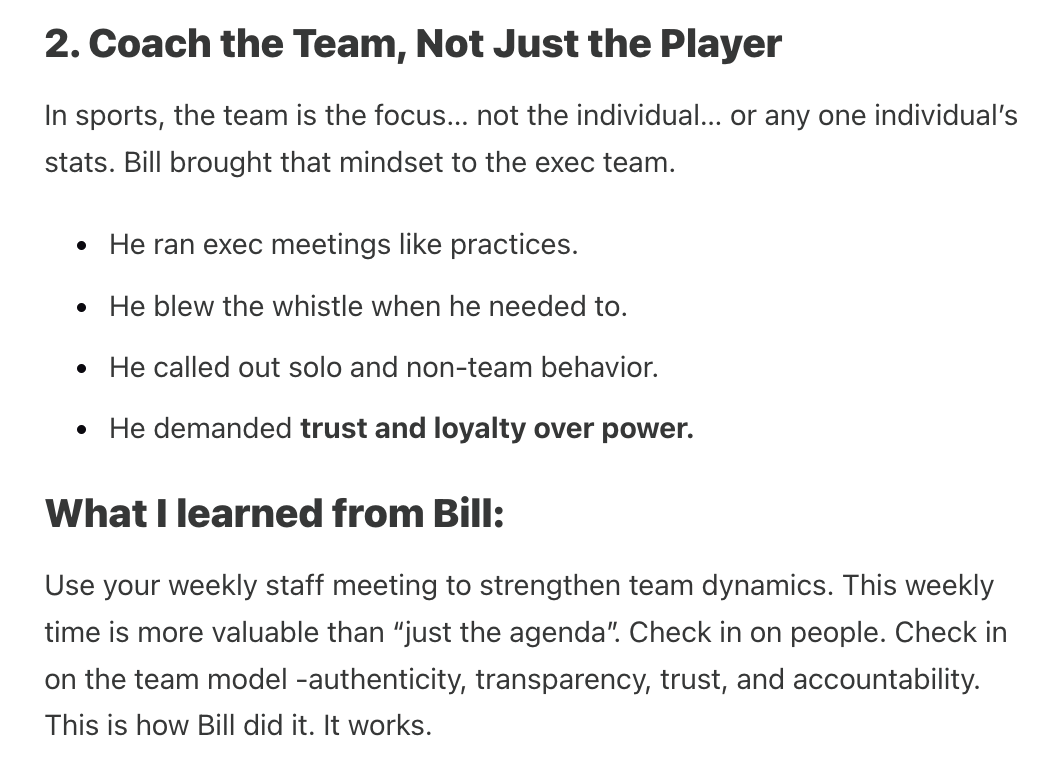
From Jim Cook’s reflections on his first boss, Bill Campbell. (You should subscribe to his newsletter. It is terrific!)
James Cham tweet media
English
5
0
2
461
Jim Cook
Jim Cook@cookflix·
3). I strongly believe it’s “how teams work” not “where teams work”. I don’t believe “remote” vs “in-office” is binary…especially with respect to connecting with people (whether zoom or face to face). It takes different techniques on zoom to bring teams together but the team remains just as important remotely as it does in-office. If remote defaults primarily to 1:1’s - the overall team loses. It’s always both…never either/or.
English
0
0
1
21
Jim Cook
Jim Cook@cookflix·
2). We had 45%+ of our workforce as remote at Mozilla well before “remote was cool”. One of my colleagues there John O’Duinn even wrote a book about how to work remote. Distributed Teams: a.co/d/d4wUPxq. We had a phrase at Mozilla “We are all remoties” - meaning that almost 50% of the time, we were not in the building - we were at one of our 12 worldwide offices, a conference, traveling, or actually WFH.
English
0
0
2
23
Jim Cook
Jim Cook@cookflix·
Thanks @jamescham and I understand the sentiment belief that “remote work” is different @curious_vii. 1). I personally don’t subscribe to the belief remote work is different …..either 1;1 or with teams. I believe the communications and leadership is simply delivered “over the air” vs “in person”.
English
1
0
2
34
Paul Grewal
Paul Grewal@iampaulgrewal·
Kentucky Ds and Rs agree: staking and mining are not securities and blockchain nodes are exempt from money transmitter regulations​​. That's worth celebrating with a bourbon. Thank you @SatoshiActFund.
Satoshi Action Fund@SatoshiActFund

We are proud to officially announce that ‘Bitcoin Rights’ has been SIGNED INTO LAW by the Governor of Kentucky! The right to self-custody, run a node, and use of digital assets is now protected for millions of Americans without fear of discrimination. This effort would not have been possible without the leadership of Rep. Bowling. Also a big thanks to: - Co-sponsor @realTJRoberts - Chair @Kyrepmeredith - Senator @JCarpenterKY - And Governor @AndyBeshearKY We also appreciate our legislative team in the ground, Julia and Patrick.

English
21
19
144
43.3K
CJ Gustafson
CJ Gustafson@cjgustafson·
HR rebranded to People Ops. IT became DevOps. Finance? We stayed Finance. Meanwhile, RevOps took a chunk of our role. If CFOs don’t step up, we’ll be boxed into a narrower lane while everyone else takes the fun stuff.
English
11
2
24
4.6K
Jim Cook
Jim Cook@cookflix·
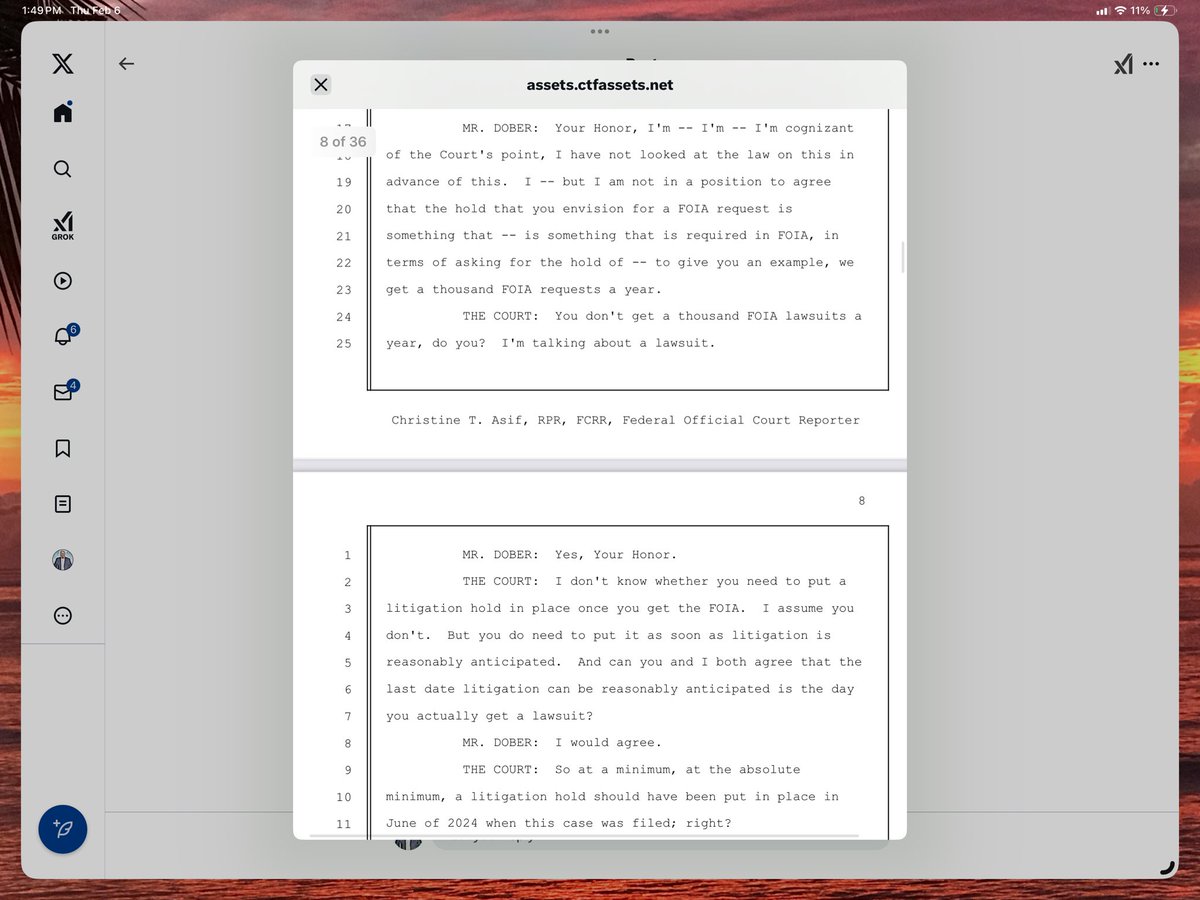
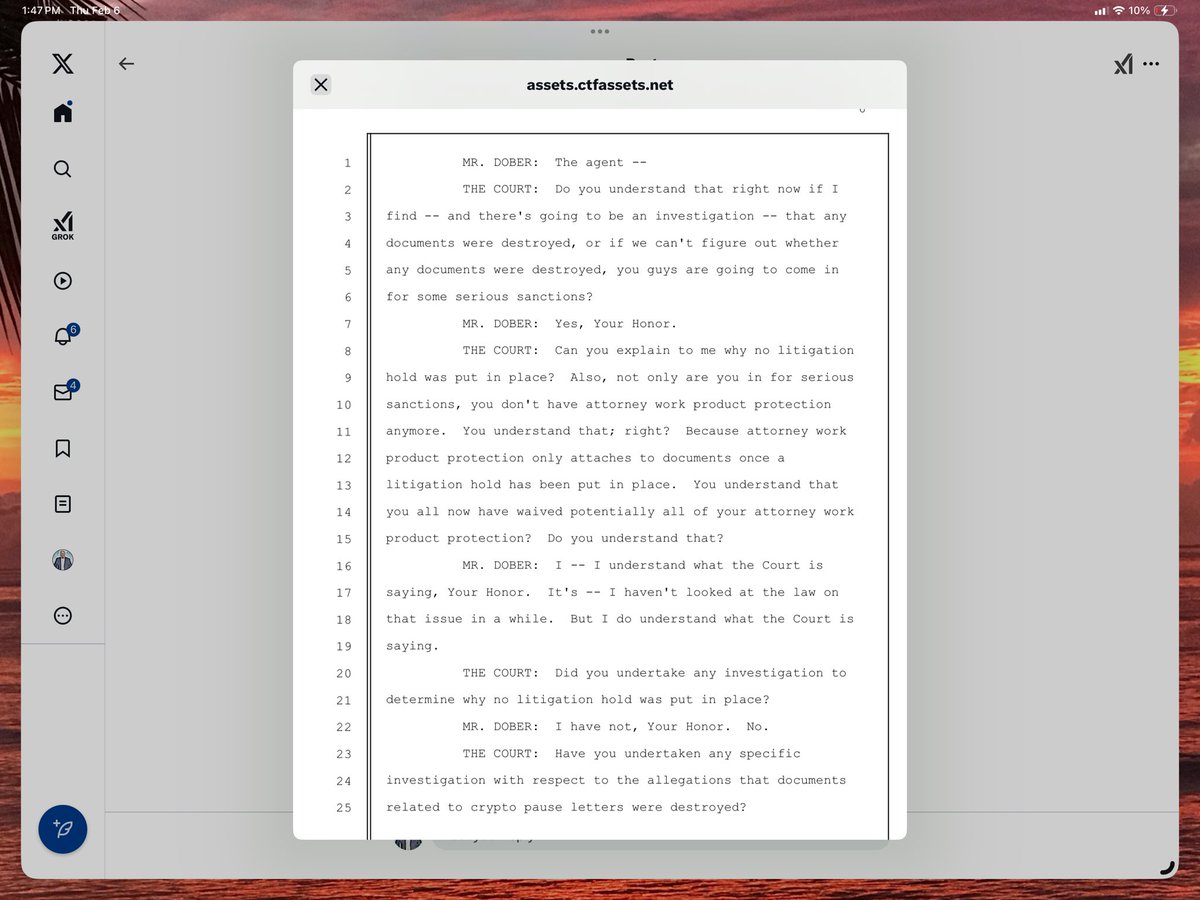
@iampaulgrewal @FDICgov This judge is awesome and PISSED OFF! And the comment on “Welcome to the NFL” at the end was priceless!
Jim Cook tweet mediaJim Cook tweet mediaJim Cook tweet media
English
3
0
5
252
Paul Grewal
Paul Grewal@iampaulgrewal·
It's a beautiful morning in DC. And I can now share a transcript of the Court hearing we had last month in our @FDICgov FOIA suit, where we showed that FDIC unlawfully withheld documents. Out of respect for the Court, I will not characterize anything in it--- you must read it for yourself (link below). 1/3
Paul Grewal@iampaulgrewal

Update: today the Court ordered @FDICgov to provide any other pause letters that the FDIC left out of its previous productions by February 7. The Court's docket entry is below. There's more, but we will await the Court's release of the transcript out of our immense respect and so you can read it for yourself. We thank the Court for its careful consideration.

English
50
93
879
520.3K
Jim Cook
Jim Cook@cookflix·
OpenAi’s Operator announcement less than 24 hrs ago has me very intrigued. I probably know a bit more about browsers than most having spent 10+ yrs a Mozilla (Firefox Browser) openai.com/index/introduc… Here we essentially have ChatGpt meets a Browser. What is a browser? It’s simply an interface to the World Wide Web. With the “Web” being a huge index of all the websites ever produced. They all require a “domain name” (domain address) after all and a Browser let’s you navigate to literally ALL of them….but you don’t “know” all of them That’s where Google/other search engines have come in over the last 20+ years Today’s announcement? What If OpenAi could search for you? Open the same browser you would have otherwise opened. Entered the same text you would have otherwise entered into the browser……retrieved the same “index” of interconnected results (the World Wide Web) But this time, OpenAI (Your new Agent) reads the results and based on your original “Prompt”…keeps going (on your behalf - as your agent) to continue to perform your “prompted task” inside this Browser window…and just “keeps going”….just like you would do. It’s Jan 2025…welcome to the new OpenAi - ChatGPT - capability…..my ask of all of you…Pay Attention….try to stay in front of this…and try to understand it…..
English
3
0
1
185
Jim Cook
Jim Cook@cookflix·
@levie is reinforcing my Dec 2024 “Ai 1st Era” post. We clearly think in terms of “Era’s”. open.substack.com/pub/jcookflix/…
Aaron Levie@levie

Driven by AI, we are entering a new era of enterprise software, ushering in systems of intelligence.  In the mid 1980s, driven by the growth of the client/server architecture, we saw the dramatic rise of systems of record. These are the back office software applications that helped enterprises run their ERP, HR, CRM, and core IT workflows. These technologies were relatively specialized, and helped automate any of the most critical tasks in the enterprise. They were defined by structured data, back office automation, and leveraged by only by select users in an enterprise. With the rise of cloud and mobile in the mid 2000s, we saw a new era of systems of engagement, as coined by Geoffrey Moore. In a world of much more dynamic and ad-hoc work in the enterprise, systems of engagement were tools for collaboration, communication, video, work and project management, social and intranets, and more. These tools dealt with all the messy, unstructured data in an enterprise - the conversations, collaborative docs, and media that began to drive a shift in how the entire enterprise worked.  Now, in the mid 2020s, we are firmly entering a new era of enterprise software, which gives rise to systems of intelligence. Systems of intelligence combine enterprise data, workflows, and AI, to deliver insights and automation to an organization. Importantly, because of the ability for AI to process unlimited unstructured data - like documents, video, or communications - we also get the same benefit from this messy data as we did our structured data. We can query, synthesize, calculate, and automate all the work around thus unstructured data just as easily as we could query a database before. Unlike systems of engagement that generally broke down the more information that goes into them, we see the reverse now with AI, where software can become more powerful and useful the more data it has access to. And with AI Agents being a native property of systems of intelligence, these systems aren’t only leveraged by every employee, they dramatically expand the output of the workforce. Systems of record are where people work by largely themselves. Systems of engagement let users work collaboratively with other people. Now systems of intelligence let us work seamlessly with people and AI.  These systems will also talk to each other in completely new ways. Instead of deterministic APIs and clear handshakes, with Agentic AI, these systems will communicate with each other much like a humans do. A user will make a request in one system, and it will fan out the ask to a variety of other similar systems relevant for the desired information. And if it didn’t get what it wanted, it will simply request again in a different way, just as a person would. We’re going to see systems of intelligence in every domain of work - across every line of business and every vertical. Some of these technologies will be incumbents that evolve, and many offerings will be brand new startups that fill a new gap between existing systems. Wild times ahead.

English
0
0
0
11
Jim Cook retweetledi
Turpentine
Turpentine@TurpentineMedia·
In this episode of Turpentine Finance, @sashaorloff sits down with @cookflix dubbed the CFO Whisperer, after 30 years in Silicon Valley as CFO at Netflix, Intuit, and Mozilla. Jim shares CFO hiring mistakes and the misunderstandings most board members and investors have about the CFO role, why being precise is the finance professional’s Achilles heel, tactical advice for impactful communication in board meetings, and more. -- TIMESTAMPS: (00:00) Preview and Intro (03:19) Early lessons from Intuit (05:28) Evolution of finance teams (09:06) Customer-centric finance (11:14) Effective stakeholder management (12:47) Strategic decision-making in finance (15:39) Board meetings preparation (19:04) Sponsor: Netsuite | Attio (21:07) Meaningful discussions at board meetings (24:07) How to be a successful CEO (31:38) Sponsor: Beehiiv | Babbel (34:11) Early days of Netflix (37:05) Monetization strategies (44:14) Hiring the right CFO (47:26) Interview question for a CFO candidate (49:35) Introducing BenchBoard (53:38) Common skills and advice (57:19) Wrap
English
3
3
8
1.7K
Jim Cook retweetledi
Marc Randolph
Marc Randolph@marcrandolph·
You can talk about your company’s culture until you’re blue in the face. You can put up the most beautiful posters in your break room and carve your values into the cornerstone of your building. But none of that will make the slightest bit of difference if your words don’t match your actions. Culture is observational, not aspirational. It’s not what you say, it’s what you do.
English
28
132
597
91.7K