bak

126 posts

bak banner
bak

bak

@copiumfueled

10-Qs for fun. Big Tech, AI infra, IPOs, macro. Notes.

Katılım Kasım 2021
45 Takip Edilen160 Takipçiler
Sabitlenmiş Tweet
bak
bak@copiumfueled·
David Sacks asked the question everyone building data centers keeps dodging: shouldn't this stuff be getting cheaper over time? Gavin Baker answered with a number. The assumption under the whole buildout is that compute gets cheaper. Chips improve, scale kicks in, cost per unit falls. Baker says the opposite is happening right now. A single gigawatt data center is 35 billion dollars in Nvidia silicon and 25 billion dollars in power and cooling. That second number is the problem. A big chunk of it is human labor to install, and labor doesn't follow Moore's law. It goes up. Then there's memory. DRAM is heading toward 30 to 40 percent of all hyperscaler capex next year. Hundreds of billions flowing into a component that only three companies on earth know how to make, and bringing new capacity online takes years. So the cost to stand up a gigawatt is climbing, not falling. This is what gets lost when people watch revenue catch up to depreciation. Depreciation is calculated on what you already spent, at prices you already paid. It's a number from the past. The cost of the next gigawatt is a number from the future, and that one keeps moving. Revenue can grow fast enough to close that gap. It won't matter much if the gap keeps widening from the other side. Watch the full episode on @theallinpod
Oguz Erkan@oguzerkan

Bloomberg: "AI demand begins to justify data center buildout." Based on the current cost of capital and operating margins of hyperscalers and the depreciation periods, ROI on AI capex turns positive at ~1.7-1.8x revenue/D&A. We are now around 1.2x. If capex doesn't explode and sales growth remains robust, ROI will likely turn positive somewhere in the next 24 months.

English
23
26
454
167K
bak
bak@copiumfueled·
Chamath Palihapitiya (@chamath) on the AI price war: "A barrel of intelligence" and why "this rationalization has to happen" "If you think AI is like oil, let's just use this analogy to make it simple. A barrel of crude is what, 86 bucks right now?" "Let's say a barrel of intelligence, which is a million tokens. You can buy that barrel for 26 bucks from Anthropic, a really good model. You can buy it from OpenAI for 26 bucks. Anthropic's latest model costs you 56 bucks. Elon is selling you a barrel of intelligence for a buck. Zuck is about to sell it to you for a buck 50. Demis and Sundar are trying to sell it to you for a dollar. The Chinese will sell it to you for 50 cents. So this rationalization has to happen." "We have the same input that has this crazy cost. If you've made a bet very early around one of these folks that are selling extremely expensive barrels of intelligence, and you try to pass through the cost, you may run into some downstream difficulty, and that has to play itself out." "Everybody that's in this ecosystem, me included, we're all struggling to figure out how do we price this stuff so that the ultimate buyer is making more money, is growing faster? And that is still a question mark." @SquawkCNBC
bak@copiumfueled

The AI revenue numbers look incredible right now. Chamath Palihapitiya's warning is that they're sitting on an ROI that, by his own math, barely exists. "The problem with enterprise revenue is at some point the person that's spending it has to see an ROI. I asked Fable 5, Anthropic's new model. I first asked it, what is the lift of the S&P 500 earnings per share growth since 2024 from AI? And they answered, oh, it's 50%. So then I looked through it and I said, well, no, you're including the money that Nvidia makes from selling chips to Amazon." "So I asked a different question, which is, then what was the EPS growth of the S&P 493? And the answer was 9%. And I said, okay, well that's different. And I said, unpack that. And the overwhelming majority of that was from pricing power sitting on top of inflation. And then the other 3% was from buybacks." "And so the answer, as far as all publicly available data, was that the actual ROI was somewhere between zero and 2%." "Enterprise is probably a little bit more brittle because there are fewer buyers and they're more demanding. Consumer on the other hand all of a sudden becomes an incredible safe harbor because you have tens of millions of buyers... it inoculates you from the vicissitudes of an ROI discussion." "At some point, you'd have to be an idiot not to ask, well, who is paying you this? And can they sustain paying it to you? ...you're spending a million dollars a year on tokens and that million dollar a year is doubling and tripling and quadrupling. At some point you're going to have to show an ROI that's above the risk-free rate of return, otherwise you're going to have some angry investors on your hands." Full Episode w/@chamath : @theallinpod

English
0
0
0
105
bak
bak@copiumfueled·
NVIDIA CEO Jensen Huang on building an HR system for AI: "Without solving the security, the access control, it's impossible to deploy." "In a lot of ways, we are creating an HR system, if you will, for AI that allows the IT organizations and all of the different business units inside the companies to be able to build, improve, and deploy these agents." His analogy comes from hiring. "It's no different than it's impossible to hire a new employee into the company if you don't onboard them, give them access control." The analogy is operational, not philosophical. He goes out of his way to de-anthropomorphize the agent itself: "it's software, it's computers," "like my vacuum cleaner." Hiring here is about how an organization builds access and context. Onboarding, for Huang, means access by role. Every employee gets exactly what their job needs. "We don't give every employee access to every file and every network." An agent gets scoped the same way a person does: certain tools, parts of the network, information, a connection to specific colleagues and other agents. Then it gets briefed. It gets a skills file, "a document about this is your mission. this is how it's previously been done, and now, help do it even better than that." Put it together and what NVIDIA is building works like onboarding an agent into an organization. Deploying the model is only one piece of it. And if an agent has to be onboarded, permissioned, and given a mission like a new hire, then a capable model is necessary but not sufficient. The differentiator moves off the general model and onto what companies have spent years building to manage people: access, context, proprietary knowledge, process. You can take the model from the frontier or grab an open one, but a company's specialized knowledge is not something you can outsource. Full conversation is on @LangChain 's YT channel
bak@copiumfueled

Jensen Huang refuses to anthropomorphize AI agents, and he explains why. "It's electrons, not atoms. It's not biological, has no consciousness. It's not awake." His analogy is deliberately domestic: "It's a tool. It's like my vacuum cleaner that's roaming around the house, cleaning up the house, doing something that I used to do." Then the dishwasher, and where he lands with it is on how we get used to things: wonder first, then routine. "A hundred years ago, when the first dishwasher came along, and now it's doing dishes by itself, it must have been magical to watch it, and we call it a dishwasher, which is a little bit like a human." And on the habit of humanizing it directly: "I think right now we tend to imbue too much human properties to it. It's nothing close to that. It's software. It's computers." His objection runs deeper than practicality. To him the human framing is simply false, not a matter of what's easier to work with: "it's nothing close to that." A human-sounding name tells you nothing about what the thing is. The dishwasher got a name that's almost human too, and watching it was still a kind of wonder, and wonder doesn't argue with how a thing works, it just settles into routine. (That last step is drawn from his words, not stated by him: Huang himself lands the anecdote on "we'll get used to it.") Only then does the operational layer arrive, the reason the distinction matters to him at all: "We know exactly how it's working, because obviously we created the harnesses around it. We obviously know how it works because it's getting better all the time. If we don't understand how something works, how do we make it better every time? And if we don't understand how something works, how do we improve it? How do we fix it?" For Huang, understanding and improvability underwrite each other. "Created the harnesses" gives you "we understand it, so we improve it," and "it's getting better all the time" runs the other way, "it improves, so we understand it." Both arrows sit right there in the quote. Which is probably why he won't move the line, the line between what you can improve and what you can only name: "I think that we ought to keep it there." Full conversation is on @LangChain 's YouTube channel

English
0
0
0
96
bak
bak@copiumfueled·
Palantir CEO Alex Karp on why America's fear of AI is a political problem, not a technical one "Most people who are middle and middle class will do better. Everybody... people who are willing to change their jobs are likely to do better, but not everyone. But that's not the real political problem. We have a political problem in this country, not a tech problem." "In past revolutions, the person at the bottom maybe their salary doubled and the person at the top became five times wealthier, but it was very unusual to be a billionaire 40 years ago. You now have a revolution where I could become 20 times wealthier than I am now. And the person who is working out here could have their salary go up 50% or double over a period of 10 years." "Our fabric of our society is already strained. It's not like in the 50s and 60s where people actually knew each other, went to the same schools. We already live in a separate but nonequal society. And then you hypercharge it with extreme economic wealth." "When you have a complete decoupling of unimaginable wealth and normal... and then this is where we're not really allowed to say this, but it's done by people that you don't really relate to. These are like very oddly shaped IQ specimens that you probably wouldn't want to have over for dinner, and if they were over for dinner you'd have nothing to talk to them about. And by the way, vice versa." "The actual fear people have is I'm going to lose my job. Now that fear, even if it's not true, the people running the lab companies who are the leaders told you it's true. They're telling you your life is going to suck and they're also getting very wealthy and you don't find them very likable." "The Silicon Valley line basically is don't believe your lying eyes. This doesn't work politically. And if you tell people don't believe your lying eyes, you know what they do? They protest vote. Because what they're really saying is you are telling me not to believe everything I know." "That's why when politicians in this country or anywhere else say, hey, don't believe your lying eyes on migration, don't believe your lying eyes on nuclear, don't believe your lying eyes on AI, they get up and they vote for people... they're like screw these people, I'm going to burn down the house." Via Mathias Döpfner
Polymarket@Polymarket

JUST IN: Hundreds protest outside OpenAI, Anthropic, & Google DeepMind offices in SF, demanding a halt to AI development.

English
0
0
0
117
bak
bak@copiumfueled·
Citadel founder Ken Griffin: AI is automating PhD-level work and, at the same time, filling in the moats around the big incumbents. "So you have to go home and hold two thoughts in your mind at the same time. One: think about the impact of this on very high-level work in the job market. In some areas it's more difficult to transition the employees. For example, if you do translation, English to German, that's a real problem. You're going to need real skills retraining. And we as a country need to think about how to use higher education to help these people retrain quickly." "But number two: the competitive moats within our corporate society are all being filled in at breathtaking rates. Now, what does this mean? This means we're likely to see a golden age of entrepreneurial activity. Entrepreneurs will be able to launch new businesses at breathtaking speeds, and take on incumbents in ways you just couldn't do five, ten, fifteen, twenty years ago." "Without getting into the details of a business, a friend of a friend has a startup. It would generally have thirty or forty people. He couldn't afford that many people. How does he run the business with just a few? We're going to see a lot of these stories come to light over the next couple of years, as entrepreneurs embrace this technology to take on very interesting opportunities by meeting the needs of customers." These stories aren't hypothetical anymore. Midjourney reached roughly $200 million in annual revenue with a team of about ten people; ElevenLabs hit $100 million with around fifty, and now Anthropic's Dario Amodei puts 70 to 80 percent odds on the first one-person unicorn appearing as soon as 2026, most likely in proprietary trading or developer tools. Full Episode: Goldman Sachs Exchanges Podcast (YT)
bak@copiumfueled

Citadel founder Ken Griffin: his team's agentic AI system reproduces an academic finance paper, six to eight weeks of work by masters- and PhD-level staff, in about two to three hours. "One of our team members built an agentic system that recreates academic papers in finance. Academia publishes a plethora of papers in finance. We read these papers, thinking about the hypothesis, about the quality of the work done. Do we think that what they observed will persist out of sample? Do stock buybacks cause those stocks to outperform? A simple example." "You have a whole legion of young masters and PhDs doing this work. Reproducing a single paper takes roughly six to eight weeks. We find a few ideas a year doing this, but for us, a few ideas could be worth quite a bit of money. My colleague built an agentic AI system that would read a paper, reproduce it, verify the results published in it, produce the results out of sample, and do all this work in about two to three hours on average." "And here's the key point. This isn't just a white-collar job. This is a master's- or PhD-level job. Six weeks of work turned into" two to three hours. This isn't a one-off trick at a single fund. Academic work documents the same shift: the length of a task an AI agent can perform autonomously is doubling roughly every seven months, and some groups are already building systems that reproduce finance strategies from papers on their own and test them out of sample. "And of note, there's no reduction in headcount sitting on the back of this breakthrough. I have incredibly talented people. We have just a huge swath of problems we're trying to attack and go after. I'll take every single productivity gain I can get, because with the talented people we have, we just have more to go after." Full Episode: Goldman Sachs Exchanges Podcast (YT)

English
0
0
3
2.4K
bak
bak@copiumfueled·
David Sacks on how America wins the AI race against China 😂 "By the way, I think the absolute best thing that could happen for America in terms of winning the AI race against China is if China somehow sprouted their own doomer community." "We need like a Chinese Yud over there." @Jason Calacanis: "We got to get their pdoom up. We got to get their pdoom up." Sacks: "We need a lot more people over there freaking out about job loss or whatever. That'd be the best thing that could ever happen to us, if they start cracking down on their labs in the same way that the doomers want to do over here." Full Episode w/@DavidSacks: @theallinpod
bak@copiumfueled

David Sacks says China's open-source push was always a tactic. You go open until you catch the frontier, then you close. Exactly what Sam Altman did at OpenAI. "Last week I explained why it would be harmful to the US to ban open models. So if you're China and you want to harm the US, maybe you would want to. It does kind of make sense, because our companies are benefiting a lot from all this R&D that they're doing." "For example, the number one model in China, as I understand it, is ByteDance's model, which is already closed. That's kind of like their ChatGPT equivalent and it's always been closed. Then you've got Alibaba's Qwen, which was open and now I think is going closed, and Z.ai, which has GLM 5.2, catching up to what was then commercially available as the American frontier at certain tasks. They're going closed too, after having been open." "So this is, I think, the tactic. You stay open until you catch the frontier or you get close to it, and then there's a really compelling incentive to go close, because you want to capture all the value for yourself. Which by the way is exactly what Sam Altman did famously at OpenAI." Jason: "Not only did they go from a nonprofit to a for-profit, they went from open models to closed models. So it's exactly paralleling what Sam realized 3 years ago." Reuters reported this month that China's Ministry of Commerce is already discussing exactly this — restricting foreign access to top models from Alibaba, ByteDance and Z.ai, the lab behind GLM 5.2. Sacks, on why open source works when you're behind: "If you want to catch up, you go open. Because you're not going to make any meaningful revenue on closed anyway, because you're not close enough to the frontier. So why would anyone buy your product? But if you go open, you get the developer community on your side." Jason: "And you get utilization, more people use it, which in AI gives you reinforcement learning."

English
0
0
2
275
bak
bak@copiumfueled·
Citadel founder Ken Griffin: his team's agentic AI system reproduces an academic finance paper, six to eight weeks of work by masters- and PhD-level staff, in about two to three hours. "One of our team members built an agentic system that recreates academic papers in finance. Academia publishes a plethora of papers in finance. We read these papers, thinking about the hypothesis, about the quality of the work done. Do we think that what they observed will persist out of sample? Do stock buybacks cause those stocks to outperform? A simple example." "You have a whole legion of young masters and PhDs doing this work. Reproducing a single paper takes roughly six to eight weeks. We find a few ideas a year doing this, but for us, a few ideas could be worth quite a bit of money. My colleague built an agentic AI system that would read a paper, reproduce it, verify the results published in it, produce the results out of sample, and do all this work in about two to three hours on average." "And here's the key point. This isn't just a white-collar job. This is a master's- or PhD-level job. Six weeks of work turned into" two to three hours. This isn't a one-off trick at a single fund. Academic work documents the same shift: the length of a task an AI agent can perform autonomously is doubling roughly every seven months, and some groups are already building systems that reproduce finance strategies from papers on their own and test them out of sample. "And of note, there's no reduction in headcount sitting on the back of this breakthrough. I have incredibly talented people. We have just a huge swath of problems we're trying to attack and go after. I'll take every single productivity gain I can get, because with the talented people we have, we just have more to go after." Full Episode: Goldman Sachs Exchanges Podcast (YT)
English
0
0
2
2.6K
bak
bak@copiumfueled·
The AI revenue numbers look incredible right now. Chamath Palihapitiya's warning is that they're sitting on an ROI that, by his own math, barely exists. "The problem with enterprise revenue is at some point the person that's spending it has to see an ROI. I asked Fable 5, Anthropic's new model. I first asked it, what is the lift of the S&P 500 earnings per share growth since 2024 from AI? And they answered, oh, it's 50%. So then I looked through it and I said, well, no, you're including the money that Nvidia makes from selling chips to Amazon." "So I asked a different question, which is, then what was the EPS growth of the S&P 493? And the answer was 9%. And I said, okay, well that's different. And I said, unpack that. And the overwhelming majority of that was from pricing power sitting on top of inflation. And then the other 3% was from buybacks." "And so the answer, as far as all publicly available data, was that the actual ROI was somewhere between zero and 2%." "Enterprise is probably a little bit more brittle because there are fewer buyers and they're more demanding. Consumer on the other hand all of a sudden becomes an incredible safe harbor because you have tens of millions of buyers... it inoculates you from the vicissitudes of an ROI discussion." "At some point, you'd have to be an idiot not to ask, well, who is paying you this? And can they sustain paying it to you? ...you're spending a million dollars a year on tokens and that million dollar a year is doubling and tripling and quadrupling. At some point you're going to have to show an ROI that's above the risk-free rate of return, otherwise you're going to have some angry investors on your hands." Full Episode w/@chamath : @theallinpod
bak@copiumfueled

Chamath Palihapitiya says his company's token costs are doubling every 45 days, while productivity gains are only around 5%. "I sat down with my CTO today and I said, how are we doing on token spend? And he said the most incredible thing. He said, right now our token costs are doubling every 45 days. And I was like, ugh. And he said, yeah. And I said, well, what is the downstream productivity? And he said, maybe 5% max." "And I said, okay, so my costs are doubling every 45 days, my upside is essentially flat. And he said, basically. And I said, well, explain why that is. And he said, honestly, what we're finding out is that you need to use a lot more tokens to get to this next iteration of improvement, because we've effectively already asymptoted." "And I said, so what should we do? And he said, honestly, we have to figure this out. So we're going to take a step back and try to figure out what to do. I don't know how many other companies will actually go through this reckoning now, but the point is everybody in the next three or four years will for sure go through it." "So I suspect that if you can get out now, you should get out now, before all of that starts to seep into the water table, because I think that's probably what allows you to get out at a huge price and raise a huge amount of money." @theallinpod

English
0
0
2
387
bak
bak@copiumfueled·
David Sacks explains why every enterprise wants off the closed models, and almost none of them can actually leave. "Enterprise CTOs would like to shift their token consumption to cheaper models for the obvious reason that that would be more efficient, and they are seeing their token cost is skyrocketing right now. So everyone's trying to figure out how do we put the brakes on this or at least control it, make sure we're getting ROI." On sovereignty: "You also have the AI sovereignty issue that we discussed last week that Alex Karp talked about, where they're worried about giving up the secret sauce or the alpha in their business to a frontier lab that may one day be competing with them. So there's no question that enterprises would like to diversify. They would like to get off of these frontier models when they can." But most of them can't. "The problem is I think in most cases they don't have the technical ability to do it. Coinbase figured out how to do it, Door Dash figured out how to do it, which is to say they built a token routing system, a layer of middleware that allows them to send frontier tasks to frontier models and non-frontier tasks to more mundane models. But I don't think your average enterprise has the technical capability to do that. So this is a case of the spirit is willing but the flesh is weak. They are willing, they would like to diversify off of these closed models, but they are unable to do it." "This is why the share of wallet of closed models actually increased. I think that open source went from 19% last year to 11% this year. So open source as a share of enterprise spending is actually decreasing." Sacks was careful to separate spend from usage: "Now I don't think that means that usage is decreasing. I think usage is skyrocketing in both these categories. It also may be the case that because the whole point of using an open model is you just pay for the compute cost, you don't have to pay a lab, it's hard to measure that usage in terms of spend." "Anyone who's saying that these closed models are gonna lose or are somehow losing, you're just not seeing it in the data. The revenue is skyrocketing. The most you can say is that enterprises that are technically capable would like to gravitate towards hybrid architectures, but it is just phenomenally convenient to go with the frontier labs, and that's why their revenue is skyrocketing." @theallinpod
bak@copiumfueled

David Sacks says China's open-source push was always a tactic. You go open until you catch the frontier, then you close. Exactly what Sam Altman did at OpenAI. "Last week I explained why it would be harmful to the US to ban open models. So if you're China and you want to harm the US, maybe you would want to. It does kind of make sense, because our companies are benefiting a lot from all this R&D that they're doing." "For example, the number one model in China, as I understand it, is ByteDance's model, which is already closed. That's kind of like their ChatGPT equivalent and it's always been closed. Then you've got Alibaba's Qwen, which was open and now I think is going closed, and Z.ai, which has GLM 5.2, catching up to what was then commercially available as the American frontier at certain tasks. They're going closed too, after having been open." "So this is, I think, the tactic. You stay open until you catch the frontier or you get close to it, and then there's a really compelling incentive to go close, because you want to capture all the value for yourself. Which by the way is exactly what Sam Altman did famously at OpenAI." Jason: "Not only did they go from a nonprofit to a for-profit, they went from open models to closed models. So it's exactly paralleling what Sam realized 3 years ago." Reuters reported this month that China's Ministry of Commerce is already discussing exactly this — restricting foreign access to top models from Alibaba, ByteDance and Z.ai, the lab behind GLM 5.2. Sacks, on why open source works when you're behind: "If you want to catch up, you go open. Because you're not going to make any meaningful revenue on closed anyway, because you're not close enough to the frontier. So why would anyone buy your product? But if you go open, you get the developer community on your side." Jason: "And you get utilization, more people use it, which in AI gives you reinforcement learning."

English
0
0
0
256
bak
bak@copiumfueled·
Chamath Palihapitiya says his company's token costs are doubling every 45 days, while productivity gains are only around 5%. "I sat down with my CTO today and I said, how are we doing on token spend? And he said the most incredible thing. He said, right now our token costs are doubling every 45 days. And I was like, ugh. And he said, yeah. And I said, well, what is the downstream productivity? And he said, maybe 5% max." "And I said, okay, so my costs are doubling every 45 days, my upside is essentially flat. And he said, basically. And I said, well, explain why that is. And he said, honestly, what we're finding out is that you need to use a lot more tokens to get to this next iteration of improvement, because we've effectively already asymptoted." "And I said, so what should we do? And he said, honestly, we have to figure this out. So we're going to take a step back and try to figure out what to do. I don't know how many other companies will actually go through this reckoning now, but the point is everybody in the next three or four years will for sure go through it." "So I suspect that if you can get out now, you should get out now, before all of that starts to seep into the water table, because I think that's probably what allows you to get out at a huge price and raise a huge amount of money." @theallinpod
Boring_Business@BoringBiz_

The AI models that will generate the most tokens will be different than the models that generate the highest revenue The way things are headed, it is very clear that low value repetitive tasks will be outsourced to the cheap and open source models But the cutting edge work done with AI will consolidate around 1 or 2 frontier models, likely led by Anthropic and OpenAI So while the cheap models will produce the most tokens, it will not provide nearly the same value. This will be the commodity layer of models The frontier LLMs will be low token generation but high value. This will be the premium layer.

English
0
0
2
511
bak
bak@copiumfueled·
David Sacks says China's open-source push was always a tactic. You go open until you catch the frontier, then you close. Exactly what Sam Altman did at OpenAI. "Last week I explained why it would be harmful to the US to ban open models. So if you're China and you want to harm the US, maybe you would want to. It does kind of make sense, because our companies are benefiting a lot from all this R&D that they're doing." "For example, the number one model in China, as I understand it, is ByteDance's model, which is already closed. That's kind of like their ChatGPT equivalent and it's always been closed. Then you've got Alibaba's Qwen, which was open and now I think is going closed, and Z.ai, which has GLM 5.2, catching up to what was then commercially available as the American frontier at certain tasks. They're going closed too, after having been open." "So this is, I think, the tactic. You stay open until you catch the frontier or you get close to it, and then there's a really compelling incentive to go close, because you want to capture all the value for yourself. Which by the way is exactly what Sam Altman did famously at OpenAI." Jason: "Not only did they go from a nonprofit to a for-profit, they went from open models to closed models. So it's exactly paralleling what Sam realized 3 years ago." Reuters reported this month that China's Ministry of Commerce is already discussing exactly this — restricting foreign access to top models from Alibaba, ByteDance and Z.ai, the lab behind GLM 5.2. Sacks, on why open source works when you're behind: "If you want to catch up, you go open. Because you're not going to make any meaningful revenue on closed anyway, because you're not close enough to the frontier. So why would anyone buy your product? But if you go open, you get the developer community on your side." Jason: "And you get utilization, more people use it, which in AI gives you reinforcement learning."
The All-In Podcast@theallinpod

🚨 POD UP! Fifth Bestie Brad Gerstner is BACK! @altcap fills in for @friedberg: -- OpenAI vs Anthropic IPOs -- The Open Source Decision in July 2026 -- Meta's New Model, Zuck's Price War -- China to Crack Down on Open Source? -- Trump Accounts Launch (0:00) Bestie intros: Brad Gerstner fills in for Friedberg! (2:58) OpenAI vs Anthropic IPOs: Why it matters who goes first, what they learned from SpaceX, unlimited TAM of intelligence (27:39) The open source decision, Meta's new model, Zuck's price war, AI duopoly (54:29) CCP considering putting export controls on Chinese models, is open source ending in China? (1:03:09) Trump Accounts launch, getting young Americans bought back into capitalism

English
0
1
2
796
bak
bak@copiumfueled·
"Every time you get a truly revolutionary technology, you always get a bubble," says Gavin Baker, walking through a pattern he takes from Carlota Perez's Financial Capital and Technological Revolutions: markets correctly read the technology as world-transforming, build out capacity with room to spare, and that overbuild triggers a pause in demand, and the pause a crash. Which raises the obvious question: is AI a bubble. Baker splits it in two, and the whole thing lives in that split. On price he's blunt: "We're obviously not in a bubble. Anyone who says we're in a valuation bubble is just not paying attention. Tech trades at the same multiple it was at five or six years ago. Tech multiples have compressed since the beginning of 25. Tech is now at a discount to staples, which happens very rarely." Then he moves the frame himself: "We're not in a bubble from a valuation perspective. But given the scale of this buildout, are we in a capex bubble? Are we overbuilding?" From there Baker steps off price and onto the buildout itself. "The ROI on all this has been really positive thus far." The current weakness is mechanical, not structural, "a little divot of ROI right now because Blackwell is such an immense expenditure and is being used for training, which doesn't generate an ROI." If it isn't a bubble, then what's holding back an overbuild? Here Baker's two brakes do different jobs, and they're worth keeping apart. The first is memory, and it works on price: "The scars of that bubble are so deep. In the bubble you went down 80 or 85. That just puts a lid on tech valuations." The second is physics, and it works on the buildout: "We're fundamentally short watts and wafers. TSM is still a bottleneck in semiconductor manufacturing." And the watts he treats as solvable himself: "even if we solve the shortage of watts with orbital data centers, TSM is still a bottleneck." His one real backstop is a single node, TSMC. That bottleneck won't loosen on the market's schedule. The people who run it, in his telling, are hard operators who once waved off Sam Altman as a "podcast bro," and they're "just not going to expand capacity as fast as the world wants them to." The scars of 2000 press down on valuations; the shortage of watts and wafers, in Baker's words, "may prevent an overbuild," the physical overheating that under Perez's model is the bubble. A bubble, to him, is "the enemy of every long-term investor," which is why he won't call it impossible. He only hopes the shortage holds the overbuild back, that this time the Perez pattern ("you always get a bubble") misfires. "I hope that keeps us from a bubble." "Optimistic and hopeful."
Gavin Baker@GavinSBaker

Thoroughly enjoyed doing this podcast with @AmirF15336 who is an impressive young man. Recorded in late February of this year. Time flies!

English
0
0
0
349
bak
bak@copiumfueled·
Jensen Huang refuses to anthropomorphize AI agents, and he explains why. "It's electrons, not atoms. It's not biological, has no consciousness. It's not awake." His analogy is deliberately domestic: "It's a tool. It's like my vacuum cleaner that's roaming around the house, cleaning up the house, doing something that I used to do." Then the dishwasher, and where he lands with it is on how we get used to things: wonder first, then routine. "A hundred years ago, when the first dishwasher came along, and now it's doing dishes by itself, it must have been magical to watch it, and we call it a dishwasher, which is a little bit like a human." And on the habit of humanizing it directly: "I think right now we tend to imbue too much human properties to it. It's nothing close to that. It's software. It's computers." His objection runs deeper than practicality. To him the human framing is simply false, not a matter of what's easier to work with: "it's nothing close to that." A human-sounding name tells you nothing about what the thing is. The dishwasher got a name that's almost human too, and watching it was still a kind of wonder, and wonder doesn't argue with how a thing works, it just settles into routine. (That last step is drawn from his words, not stated by him: Huang himself lands the anecdote on "we'll get used to it.") Only then does the operational layer arrive, the reason the distinction matters to him at all: "We know exactly how it's working, because obviously we created the harnesses around it. We obviously know how it works because it's getting better all the time. If we don't understand how something works, how do we make it better every time? And if we don't understand how something works, how do we improve it? How do we fix it?" For Huang, understanding and improvability underwrite each other. "Created the harnesses" gives you "we understand it, so we improve it," and "it's getting better all the time" runs the other way, "it improves, so we understand it." Both arrows sit right there in the quote. Which is probably why he won't move the line, the line between what you can improve and what you can only name: "I think that we ought to keep it there." Full conversation is on @LangChain 's YouTube channel
bak@copiumfueled

NVIDIA CEO Jensen Huang: "The more AI we use, somehow the more people we have to hire." It's a claim that cuts against the mainstream view: the more AI his company uses, the more people it has to hire. The work shifted rather than disappeared. "Coding is like typing, and so they're gonna do less typing." The engineers who used to write code now build agents: "now we have a lot of software engineers, building agents. They used to code software, but now they're building agents." The task moves up a level, from writing the instructions to designing the system that follows them. As Huang puts it himself: "They're gonna be more systems engineers." And that new level turns out to be bigger than the old one. Building an agent isn't a single task. It's the model, the tools, the memory, the guardrails, and the tests that prove the whole thing works. "They're creating evals. They're creating benchmarks. They're creating guardrails." Every capability you hand to a machine has to be specified, wired together, and checked by a person before anyone trusts it in production. Huang thinks his engineers prefer it this way. "Every one of my software engineers prefer to be building agents than to be writing Python code." The routine gets automated. The part that needs judgment expands to fill the space it leaves behind. That piece of the logic comes not from Huang but from his interviewer, LangChain co-founder Harrison Chase (@hwchase17). In the exchange about evals, he notes that judging an agent's quality is best done by the people who already know the domain from the inside: "quantifying whether it's good or not is oftentimes best done by subject matter experts who already live inside the enterprise and can easily give feedback." That work can't be handed to the same automation it's meant to judge; it has to come from someone inside the company who knows what "good" looks like. Huang agrees, saying "That's right," and takes it further: every professional, from a doctor to an engineer, is now building themselves an agent, handing it the routine, and moving up to the level where judgment matters. Nvidia is its own proof. It closed its most recent fiscal year with about 42,000 employees, up from 36,000 the year before, a roughly 17 percent jump in a single year. Automation removes tasks, not work. Specifying those tasks, building the systems, and verifying the output are still human, and there's more of it than before. Cheap, fast intelligence also widens the horizon of what's worth attempting at all, and on that wider horizon, as Chase frames it, the question isn't "what can we automate from before" but "what couldn't we do before that we can do now." Both movements point the same way: toward people. Which is why the company deploying AI most aggressively is also hiring at one of the fastest rates in its industry. Full conversation is on @LangChain's YouTube channel

English
0
0
2
284
bak
bak@copiumfueled·
"The nature of AI is, as AI eats the world, silicon is going to eat the world," Gavin Baker (@GavinSBaker) said, "because it's so much more computationally intensive than deterministic software written by humans." Where that intensity comes from: "AI, even if you put a harness on it, even if you do the chain of thought, even if you have multiple agents, it's probabilistic and it is recomputing the answer each time. And that lets it do superhuman things that software written by humans can't do. But it does mean it's extremely computationally expensive." To take the thought a step past where Baker leaves it: deterministic code pays for thinking once and amortizes it, while probabilistic AI pays again on every inference. The cost and the power turn out to be two sides of the same machine. Which is why: "Semiconductors, watts and wafers are everything. And watts and wafers are my first love."
Amir Fischer@AmirF15336

Full episode now on X: My conversation with @GavinSBaker, founder and CIO of Atreides Management and one of the sharpest technology investors of the last 25 years, is out now. I sat down with Gavin to talk about how a kid from Texas who planned to live out of the back of a pickup truck, climb full-time, and write the next great American novel instead became one of the most respected deep-tech investors of his generation, and why he believes everything important he learned came from getting humbled early. Gavin spent 18 years at Fidelity, rising to manage the $17 billion OTC fund. He met Jensen Huang at 23 when NVIDIA was a tiny stock, showed up to a near-empty 6 PM meeting with @elonmusk when Tesla was a $1.5B company, and has read essentially every NVIDIA and Tesla transcript since. In 2019 he left to found Atreides, where he invests across public and private markets with the same first-principles lens — watts, wafers, and the physics of compute. What makes Gavin different is that he treats investing as a game of self-knowledge as much as analysis. We spent most of the conversation not on stock picks, but on temperament, failure, and what actually separates great investors from everyone else. We spoke about: - A free-range Texas childhood with an unlimited book budget and asking his parents if dinner was a "one-book, two-book, or three-book dinner" - Writing a bearish semiconductor note at 23, weeks before the dot-com crash, off a simple inventory analysis - Blowing up on large-cap pharma at 25 — going from department star to the very bottom - "You either panic early or double down late, and almost no one does both" — and why knowing which one you are is everything - Why being early is the same thing as being wrong - Reading two books during every drawdown, and finding a number you can improve when everything else is going wrong … and much more. This was filmed in February 2026

English
0
0
0
177
bak
bak@copiumfueled·
NVIDIA CEO Jensen Huang: "The more AI we use, somehow the more people we have to hire." It's a claim that cuts against the mainstream view: the more AI his company uses, the more people it has to hire. The work shifted rather than disappeared. "Coding is like typing, and so they're gonna do less typing." The engineers who used to write code now build agents: "now we have a lot of software engineers, building agents. They used to code software, but now they're building agents." The task moves up a level, from writing the instructions to designing the system that follows them. As Huang puts it himself: "They're gonna be more systems engineers." And that new level turns out to be bigger than the old one. Building an agent isn't a single task. It's the model, the tools, the memory, the guardrails, and the tests that prove the whole thing works. "They're creating evals. They're creating benchmarks. They're creating guardrails." Every capability you hand to a machine has to be specified, wired together, and checked by a person before anyone trusts it in production. Huang thinks his engineers prefer it this way. "Every one of my software engineers prefer to be building agents than to be writing Python code." The routine gets automated. The part that needs judgment expands to fill the space it leaves behind. That piece of the logic comes not from Huang but from his interviewer, LangChain co-founder Harrison Chase (@hwchase17). In the exchange about evals, he notes that judging an agent's quality is best done by the people who already know the domain from the inside: "quantifying whether it's good or not is oftentimes best done by subject matter experts who already live inside the enterprise and can easily give feedback." That work can't be handed to the same automation it's meant to judge; it has to come from someone inside the company who knows what "good" looks like. Huang agrees, saying "That's right," and takes it further: every professional, from a doctor to an engineer, is now building themselves an agent, handing it the routine, and moving up to the level where judgment matters. Nvidia is its own proof. It closed its most recent fiscal year with about 42,000 employees, up from 36,000 the year before, a roughly 17 percent jump in a single year. Automation removes tasks, not work. Specifying those tasks, building the systems, and verifying the output are still human, and there's more of it than before. Cheap, fast intelligence also widens the horizon of what's worth attempting at all, and on that wider horizon, as Chase frames it, the question isn't "what can we automate from before" but "what couldn't we do before that we can do now." Both movements point the same way: toward people. Which is why the company deploying AI most aggressively is also hiring at one of the fastest rates in its industry. Full conversation is on @LangChain's YouTube channel
Gergely Orosz@GergelyOrosz

Talked to an engineer inside of NVIDIA about how they and their team works. Very interesting: “We don’t need to worry about layoffs. This means no need to worry about elbowing people out of the way to try and make yourself “safe” and important. So everyone helps everyone.”

English
2
2
6
1.6K
bak
bak@copiumfueled·
Former A16Z in-house analyst Benedict Evans (@benedictevans) is questioning what almost everyone treats as a given: that the foundation model companies are where the value accrues. His case rests on one observation: "the models don't seem to have network effects." None of them runs away from the pack because other people use it. So competition doesn't collapse into a single winner, the race just keeps going. And the products barely differ. If three to six players are all selling the same thing, where does pricing power come from? Meanwhile you need thousands of applications, and the labs can't build them all, the same way Microsoft never built them all. The value moves into the apps. It ends up looking less like Windows and more like cloud, where the customer buying software doesn't care which cloud it runs on. Elsewhere in the conversation Evans runs the same line through telecom, where he started his career. A trillion dollars a year in revenue, data usage up more than a thousand-fold since 2010, and the stocks have gone nowhere in 25 years. Low-margin commodity infrastructure, with all the interesting stuff built higher up the stack. Evans doesn't hide the thesis's soft spots. He calls it deterministic himself, points out that the same conversation about the internet in 1997 would have missed nearly everything, and lands on this: "I look forward to being proven wrong, but... that's what it looks like now."
Lenny Rachitsky@lennysan

A rational conversation on where AI is actually going with @benedictevans For 20+ years, Benedict has been one of the clearest, most reliable thinkers on where technology is heading, and how it'll impact our lives. He was @a16z's resident "thinker" for 5+ years, and has spent the last six as an independent analyst tracking the most important tech trends. As you’d expect, he’s spending all of his time on AI. In his words, "AI is eating the world." We discuss: 🔸 Where value will actually accrue in the AI stack 🔸 Why AI labs are suddenly buying consulting firms 🔸 The rise in anti-AI sentiment, and where it leads 🔸 Why distribution is becoming the ultimate moat 🔸 Why the right question about your job isn’t “What percent can AI do?” but “Is this a task or a job?” 🔸 Why things will probably be okay Listen now 👇 youtu.be/BD3vLtWhT5A

English
1
0
0
280
bak
bak@copiumfueled·
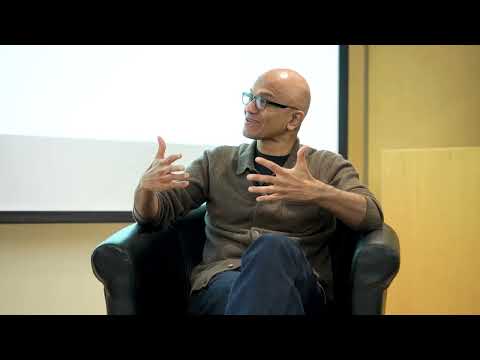
Satya Nadella explained why renting the best AI model costs a company its edge at the frontier. And why that decides who ends up owning the frontier itself. If a model learns from data, he asked, what is the future of the firm? A firm today is its private knowledge and its people. Feed that into someone else's model and the value walks out with the tokens. So Microsoft licenses its models with the weights included. Any company can set up its own training environment, its own private evals, and let a model train on its own data. The traces, the IP, the outcomes stay with the company. He was specific about what compounds. Not just human capital. Token capital. Then the line that matters: if you're just a consumer of a foundation model, Nadella isn't sure how you keep enterprise value, let alone create it. And that's his actual point. The only way the whole thing stays positive-sum, with lots of companies at the frontier instead of a few labs taking everything, is if every company builds and retains its own IP. Full talk on @StanfordOnline
English
1
0
0
106