Matthew Crupi

167 posts

Matthew Crupi banner
Matthew Crupi

Matthew Crupi

@crupi_matthew

Investor, check out my substack :) https://t.co/lskAB3tZPK

Katılım Ekim 2020
147 Takip Edilen283 Takipçiler
Matthew Crupi retweetledi
Stocks & Stones | Mathieu Martin
$XLY.TO $CBWTF The current setup in Auxly reminds me a lot of Kraken Robotics $PNG.V in 2023. Here's why: In 2023, Kraken's founder retired and decided to sell his 10%+ stake on the open market, making the stock crater from $0.65 to $0.35 over 6-7 months. Meanwhile, the business continued to perform exceptionally well, posting record quarterly results. Once the founder finished selling, there was no supply left, and the stock snapped back +55-60% in 2 months (and then went on its epic bull run). Auxly has faced similar heavy selling pressure over the last year or so. When the company was in financial trouble three years ago, it raised capital and issued/amended numerous warrants with an exercise price of $0.045/share. Most of these warrants were set to expire this month. Based on the intel I got, the hedge fund holding those cheap shares and warrants has been liquidating them on the open market for several quarters, selling into every positive news that the company put out. That structural selling pressure has prevented the stock from moving higher, despite the company posting record financial results almost every quarter. If you look at the volume over the last two weeks, Acumen Capital crossed 3 large blocks of shares, including the last one this morning (shown in the picture below). With this trade, I believe that all the remaining $0.045 warrants have been exercised and the shares sold to long-term holders. The overhang should now be GONE. At 7x TTM EBITDA (and 5x forward EBITDA based on my estimates), Auxly screens as one of the cheapest cannabis stocks in the market today despite its best-in-class growth and margin profile. This looks like a coiled spring that is poised for a re-rate. Disclaimer: This is only my opinion and should not be treated as a recommendation or investment advice. I am wrong a lot. The Rivemont MicroCap Fund is a shareholder of Auxly Cannabis Group (TSX: XLY) and Kraken Robotics (TSX-V: PNG). I am the portfolio manager and a unitholder of the fund.
Stocks & Stones | Mathieu Martin tweet media
English
4
2
43
4.7K
Matthew Crupi
Matthew Crupi@crupi_matthew·
Great piece by @ralphinvests on Armanino foods $AMNF. This is deep research that highlights the economics of the foodservice pesto market and the market structure that has allowed $AMNF to accelerate in the past 5 years in particular. Give it a read on his substack if interested.
English
1
1
4
415
Rose Celine Investments 🌹
Rose Celine Investments 🌹@realroseceline·
I bought a new stock for my portfolio today. Only the second new position I have started this entire year. It is a $3.5b small cap non tech company that I have admired for many years, but I was never able to buy it because the valuation always felt too expensive. I think one of the hardest things in investing is accepting that a great business and a great investment are not always the same thing. Sometimes the business is incredible for years while the stock itself is a terrible investment simply because expectations and valuation became disconnected from reality. Ironically my first purchase this year was $NOW, which at the time was considered one of the worst buys imaginable on this platform and I got totally killed in here. People were acting like the business completely broke overnight. A few weeks later sentiment flipped and suddenly it became a loved companies again. The fascinating part is the actual business barely changed during that period. Mostly the stock price and the narrative changed. That is one of the biggest lessons over time. Social media sentiment moves much faster than business fundamentals. Investors often confuse volatility with change. A stock declining 25% does not automatically mean the business is suddenly 25% worse. Another thing I have learned is that patience in investing looks stupid until it suddenly looks disciplined. I only bought 2 new stocks this year because truly great opportunities are actually pretty rare. Most people trade constantly because activity feels productive, but some of the best returns I have ever had came from doing almost nothing for long stretches and then acting aggressively when price, expectations, and quality finally aligned. What interests me most is not next quarter or even next year. I care far more about what this business can potentially look like 5-10 years from now. Is the moat strengthening? Are the unit economics improving? Does management allocate capital intelligently? Those questions matter infinitely more to me than whether social media currently loves or hates the stock. I no longer really share my exact buys and sells publicly the way I used to. Not because I am trying to be secretive, but because I do not want people blindly copying me without fully understanding the risks, valuation, time horizon, etc. A stock that fits my portfolio, psychology, and long term expectations may be completely wrong for someone else. I think social media has created this idea that investing is about copying and cloning instead of thinking. But real investing is much deeper than that. Two people can buy the exact same stock and have completely different outcomes because one understands what they own and the other is simply following a narrative. 🌹
English
76
5
252
46.5K
Matthew Crupi
Matthew Crupi@crupi_matthew·
@realroseceline Yes, there may be investors around the world who may be better than you in certain areas. They can analyze some sectors better than you, have a better circle of competence potentially. But experience may be the best asset for a long term investor, and that is your strength.
English
2
0
0
87
Matthew Crupi retweetledi
Mister Planero
Mister Planero@MisterPlanero·
$MELI hoy demostró que puede crecer aún más si se lo proponen. Pero a costa de matar los márgenes a corto plazo. El negocio mejora cada día, aún así, pisan el acelerador para alejarse de la competencia y tener mayor cuota de mercado. No quiero ganancia hoy, quiero ser el rey mañana. Es un mercado de ansiosos. Hace poco un informe demostraba que el promedio de tenencia por activo es de 7 meses, cuando antes era de años. Todo es de corto plazo. Las redes sociales, la tecnología, el día a día, nos hicieron más ansiosos. Hoy la gente quiere todo YA. Nos mal acostumbramos. Eso genera ansiedad. La ansiedad genera venta, compra y volatilidad. Creo que en estos años, el que sepa esperar y analizar negocios, puede hacer mucho dinero. El que mire la cuenta seguido, va a perder.
Español
3
5
87
3.5K
Matthew Crupi retweetledi
CapexAndChill
CapexAndChill@CapexAndChill·
Another great report from $UBER. Some thoughts on the call 👇 Uber is using AI to fundamentally change its cost structure. AI agents now write over 10% of Uber's production-ready code. Almost all of Uber's software engineers use AI coding tools every month. This massive boost in developer speed allows Uber to slow down new corporate hiring. The app now successfully guesses a rider's destination 75% of the time using AI. Rising auto insurance costs were a massive burden for Uber in recent years. That trend is now reversing. Uber locked in hundreds of millions of dollars in insurance savings for 2026. Instead of keeping the extra cash, Uber is passing the savings to consumers through lower prices. These lower prices are driving faster trip growth. California markets like Los Angeles and San Francisco are seeing the biggest improvements. Uber is not just placing robotaxis on its app. They are building the financial and physical infrastructure to control the entire autonomous vehicle space. Uber expects to have autonomous vehicles live in 15 global cities by the end of 2026. They launched Uber Autonomous Solutions to help partners commercialize faster. Uber partnered with Marsh and Apollo to create a unique insurance facility just for AV's. Uber is working with Santander to solve the complex challenge of financing expensive autonomous fleets. Uber is actively locking consumers into a single ecosystem where rides, food, and travel feed into each other. The Uber One membership program hit 50M global members. These members now generate exactly half of all gross bookings across both Mobility and Delivery. A new $EXPE partnership puts 700K hotels directly into the Uber app. Uber rewards hotel bookers with 10% back in Uber credits to spend on future rides and meals. Consumers who use multiple Uber services grow 1.5 times faster than users who only use one service. Great call as usual! Love Seeing this team execute.
CapexAndChill tweet media
English
7
5
72
4.8K
Matthew Crupi retweetledi
Sidecar Investor
Sidecar Investor@sidecarcap·
Countless investors already own the stock that will make them rich. And almost everyone will sell due to some temporary business issue or economic concern. Knowing when to hold is almost the whole game.
English
5
8
73
4.8K
Matthew Crupi retweetledi
Christopher Bloomstran
Christopher Bloomstran@ChrisBloomstran·
Now he expects a $25 trillion market cap. That’s 36% of the entire overvalued U.S. stock market and 22% of global GDP. My god he’s the CEO of a public company and says this promotional, absurd garbage publicly. Somebody, anybody, please make it stop. @SECGov
Joe Rogan Podcast News@joeroganhq

Elon Musk: "I kind of agree with Ark Invest and Cathie Wood that autonomy, robotic taxis, makes Tesla about a $5 trillion company. The Optimus robot, I think, makes Tesla a $25 trillion company."

English
66
69
554
101.3K
Matthew Crupi
Matthew Crupi@crupi_matthew·
How many Tesla car owners who got defrauded by musk for FSD are going to be eager to buy another Tesla?
English
0
0
2
69
Matthew Crupi retweetledi
Political Reality
Political Reality@PolitiReality·
For the simps that think $TSLA actually had positive cash flow, just take a look at the 1.3B increase in payables. Usually when your business slows down your payables decrease, or at best stay flat when you stretch out the time. In this case sales are 71 days which means they are for purchases that all fell in Q1. As such, $TSLA will likely take a $3-5B hit to cash every quarter starting in Q2. At that rate, the cash will run out by end of ‘27. Enjoy the ride fanboys.
English
9
7
72
3.1K
Matthew Crupi retweetledi
BonkDaCarnivore
BonkDaCarnivore@BonkDaCarnivore·
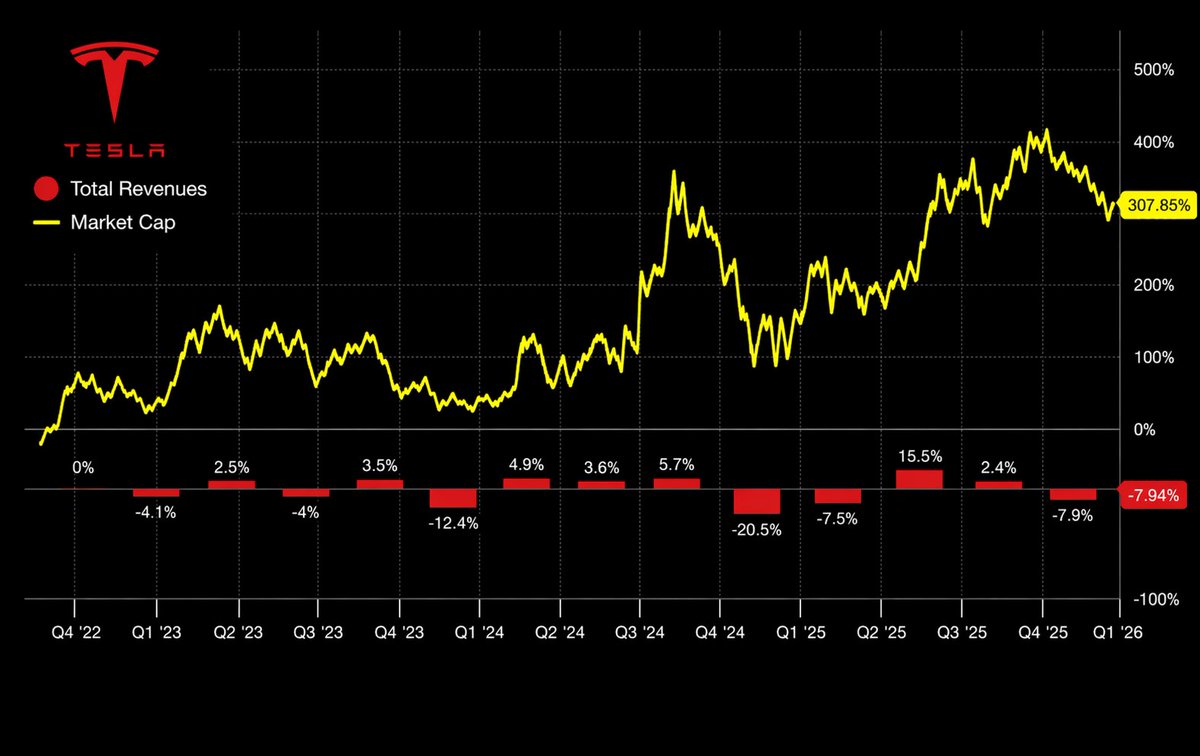
The disaster that is $TSLA's earnings, pt 1: There was so much wrong with Tesla's Q1 earnings tonight that I have to break it into smaller bits, and it could very well take up every queued post slot today. Let's dive in, shall we? Their Q1 print, at a glance, was "respectable enough" - EPS of .41 on just under 22.4B in revenue on the top line - good for a 17% and 1% beat of the ankle-high already reduced expectations of the street. YoY EPS of 52% and 16% on rev. QoQ numbers looked bad, but they couched it as the result of their aggressive sales promotion drive in Q4 to clear inventory (read: To make sure Elmo cleared the gates for his equity based compensation). Stock initially popped ~5% on the release. The only problem? It's all BS. If you look under the hood, you'll see that a whopping 480 million of their top line revenue was 1 time. Excluding that alone would knock their EPS to .31, an 11.4% miss. How did they do it and generate so much "free cash"? A big part was the age-old trick of *checks notes* simply not paying their bills. They had a quarterly revenue decline of 2.5B, papered by a 1.3B increase in payables with declining receivables of 617M. Oh, and they dumped their pre-paid expensive levels to 1B. They pushed supplier payments by 10 days - from 61 to 71. For the record, 6 months ago it was only 52 days, so they've stretched out their payments by 30%. Another way they did it was by - somehow, and I'm not sure how they did this or why it would pass audit - counted their tariff receivables twice (they booked the refunds both as income in auto and energy), and then cooked the books on how they calculate warranty flow. On that same vein of "simply don't pay": The expectation was they were going to report -1.8B in free cash and "surprised" with +1.4. Remember that 20 billion in capex they said they were going to spend on AI in FY26? Well, they upped that projection to 25B...but didn't spend ANY of that additional capex they said they were going to spend, in an attempt to frame their "hypergrowth" tale - they're implying they're going to backload it onto Q4 26 to drag out impact. Matter of fact, they only paid for 2.5B worth in Q1 - less than half of their previously claimed run rate. Meaning, if they hadn't delayed their previous stated expenditures, they would have missed by 300 million. And I don't even want to go into how they issued 4.5B in new debt. TL:DR: Literally everything about this earnings call, from a numbers perspective, is either outright fake or depressingly bad. If you don't see that, then you aren't an investor, you're a cultist.
BonkDaCarnivore tweet media
English
38
97
468
36.4K
Matthew Crupi retweetledi
George Noble
George Noble@gnoble79·
Last night was the biggest disaster in the history of Tesla. Let me walk you through what actually happened on that earnings call, because the headlines are doing you a disservice: Elon Musk got on the call and admitted (his words) that Hardware 3 "simply does not have the capability to achieve unsupervised FSD." He said he wished it were otherwise. He said the memory bandwidth is one-eighth of what Hardware 4 has. And that's the end of the conversation. Approximately 4 million Tesla vehicles on the road right now have Hardware 3. Many of those owners paid $8,000 to $15,000 for Full Self-Driving capability based on Musk's repeated promises (going back to 2016) that the hardware was sufficient for full autonomy. As recently as 2022, Musk was publicly assuring owners that HW3 had the processing power to get it done. BUT IT DIDN'T Those promises are now officially broken. The solution is a "discounted trade-in" toward a new car with Hardware 4. Not a refund or a free upgrade... A discount on buying ANOTHER Tesla. Investor Ross Gerber said it too - all HW3 owners got screwed, and with roughly 285,000 FSD purchasers affected, the potential liability runs into the BILLIONS. But that's not even the worst part. Musk was asked if the current FSD v14.3 was ready for unsupervised deployment. He said yes. Then immediately walked it back and admitted Tesla has "major architectural improvements" in the pipeline that would significantly improve safety. What he really means: the software isn't SAFE ENOUGH to deploy without a human watching. Full unsupervised FSD for consumer cars is pushed to Q4 2026. At the earliest... Maybe. How many times has this deadline been pushed? I've lost count. And trust me, I've seen a lot of broken promises. But this one takes the cake. Now let's talk about the numbers everyone is celebrating: Tesla reported $22.4 billion in revenue and $0.41 in non-GAAP earnings. A "double beat." The stock popped 4% after hours. Victory, right? WRONG Dig into the actual filing: The number one driver of operating income improvement wasn't cost reductions, wasn't volume growth, wasn't FSD revenue. It was - and Tesla listed this FIRST in their own shareholder letter - "one-time benefits related to warranty and tariffs." They released warranty reserves. They booked tariff refund windfalls. They stretched supplier payments by 10 days. They took on billions in new debt. Then they presented everything through non-GAAP metrics that strip out over $1 billion in stock-based compensation. GAAP net income was $477 million on $22.4 billion in revenue. That's a 2.1% net margin. On a $1.4 trillion market cap. Let me put that in perspective: 3.75 billion shares outstanding. Annualize the Q1 GAAP profit and you get roughly $1.9 billion. That's a trailing P/E ratio north of 700. Use the adjusted number - strip out stock comp, which is a REAL cost to shareholders through dilution - and you're still at around 250x earnings. All of this is extremely bad, but I didn't even talk about the CAPEX BOMB yet... 3 months ago, Tesla guided to "over $20 billion" in 2026 capital expenditure. Last night they raised it to over $25 billion. A $5 billion increase in a single quarter. That's 3x their historical annual capex run rate - $8.5 billion in 2025, $11.3 billion in 2024. The CFO confirmed on the call that Tesla expects NEGATIVE free cash flow for the rest of the year. So you have a company generating roughly $6 billion in annual free cash flow on a good year, and they're about to spend $25 billion. The math doesn't work. They will almost certainly need to issue equity. Which means dilution. Which means the $1.9 billion in annual earnings gets spread across even MORE shares. The core auto business is literally deteriorating in real time: Tesla delivered 358,000 vehicles in Q1 (missed estimates again). They produced 408,000. That's 50,000 cars sitting on lots that nobody bought. Inventory days jumped from 10 to 27 in just a few quarters. California (their most important US market) saw registrations crash 24% year over year. Their market share in the state fell from 9.2% to 7.7%. That's on top of a Q1 2025 that was ALREADY weak from Model Y retooling. They're declining off a decline. And here's what really kills the bull case... The entire valuation rests on robotaxis, Optimus robots, and autonomy. So let's put numbers on it: Waymo - the actual leader in autonomous driving with 15 million completed rides in 2025 alone, over 127 million autonomous miles driven, operating commercially across 6 US cities with plans to expand to 20 more - just raised $16 billion at a $126 billion valuation. That's the market's verdict on what the LEADING robotaxi company is worth. $126 billion. And Waymo is YEARS ahead of Tesla in actual deployment. Tesla has 3.75 billion shares outstanding. So even if you assign $126 billion in robotaxi value (giving Tesla full credit for matching Waymo despite being nowhere close) that's $33 a share. Add the auto business at generous auto-industry multiples, maybe $20 a share. Throw in energy storage and services, $10-15. Sum of the parts gets you to roughly $65-70 a share if you're feeling generous. Maybe $50 if you're not. The stock is $387. So what exactly are you paying for? You're paying for a STORY. You're paying for PROMISES that keep getting pushed back, technology that keeps falling short, and a business plan that requires spending $25 billion a year while the core product sells fewer units at declining margins in a market where California sales just fell 24% and the federal EV tax credit is gone. I managed the number one mutual fund in America. I founded two billion-dollar hedge funds. I've been doing this since 1981. And I am telling you: Tesla at $387 is one of the most egregious mispricings I have seen in my entire career. THE CRASH WILL BE EPIC
English
1.2K
2.6K
10.4K
1.2M
Matthew Crupi retweetledi
Hamid
Hamid@hamids·
Oh man. I just listened to the $TSLA call and it's very cringe-worthy. Tesla was up ~4% on what seemed like a beat before the call and after the call, the stock ended down. Tomorrow might be even worse as people start to digest all the info. Energy business, which was supposed to be growing rapidly and make up for the car-business shortfall, is down y-o-y. The Fremont factory conversion getting ready for Optimus, appears to be behind schedule based on Elon's comments. They set expectations that CapEx growth is going to be massive going forward as Tesla continues to invest in AI and factories. Slow Robotaxi rollout was initially blamed on regulators, then later Elon gave lots of examples of edge cases that he thought were so funny, but the issues need to be resolved before rollout. This is something that many people have been saying for a long time. Being "scared of crossing railroad tracks" is no joke! Then the whole HW3 fiasco...Finally another admission that HW3 will never achieve FSD. So many people paid between $6K - $15K for HW3. The lawsuits around this are not going to be good. Then there's the recurring New Roadster demo, which is perpetually a month away and always continues to be a month away! 🤣 With a PE of 214, you can't even say "but look at the future" because the forward PE is expected to be even worse at 248! Ouch. As someone who held $TSLA stock for ~9 years (2015 to 2024), I can't help wonder what people see in it today?
Hamid tweet media
English
181
80
964
200.2K
Matthew Crupi
Matthew Crupi@crupi_matthew·
@realroseceline If I buy in today at $1.5T, approx what year will the business be generating $100B in earnings for a earnings yield of 6.6%? But 6.6% isn’t enough for me, so in what year will they generate $200-300B to justify me buying today?
English
1
0
2
567
Rose Celine Investments 🌹
Rose Celine Investments 🌹@realroseceline·
Thoughts on $TSLA $TSLA is clearly no longer just a car company and this report makes that obvious. Musk is basically walking on water right now. The fact that he’s building autos, energy, AI, robotics, and a Robotaxi network all at once while still producing serious free cash flow is something you almost never see in business. And yeah, people are going to point to the PE and say it’s expensive, but that completely misses what’s actually going on here. Quite frankly, that argument is moronic and shows a lack of understanding of what’s being built. Most companies struggle to do one thing well. $TSLA is trying to solve manufacturing, energy, autonomy, AI infrastructure, robotics, and fleet economics all at once. And somehow it’s still generating billions in free cash flow. That’s not normal, it’s not even comparable. They’re scaling the core auto business, building energy, and at the same time pouring capital into AI and autonomy. This is an entirely different economic model. The bet is simple, give up near term margins to build something that looks more like software later. Revenue was $22b, up 16%. That came from more deliveries, services up 42%, better pricing, and more FSD revenue. But not all of it was perfect. Energy was down and regulatory credits fell, so the growth was still good, but mixed. Profitability improved, but let’s not pretend this looks like a software company yet. Operating income was about $900m with a 4.2% margin and $500m in net income. Margins are moving up, but they’re still low relative to what this business could become. The reason is obvious. They’re spending heavily on AI, R&D, and infrastructure, and SBC is still elevated. That’s their strategy, and they’re deliberately compressing margins today to build something much bigger over time. Cash flow is what matters most because they generated roughly $4b in operating cash flow and $1.4b in free cash flow. That’s very impressive, but they’re also spending $2.5b on capex and invested $2b into SpaceX. This is still a capital heavy business today, even if the long term goal is to become asset light. The balance sheet is what makes all of this possible. Around $45b in cash and a massive asset base. That gives them time, and time is everything when you’re trying to build something this ambitious. Every dollar $TSLA generates isn’t being returned, it’s being redeployed into AI compute, factories, and vertical integration. This isn’t a company optimizing earnings, it’s a company allocating capital into optionality. The question isn’t margins today, it’s what those dollars earn over the next decade. This quarter, operations were a bit more mixed. Deliveries were 358k, up 6%, while production was 408k, up 13%. Inventory moved up to 27 days. That’s not alarming, but it tells you demand isn’t running away from them anymore. They are no longer supply constrained. FSD is my favorite part of the report. Subscriptions hit 1.28m, up 51%. That’s a huge deal because it is an early signal of the shift from selling a car once to monetizing it over time. If that works, the entire model changes drastically. At 1.28m subscribers, even modest pricing starts to matter big time. At $100 a month, that’s roughly $1.5b a year. Scale that across tens of millions of vehicles and the numbers start to get enormous. This is how a car company slowly becomes a software company. Energy had a weak quarter with storage down 15%, but I wouldn’t overreact. This business is lumpy and new capacity is coming online. Longer term, it’s still a meaningful growth driver. Meanwhile, the infrastructure keeps getting stronger. The Supercharger network is growing close to 20% with over 8,400 stations and roughly 80,000 connectors. People don’t talk about this enough, but it’s a huge advantage. 1/2 👇
English
50
91
660
56.1K
Matthew Crupi retweetledi
Daniel Pronk
Daniel Pronk@PronkDaniel·
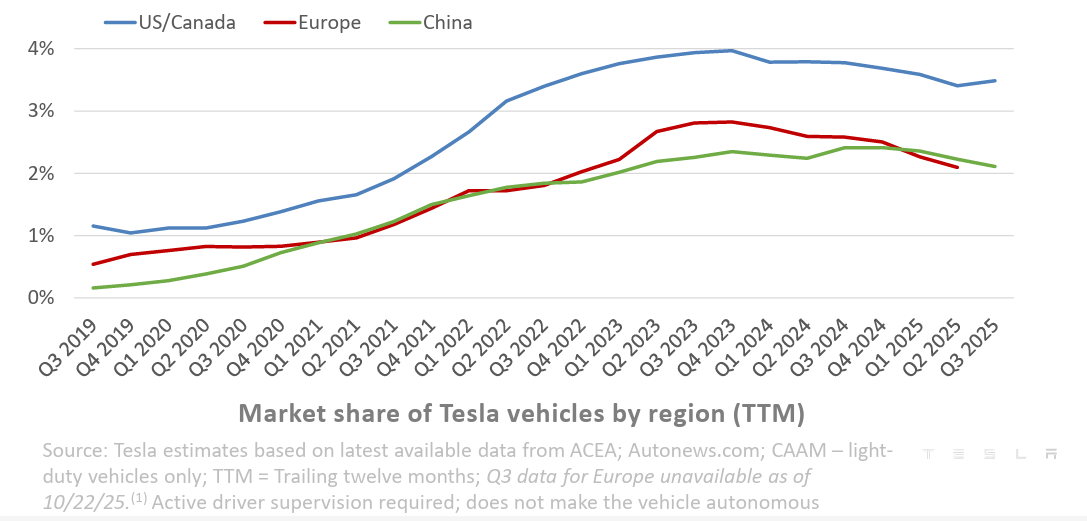
It's interesting that $TSLA no longer shares it EV market share slides. Looks like they stopped in Q3 2025. This was the most recent one.
Daniel Pronk tweet media
English
5
4
45
8.7K
Matthew Crupi retweetledi
Investor Denis
Investor Denis@InvestorDenis·
$UBER CEO in 2025: “Transportation alone is a trillion dollar opportunity. Autonomous should be the ultimate competition against personal car ownership. We’re still very early in the game.” Now in 2026, it’s clear $UBER has realized that if it doesn’t help $LCID ($500 million investment) and $RIVN ($1,25 billion investment) scale, it could end up without robotaxis. $UBER is securing supply by avoiding heavy capex. It’s going to handle insurance, cleaning, charging, remote assistance, etc., without buying robotaxis. But it does deploy funds strategically to ensure a guaranteed supply of robotaxis and finance their production. $UBER is going to be a major player in AV.
English
0
1
2
881