

Crypt
3.7K posts

Crypt
@cryptartisan
I break things & document insights
Onchain Katılım Aralık 2023
720 Takip Edilen741 Takipçiler
Crypt retweetledi
Introducing invoice financing marketplace on @arc
Businesses across the world issue invoices and wait for a long time to get paid. During that wait, their cash flow is frozen. Banks offer financing but the process takes long, costs high fees, and involves paperwork that most small businesses cannot handle. The system can be replaced with smart contracts that settle in under one second.
This product i built is called Arc Invoice Desk. A seller uploads an unpaid invoice. It gets minted as an ERC-721 NFT on Arc Network, with the invoice document stored on IPFS and its SHA-256 hash locked permanently onchain. A 24 hour Dutch auction opens. Lenders deposit USDC and compete by offering discount rates. The seller receives a USDC advance immediately when the auction clears. When the invoice is due and the buyer pays, the payment is converted atomically to USDC and distributed to lenders with their yield.
Every single feature of Arc Invoice Desk only works because of something specific that Arc provides.
The auction uses Arc's opt-in privacy to shield bid amounts. On any public blockchain, every bid is visible the moment it is submitted. Competing lenders can see your discount rate and undercut you by a fraction. The auction collapses into a race to the bottom. Arc lets lenders commit a cryptographic hash of their bid during the auction window. No one sees the actual rate. When the auction closes, bids are revealed and the lowest rate wins. This is the only way to run a fair Dutch auction on a public blockchain.
Settlement uses Circle StableFX, which Arc has integrated natively. A buyer in Germany can pay in EURC. A lender in France receives USDC. The conversion happens atomically in a single transaction on Arc. There is no intermediate step, no slippage risk, no counterparty exposure. Lenders never touch foreign currency. This works because Arc has sub-second finality through Malachite BFT consensus. On a chain with 12 second blocks, an atomic multi-step swap has a window where it can fail. Arc eliminates that window entirely.
Lenders deposit using Circle CCTP, which Arc supports natively. A lender can bring USDC from any supported chain directly into the Arc lending pool without manually bridging or switching wallets. Circle handles the cross-chain message and attestation. The funds arrive on Arc within minutes. This is what makes it practical for institutional capital to participate. Without this, most lenders would never bridge manually just to bid on one invoice.
Code Repo: github.com/Cryptbits/arc-…
Faucet: faucet.circle.com
Live: arc-invoice-desk.vercel.app
English
@OpenGradient ProofGraph
Crypt@cryptartisan
I built something on @OpenGradient it's called ProofGraph, a verifiable intelligence graph where every answer is cryptographically proven on the OpenGradient blockchain. Here's how it works, you ask any question, proofgraph fires 3 reasoning nodes in parallel inside OpenGradient's TEE, each one approaching the problem from a completely different angle. Core Analysis breaks down how something works technically. Evidence and Context brings the real world facts and comparisons. Key Takeaways gives the practical implications. Each of these three nodes runs simultaneously inside a hardware sealed AWS Nitro Enclave, gets paid for autonomously via x402 in OPG on Base Sepolia, and produces its own transaction hash on Nova Testnet. Once all three complete, a fourth node the Synthesis takes all three outputs and combines them into one final verified answer. That is 4 TEE inference calls, 4 transaction hashes and 4 nodes on the graph per query. Every node appears on the graph as it completes. Every node is clickable and links directly to explorer.opengradient.ai where anyone can verify the proof independently. The graph grows over time and new questions find and cite verified nodes from previous sessions so knowledge compounds. What is running underneath all of this: TEE inference via og.LLM so every node is hardware proven. x402 embedded directly inside the TEE so each node pays for itself. Digital Twin routing so each reasoning task goes to the most relevant specialist persona from Twinfun. MemSync storing completed sessions as persistent memory. Every proof hash settling publicly on OpenGradient's Nova Testnet. Note: Base Sepolia ETH: alchemy.com/faucets/base-s… and OPG on Base Sepolia: faucet.opengradient.ai are needed for testing. Live: proofgraph.vercel.app Code Repo: github.com/Cryptbits/proo…
Deutsch

We are highlighting a set of community-built tools developed on OpenGradient’s verifiable AI infrastructure.
These projects demonstrate how the Network for Open Intelligence can be applied to on-chain security, due diligence, and smart contract analysis, with an emphasis on verifiability and reduced reliance on trust assumptions. 🧵 👇🏻

English

Can't wait to see you here. community.arc.network
Arc@arc
Introducing Arc House, the new home for the Arc community, and Architects, the program recognizing the builders shaping the Arc ecosystem. Arc House brings everything together: → Educational content and discussions → Hackathons and events → Community groups and meetups → Builder activity and recognition The Architects program introduces a tiered system where contributors earn points, unlock roles, and gain visibility across the ecosystem. Arc House is where the community gathers. Architects recognize the people building it. arc.network/blog/introduci…
English

Introducing Arc House and the Architects Program
community.arc.network/home/content
English
I built a tool for the @getoro_xyz community called the Data Worth Calculator. You answer questions about the apps on your phone and it tells you the estimate of how much money Big Tech made from your data. The numbers are pulled directly from full year public filings, the most recent annual data available 2025/2026. (docs.google.com/document/u/0/d…)
This is exactly what you need to understand as we are looking forward to ORO AI Season 2
Instead of corporations extracting your data and keeping every dollar, ORO lets you contribute your data on your own terms and earn ORO Points for it, everything verified and recorded transparently on chain so no single company controls your payout. The technology uses zkTLS and Trusted Execution Environments meaning your private information is never exposed in the process.
Go try the calculator, see your personal number, share your result, then go straight to open ORO app and register. Your data has been working hard for everyone else for years. Season 2 is your chance to finally be on the right side of that equation.
Calculator: oro-data-calculator.vercel.app
English
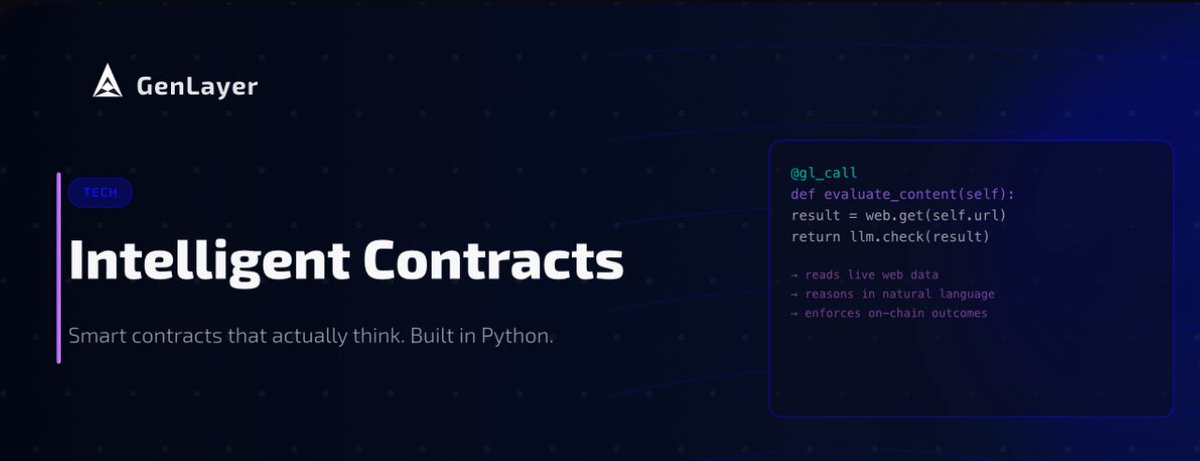
Why @GenLayer uses Python for Intelligent Contracts, here’s the answer.
Solidity is powerful for deterministic execution, but the world isn't deterministic.
Real disputes involve natural language. Real data is unstructured. Real decisions require context, nuance, and judgment not just boolean logic.
Intelligent Contracts are different:
- Written in Python (the language of AI and data science)
- Can read live web data directly, no oracles needed
- Interpret natural language instructions natively
- Reason about ambiguous terms like "satisfactory delivery" or "force majeure"
- Execute, enforce, and settle all onchain
Greyboxing keeps the AI execution sandboxed, Optimistic Democracy keeps the consensus decentralized and validators running diverse LLMs keep it honest.
This is what self executing contracts were always supposed to mean.
Resources: docs.genlayer(.)com
Get started: points.genlayer.com/?ref=POU603M3
Crypt@cryptartisan
The Bradbury Testnet is live and represents a key milestone for @GenLayer This network allows developers, validators, and researchers to experiment with Intelligent Contracts, AI validators, and consensus mechanisms under real network conditions. It provides an environment where the community can explore how decentralized AI validation works in practice. Testnets are often viewed as technical steps in a roadmap, but Bradbury represents the first opportunity to experience how AI native blockchain infrastructure behaves in a live ecosystem. Get started: points.genlayer.com/?ref=POU603M3
English

Crypt retweetledi
I built something on @OpenGradient it's called ProofGraph, a verifiable intelligence graph where every answer is cryptographically proven on the OpenGradient blockchain.
Here's how it works, you ask any question, proofgraph fires 3 reasoning nodes in parallel inside OpenGradient's TEE, each one approaching the problem from a completely different angle. Core Analysis breaks down how something works technically. Evidence and Context brings the real world facts and comparisons. Key Takeaways gives the practical implications. Each of these three nodes runs simultaneously inside a hardware sealed AWS Nitro Enclave, gets paid for autonomously via x402 in OPG on Base Sepolia, and produces its own transaction hash on Nova Testnet. Once all three complete, a fourth node the Synthesis takes all three outputs and combines them into one final verified answer. That is 4 TEE inference calls, 4 transaction hashes and 4 nodes on the graph per query.
Every node appears on the graph as it completes. Every node is clickable and links directly to explorer.opengradient.ai where anyone can verify the proof independently.
The graph grows over time and new questions find and cite verified nodes from previous sessions so knowledge compounds.
What is running underneath all of this: TEE inference via og.LLM so every node is hardware proven. x402 embedded directly inside the TEE so each node pays for itself. Digital Twin routing so each reasoning task goes to the most relevant specialist persona from Twinfun. MemSync storing completed sessions as persistent memory. Every proof hash settling publicly on OpenGradient's Nova Testnet.
Note: Base Sepolia ETH: alchemy.com/faucets/base-s… and OPG on Base Sepolia: faucet.opengradient.ai are needed for testing.
Live: proofgraph.vercel.app
Code Repo: github.com/Cryptbits/proo…
English

@cryptartisan @OpenGradient This looks solid, I tried it too and it’s top notch
English

@cryptartisan @OpenGradient I explored it a bit looks really promising 👌
English

@cryptartisan @OpenGradient Brooo!!! this is awesome, thanks for shipping this. 🙌
I’ll be exploring this
English

The Bradbury Testnet is live and represents a key milestone for @GenLayer
This network allows developers, validators, and researchers to experiment with Intelligent Contracts, AI validators, and consensus mechanisms under real network conditions.
It provides an environment where the community can explore how decentralized AI validation works in practice.
Testnets are often viewed as technical steps in a roadmap, but Bradbury represents the first opportunity to experience how AI native blockchain infrastructure behaves in a live ecosystem.
Get started: points.genlayer.com/?ref=POU603M3
English
AI models have improved dramatically over the past few years, but one constraint is becoming increasingly visible with high quality training data is finite. Public web data has been heavily scraped, filtered, and reused across multiple model generations.
@getoro_xyz 🧵

English