cryptokid73.xrd

651 posts

cryptokid73.xrd

cryptokid73.xrd

@cryptokid73

Katılım Eylül 2021
161 Takip Edilen50 Takipçiler
Hunter Horsley
Hunter Horsley@HHorsley·
There are two types of companies / projects in crypto — 1. One-cycle 2. Multi-cycle Admire all who build / contribute, and especially admire those who endure to be multi-cycle players. We’re now entering the next cycle.
English
35
17
228
22.5K
cryptokid73.xrd
cryptokid73.xrd@cryptokid73·
👀
Crypto_Girl@tadkis

Big milestone for @radixdlt Hyperscale design 👀 @flightofthefox just solved what he calls the last hard scalability problem: flattening the exponential cost of cross-shard provisioning. Instead of expensive per-transaction quorum checks across shards, the new design: •gossips compact shard block headers •verifies state via lightweight Merkle proofs •shifts cost from transactions to shards Back-of-the-napkin math: 95%+ reduction in bandwidth & compute at scale 🚀 This removes a major red flag for large BFT shard groups and sets the foundation for light clients and better transaction previews. Full explanation 👇 t.me/hyperscale_rs/… #Hyperscale #Web3Architecture #BlockchainScaling #DLT

ART
0
0
0
11
cryptokid73.xrd retweetledi
SURFMEISTER.XRD ❤‍🔥
SURFMEISTER.XRD ❤‍🔥@scropmeister·
🧵 If You’re Still Here, This Is For You. (1/🧵) Most people only show up for green candles. You stayed for the hard conversations. That already puts you in a different category. 🟣
SURFMEISTER.XRD ❤‍🔥 tweet media
English
5
13
32
311
vitalik.eth
vitalik.eth@VitalikButerin·
Ethereum itself must pass the walkaway test. Ethereum is meant to be a home for trustless and trust-minimized applications, whether in finance, governance or elsewhere. It must support applications that are more like tools - the hammer that once you buy it's yours - than like services that lose all functionality once the vendor loses interest in maintaining them (or worse, gets hacked or becomes value-extractive). Even when applications do have functionality that depends on a vendor, Ethereum can help reduce those dependencies as much as possible, and protect the user as much as possible in those cases where the dependencies fail. But building such applications is not possible on a base layer which itself depends on ongoing updates from a vendor in order to continue being usable - even if that "vendor" is the all core devs process. Ethereum the blockchain must have the traits that we strive for in Ethereum's applications. Hence, Ethereum itself must pass the walkaway test. This means that Ethereum must get to a place where we _can ossify if we want to_. We do not have to stop making changes to the protocol, but we must get to a place where Ethereum's value proposition does not strictly depend on any features that are not in the protocol already. This includes the following: * Full quantum-resistance. We should resist the trap of saying "let's delay quantum-resistance until the last possible moment in the name of ekeing out more efficiencies for a while longer". Individual users have that right, but the protocol should not. Being able to say "Ethereum's protocol, as it stands today, is cryptographically safe for a hundred years" is something we should strive to get to as soon as possible, and insist on as a point of pride. * An architecture that can expand to sufficient scalability. The protocol needs to have the properties that allow it to expand to many thousands of TPS over time, most notably ZK-EVM validation and data sampling through PeerDAS. Ideally, we get to a point where further scaling is done through "parameter only" changes - and ideally _those_ changes are not BPO-style forks, but rather are made with the same validator voting mechanism we use for the gas limit. * A state architecture that can last decades. This means deciding, and implementing, whatever form of partial statelessness and state expiry will let us feel comfortable letting Ethereum run with thousands of TPS for decades, without breaking sync or hard disk or I/O requirements. It also means future-proofing the tree and storage types to work well with this long-term environment. * An account model that is general-purpose (this is "full account abstraction": move away from enshrined ECDSA for signature validation) * A gas schedule that we are confident is free of DoS vulnerabilities, both for execution and for ZK-proving * A PoS economic model that, with all we have learned over the past half decade of proof of stake in Ethereum and full decade beyond, we are confident can last and remain decentralized for decades, and supports the usefulness of ETH as trustless collateral (eg. in governance-minimized ETH-backed stablecoins) * A block building model that we are confident will resist centralization pressure and guarantee censorship resistance even in unknown future environments Ideally, we do the hard work over the next few years, to get to a point where in the future almost all future innovation can happen through client optimization, and get reflected in the protocol through parameter changes. Every year, we should tick off at least one of these boxes, and ideally multiple. Do the right thing once, based on knowledge of what is truly the right thing (and not compromise halfway fixes), and maximize Ethereum's technological and social robustness for the long term. Ethereum goes hard. This is the gwei.
English
1.1K
957
7.6K
899.6K
sassal.eth/acc 🦇🔊
sassal.eth/acc 🦇🔊@sassal0x·
Why is the algorithm on here so broken? The 'For You' tab shows me many more posts from people I'm following than the 'Following' tab does but it also shows me absolute garbage about things I've never shown any interest in. Can the devs do something?
English
30
5
109
6.4K
cryptokid73.xrd retweetledi
avaunt.xrd
avaunt.xrd@a_vaunt·
@Radix_ecosystem Game changer for me. I don't feel safe transacting on any other Blockchain
English
3
1
15
197
cryptokid73.xrd
cryptokid73.xrd@cryptokid73·
Sounds about right. No pressure @timanrebel! 😅
PaulRello.xrd@chickenfinesse1

Everyone keeps asking why Radix looks ignored by the market If the tech works, why is nobody buying Here is the truth 🕊️ Dan left us 😨 The ecosystem panicked 🏃‍♂️ People left 🤯 Leadership got rattled 💸 Investors froze 💔 Confidence evaporated 🔥 That was emotional collapse ⚙️ Not technical collapse 📉 The price does not reflect the tech 😬 The price reflects fear But here is what people forget 🛠️ The team never stopped building 🔗 Hyperlane went live with permissionless bridging to 150 plus chains 🪪 idOS integration added decentralized identity and on chain reputation 📦 Astrolescent kept bringing liquidity ⚡ Tim Man began independent Hyperscale testing 🔬 Early tests hit six figure swaps per second 🧱 Validators prepared for the public Hyperscale test 🔒 Previous Radix Engine audits remained clean Now the entire future comes down to one thing 🔍 Does Hyperscale work or not ❌ If it fails 💀 Radix is finished ✅ If it works 🚀 The entire narrative flips overnight 📈 Exchanges return 🧱 Builders return 🌊 Liquidity returns 💼 VCs wake up 🎤 Influencers pretend they always believed ⚡ Tim Man already hit 100,000 swaps per second 📢 He said the architecture worked exactly as Dan designed ⏳ The market is waiting for public proof 🏁 The moment that proof drops 🌋 Everything changes #Radix $XRD

English
0
0
0
4
Cointelegraph
Cointelegraph@Cointelegraph·
⚡ QUESTION: Are you ok? Be honest.
English
380
22
682
99K
cryptokid73.xrd retweetledi
Radix Community Council
Radix Community Council@Radix_ecosystem·
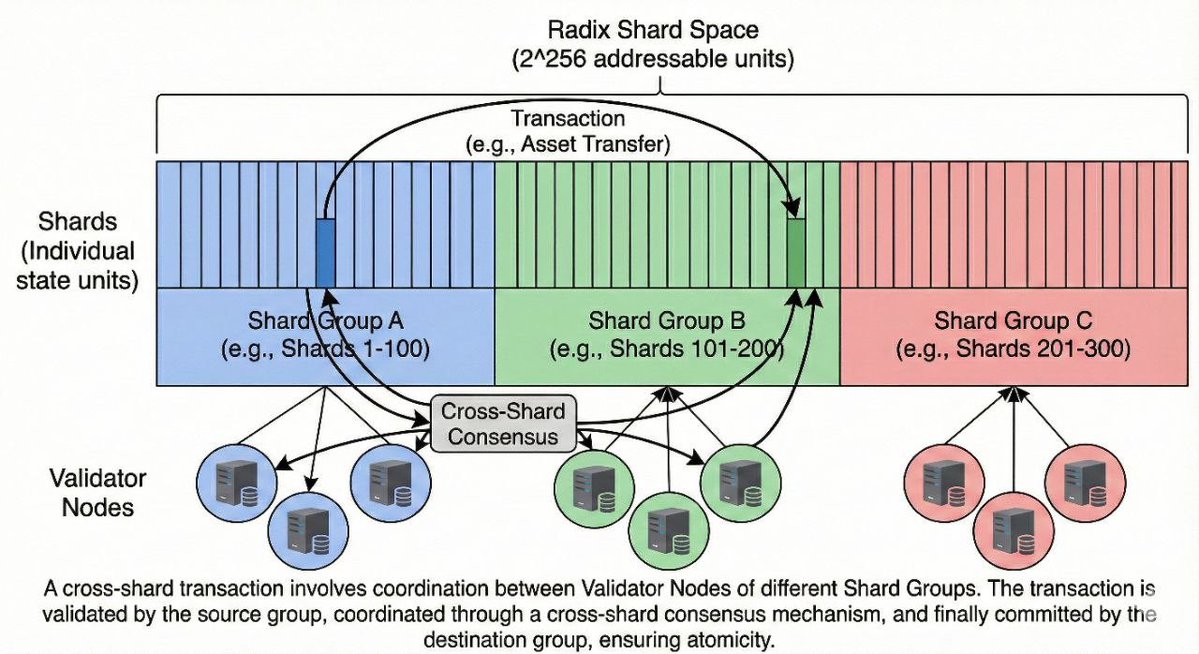
What is sharding? 🤔 And why does it matter for Radix? Imagine a huge supermarket with only one open checkout. Everyone stands in the same line. Slow. Frustrating. Traffic jam. - that’s how most blockchains work today. Sharding = opening thousands of checkouts at once. Each checkout (shard) handles part of the activity, so the whole system can scale smoothly. But here’s the catch: Most chains can’t keep your transaction atomic across different checkouts. If you need items from multiple aisles at once (DeFi), things break or get delayed. Radix is different. Radix shards the entire address space (2^256), and keeps all cross-shard actions atomic and safe - meaning everything either succeeds together or fails together. So DeFi works exactly as users expect. Fast. Safe. Predictable. At scale. Picture below 👇
Radix Community Council tweet media
English
3
39
82
1.3K