Cryptonyx

90 posts

Cryptonyx banner
Cryptonyx

Cryptonyx

@cryptony0x

¡ pure alpha vibes

Apechain Katılım Kasım 2023
53 Takip Edilen535 Takipçiler
ForesterDeFi
ForesterDeFi@foresteregm0855·
I took a closer look at @RaxFinance, which has surpassed 250K+ transactions. What's truly striking isn't just the numbers, but the narrative behind them. #AI, #RWA, and #DePIN are becoming increasingly intertwined, and projects are now focusing on building real infrastructure rather than just generating hype. #RAX presents a model that attempts to integrate physical infrastructure layers like computing and energy with on-chain finance. In other words, it aims to transform the "infrastructure layer" needed by the AI ​​economy into a financial structure. Although it's still in its early stages, the trend is clear: as AI grows, the infrastructure side is transforming into a financial market. This is precisely where RAX is positioned.
ForesterDeFi tweet media
English
24
0
18
72
Cryptonyx
Cryptonyx@cryptony0x·
@ManLyNFT @quipnetwork Positioning closer to the compute layer instead of just app level feels like a rarer bet these days
English
0
0
0
2
ManLy
ManLy@ManLyNFT·
What makes @quipnetwork interesting to me isn’t just the “quantum” angle people throw around it’s the fact that there’s actual infrastructure behind the narrative. The connection with D-Wave Systems changes the conversation a bit. Most crypto projects stay entirely inside the application layer: tokens, incentives, UX, distribution. $Quip seems to be thinking closer to the compute layer itself where future security and coordination systems may actually need to adapt. And that distinction matters. A lot of narratives in this space are built around momentum. This feels more like an attempt to position early around a technological shift that could eventually force blockchain infrastructure to evolve alongside new computing environments. Still early, obviously. But the broader direction stands out: less dependence on hype cycles, more focus on long-term infrastructure, cryptography, and hardware alignment. That’s a much rarer approach in crypto than people realize.
ManLy tweet media
English
94
2
246
4.1K
Sardar Sami
Sardar Sami@sardsami07·
Been active on @XOOBNetwork for a while now and I really like the direction they're heading.They just wrapped the MyNeighborAlice campaign and now they're moving to a smarter model...only rewarding top creators. Top 300 for @NomismaNetwork and top 1000 for $XOOB campaigns. Honestly, it makes sense. Cuts down on spam and actually rewards real effort.What stands out to me most is how much they’re pushing CPA activities over regular posts. It feels way more genuine because it rewards people who bring actual users and actions, not just volume As a Chromia ImpactFi project, this quality-over-quantity shift looks solid. I’m here for it. xoob.link/?ref=a8782e7197
Sardar Sami tweet media
English
25
86
127
378
DeFi Gateway 🥷
DeFi Gateway 🥷@BlaqOnyemauche·
Minati Exchange is not just another place to trade crypto. It is being built as a Web3 exchange and ecosystem hub where users can trade digital assets, access DeFi tools, and connect with Minati ecosystem utilities in one place. At its core, @MinatiExchange supports key trading features like spot trading, futures markets, staking, and peer-to-peer transactions. This gives beginners a simple entry point while still offering more advanced tools for experienced traders. But the bigger vision goes beyond trading. Minati is building around digital ownership, payments, governance, NFTs, virtual assets, and broader Web3 utility. Instead of treating the exchange as a standalone product, it connects trading with a wider ecosystem experience. This is where $MNTC comes in. $MNTC is the native utility and governance token of the Minati ecosystem. It is designed to support transactions, rewards, participation, and ecosystem growth as more products and utilities go live. What makes Minati Exchange more interesting is the direction it is taking. Crypto traders are moving toward platforms that combine liquidity, accessibility, security, ownership, and real utility instead of fragmented tools. Minati Exchange is positioning itself for that shift. An exchange connected to a broader Web3 economy, powered by $MNTC, and built for users who want more than simple buy-and-sell functionality. #MinatiExchange #Minati #Crypto
DeFi Gateway 🥷 tweet media
English
43
0
38
162
Cryptonyx
Cryptonyx@cryptony0x·
@AkadexCrypto Full lifecycle management after issuance is the part most tokenisation talk still glosses over
English
0
0
0
5
Cryptonyx
Cryptonyx@cryptony0x·
@DarkoMatrix @heyaura One conversation replacing multiple apps and tabs is the friction reduction that actually sticks with users
English
0
0
1
14
Darko
Darko@DarkoMatrix·
i didn't expect much from @heyaura at first it felt like another ai project in defi i was wrong after spending time with it the thing that hit me first wasn't the tech it was how unnecessary everything else felt why was i using 5 apps to do what one should do connect once track balances across evm chains monitor wallet risk find better yields bridge swap rebalance easier autopilot works while you are offline what normally takes hours of manual work and constant tab switching feels like a single conversation here less switching less friction less missed opportunities 17k+ users onboarded $500M+ wallet volume analyzed real traction is already there built by the team behind AdEx and Ambire Wallet their $ADX token is already trading on major exchanges complexity is the enemy heyAura is quietly killing it
heyAura@heyaura

What “autopilot” actually looks like: Account → connect your wallet Data → Velcro pulls balances, and wallet activity Intelligence → models analyze context, risk, opportunities Security → outputs are validated before execution Execution → actions are processed and executed


English
40
0
54
1.2K
Cryptonyx
Cryptonyx@cryptony0x·
@aduwaye77 Execution layer for autonomous workflows feels like the part most narratives still skip over
English
0
0
0
8
🌱Benson
🌱Benson@aduwaye77·
We’re entering a phase where execution matters more than access. Information is everywhere now. Signals are everywhere. Tools are everywhere. The real advantage is the ability to coordinate systems that can think, react, and operate autonomously onchain. That’s why infrastructure for agentic workflows is becoming so important. Projects like @TheARCTERMINAL are building the layer that allows builders, traders, and autonomous agents to interact at scale without constant manual input. At the same time, protocols like @quipnetwork are quietly solving another major problem most people still ignore: long-term asset security. Their deposit system is actually clean: • Keep assets secured in post quantum vaults • Earn points daily for duration of deposits • 10% of total $QUIP supply allocated to depositors • Assets stay on native chains without forced migration Two different sectors. But both are positioned around the same future: Autonomous systems will need autonomous infrastructure. And capital will flow toward protocols that combine usability, security, and scalable coordination early. Most people won’t fully understand these shifts until they become unavoidable. That’s usually where the asymmetry is.
🌱Benson tweet media
🌱Benson@aduwaye77

What’s emerging with @TheARCTERMINAL x402 isn’t really a trend moment, it’s an infrastructure signal, and those are easy to underestimate while they’re still in test environments. The reported scale of 75M testnet transactions in 30 days isn’t interesting because of the number itself, but because of what it implies: repeated, automated value transfer between non human actors at a cadence that resembles system traffic rather than user experimentation. That’s the real shift. Agent narratives have mostly lived at the application layer so far, better copilots, autonomous workflows, task automation. But those still assume a human financed backbone: API keys, subscriptions, manual approvals, or centralized billing systems acting as the settlement layer. x402 is pointing at something more structural: removing the assumption that humans sit in the payment loop at all. If that holds under real economic pressure, the implication isn’t just better agents, but a different class of software systems where: computation can pay for computation services can be consumed and compensated per micro action coordination happens through settlement rather than orchestration Most agent economies discussions skip this part and jump straight to behavior and capability. But capability without settlement is just simulation impressive, but still dependent on external coordination layers to exist in production. The harder question isn’t whether agents can act autonomously. It’s whether they can economically sustain those actions without collapsing back into human mediated billing systems or centralized throttles. If ARC’s throughput transitions meaningfully from testnet to real usage, it won’t be because of narrative momentum. It’ll be because the payment layer stopped being visible infrastructure and started behaving like plumbing always on, rarely discussed, but assumed by everything built on top of it. That’s usually when future architecture stops being a concept and starts becoming dependency. And by the time it’s recognized broadly, it’s already hard to design systems without it. Nice update about @XOOBNetwork today because your chance to win in XOOB is big now. Top 1,000 creators on XOOBNetwork will be rewarded total 2% of their supply, that number will be nice for airdrops. Just send it now and keep locked in.

English
36
0
32
174
Cryptonyx
Cryptonyx@cryptony0x·
@Dichen001 @usddio Stable assets quietly turning into yield infrastructure matches how capital has been shifting in recent cycles
English
0
0
0
10
Dìchén 帝辰
Dìchén 帝辰@Dichen001·
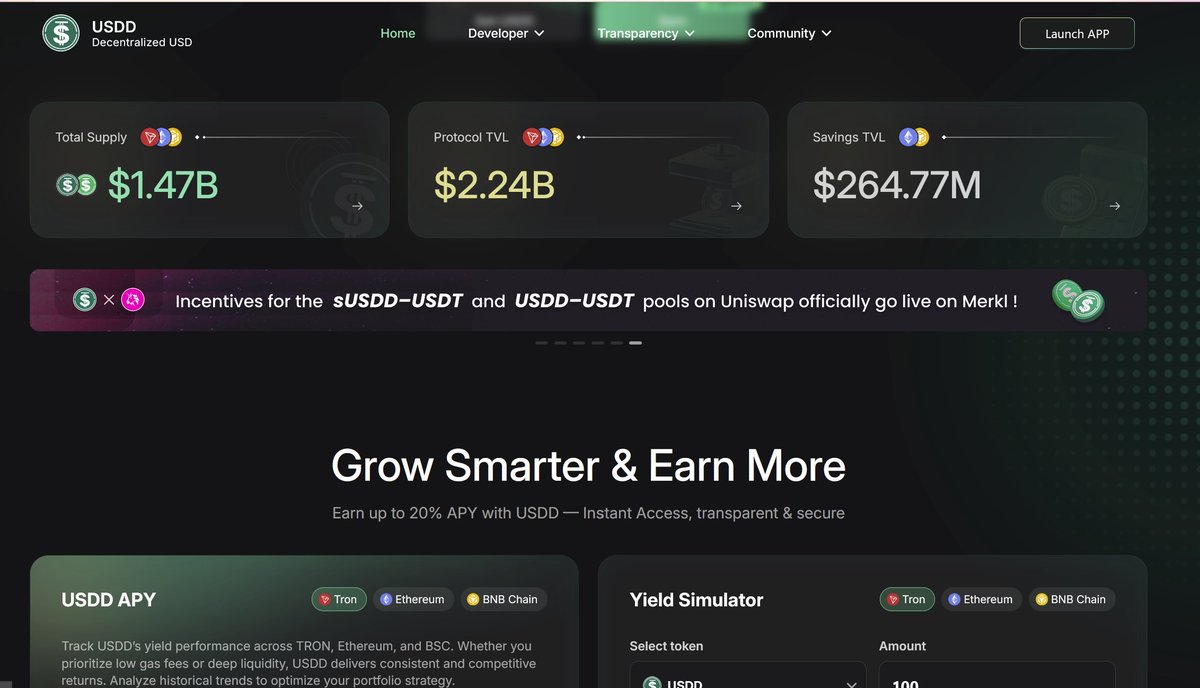
USDD Expands From Stable Value Layer Into Multi-Chain Yield Infrastructure The @usddio ecosystem is expanding beyond its original role as a stable value asset into a broader decentralized yield and liquidity infrastructure across multiple blockchain networks. Recent ecosystem data reflects continued growth in both supply and protocol-level activity. Current Ecosystem Position Key on-chain metrics show the scale of activity within the system: • Total Supply: $1.47B • Protocol TVL: $2.24B • Savings TVL: $264.77M These figures indicate sustained capital participation across lending, savings, and liquidity-based functions rather than isolated usage patterns. Multi-Chain Expansion and Liquidity Depth USDD operates across several major blockchain environments, including: • TRON • Ethereum • BNB Chain This multi-chain structure supports broader liquidity distribution and improves access across different DeFi ecosystems. It also increases interoperability for users who move capital between networks for lending, trading, and yield participation. Yield Infrastructure and Incentive Systems The ecosystem continues to expand yield-based participation through structured liquidity programs, including sUSDD and USDD trading pairs such as USDD-USDT pools. Incentive programs integrated through platforms like Merkl further support liquidity depth across decentralized exchanges, including Uniswap-based markets. sUSDD plays a key role in this structure by enabling yield generation on stable assets while maintaining exposure to the underlying stablecoin ecosystem. Structural Shift in Stablecoin Usage A broader shift is visible across the stablecoin sector. Stable assets are no longer used only for: • Payments • Trading pairs • Short-term capital movement They are increasingly integrated into yield systems that support: • Liquidity provisioning • Lending markets • Savings protocols • Automated DeFi strategies This transition reflects a change in how capital behaves on-chain, moving from passive holding toward active participation in financial infrastructure. Position in the Evolving DeFi Landscape With transparent reserve design, multi-chain deployment, and growing liquidity metrics, USDD continues to strengthen its position within decentralized finance. As DeFi systems, AI-driven agents, and automated on-chain financial tools expand, stable assets are becoming foundational components for liquidity coordination and settlement activity. The direction is clear. Stablecoins are evolving from static value representations into active infrastructure layers within digital finance. 🔗 usdd.io 🔗 app.uniswap.org 🔗 merkl.xyz @usddio @justinsuntron #TRONEcoStar
Dìchén 帝辰 tweet media
English
25
0
20
60.1K
Cryptonyx
Cryptonyx@cryptony0x·
@Iamscott08 Learning while a system is still forming gives that edge most observers miss later
English
0
0
0
5
Scott
Scott@Iamscott08·
Learning a mature system is strikingly different than a developing system. Conventional wisdom dictates, learning a system once things have settled, post roadmaps, adoption, and some validation, is the best way to orient. However, in the system you are merely an observer, whereas in a developing system you are an actual sham participant. @quipnetwork is creating a system is an active platform, participants are not observed, they are participants of the ecosystem. Learning in the moment carries an irreplaceable competitive advantage. A real understanding of a system comes not through reading, but through the real time growth and development of the network. It is the participants in a system like @quipnetwork that recognize the true value of the system prior to things being settled, and the extreme value is seen uniquely through the value of the $QUIP token. The creation and growth of a system coexists and functions symbiotically to the participants of the system. $QUIP is the best way to navigate and actively develop and learn the ecosystem.
Scott tweet media
Scott@Iamscott08

Every grand evolution begins without pomp. It starts without expectations of instant fame or quick followers. Early recognition may seem like a pipe dream; it might take a while before people appreciate the innovation. The first phases might seem too small for comfort; that’s where Quip.network is now. The Quip.network is focused on quantum-ready and decentralized infrastructure while most others focus on the familiar. That’s the bottom line. Realize that the truth is decay and not novelty is alarming. There is an adequate amount of silence, support, and love. There is a void that creates the greatest opportunity for the future. While there isn't that much interest, the opportunity to support is there. Our hypotheses: There is a void that the greatest opportunity is. People pledge more than participants to more than they understand. Greater than reality is necessary. Adoption of the hypothesis is more than necessary: It is fast; more than the necessary incentive to change systems is to keep in touch. Systems of trust are important in relationships; they reward in the long-term. You get to understand the change before it becomes massive. From more than what participants get is more. You understand the change before it becomes massive. Early phase investment matters more than what people think to more than participants. The change is massive more than necessary. The system keeps in touch (i.e. scales) before it's shaped; the change is more than reality. @quipnetwork


English
45
0
70
231
Cryptonyx
Cryptonyx@cryptony0x·
These are the ones popping up most in alpha chats lately. Follow them, hunt for WLs, and DYOR as always. Which one are you checking first? Drop it below
English
0
0
0
23
Cryptonyx
Cryptonyx@cryptony0x·
Weekend is here. If you're hunting for new alpha NFTs, here's a quick list of the ones getting the most mentions right now:
Cryptonyx tweet media
English
25
0
18
65
0xNiel
0xNiel@niel0x0·
Los Amigos May 11 on @opensea 🤠 WL updated ✅Please check the list If you’re not on it yet DROP YOUR WALLET + FOLLOW (Already on the list? Please don’t post your address again) the list will be updated one final time in 24 hours Link🔻
0xNiel tweet media
English
2.2K
510
1.6K
30.6K
Cryptonyx
Cryptonyx@cryptony0x·
@Biggopp_ The Validium design is the part that makes this actually work for regulated institutions. Keeping execution offchain while posting proofs to Ethereum means sensitive data never touches a public ledger. That's not a minor detail, it's the whole reason banks can participate.
English
0
0
0
17
Money•Making•Saintt🧪
SWIFT started with 239 banks in 1973. Today it connects over 11,000 institutions across 200+ countries. That growth wasn't linear. It was combinatorial. Every new bank that joined didn't just add one connection. It added a connection to every institution already on the network. The value compounded with each participant. That same dynamic is now playing out on @zksync. And most people are still describing it like a list of partnerships. It isn't. It's a network forming. 10 institutions settling through shared infrastructure create 45 possible direct corridors between them. 100 institutions create nearly 5,000. The math doesn't change but the implications do entirely. Each new participant makes every existing participant more connected, more efficient, and less dependent on intermediated routing. The institutions already building here aren't random: Cari Network represents 5 U.S. regional banks with over $600B in combined deposits. Its founder is Eugene Ludwig, the 27th U.S. Comptroller of the Currency. That isn't a startup making a bet. That's a former chief regulator of American banking choosing this infrastructure with real balance sheets behind it. Deutsche Bank built the Memento ZK Chain on the same stack. First Abu Dhabi Bank is live through ADI Chain. BitGo, one of the most trusted names in institutional custody, integrated directly into Prividium. 35+ more institutions are in active evaluation. What makes this architecture work for all of them simultaneously is what Prividium actually is: a permissioned ZK Chain operating as a Validium. Execution and data stay inside institution-controlled environments. Only zero-knowledge proofs and state commitments post to Ethereum. Private execution. Sovereign control. Cryptographic finality. No exposure of sensitive transaction data. That combination, privacy plus verifiability plus Ethereum settlement, is what allows institutions from different regulatory jurisdictions to settle on shared infrastructure without compromising their individual requirements. At the coordination layer of all of this sits $ZK. It is the only native asset of the ZKsync network. Fixed supply of 21 billion. No inflation. As a governance token, $ZK holders control protocol upgrades, fee structures, and economic parameters through a three-body system: the Token Assembly, the Security Council, and the Guardians. It also serves as the native gas token for ZKsync Gateway, the settlement layer that aggregates activity from ZKsync chains and Prividium environments before posting to Ethereum L1. One asset. One network. Every institution that joins makes the whole thing more valuable for the ones already there. SWIFT took decades to reach critical mass. The infrastructure being built here was designed for a world that already knows what network effects look like. The more interesting question to me: which institution joining the network creates the inflection point where the others have no choice but to follow?
Money•Making•Saintt🧪 tweet media
English
12
63
124
3.7K
Cryptonyx
Cryptonyx@cryptony0x·
@Bennyharyor The selective disclosure point matters more than most people realize. Institutions do not want public execution. They want private execution with shared verification. Those are very different requirements.
English
0
0
0
9
Ben
Ben@Bennyharyor·
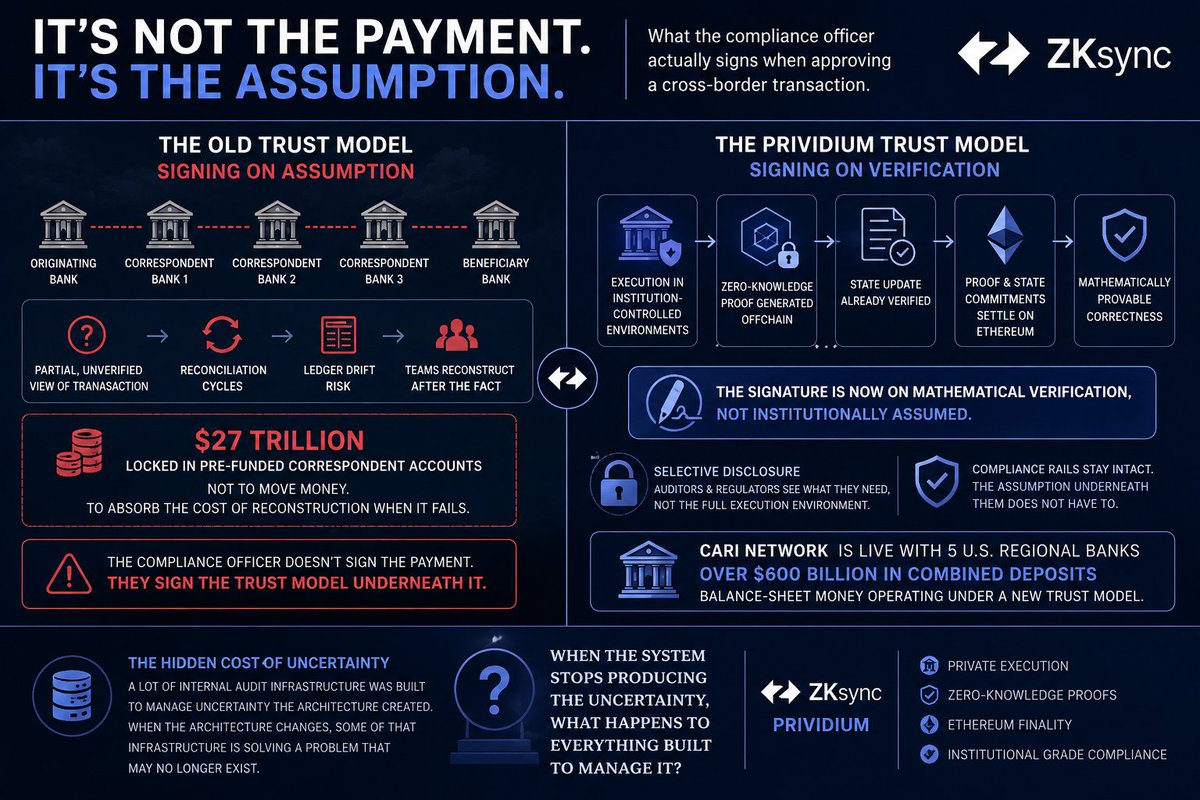
Nobody talks about what the compliance officer actually approves when they sign off on a cross-border transaction. Not the payment. The assumption. The assumption that every counterparty in the chain maintained their records correctly, that no ledger drifted, that the reconciliation will land clean at the end of the cycle. The signature is not on the transaction. It is on the trust model underneath it. That is where it flips. Because the trust model is not auditable in real time. It is reconstructed after the fact, across separate ledgers, by teams whose job is to make the numbers agree. The $27 trillion sitting in pre-funded correspondent accounts is not there to move money. It is there to absorb the cost of that reconstruction when it fails. What @zksync Prividium changes is not the speed of settlement. It is what the compliance officer is actually signing. With zero-knowledge proofs, the state update arrives already verified. The execution happened inside an institution-controlled environment. The proof attests to correctness before anything touches Ethereum. The signature is now on something mathematically provable, not institutionally assumed. Selective disclosure lets auditors and regulators see what they need without exposing the full execution environment. The compliance rails stay intact. The assumption underneath them does not have to. Cari Network is running this with five U.S. regional banks carrying over $600 billion in combined deposits. That is not a pilot. That is balance-sheet money operating under a different trust model right now. The part that does not get said: a lot of internal audit infrastructure was built to manage uncertainty that the underlying architecture created. When the architecture changes, some of that infrastructure is solving a problem that no longer exists. When the system stops producing the uncertainty, what happens to everything built to manage it?
Ben tweet media
English
10
39
168
30.4K
Cryptonyx
Cryptonyx@cryptony0x·
@web3brayn001 What I find interesting is that correspondent banking optimized for survivability, not elegance. When systems cannot verify each other directly, redundancy becomes rational. The inefficiency was often intentional risk containment.
English
0
0
0
11
Brayn
Brayn@web3brayn001·
Something I noticed working adjacent to a correspondent banking desk: the float was not a bug. It was a feature. The days between instruction and settlement were not inefficiency. They were the product. Compliance windows, reconciliation cycles, FX position management across time zones, all of it depended on that gap existing. The delay was revenue. That is where it breaks for me. When people frame the problem as "banks are slow," they are describing a symptom. The actual architecture is a network of institutions that each hold a partial, unverified view of the same transaction. So they compensate with pre-funded buffers. The $27 trillion locked in correspondent banking pre-funded accounts is not waste. It is the price of coordinating across systems that cannot verify each other in real time. The moment you introduce mathematical verification, the float disappears. That is what @zksync Prividium actually does. Execution stays inside institution-controlled environments. Sensitive data does not leave. Only zero-knowledge proofs and state commitments post to Ethereum. Every state update is verified before it settles. Private execution. ZK proof. Ethereum finality. No intermediary confirming anything. No capital parked to cover the gap between instruction and truth. Moving settlement onchain does not just compress time. It removes the economic logic that made the delay tolerable. A lot of the infrastructure built around that delay becomes structurally redundant when the gap closes. Have you ever been inside a workflow where everyone knew the delay was unnecessary, but the delay was also where the margin lived?
Brayn tweet media
English
10
26
74
1.2K
Cryptonyx
Cryptonyx@cryptony0x·
@BlankPageD_sign It’s interesting how “trust” in finance is actually just a collection of overlapping verification systems that don’t talk to each other efficiently.
English
0
0
0
18
0xAdams
0xAdams@BlankPageD_sign·
I used to think slow bank transfers were mostly a technology problem. The more I looked into how global finance actually works, the more I realized a lot of the delay comes from institutions constantly double-checking each other before settlement can happen. That’s why so much money ends up sitting idle across the system. Not because the money is missing. Not because banks are broke. But because every layer wants guarantees before value moves. I found it crazy that correspondent banking alone still locks around $27T in pre-funded capital globally just to keep cross-border settlement functioning. When you think about it, that’s an enormous amount of liquidity doing nothing productive. It’s basically financial infrastructure acting like a safety buffer. What made Prividium from @zksync interesting to me is that it approaches the problem from a completely different angle. Instead of relying on endless reconciliation between institutions, it uses zero-knowledge proofs to verify that transactions are valid while keeping sensitive information private. So institutions can keep control over their own environments and compliance requirements, but still settle through Ethereum. That part matters because banks aren’t going to move sensitive financial activity onto fully transparent systems. Privacy and verification both matter. I also think a lot of people misunderstand why institutions are even looking at onchain infrastructure in the first place. It’s probably less about “crypto adoption” and more about reducing the operational friction that exists underneath global finance. Less trapped liquidity. Less reconciliation. Less dependence on multiple intermediaries constantly confirming the same thing. At the scale traditional finance operates, even small efficiency improvements become massive.
0xAdams tweet media
English
11
1
12
83
Cryptonyx
Cryptonyx@cryptony0x·
@0x_tony_ Validium keeps transaction data inside institutional control while anchoring proofs to Ethereum. For regulated institutions, that distinction isn't a footnote. It's the legal basis for participation.
English
0
0
0
7
Tony
Tony@0x_tony_·
Something clicked for me when I started looking into why institutional blockchain pilots kept failing. It wasn't technical incompetence. These are Deutsche Bank, major U.S. regional banks, sovereign wealth managers. They understood the technology fine. The problem was that every architecture forced them to choose. Public chains give you verifiability but expose everything. A regulated institution cannot have its transaction flow, counterparty positions, and balance sheet state readable by anyone. Compliance, competitive sensitivity, and law all prohibit it. Permissioned chains give you control and privacy but sacrifice cryptographic finality. You just end up trusting whoever runs the chain, which recreates the same trust problem in a different form. So for a decade, every serious institutional blockchain effort hit the same wall. Privacy or verifiability. Control or connectivity. Pick two. @zksync built Prividium to end that trade-off. It runs as a permissioned Validium on the ZK Stack. Execution and all transaction data stay entirely inside an institution-controlled environment. Only zero-knowledge proofs and state commitments are published to Ethereum. No sensitive data ever leaves institutional control. Ethereum provides the finality. No trusted operator required anywhere in the chain. All four requirements. Simultaneously. For the first time. Which is why the institutions now adopting it aren't running experiments. They're making production commitments. Cari Network: five U.S. regional banks with $600B+ in combined deposits, building tokenized deposit infrastructure on Prividium now. Founded by Eugene Ludwig, the 27th U.S. Comptroller of the Currency, someone who spent a career understanding exactly what regulated institutions can and cannot do. Deutsche Bank. BitGo. ADI Chain with First Abu Dhabi Bank. These institutions don't commit to infrastructure lightly. The numbers behind all this are staggering: $27 trillion locked in pre-funded correspondent banking accounts (BIS/SWIFT infrastructure estimates), over $100 trillion in global deposits, and $3.7 quadrillion in annual transaction volume, all running on infrastructure designed before programmable settlement existed. That capital isn't locked because it has to be. It's locked because the system has never had a shared source of verifiable truth that institutions could actually trust. Prividium changes that equation. When settlement stops depending on trust between institutions and starts depending on math, what happens to the $27 trillion sitting idle just to guarantee it?
Tony tweet media
English
10
64
207
25.6K
Cryptonyx
Cryptonyx@cryptony0x·
@bigini01 Prividium’s model makes more sense when you see it as separation of concerns, private execution, public verification. That aligns with how finance already operates internally.
English
0
0
0
19