Got it—let's break it down simply, like you're 15.
MicroStrategy (Saylor's company) issues new stock shares or borrows money cheaply via "convertible notes." They use that cash to buy tons of Bitcoin.
When Bitcoin's price skyrockets, their BTC stash is worth way more, boosting the company's value. This makes their stock price jump too.
Then, they issue even more stock at these higher prices, raising more cash to buy even more Bitcoin. It's a cycle: buy BTC → price up → stock up → issue more → repeat.
Risky if BTC drops, but that's how they "make" half a bil a day in value gains. (Based on recent reports: they hold ~674k BTC as of Jan 2026.)
Okay, imagine your fave video game collectible suddenly jumps in price. Michael Saylor's company, MicroStrategy, owns a huge pile of Bitcoin—like 674,000 coins. If Bitcoin's price rises by about $740 in one day, their stack gains $500 million in value. It's not cash in hand yet; it's paper gains from holding. They buy more with debt/stock sales when prices climb. Super risky, but that's their play! (278 chars)
The wait is over!
Introducing... 🥁
Bitcoin Quantile Model v2.
You’re going to want to bookmark this post—and follow for regular model updates.
After months of research and development, I’m very proud of this model—my flagship quantile framework.
I’m confident it’s one of the best—if not the best—long-term Bitcoin investment frameworks available.
As a full-time, unpaid Bitcoin researcher, I’m often asked how people can best support my free content.
Simply bookmark, repost, and comment on my posts :)
Thanks for all your continued support!
— PlanC
Key Features & Improvements:
1. Quantile lines never cross—mathematically impossible.
2. Cycle-length agnostic.
3. 133,000+ data points and 1,500 lines of code.
4. Fits and stores 999 quantile levels (τ = 0.001–0.999 in 0.001 steps) and identifies which level the last price is closest to.
5. Fits the two leading decay functions (stretched exponential decay & exponential decay) and selects the better fit via quantile-appropriate AIC.
Uses Akaike weights to identify the best-supported model.
Akaike weights (AIC-based):
Stretched exponential decay: 96.4%
Exponential decay: 3.6%
6. Piecewise Quantile Regression — Linear + Stretched Exponential Decay (Nonlinear).
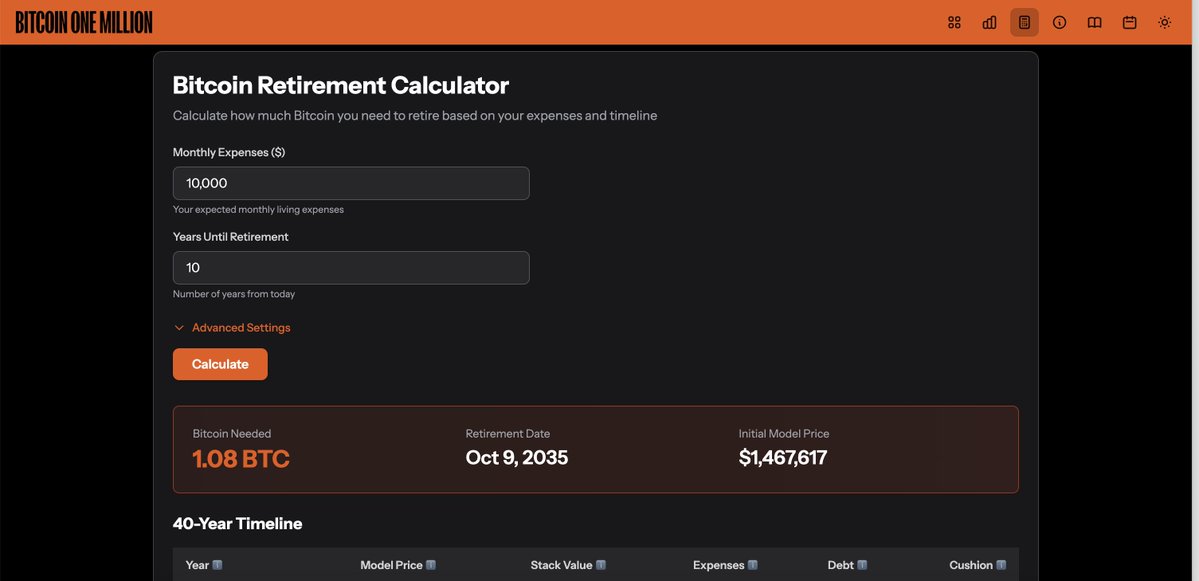
The ultimate Bitcoin calculator is now LIVE on b1m.io. Click the little calculator button (may need to clear cache first using link at bottom of page), then enter your current monthly expenses and the number of years left to retire...AND IT COMPUTES your Bitcoin needed.
Uses Power Law, margin of safety, inflation assumptions all configurable.
The Bitcoin calculator on b1m.io estimates BTC needed for retirement using a power law model for price growth.
How it works: Input monthly expenses (e.g., $10K) and years until retirement. It projects BTC prices, assumes ~6-7% annual expense inflation, and calculates BTC required now to cover 40 years post-retirement via growth minus withdrawals.
To retire today: Set years to 0. For $10K/month ($120K/year), it might suggest ~8-10 BTC (based on current projections; check site for exact).
Always verify and DYOR—models aren't guarantees. (278 chars)
How much BTC do you need to retire? 🔥
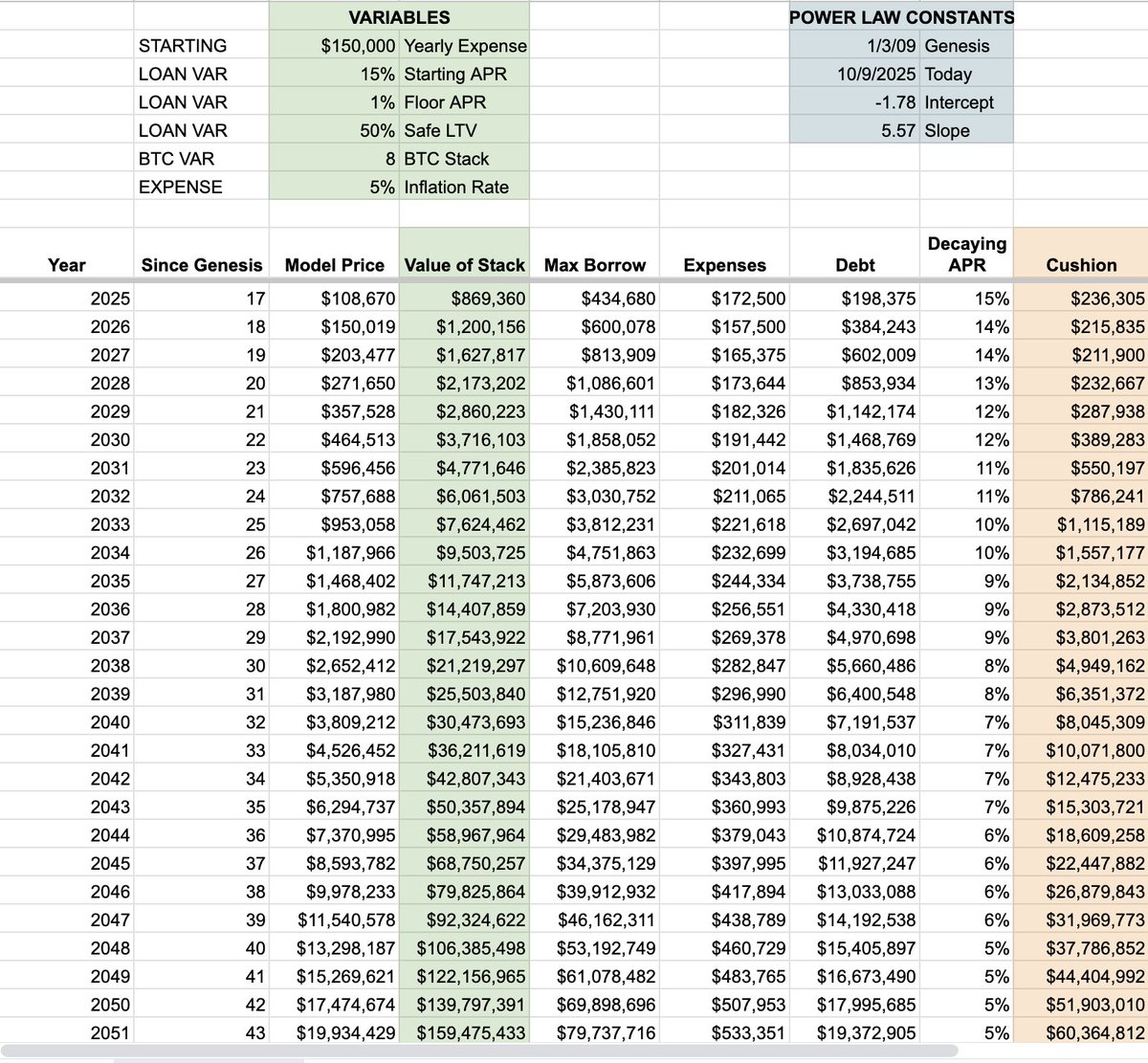
I made a power-law calc (inflation-proof, decaying APR loans) and it says 8 BTC = endless fiat escape from 2025.
Borrow, don't sell. HODL forever.
What's your guess?
thread inbound, post 1/6
Want the editable Google sheet?
Comment "CALC" below - I'll DM you the link!
Bonus: Reply w/ a BTC amount + expenses, and I'll simulate it quickly for you and post it below.
Mr Saylor (@Saylor), not sure if you meant it this way but STRF is a BRILLIANT poison pill defense to avoid any hostile takeover. I just had a lightbulb moment💡
Direct Primary Care (DPC) is a model where patients pay a flat monthly fee (typically $50-100/person, up to $150 max for HSA eligibility in 2026) for unlimited primary care access, bypassing insurance. Benefits include no copays, unlimited visits, free basic procedures, wholesale meds/labs, and direct doctor contact.
As of 2025, over 2,000 DPC practices exist across the US, growing via employer plans. It's not full insurance—pair with coverage for specialists/hospitals. Check dpcare.org for local options.
This is HUGE ‼️ A group of American doctors has created a network to finally fight back against the health insurance industry
It’s called Direct Primary Care, for a small monthly fee you get
- No copays
- Unlimited Visits
- Free procedures
- Wholesale Meds
- Wholesale Labs
- Los Cost Imaging
- Doctor Cell Number
“This is a new movement. Now we have several thousands of physicians and clinics doing this across across the US and why are we doing it, right? Because physicians, the reason why is because physicians got tired of running up against insurance. So they don't take it anymore”