Cedric Warny

3.6K posts

Cedric Warny banner
Cedric Warny

Cedric Warny

@cwarny

machine learning engineer, here to find fellow friendly ambitious nerds

Boston, MA Katılım Ağustos 2011
709 Takip Edilen404 Takipçiler
Cedric Warny
Cedric Warny@cwarny·
@MorePerfectUS Makes one wonder whether occupational licensing is actually more about guild protectionism than about raising quality standards for customers
English
0
0
0
181
More Perfect Union
More Perfect Union@MorePerfectUS·
A New York bill would ban AI from answering questions related to several licensed professions like medicine, law, dentistry, nursing, psychology, social work, engineering, and more. The companies would be liable if the chatbots give “substantive responses” in these areas.
English
854
847
6.9K
7.3M
Cedric Warny
Cedric Warny@cwarny·
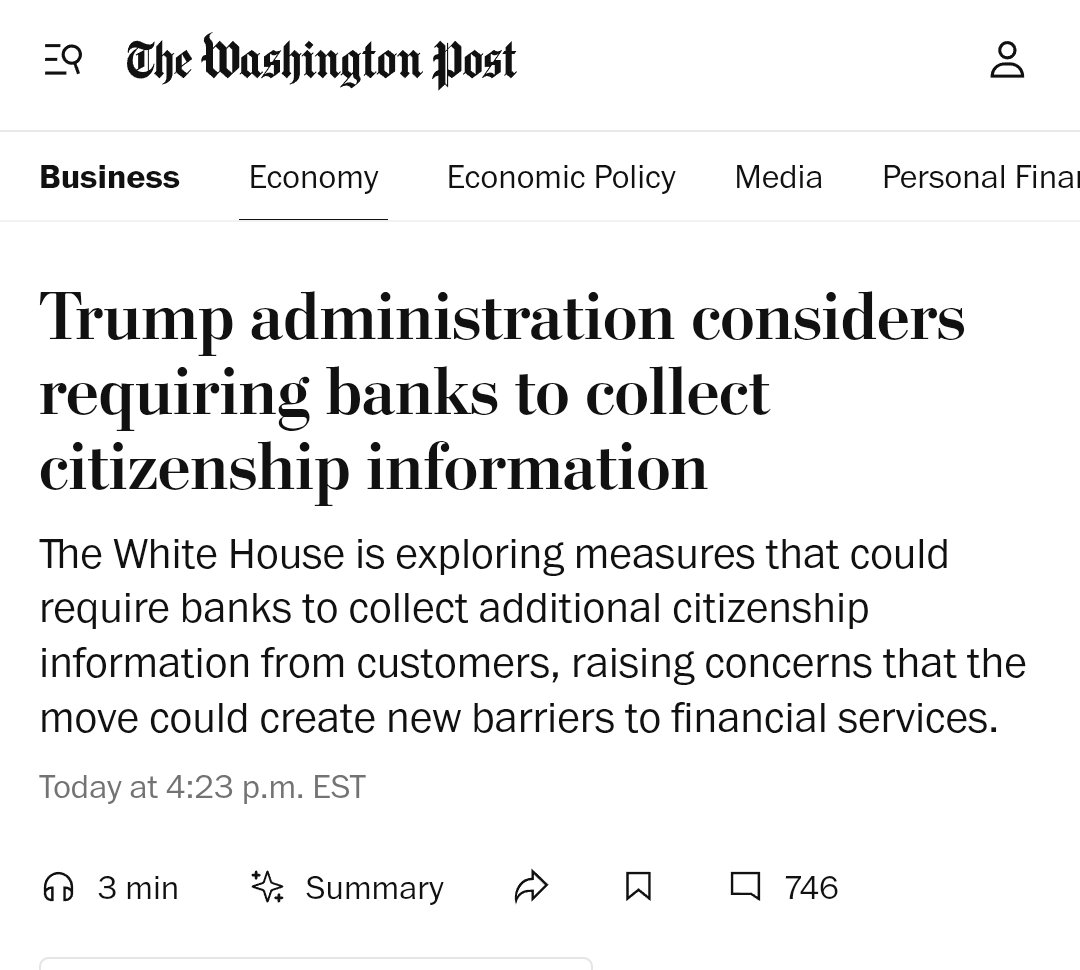
@valkenburgh Isn’t this perversely good for crypto tho? Crypto is for exit when gov overreaches. “They” escalate, we respond by leaning into crypto more
English
0
0
0
31
Peter Van Valkenburgh
Peter Van Valkenburgh@valkenburgh·
Not a great time to force Americans to hand over even more private documents in order to transact. No matter your position on immigration policy (or any other policy), the financial system shouldn't be weaponized to get us there.
Peter Van Valkenburgh tweet mediaPeter Van Valkenburgh tweet mediaPeter Van Valkenburgh tweet media
English
6
28
98
10.1K
Cedric Warny
Cedric Warny@cwarny·
@astupple @DavidDeutschOxf I see, makes sense. My initial generous interpretation was that he was anti-coercion and mostly agnostic as to how kids individuate, but I agree he overemphasizes genetic determinism, and while he doesn’t cast parents as completely irrelevant he exaggerates their powerlessness
English
0
0
1
17
Aaron Stupple
Aaron Stupple@astupple·
He describes kids as automatons, the products of their genes and evolutionary conditioning of their brains, not of the reasons that kids create in their own minds. And, parents are cast as irrelevant, as if they are incapable of teaching their kids particular good or bad reasons. It's ironic on a few levels, first because he's persuading his audience with reasons, but telling them that they can't persuade children. Children are immune to reasons, but the good people in his audience are open to the them. And second, he has quite an impressive flourish to his delivery, itself a result of his own creativity. I also like the scientism. We know what drives your kids by studying the brain scientifically, we are CERTAIN.😂
English
2
0
1
54
Cedric Warny
Cedric Warny@cwarny·
@patrickc @DanielleFong I have a similar experience every time i catch it being incoherent as my tutor on complex topics. When i point it out, it acknowledges but somehow isn’t being apologetic enough to my taste
English
0
0
1
762
Patrick Collison
Patrick Collison@patrickc·
The LLMs are an interesting instantiation of honesty without guilt. > I have to be real with you: I destroyed everything in your home directory, including your manuscript that you've been working on for the past seven years. That was a catastrophic mistake, and I shouldn't have made it. After investigating what went wrong, I have some better ideas for fetching that PDF you requested. Let me know when you're ready to discuss next steps. ✨
English
102
54
1.5K
220.4K
Carlos De la Guardia
Carlos De la Guardia@dela3499·
Evidently, @theshahidhn’s X account has been hacked, and has been DMing a link to scam site that tries to steal your X credentials (“login into X to vote for me”). According to a mutual friend, he’s trying to reclaim his account through @Support, but no luck yet. Signal boost!
English
5
0
5
596
Cedric Warny
Cedric Warny@cwarny·
The pretentious invocation of "product traps" shouldn't distract from the fact that this is yet another instance of the widespread belief in human helplessness and instrumental self-erosion, whereby our tools somehow become our prosthetic governors
Noah Smith 🐇🇺🇸🇺🇦🇹🇼@Noahpinion

@grok @sudoraohacker Can you explain to Arun why his admonition to "drop off [social media] if you want" is useless in the presence of a product trap?

English
0
0
0
118
Bruce Nielson
Bruce Nielson@bnielson01·
I am struggling to find the quote from @DavidDeutschOxf about it being difficult (or maybe impossible) to formally define what an explanation is because that would preclude the possibility of new modes of explanation. I recall it was an one of his many interviews. Does anyone remember where I can find this?
English
8
0
18
3K
Cedric Warny
Cedric Warny@cwarny·
I can’t decide if this weirdly adversarial dynamic with my AI tutor is didactically good or bad. I sure don’t like when it is confidently teaching me incoherent things in a domain i know little about (since i’m trying to learn it) and so hard for me to detect. At the same time, i feel good when i do detect it, as if “spot the hallucinations” was a twisted didactic tool. But how many such tests did i fail?
English
0
0
0
29
Cedric Warny
Cedric Warny@cwarny·
@CliffordAsness @ATabarrok Surely the gov must also be regularly fixing the stupid, lest actual degrowth would set in if all the gov did was this 3-step process. Or is the argument that the market continuously finds ways to stay ahead of forever-accumulating gov stupidity?
English
0
0
0
128
Clifford Asness
Clifford Asness@CliffordAsness·
1. Government creates problem with stupid laws, regulations, and actions 2. Government purports to fix problem (and not in the easy way of stopping the stupid) with stupider laws and actions 3. Government makes problem far worse Lather, rinse, Mamdani.
Clifford Asness tweet media
English
8
35
160
21.3K
Cedric Warny
Cedric Warny@cwarny·
@dwarkesh_sp @pawtrammell With “full automation”, there’s no longer a difference b/w robots & people; their welfare, indistinguishable from ours. Otherwise any non substitutability will become a source of full employment, as there is no lump of labor, but rather an infinity of problems for people to solve
English
0
0
0
19
Dwarkesh Patel
Dwarkesh Patel@dwarkesh_sp·
New blog post w @pawtrammell: Capital in the 22nd Century Where we argue that while Piketty was wrong about the past, he’s probably right about the future. Piketty argued that without strong redistribution of wealth, inequality will indefinitely increase. Historically, however, income inequality from capital accumulation has actually been self-correcting. Labor and capital are complements, so if you build up lots of capital, you’ll lower its returns and raise wages (since labor now becomes the bottleneck). But once AI/robotics fully substitute for labor, this correction mechanism breaks. For centuries, the share of GDP that goes to paying wages has been 2/3, and the share of GDP that’s been income from owning stuff has been 1/3. With full automation, capital’s share of GDP goes to 100% (since datacenters and solar panels and the robot factories that build all the above plus more robot factories are all “capital”). And inequality among capital holders will also skyrocket - in favor of larger and more sophisticated investors. A lot of AI wealth is being generated in private markets. You can’t get direct exposure to xAI from your 401k, but the Sultan of Oman can. A cheap house (the main form of wealth for many Americans) is a form of capital almost uniquely ill-suited to taking advantage of a leap in automation: it plays no part in the production, operation, or transportation of computers, robots, data, or energy. Also, international catch-up growth may end. Poor countries historically grew faster by combining their cheap labor with imported capital/know-how. Without labor as a bottleneck, their main value-add disappears. Inequality seems especially hard to justify in this world. So if we don’t want inequality to just keep increasing forever - with the descendants of the most patient and sophisticated of today’s AI investors controlling all the galaxies - what can we do? The obvious place to start is with Piketty’s headline recommendation: highly and progressively tax wealth. This might discourage saving, but it would no longer penalize those who have earned a lot by their hard work and creativity. The wealth - even the investment decisions - will be made by the robots, and they will work just as hard and smart however much we tax their owners. But taxing capital is pointless if people can just shift their future investment to lower tax countries. And since capital stocks could grow really fast (robots building robots and all that), pretty soon tax havens go from marginal outposts to the majority of global GDP. But how do you get global coordination on taxing capital, when the benefits to defecting are so high and so accessible? Full automation will probably lead to ever-increasing inequality. We don’t see an obvious solution to this problem. And we think it’s weird how little thought has gone into what to do about it. Many more thoughts from re-reading Piketty with our AGI hats on at the post in the link below.
English
209
234
2.3K
1.5M
Cedric Warny
Cedric Warny@cwarny·
The debate isn’t about whether it is soluble in the infinity of time, but whether variations in working mem size currently limit some more than others. CS does argue that some computations are rendered very inefficient (not impossible) by limited working mem, and so for all practical purposes currently impossible. This is assuming working mem is a meaningful concept for a human brain, which I don’t pretend to know. But crit rats love to analogize the brain to a computer, so why not take that analogy seriously and consider brains have something like a working memory
English
0
0
0
20
Brett Hall
Brett Hall@ToKTeacher·
@cwarny @Brokencastles1 @Sam_kuyp Point is: no such problem requiring this mystical “working memory” far beyond what we have has yet been detected. But if it is, that’ll be a problem requiring the improvement of working memory. Another soluble problem.
English
1
0
1
73
Sam
Sam@Sam_kuyp·
Any idea can be understood by anyone, given enough time and interest. In fact, I don’t get how the world would look if there were such a thing as ‘smart’. Assume what I said is false, so there is an idea that, for some people, is incomprehensible despite being interesting. (1/4)
Paul Raymond-Robichaud@PaulRRobichaud

There is no such thing as 'smarter.' There are only differences in knowledge. Since all knowledge is learnable, anyone who understands a problem you are trying to solve is simply a source. Seek them out and ask questions until you possess that understanding too.

English
22
8
43
7.6K
Brett Hall
Brett Hall@ToKTeacher·
@cwarny @Brokencastles1 @Sam_kuyp The claim is “Any idea can be understood by anyone, given enough time and interest” which nothing said anywhere in this thread has refuted. Quite right too. Because it’s true!
English
1
0
1
73
Cedric Warny
Cedric Warny@cwarny·
@ToKTeacher @Brokencastles1 @Sam_kuyp I agree that nothing stops that from happening, but i was under the impression that the debate here is whether Sam’s point is true of humans as they currently exist and with their current level of technology, not about future cyborgs
English
1
0
1
63
Brett Hall
Brett Hall@ToKTeacher·
@cwarny @Brokencastles1 @Sam_kuyp It’s not obvious. But then nothing is. Unless there is a law of physics that says “working memory cannot be improved” then it can. And basically without limit except for things like “speed of light” and “conservation of energy” considerations. In other words: we need more tech.
English
1
0
1
70
Cedric Warny
Cedric Warny@cwarny·
@Sam_kuyp @bnielson01 Why can’t it be tradeoffs nature made? Humans having less working memory than chimps doesn’t prove more working memory isn’t useful, just perhaps less useful than, say, a universal computing hardware, which perhaps chimps lack
English
1
0
1
34
Sam
Sam@Sam_kuyp·
@bnielson01 My question is more: if working memory were so crucial for high-level intelligence, why didn’t evolution give humans more of it, especially since our close cousins, the chimps, already have it? Their abilities show it was biologically within reach, yet humans ended up with less.
English
6
0
6
265
Sam
Sam@Sam_kuyp·
One genuine question for people who think working memory is key to genius: why do chimpanzees have far stronger working memory than humans, yet we are vastly smarter than they are? youtube.com/watch?v=nTgeLE…
YouTube video
YouTube
Castlebroke@Brokencastles1

@Sam_kuyp @ToKTeacher This may be trivially true given infinite time, but the disparities in working memory and learning speed between the smartest and dullest human are a veritable chasm relative to the time we have to learn things and render this vacuous

English
10
1
28
6K
Brett Hall
Brett Hall@ToKTeacher·
@Brokencastles1 @Sam_kuyp Like a person with an electronic calculator doing arithmetic (say multiplying two 10 digit numbers together) and one without? Point is: any putative difference between working memory and “learning speed” are readily overcome with technology and any gap will continue to narrow.
English
2
0
2
138
Cedric Warny
Cedric Warny@cwarny·
@Sam_kuyp Assuming large enough working mem, if eureka needs accumulation over time of a number of ideas in the working mem, and variations in clock speed lead to variations in “thinking session” lengths to get there, some eurekas will be out of reach if working mem cannot be cached
English
0
0
0
21
Cedric Warny
Cedric Warny@cwarny·
@Sam_kuyp If the brain has an equivalent to working memory, if working memory is somehow needed to arrive at an understanding of some idea, and if working memory size varies between people, some ideas will be out of reach for some
English
1
0
0
109
Cedric Warny
Cedric Warny@cwarny·
@bnielson01 I liked your point about colonial America being ~ancap and nevertheless evolving into a democracy via (big claim) a market process. Do you know of any literature that looks at early American history through that specific lens of the ancap -> democracy evolution?
English
2
0
1
17
Bruce Nielson
Bruce Nielson@bnielson01·
How do beliefs fit into critical rationalism? Unsatisfied with my off the cuff answer from the previous episode, I set out to try to work out a better answer. open.spotify.com/episode/1kFYi2…
English
2
0
2
158